Posts

2025 Study Architecture Student Showcase - Part XI

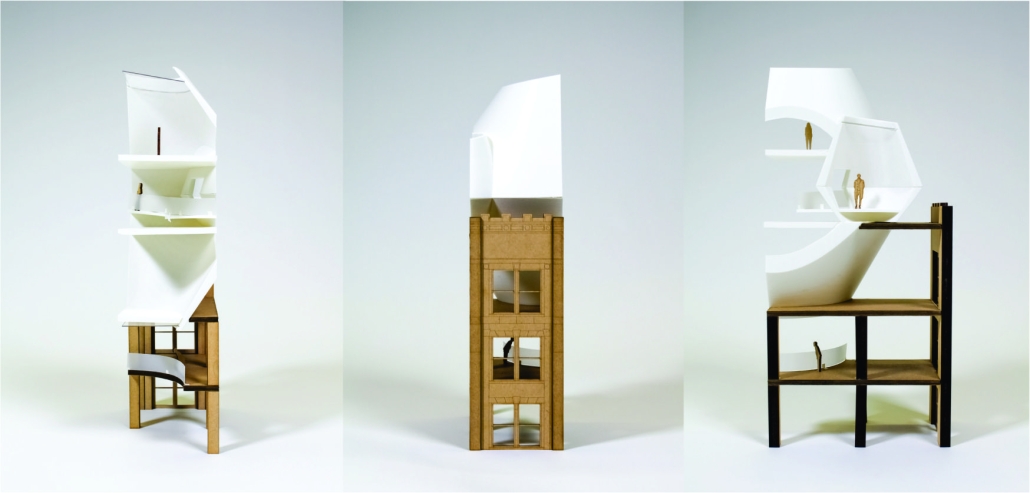
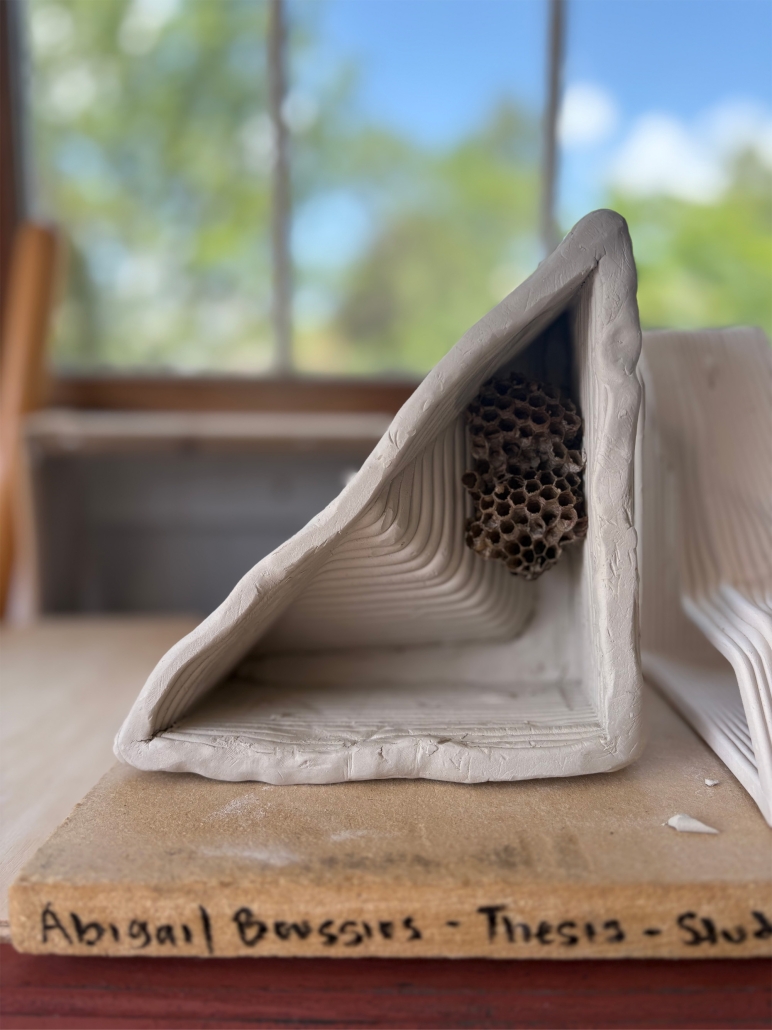
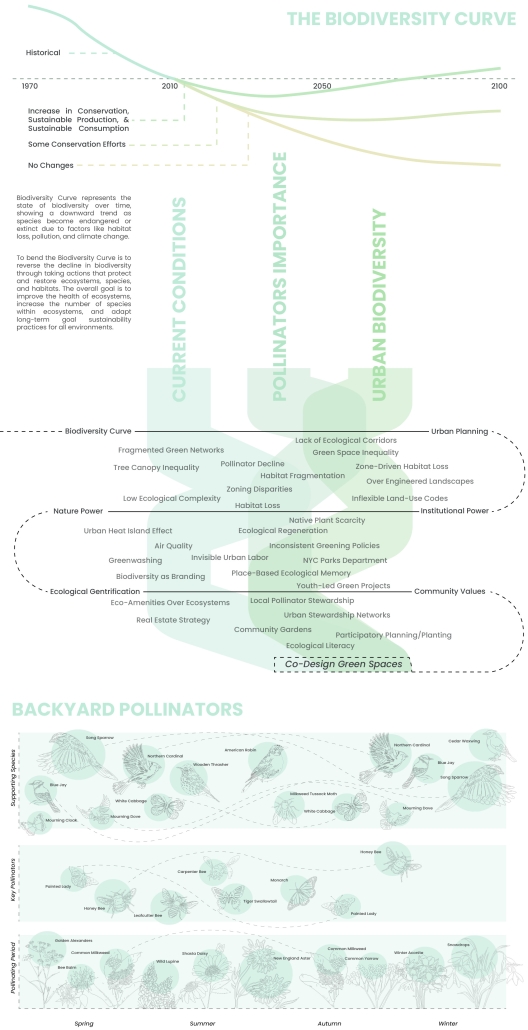
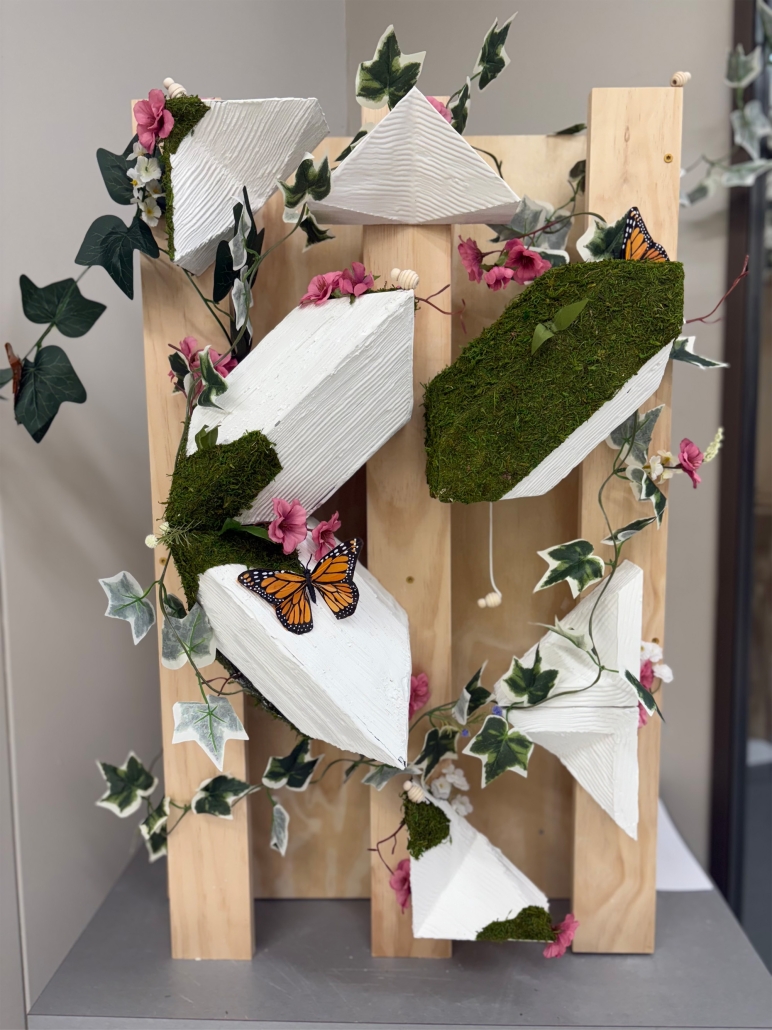
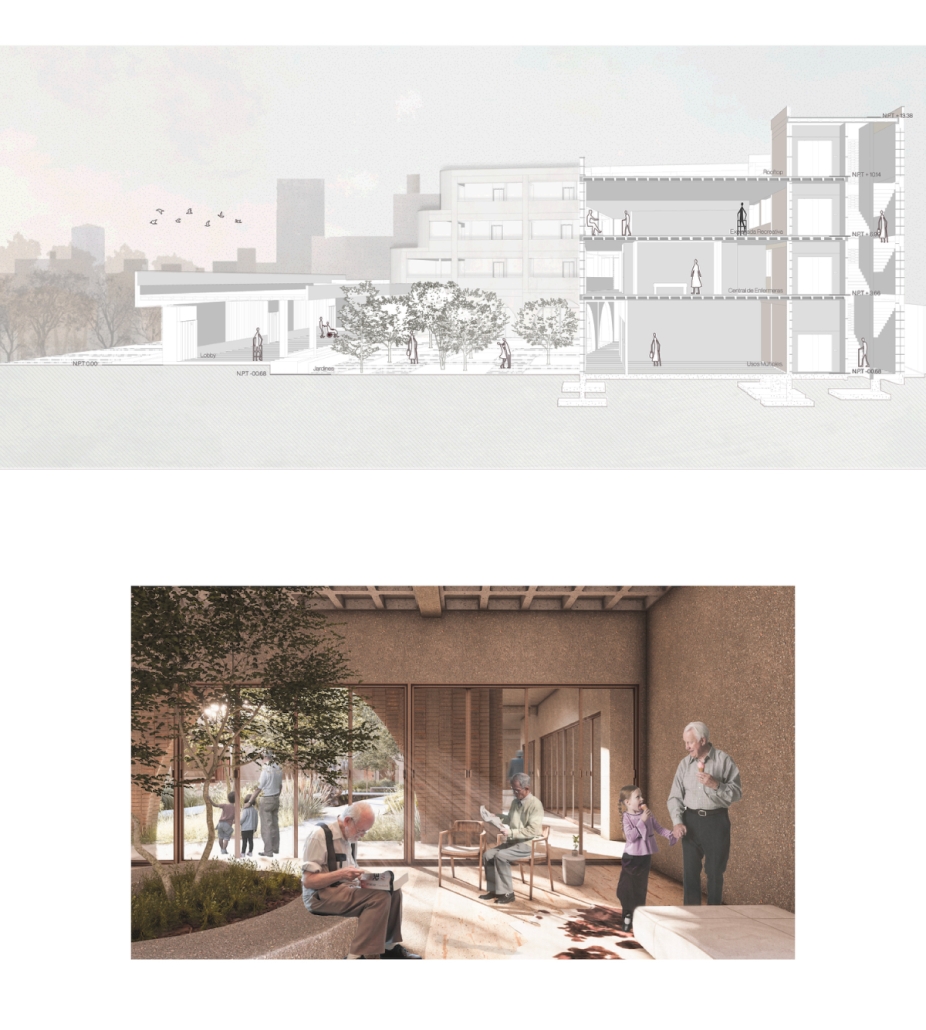
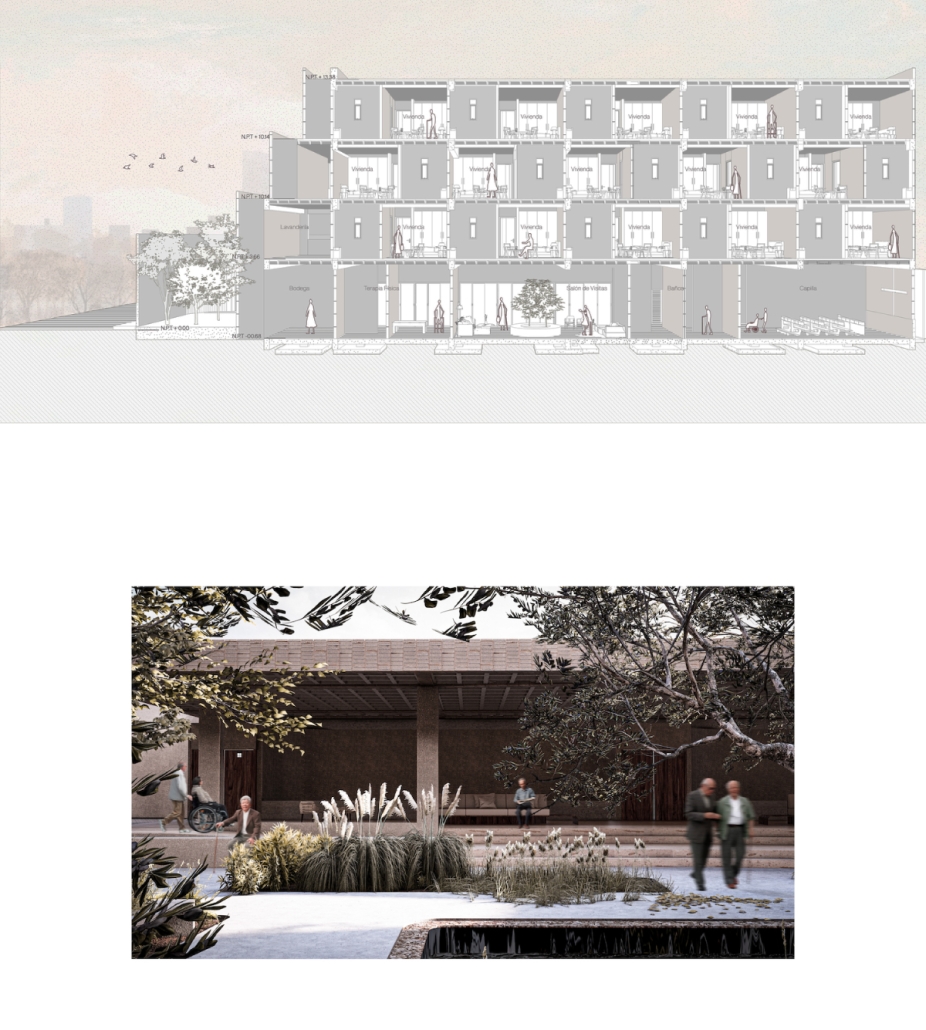
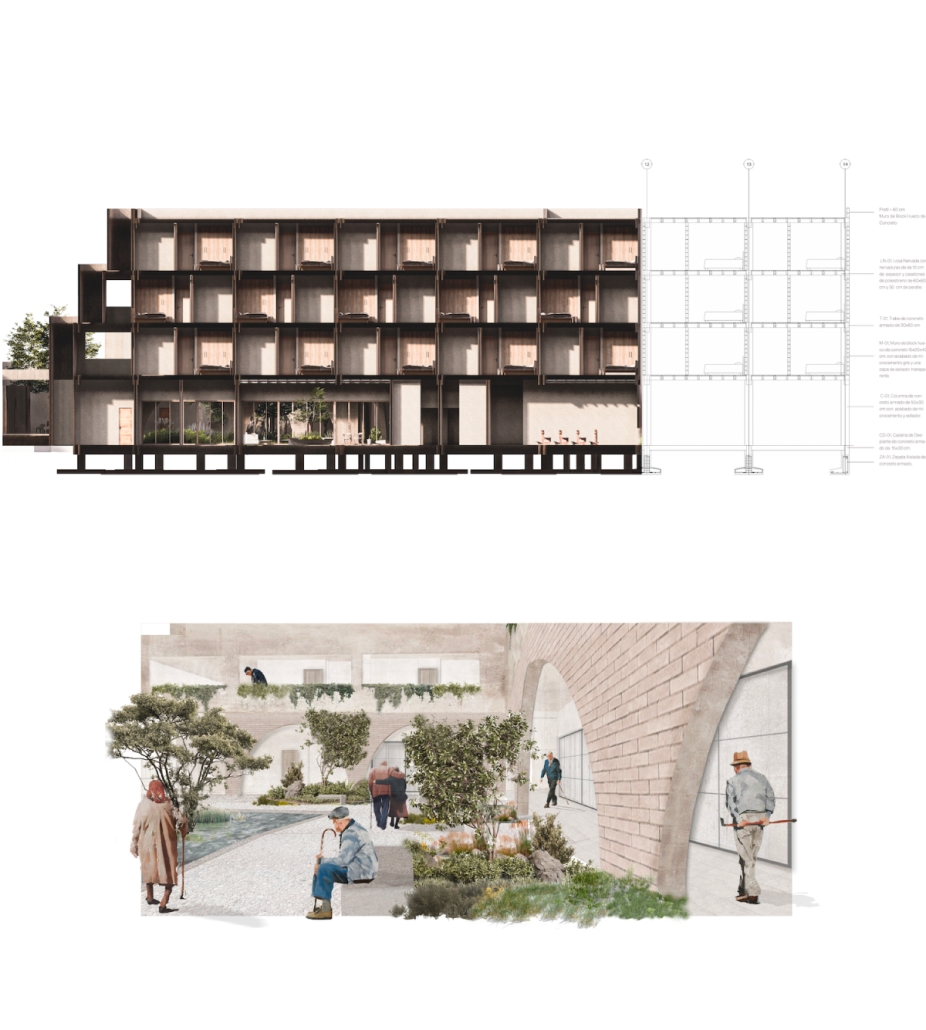
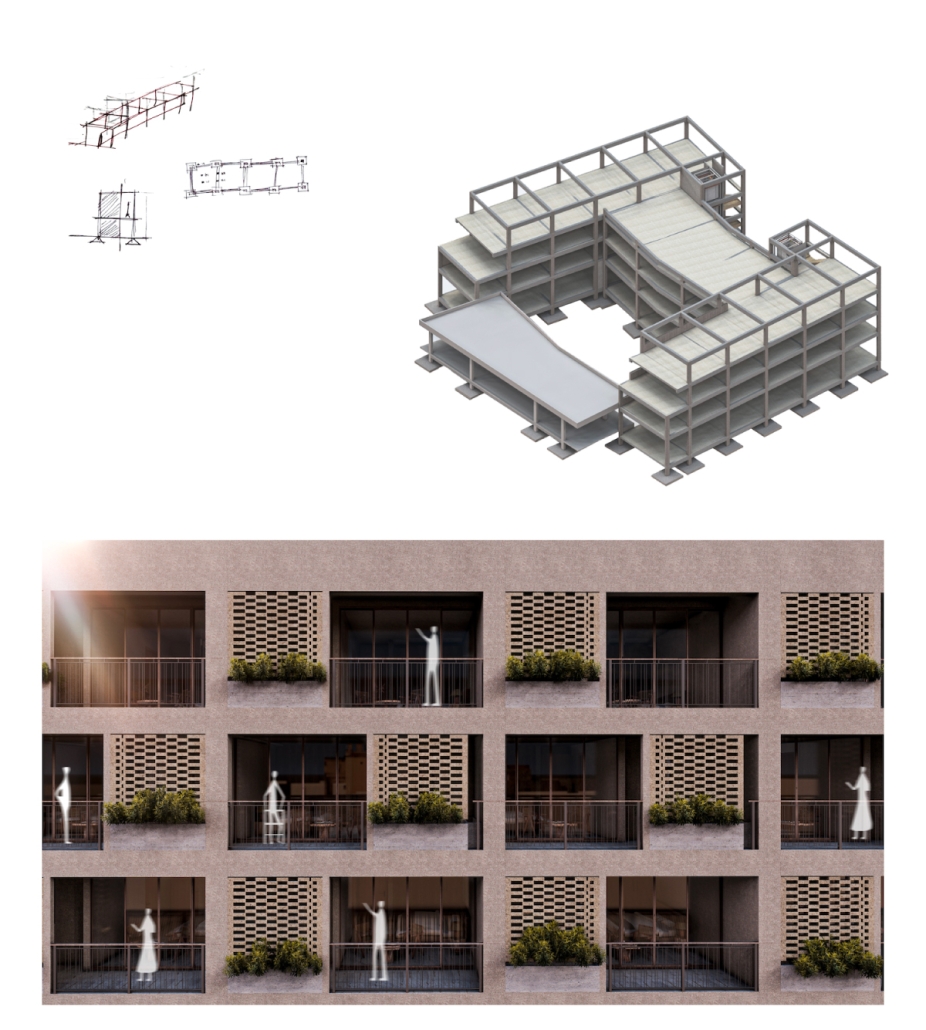
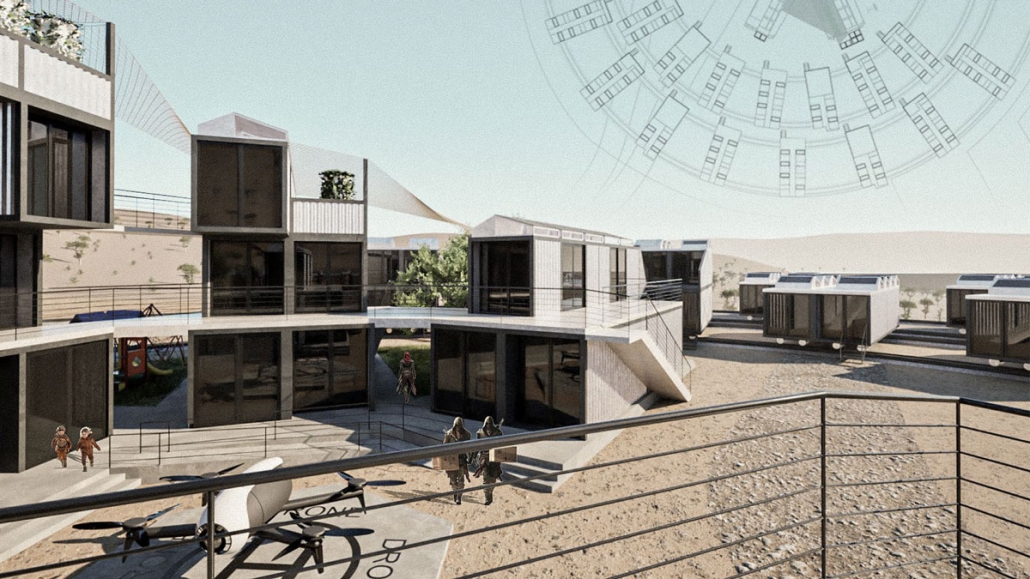
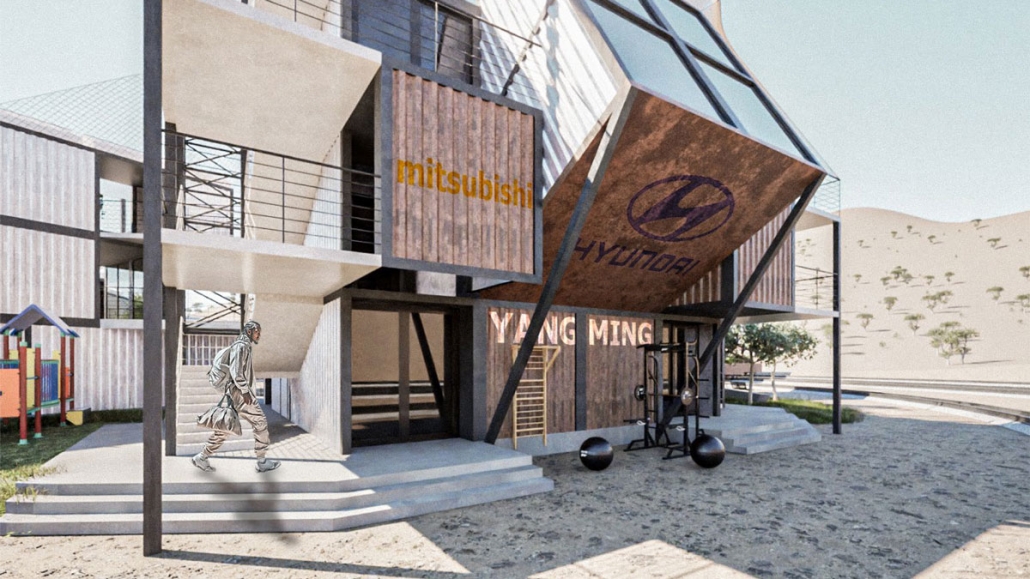
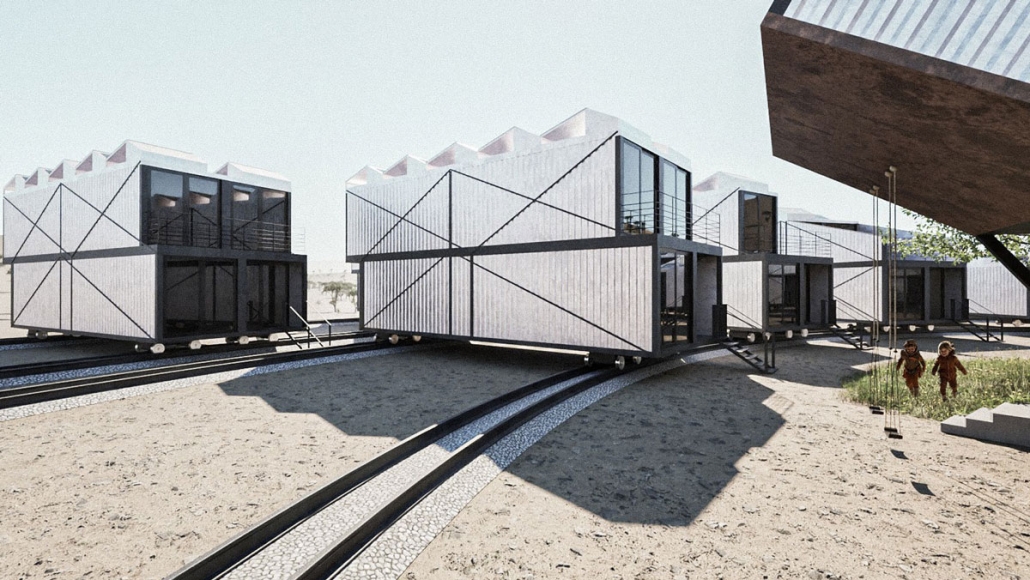
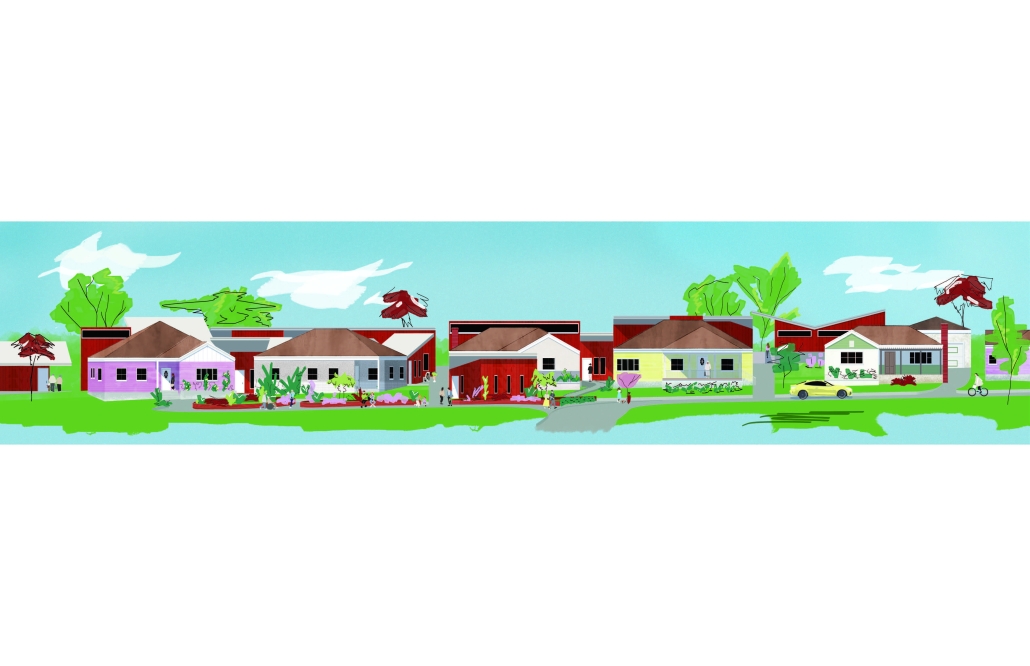
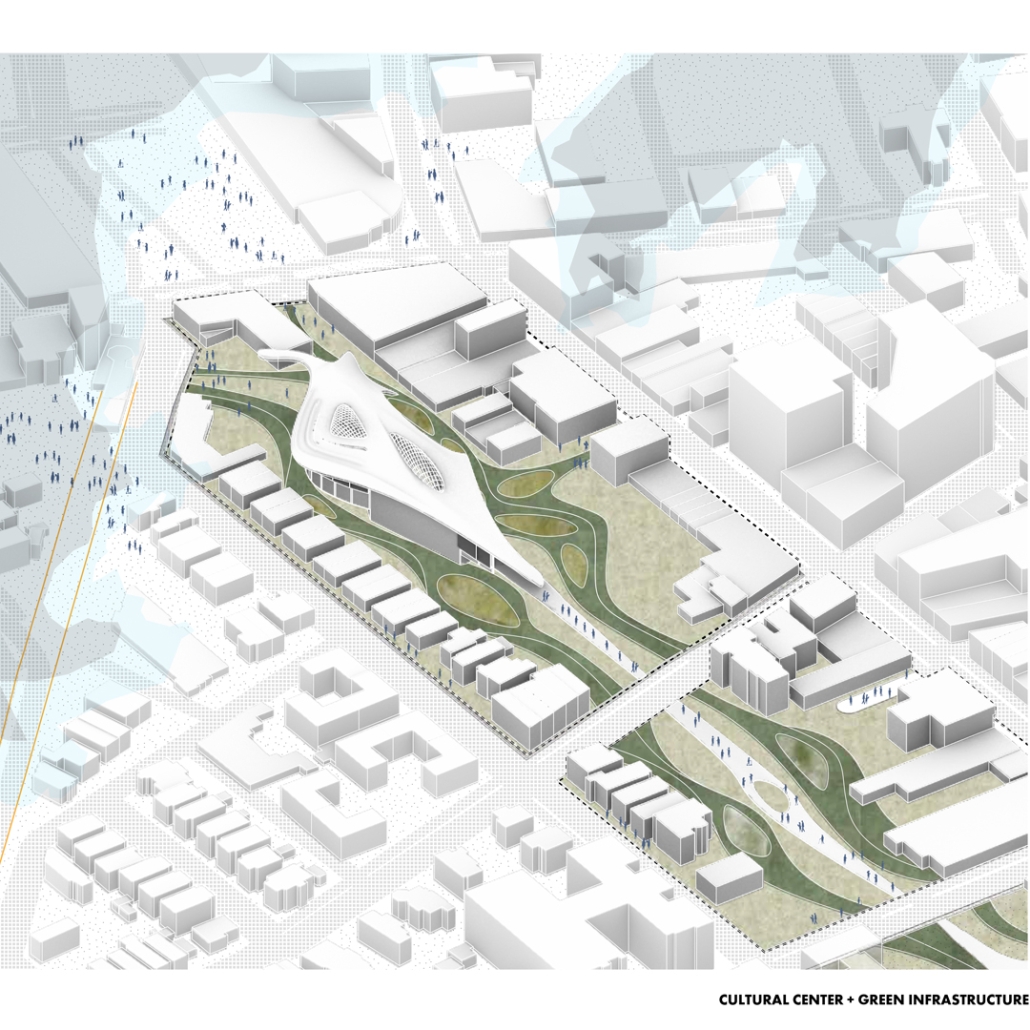
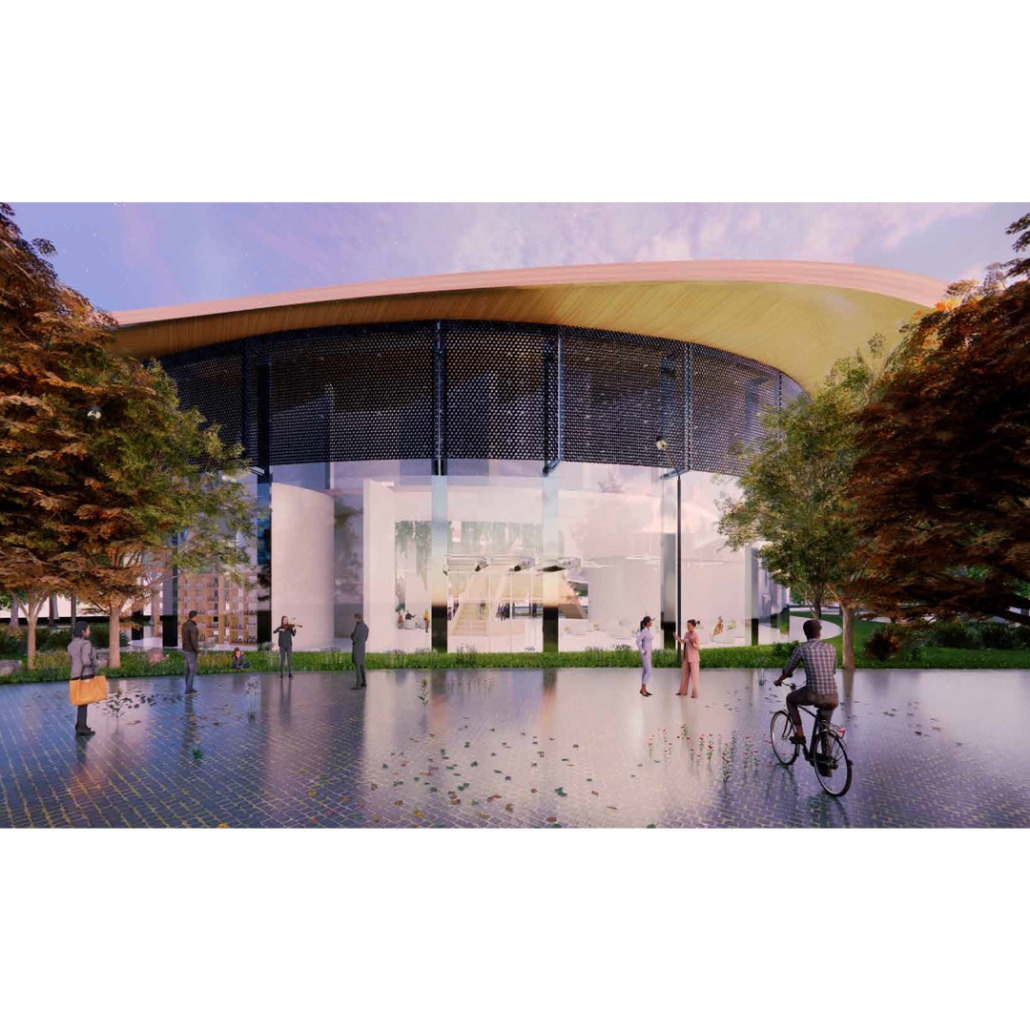
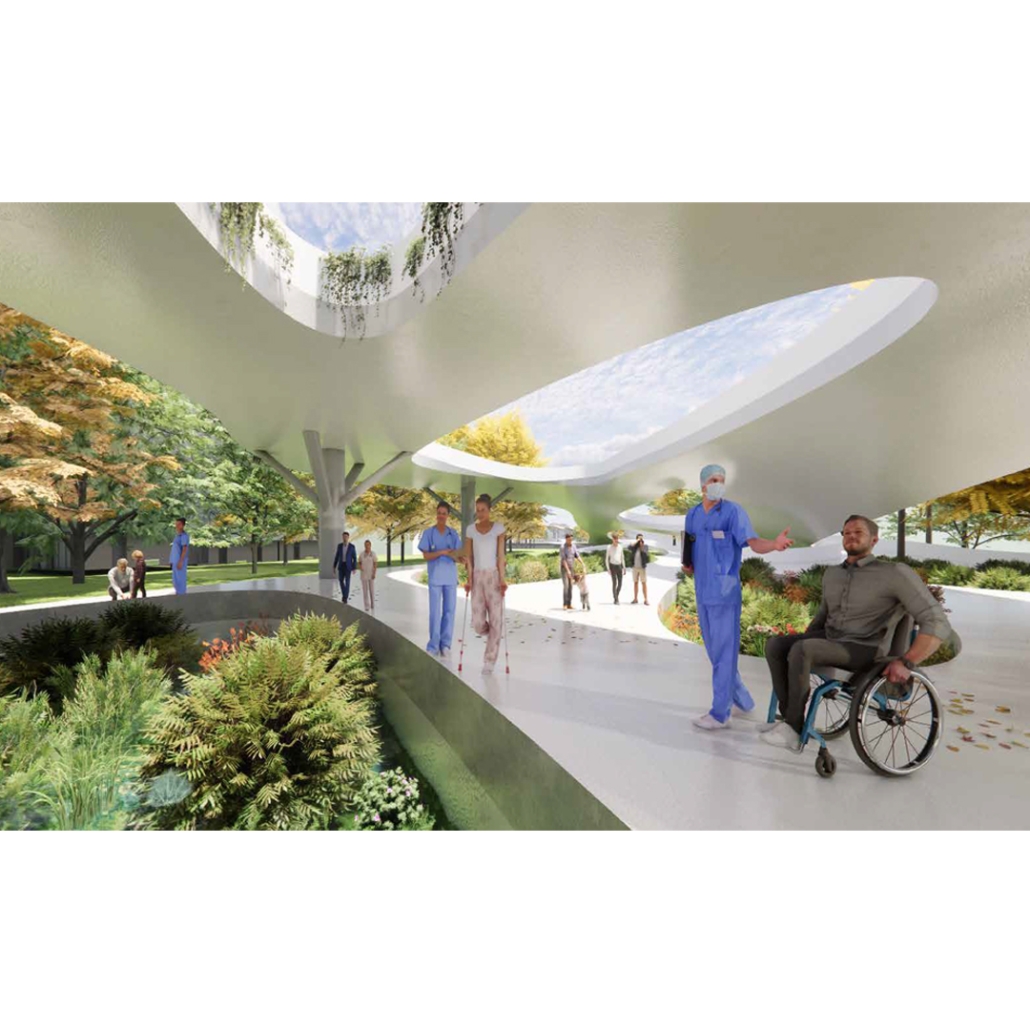
Architecture has the power to transform a space. In Part XI of the 2025 Study Architecture Student Showcase, we put a spotlight on revitalized spaces. These projects take their pre-existing sites and create new spaces that promote sustainability, community connection, accessibility, and resiliency. The transformed sites include naval bases, power plants, industrial sites, local landmarks, abandoned city centers, underserved neighborhoods, and more. Each project incorporates design, construction, policy, and infrastructure to reimagine new spaces that serve their communities. 

Take a closer look below!

The Greenest Building, The One That is Already Built by Audrey Barnhart, M.Arch ’25
Roger Williams University | Advisor: Rubén Alcolea

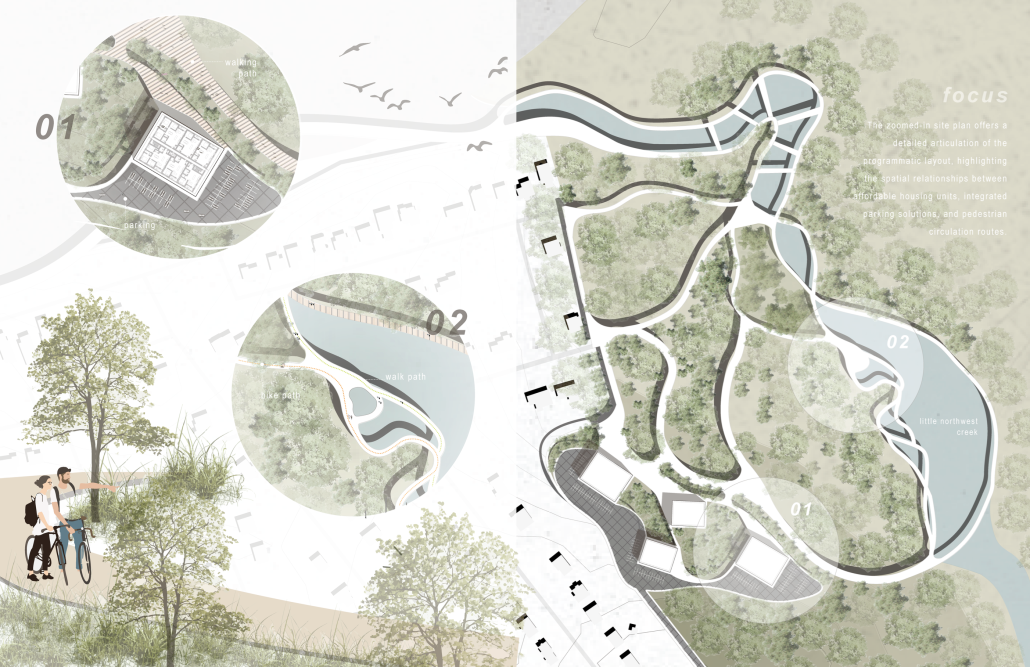
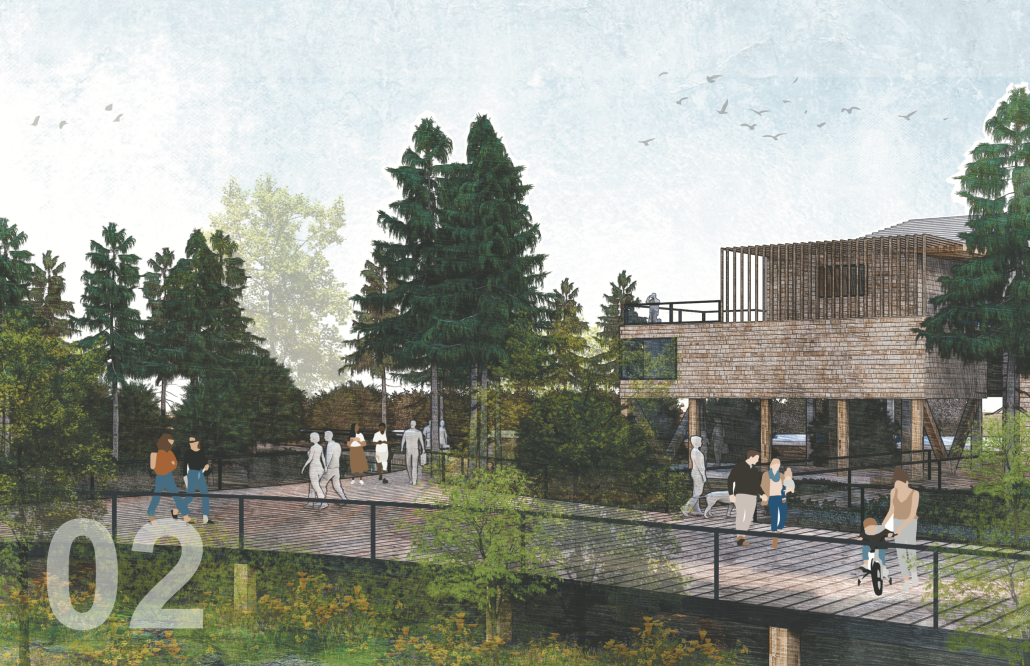
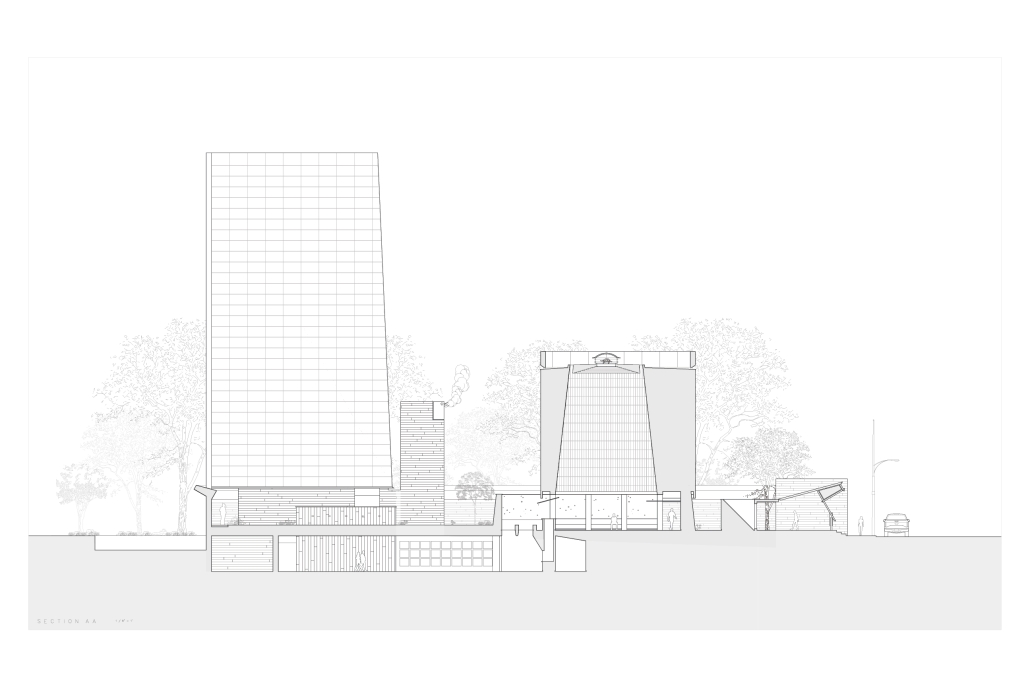
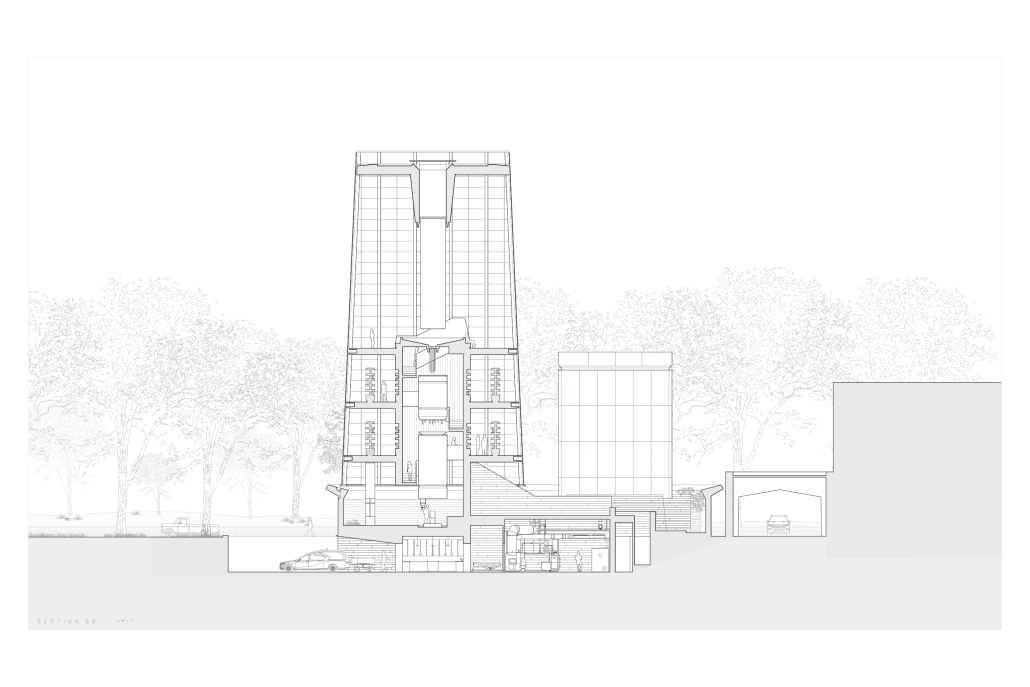
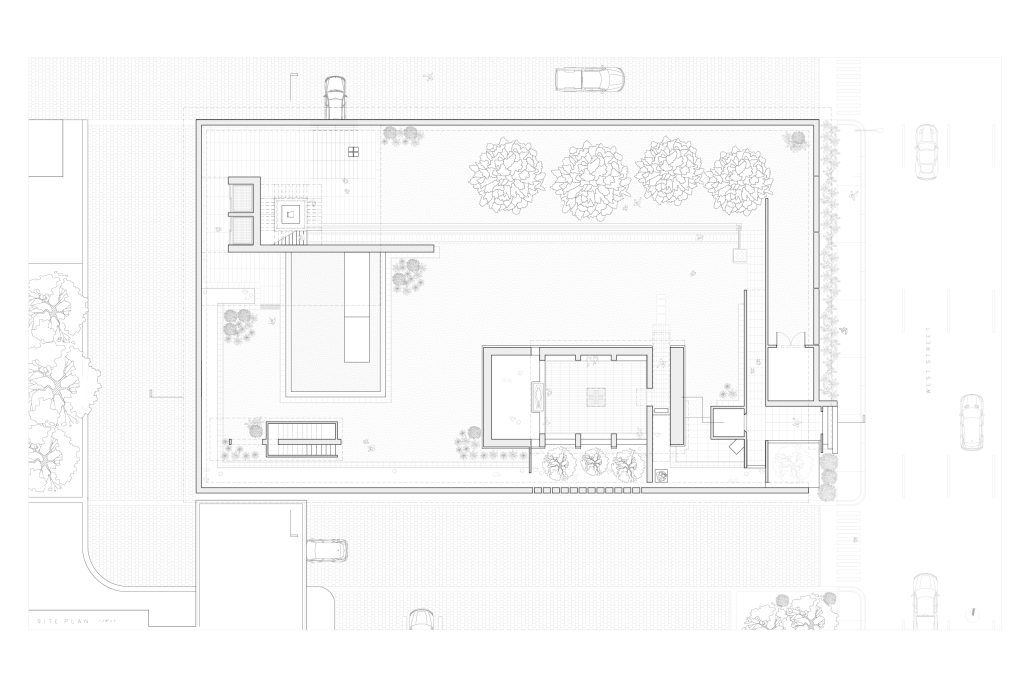
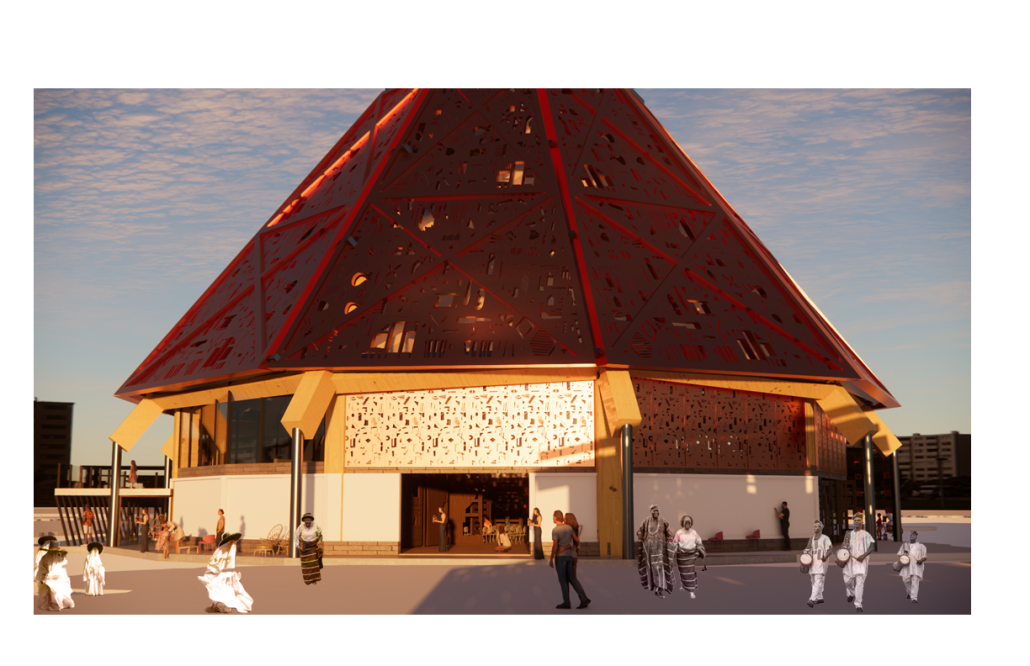
This thesis explores adaptive reuse and sustainability by transforming a retired coal-fired power plant into a conservation center. With over 300 decommissioned coal plants across the U.S., the project asks: Should these monumental industrial relics be demolished, or reimagined to serve communities once again? The selected site is located on Mare Island, California, a former naval base now undergoing revitalization. Positioned near polluted waters and existing conservation efforts, the site becomes a strategic place for ecological restoration.

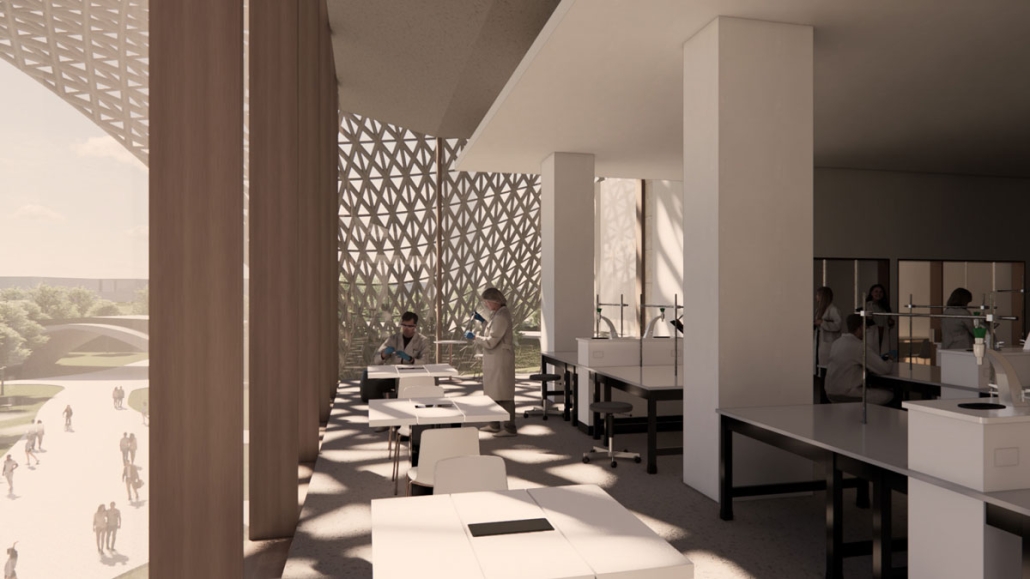
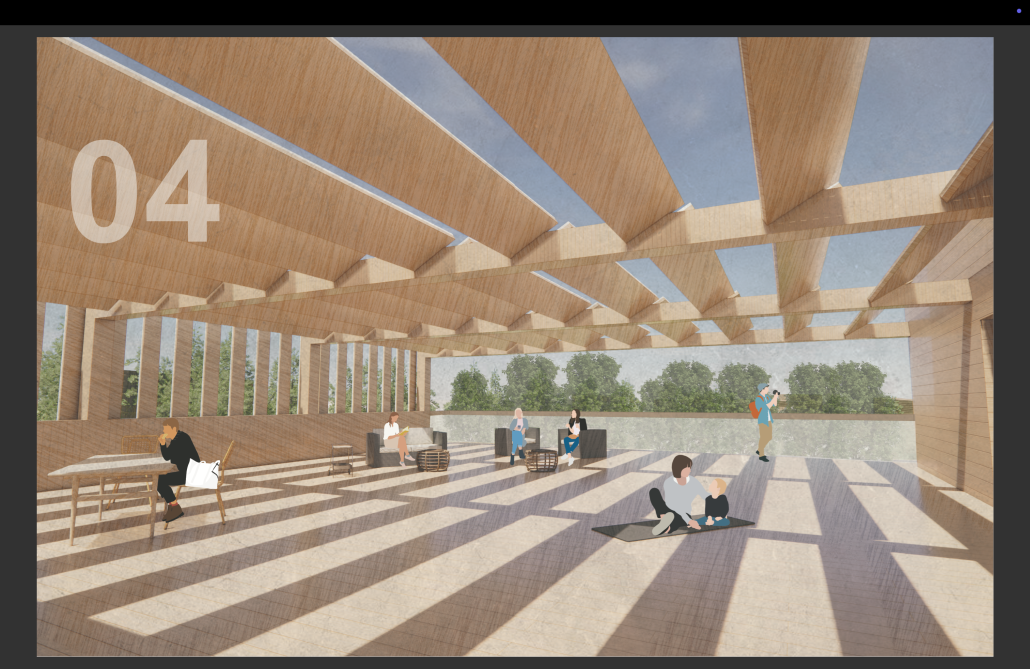
The design preserves the historic brick and concrete shell of the power plant, inserting a self-supporting mass timber structure within. This new framework uses sustainably sourced CLT panels and glulam beams, forming a light-filled, naturally ventilated interior that supports vegetation between the old and new structures. Only at vertical circulation points do the two structures physically meet, symbolizing a transition between past and future.

Programmatically, the conservation center includes public education spaces, research labs, and residential units. A rewilded landscape replaces paved surfaces, reducing the urban heat island effect and encouraging biodiversity. A narrow water channel brings Bay water into the site for ecological engagement, while a nearby storage hangar is converted into a ferry terminal to enhance sustainable transportation.

Passive design strategies guide the intervention, with large open-air windows providing daylight and ventilation. Prefabricated timber elements reduce site impact. Overall, the project demonstrates how industrial heritage can support ecological recovery, creating a dialogue between decay and renewal, nature and structure, and the old and the new.

This project won the Thesis Honor Award.

Instagram: @rwu_cummingsarch, @alcoleatarrago

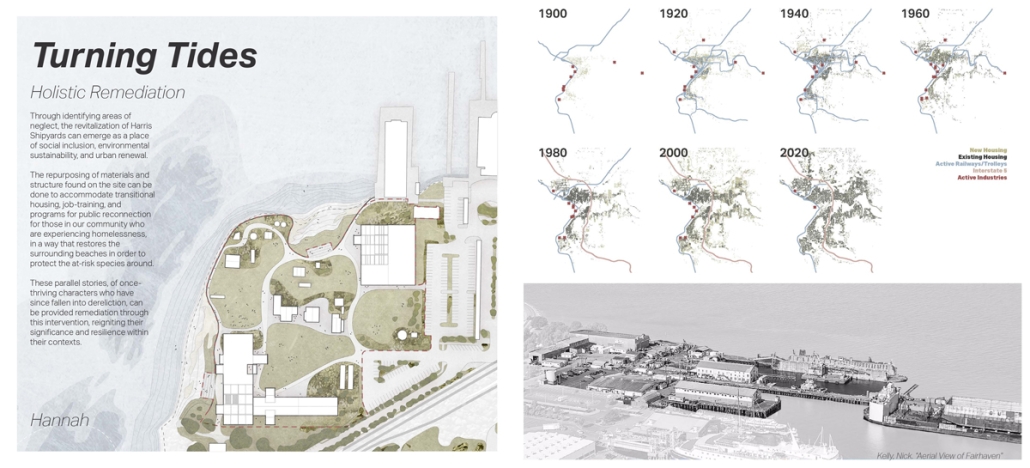
Turning Tides: Holistic Remediation by Hannah Moore, B.Arch ‘25
Academy of Art University | Advisors: Simon McKenzie, Philip Ra & Ricardo Solar

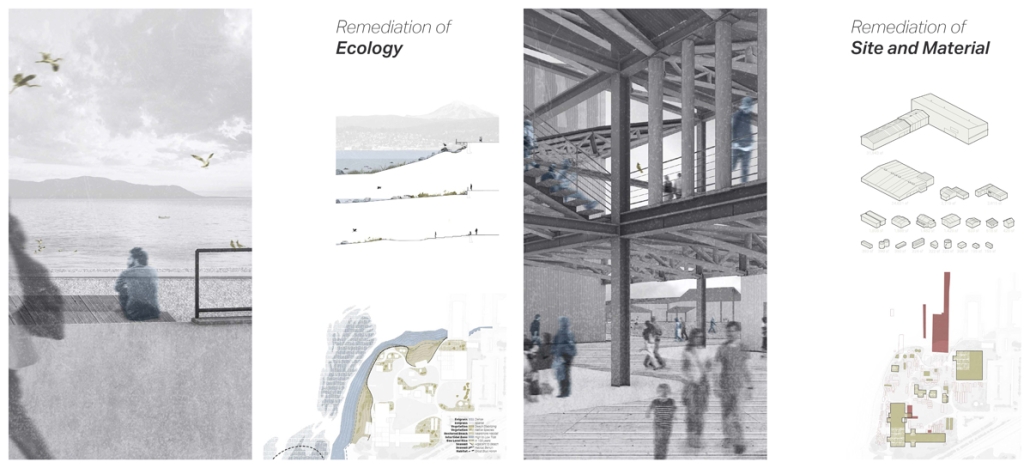
Through identifying areas of neglect, the revitalization of Harris Shipyards can emerge as a place of social inclusion, environmental sustainability, and urban renewal.

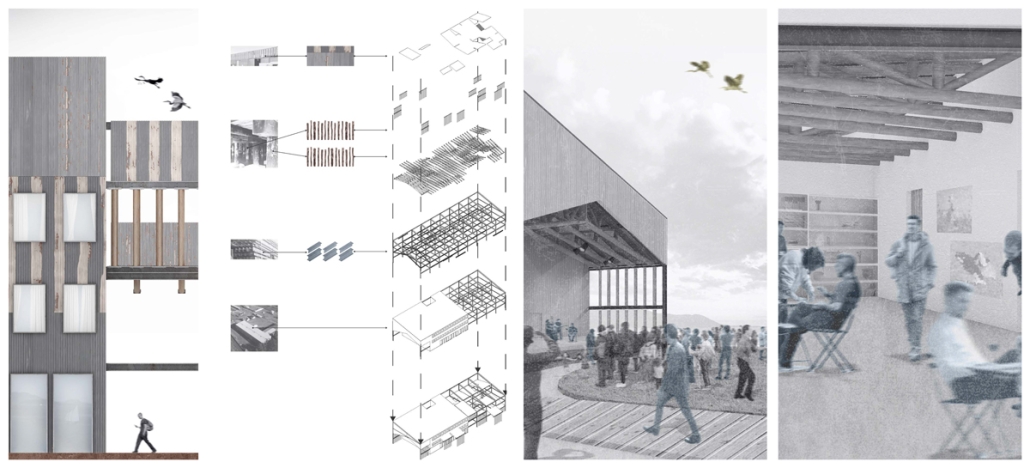
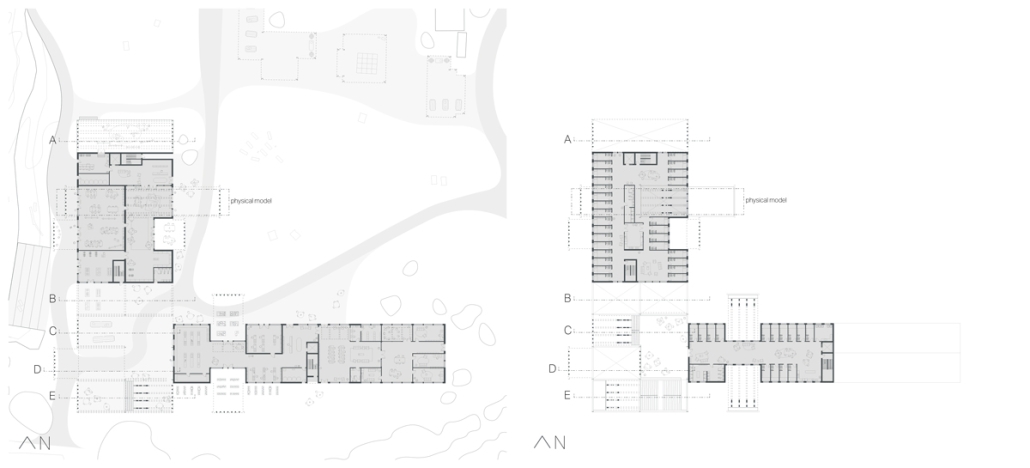
The repurposing of materials and structure found on the site accommodates transitional housing, job-training, and programs for public reconnection for those in our community who are experiencing homelessness. In addition, the project restores the surrounding beaches in order to protect at-risk species.

These parallel stories, of once-thriving characters who have since fallen into dereliction, can be provided remediation through this intervention, reigniting their significance and resilience within their contexts.

This project won the B.Arch Thesis Award. 

Click here to learn more.

Instagram: @hannah.3, @smckenzie23, @ricardo_solar_architecture

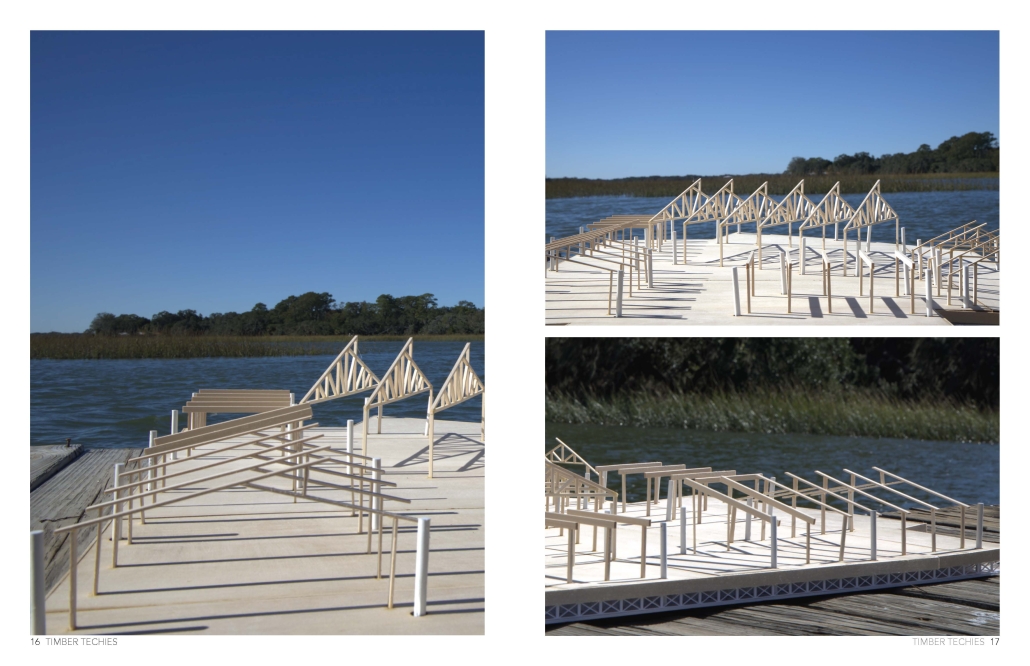
Rebuild From Decay: An Industrial Solution for A Post-Industrial Age by Kyle Sylvester, M.Arch ’25
Wentworth Institute of Technology | Advisors: Lauren McQuistion & Tom Chung

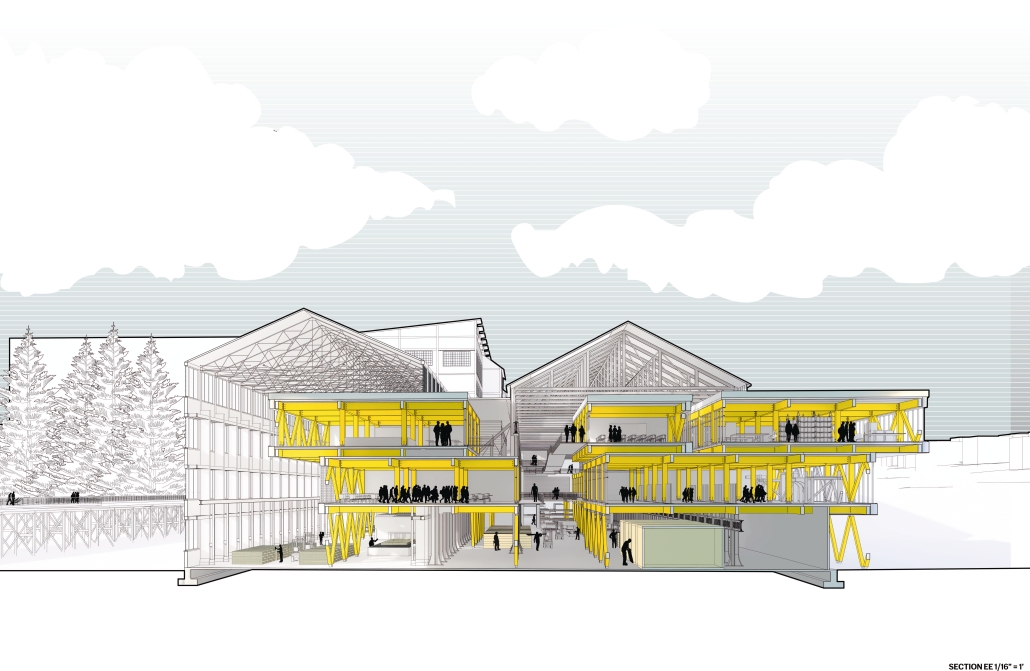
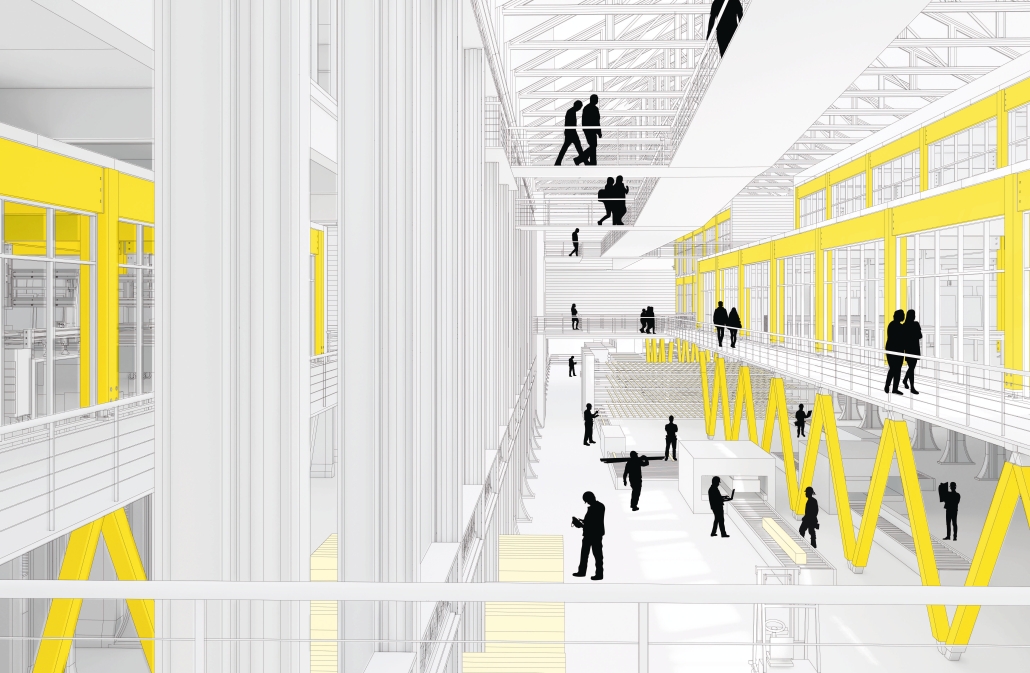
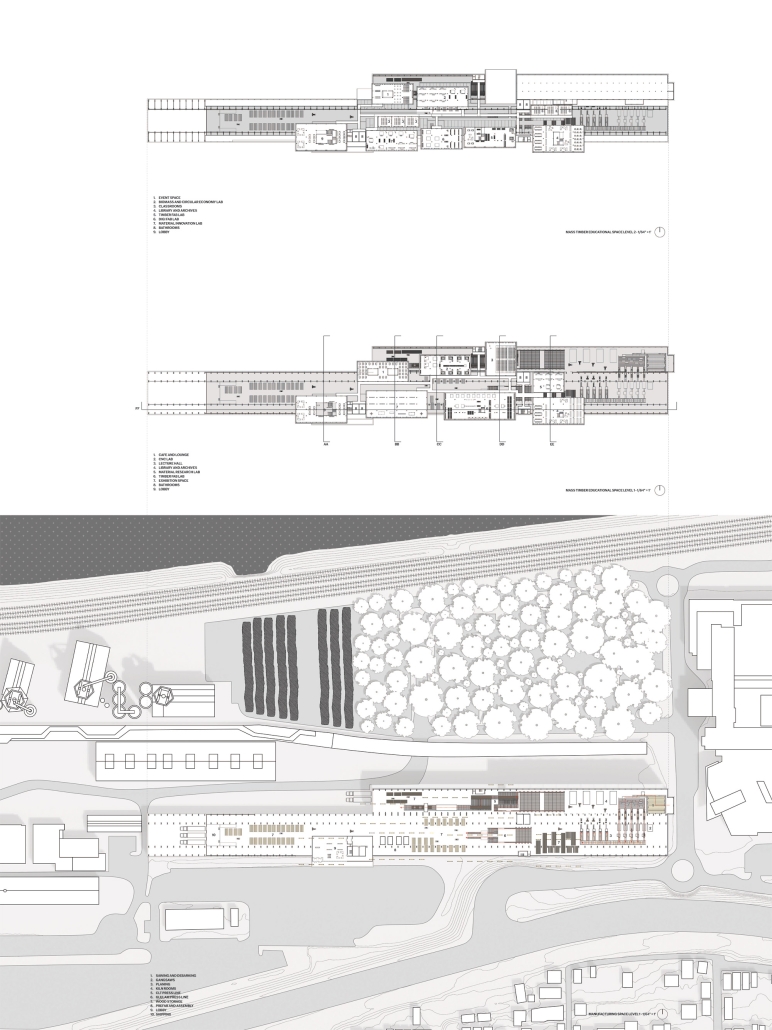
Mass timber presents an opportunity to redefine the future of abandoned industrial sites through the introduction of a new industry. While many of these sites have been repurposed as cultural and landscape parks, this approach often reduces their industrial identity to just a facade for new programs, disconnecting them from their manufacturing past. By integrating mass timber manufacturing and education within the fabric of an industrial wasteland, this model preserves the site’s historical significance while also creating a hub for sustainable industry, ensuring its continued use in the 21st century. 

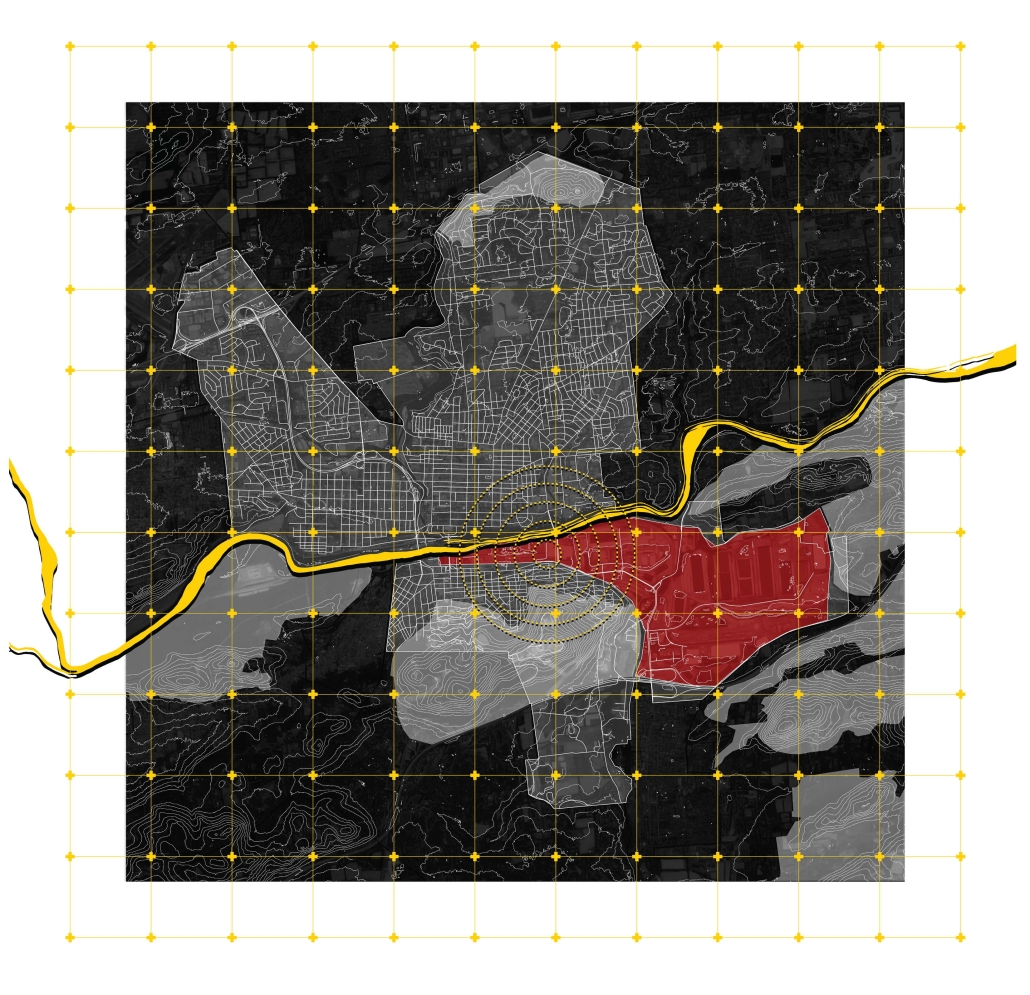
This thesis revitalizes Machine Shop No. 2 at Bethlehem Steel Mill by maintaining and reinterpreting its industrial legacy. Typically, industrial wastelands are repurposed as landscape parks or cultural centers, stripping away the site’s industrial memory and using its infrastructure as a facade. By integrating sustainable mass timber construction, this proposal offers a forward-thinking approach to revitalizing post-industrial spaces through the use of mass timber construction. The existing machine shop has been transformed into a mass timber manufacturing facility and educational center for renewable materials, blending production and education through layered programming. This approach preserves the site’s identity while addressing the need for sustainable construction practices.

This project won the Wentworth School of Architecture and Design: Design Excellence Award. 

Instagram: @ksly5, @mc.quistion

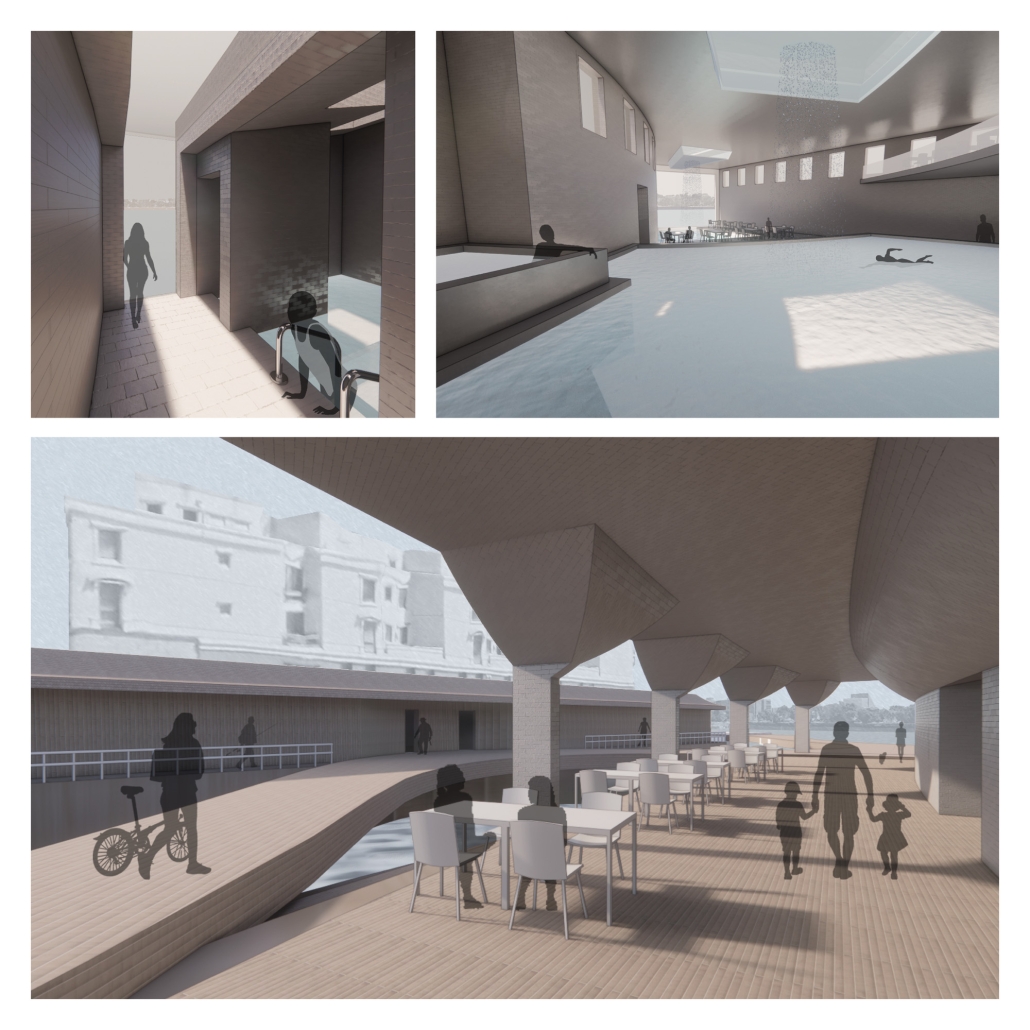
From Wrecks to Wonders: Reclaiming Shorelines, Enriching Communities by Karunia Ayu, Hongxiang Wang & Tianqi Zhao (Enoch), MSAUD (Master of Science in Architecture and Urban Design) ’25
Columbia University | Advisors: Kate Orff, Geeta Mehta, Emanuel Admassu, Sebastian Delpino, Gabriel Vergara, Lucas Coelho Netto & Shrey Patel

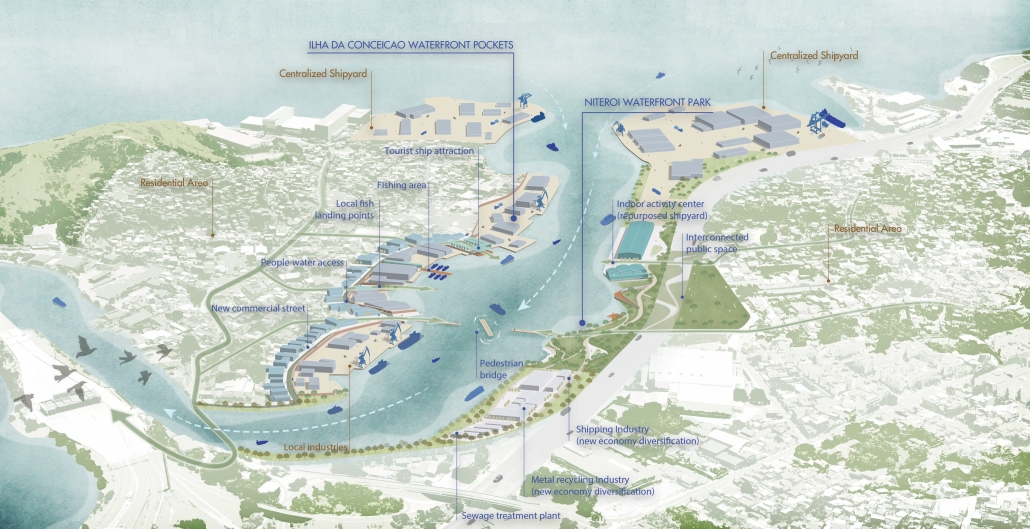
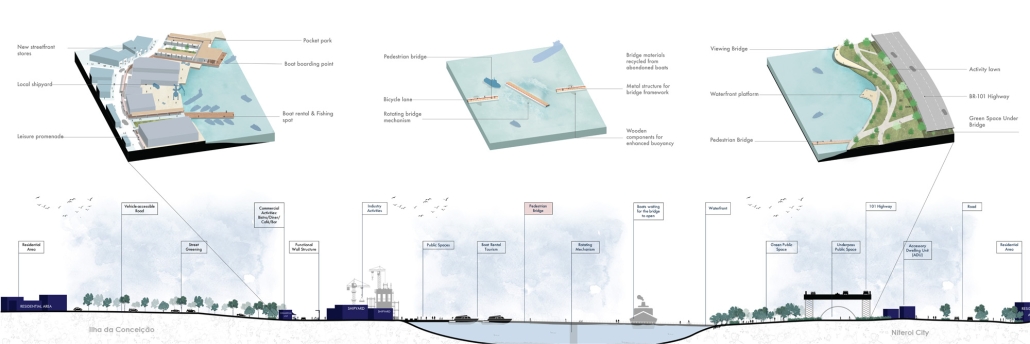
WHAT IF THE WATERWAY IS REOPENED, BROUGHT COMMUNITY ACTIVITIES TO ITS SHORES, AND REIMAGINED THE ECONOMY AND INDUSTRY ALONG THE BANKS?

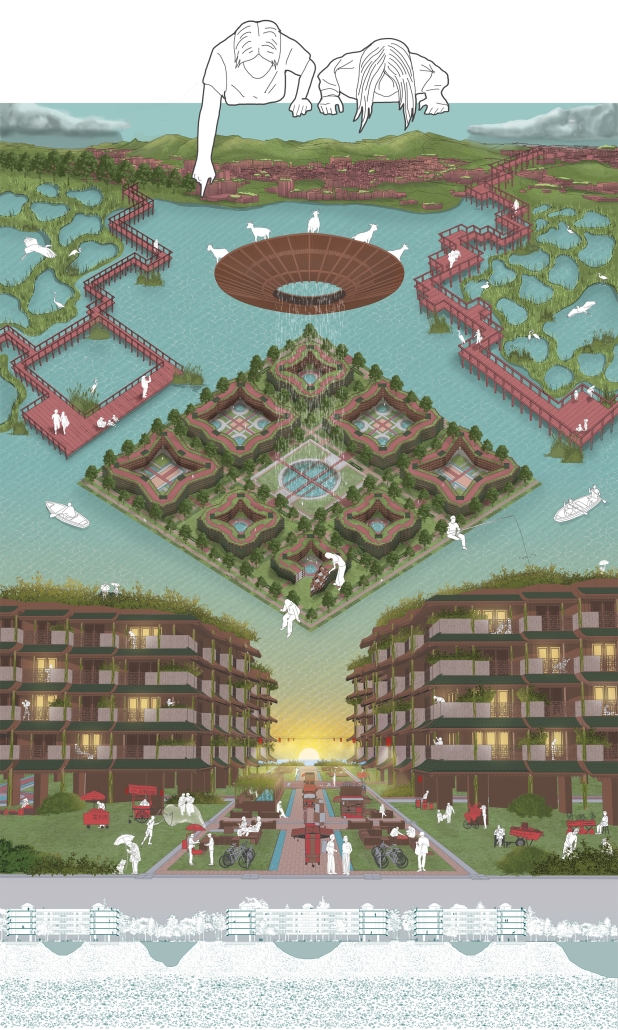
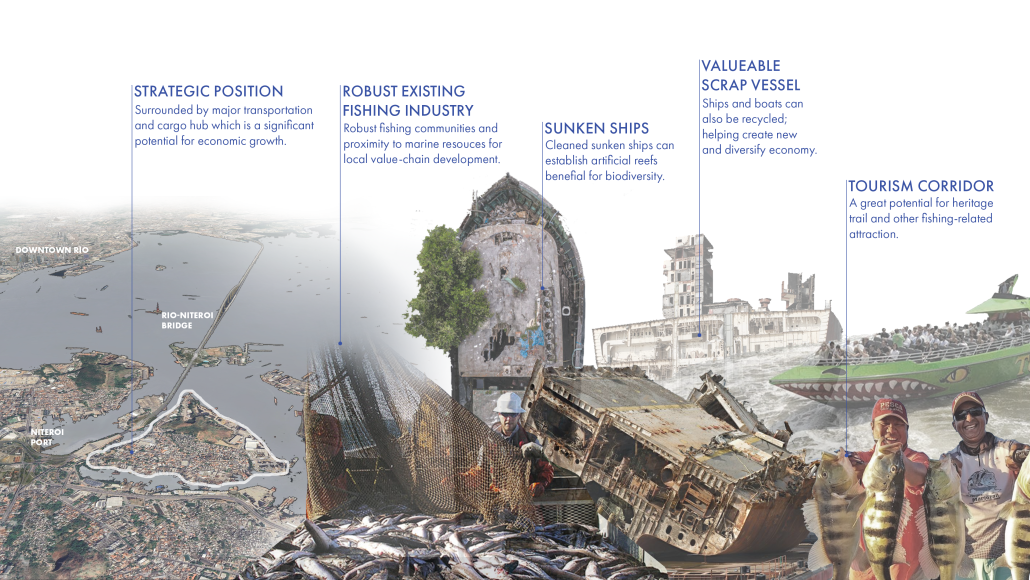
In the past, the island of Ilha da Conceição was composed of three separate islets located within Guanabara Bay. The construction of Niterói’s port and the later Rio–Niterói Bridge, which was driven by the expanding oil industry, filled in the channels that separated the two islands. This effectively annexes the islands to the city while also obstructing the natural flow of water. In addition to the accumulation of derelict ships, this land reclamation has resulted in the accumulation of wastewater and industrial runoff, which has resulted in the transformation of once-clean currents into polluted pools that are stagnant.

The shoreline is now dominated by industrial activity, which has cut off communities from the water and undermined both the quality of the catch and traditional ways of making a living. Local fishermen used to thrive in this area previously.

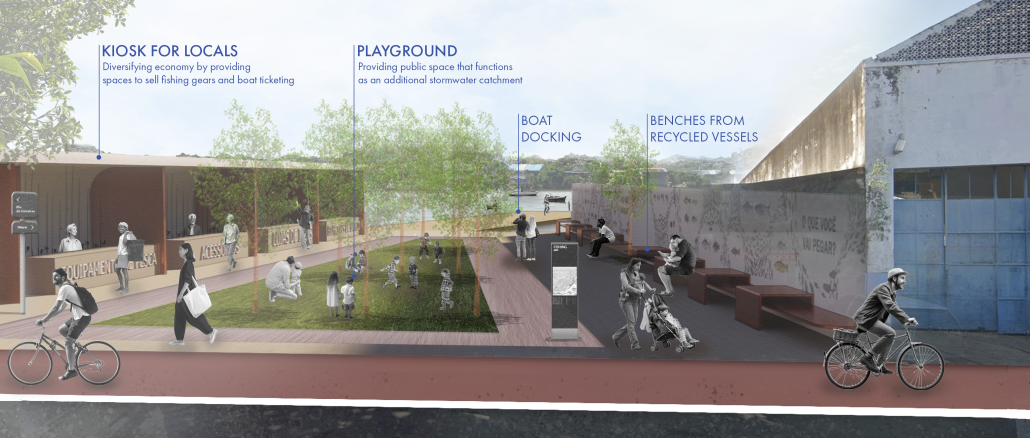
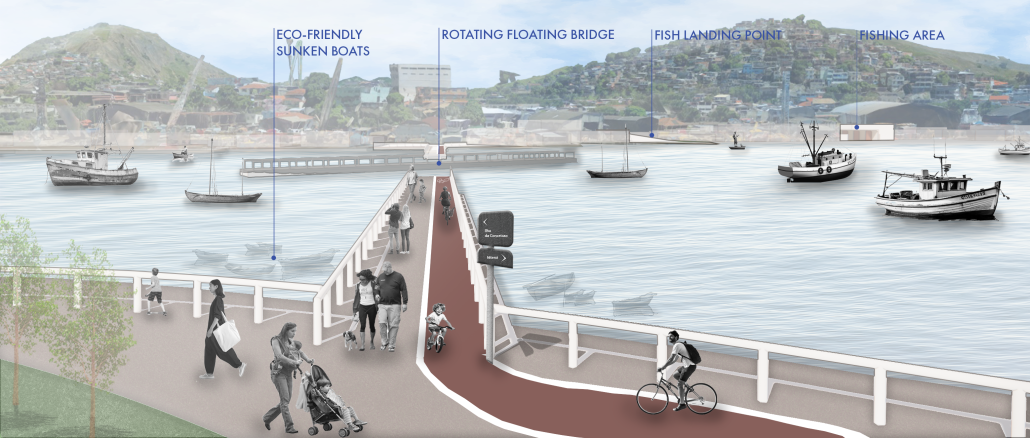
The ‘what if’ scenario that we have envisioned involves reestablishing water circulation without displacing any industry. By relocating factories to nearby locations and innovatively repurposing vessels that have been abandoned, we could bring back a canal that is cleaner and flows more freely. Residents of Ilha da Conceição and Niterói would be brought together through the creation of new public spaces along its banks. These spaces would serve as natural filtration zones and social connectors.

What is the end result? improved water quality, revitalized community fishing, and parks along the water’s edge that are very inviting. The demonstration that industry, ecology, and community can coexist in harmony would be [highlighted] by the fact that improved access to the bay would stimulate the creation of jobs, broaden access to goods and services, and ignite local economic growth.

Click here to learn more. 

Instagram: @runikarunia, @enoxizi, @mehtageeta999 @eadmassu, @sdelpino_arq, @gabrielvergarag, @lucascoelhonetto, @cauecapille, @shrey_patel1999

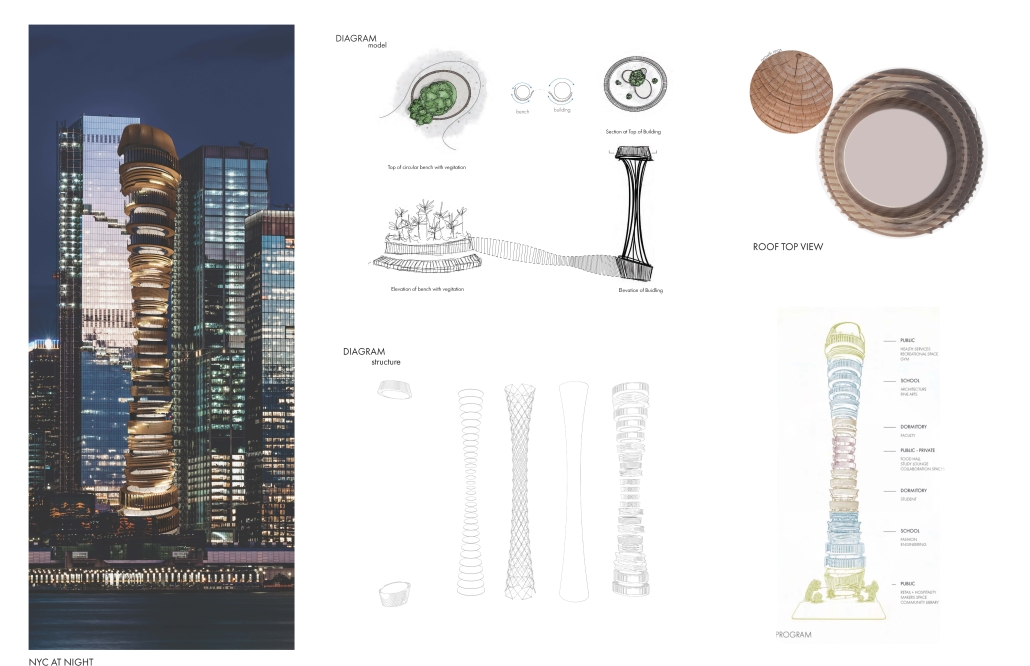
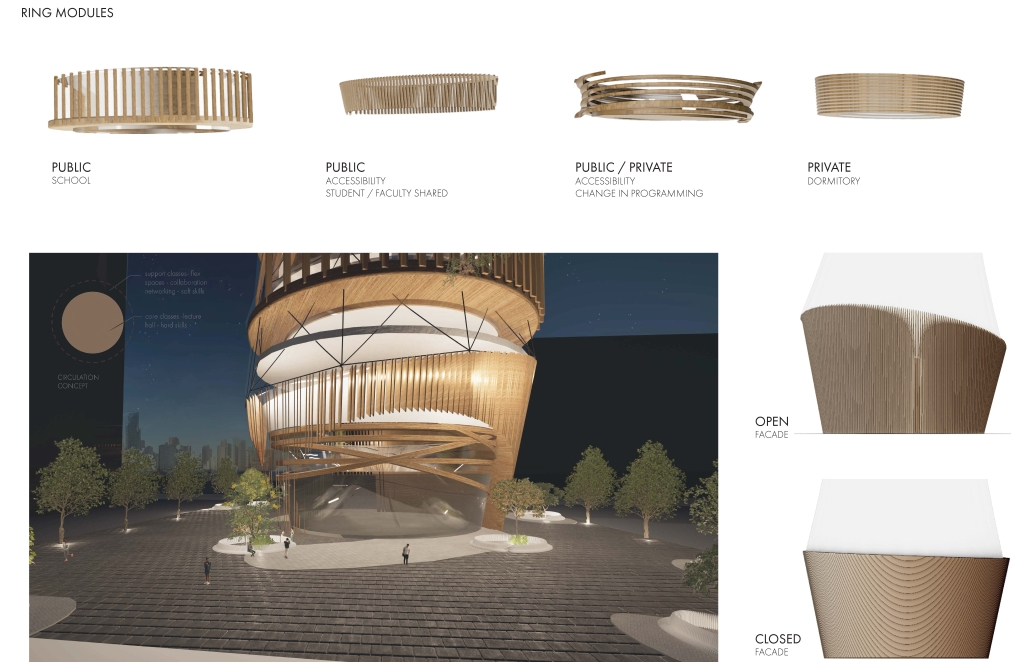
City Within a Shell, Reclaiming underutilized buildings for living learning and belonging. by Kush Choganwala, M.Arch ’25
Boston Architectural College | Advisors: Ralph Jackson &  Ian F. Taberner

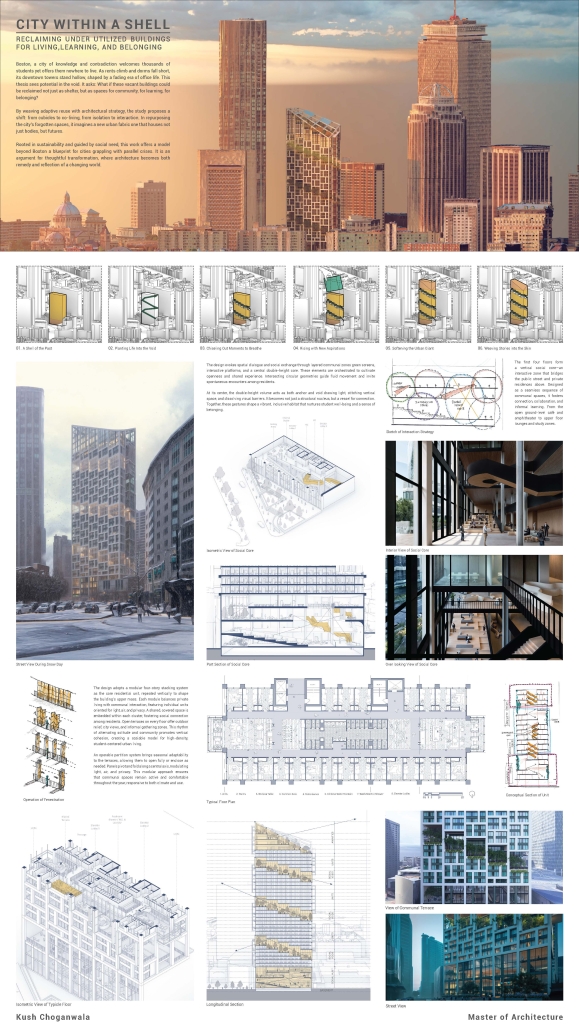
In a city defined by knowledge and ambition, where students arrive with dreams larger than their square footage, a quieter truth rises between the lines of the skyline: vacancy. Beneath the towers of Back Bay, amid the noise of commerce and culture, stand buildings built for another time empty, waiting, still. “City Within a Shell” is a thesis rooted in this urban contradiction. It asks: What if the city’s forgotten rooms could be reimagined for those still finding their place within it? What if architecture, instead of beginning with demolition, began with listening to the structures that remain, and the lives that need them?

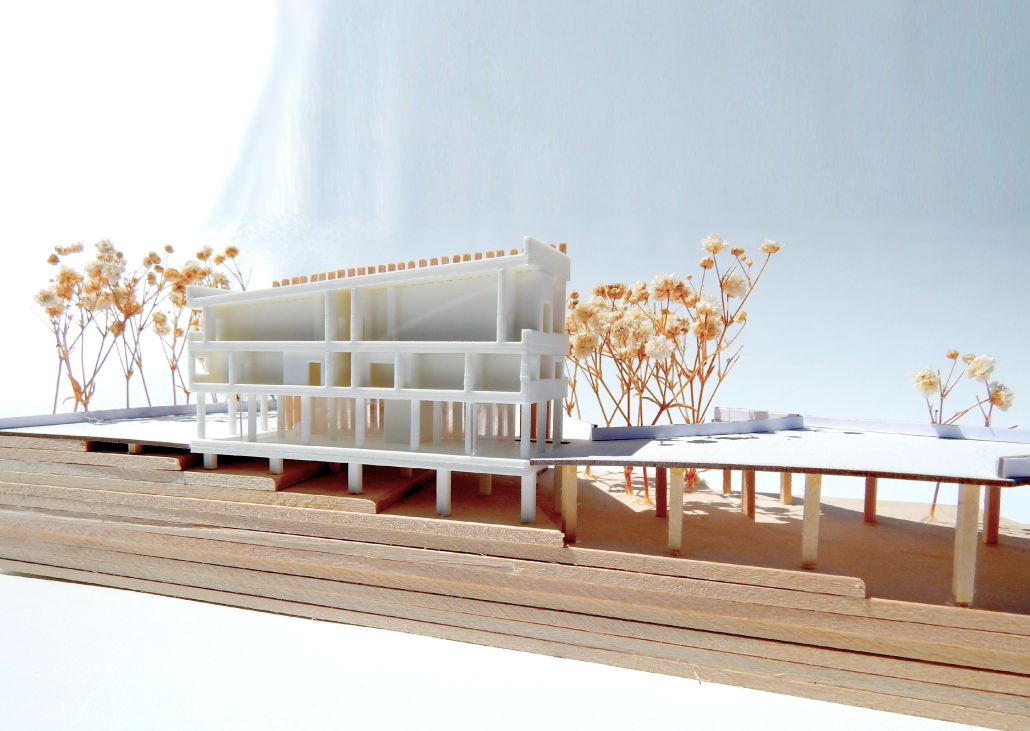
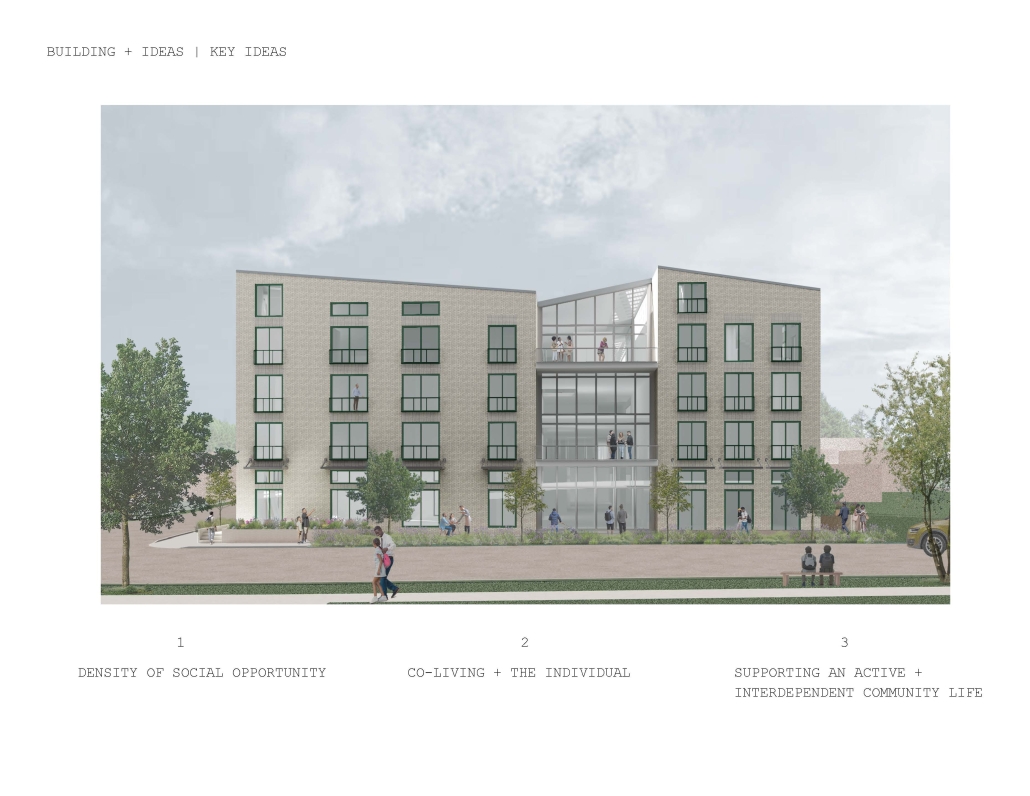
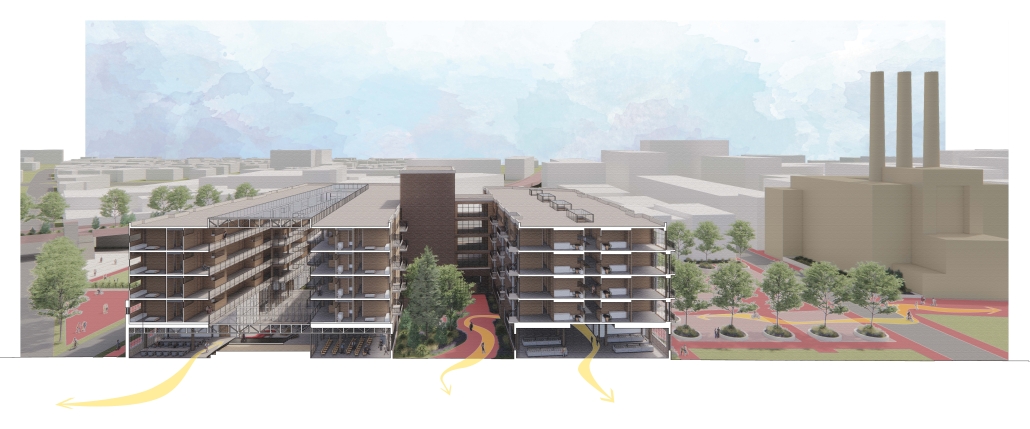
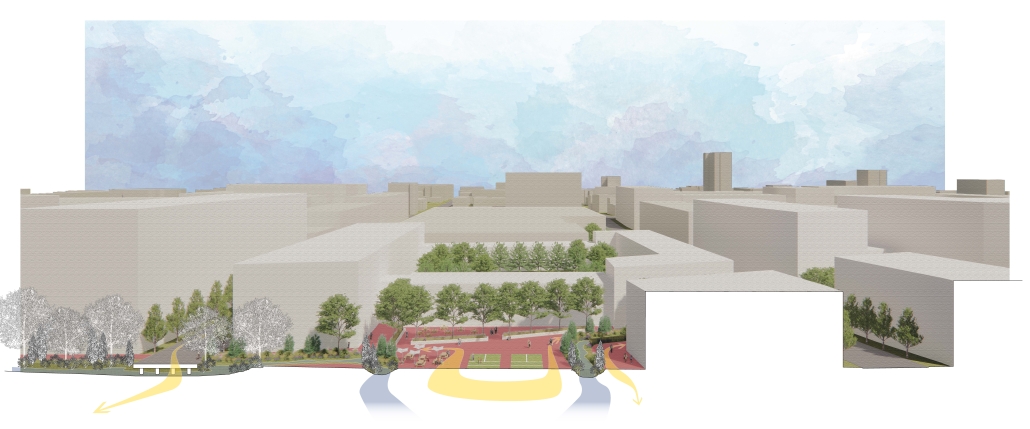
This project proposes the adaptive reuse of the Sheraton Boston Hotel’s South Wing, transforming a vacated hospitality structure into a vertical co-living environment for students. Located in the academic epicenter of Boston, surrounded by institutions like Northeastern, Berklee, and the Boston Architectural College, the site holds the potential to serve the very population it has long overlooked. 

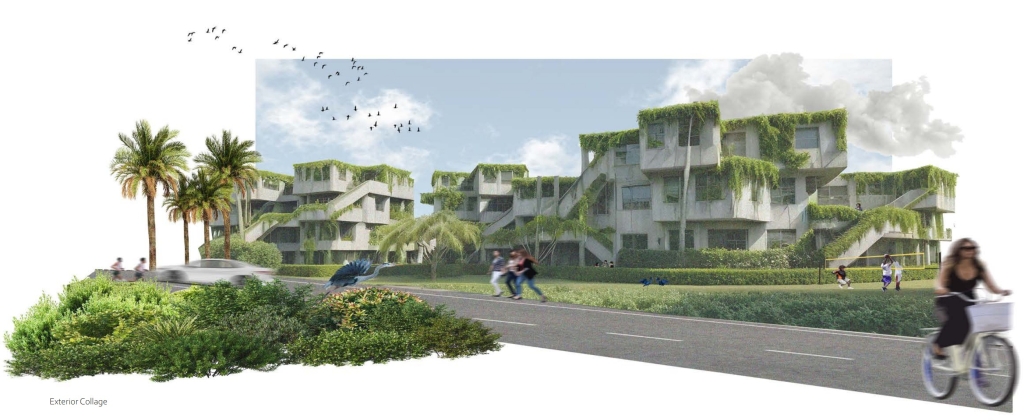
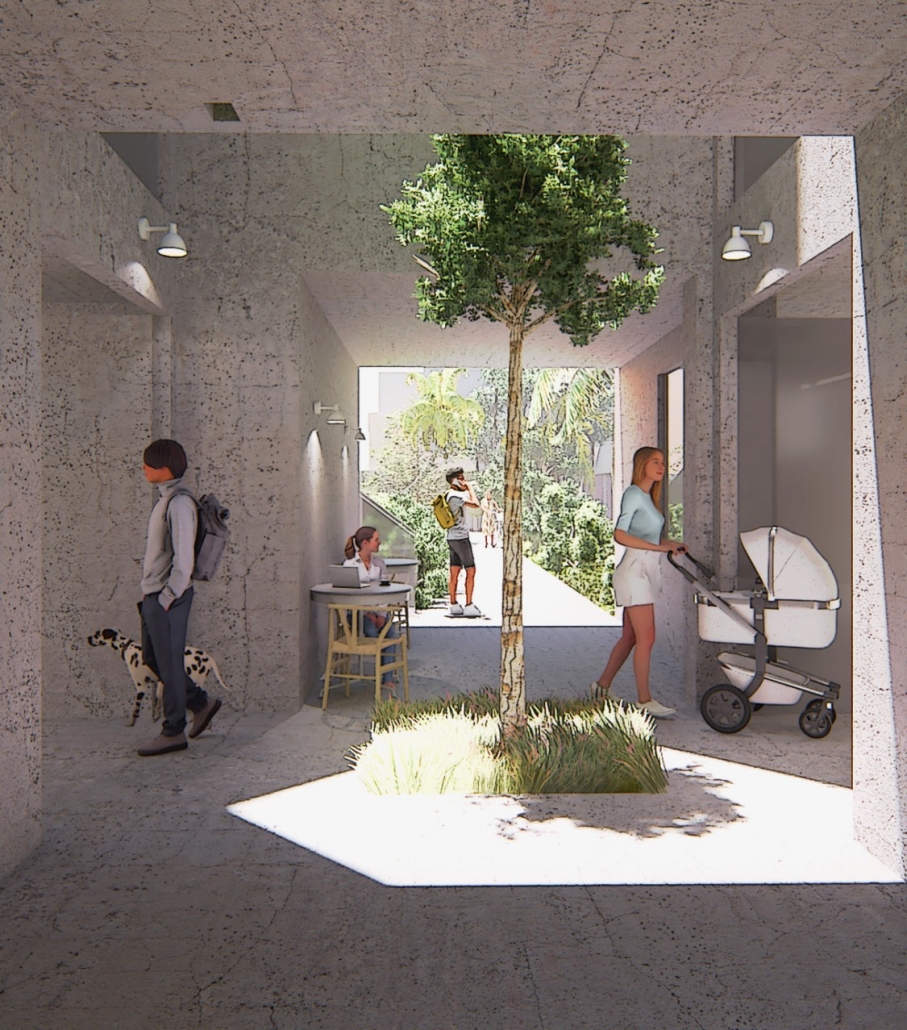
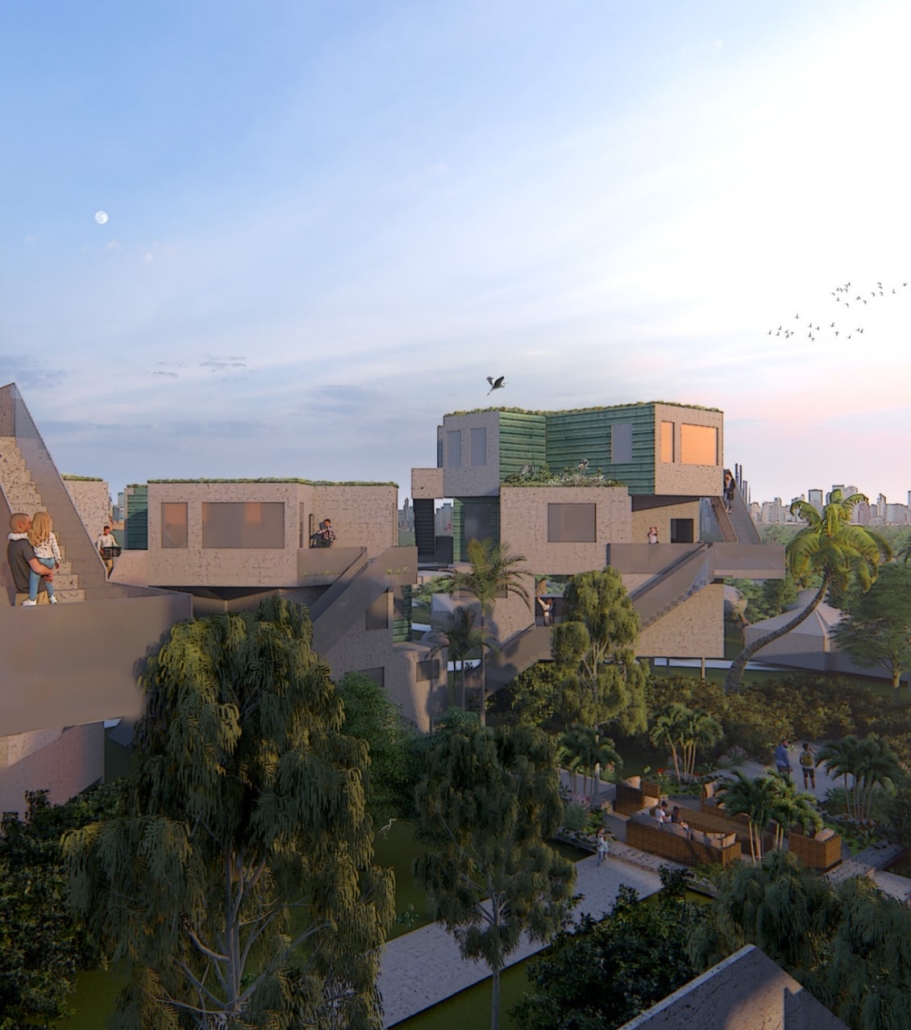
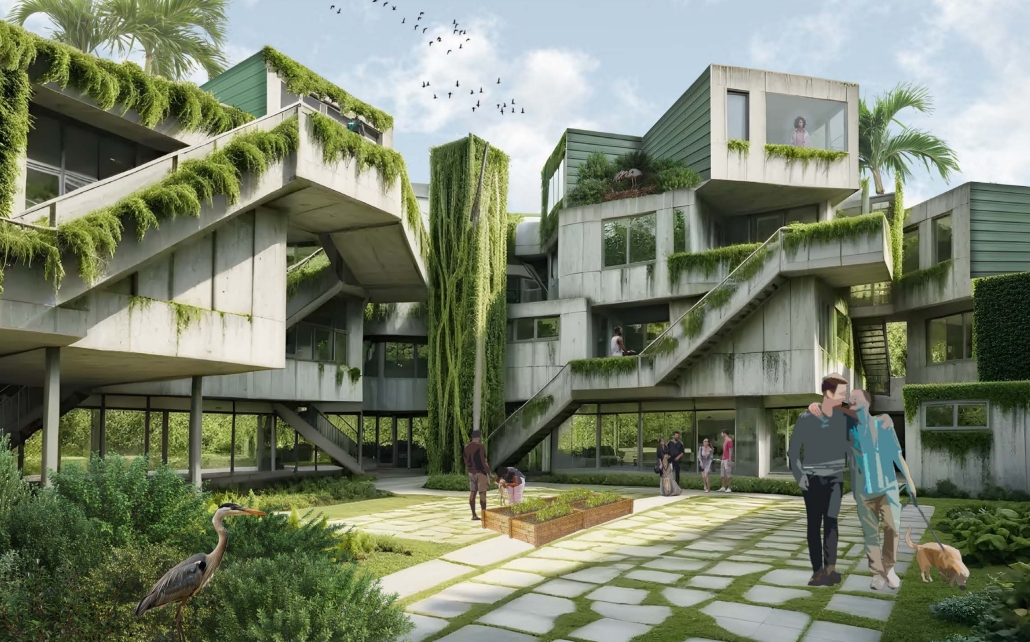
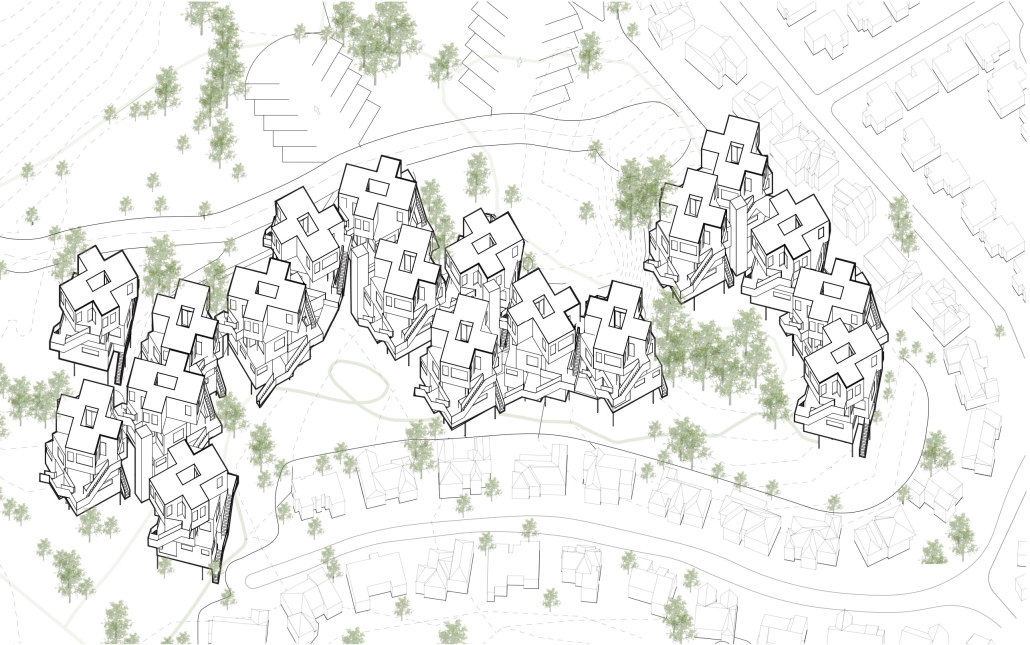
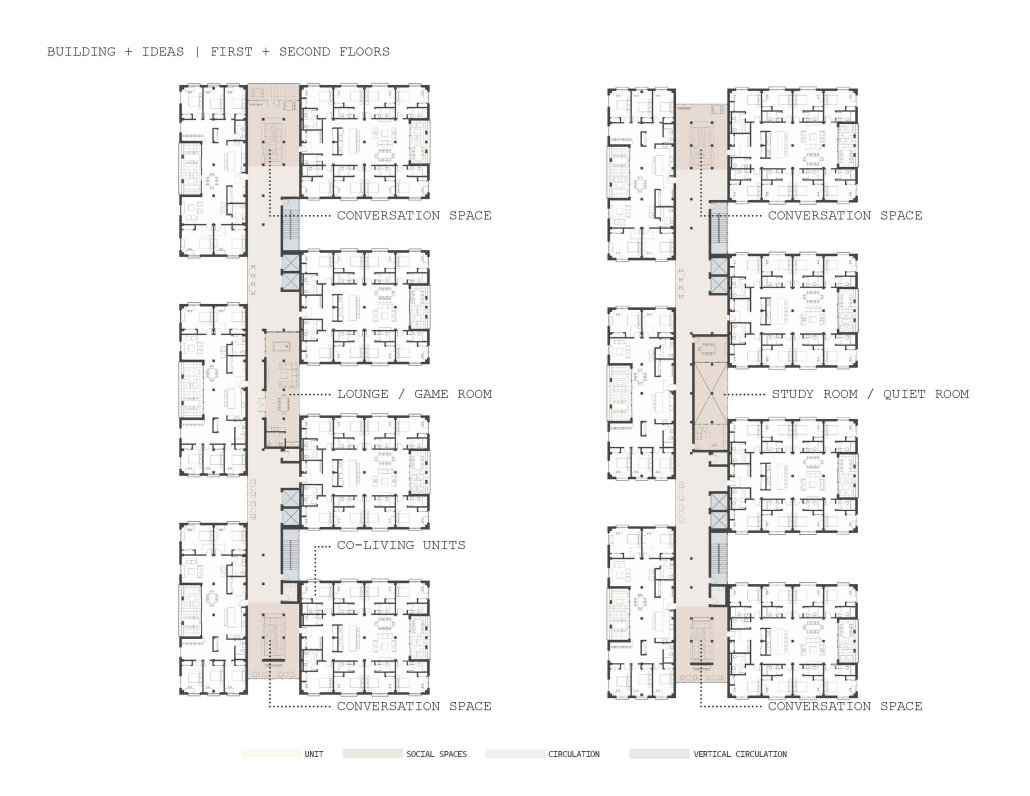
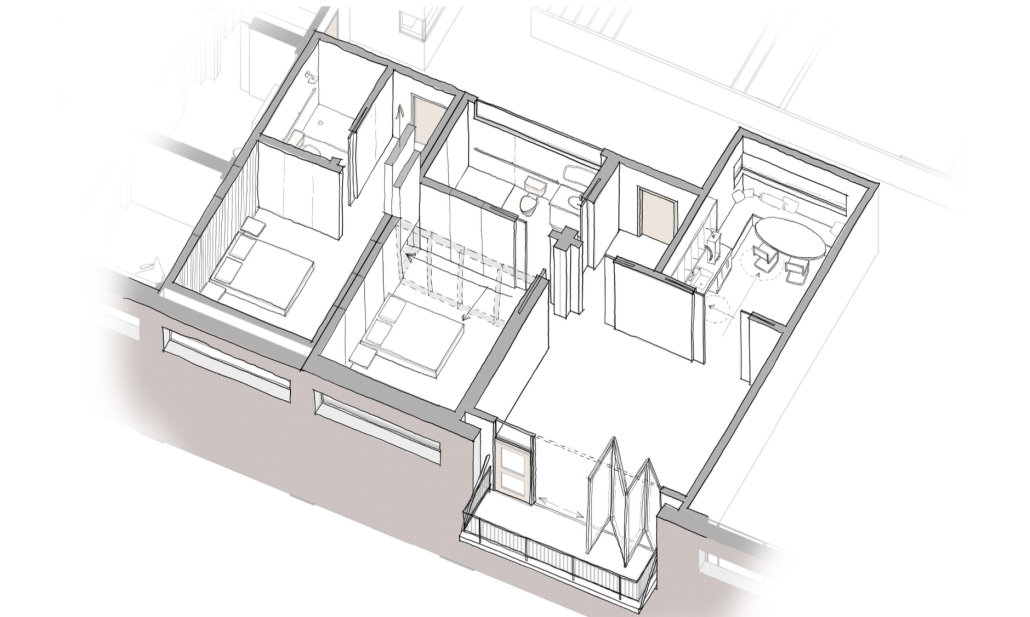
The design strategy centers on a modular four-story stacking system that integrates living units with shared kitchens, study lounges, wellness pods, and green terraces. These clusters spiral around a central spine, a vertical social core that weaves moments of interaction into the daily rhythm of living. The new facade becomes a living skin: softened with balconies, filtered with light, wrapped in green, inviting the city to witness a transformation not just of form, but of purpose. Methodologically, the thesis draws from precedent case studies in New York, Philadelphia, and Berlin, where adaptive reuse and cooperative housing models have reshaped the residential landscape. Site analysis, zoning and policy review, economic feasibility studies, and environmental performance simulations ground the proposal in practical viability while guiding its architectural expression. But beyond numbers and plans, this work is a meditation on belonging. It acknowledges that housing is not just a commodity, but a condition for well-being. It positions design as a tool not only for efficiency, but for empathy. And it offers a replicable framework—both spatial and strategic for cities grappling with similar imbalances between abundance and need.

City Within a Shell challenges the idea that buildings expire when their original function fades. Instead, it proposes that architecture can evolve layered, resilient, and generous. It suggests that within the walls we inherit, there is room to imagine something better: a city where vacancy is not a failure, but a beginning. Through this thesis, architecture becomes an act of reclamation of space, of purpose, and of the right to belong.

This project won the Edwin T. Steffian Award, Best of M.Arch Thesis. 

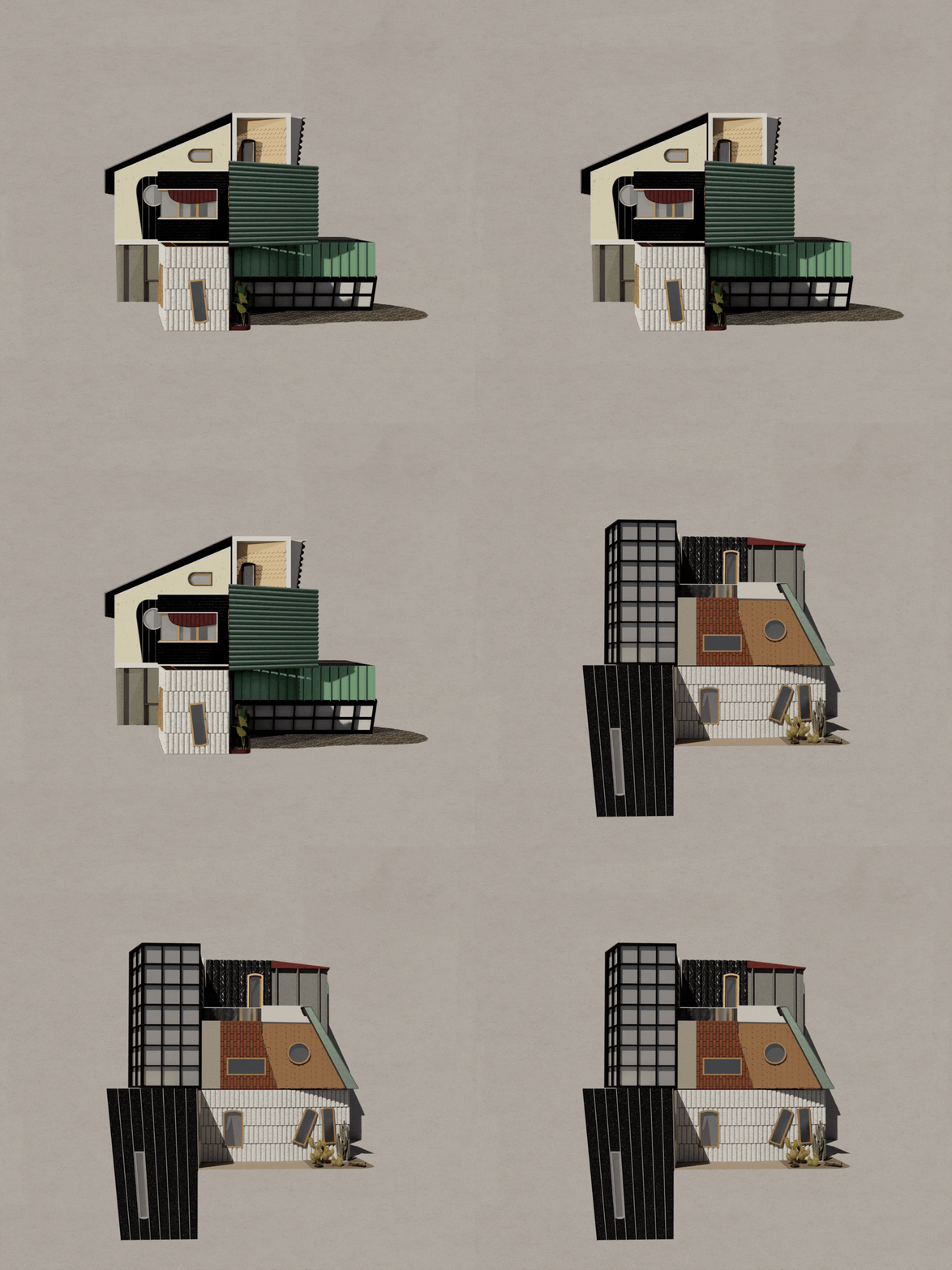
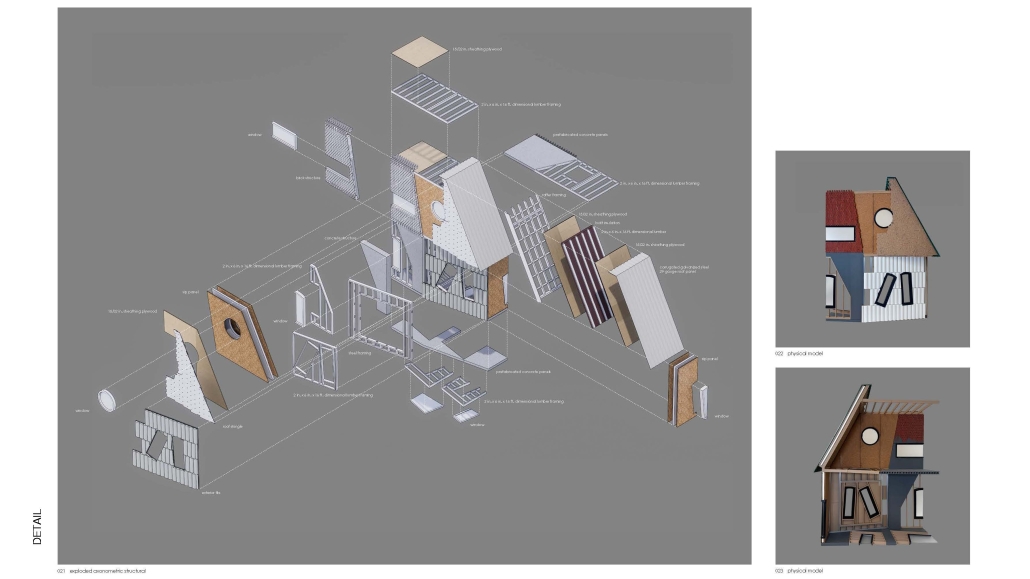
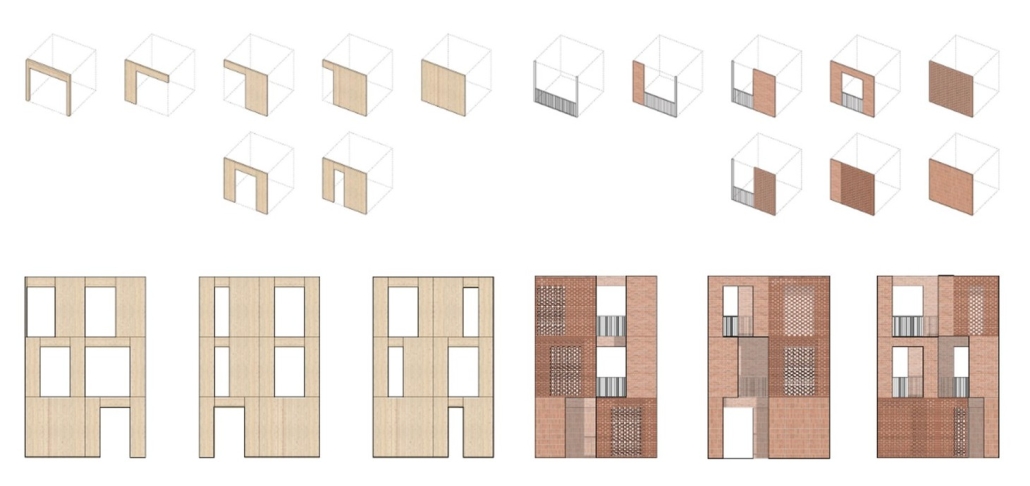
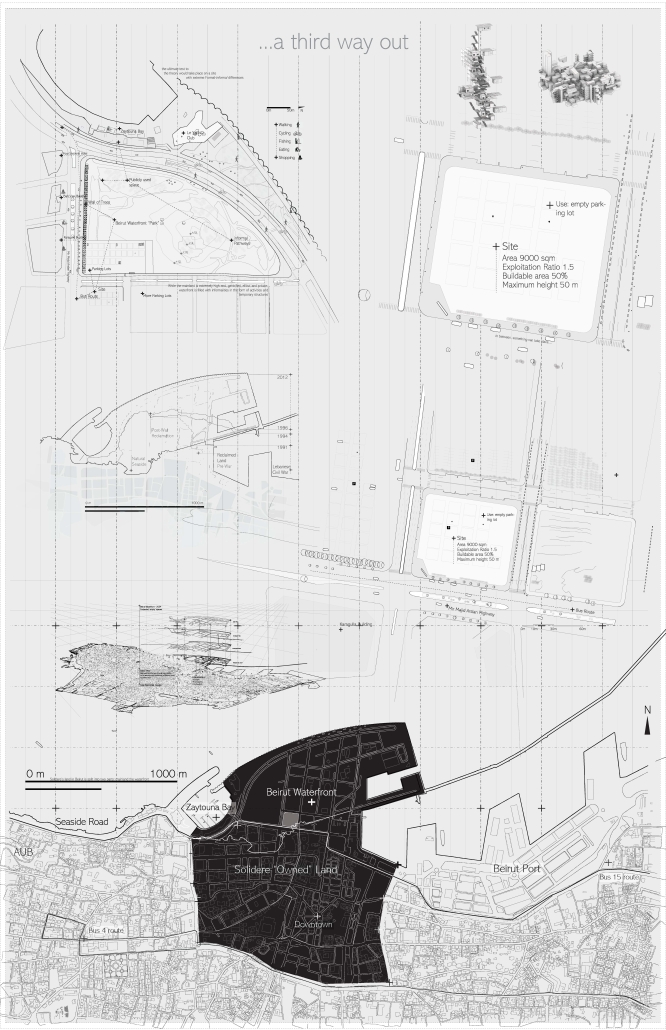
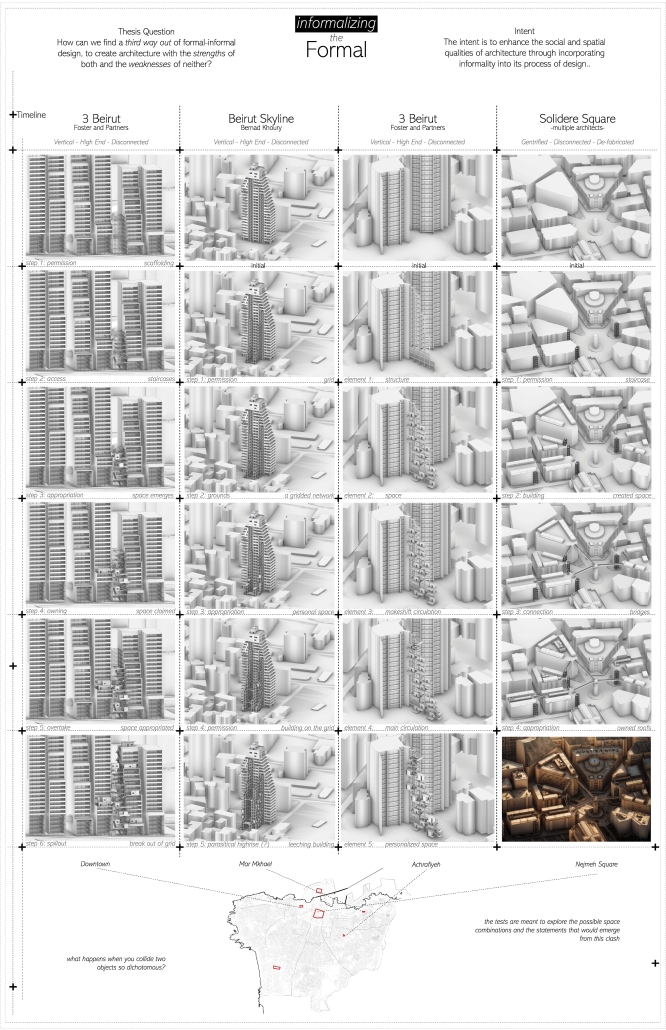
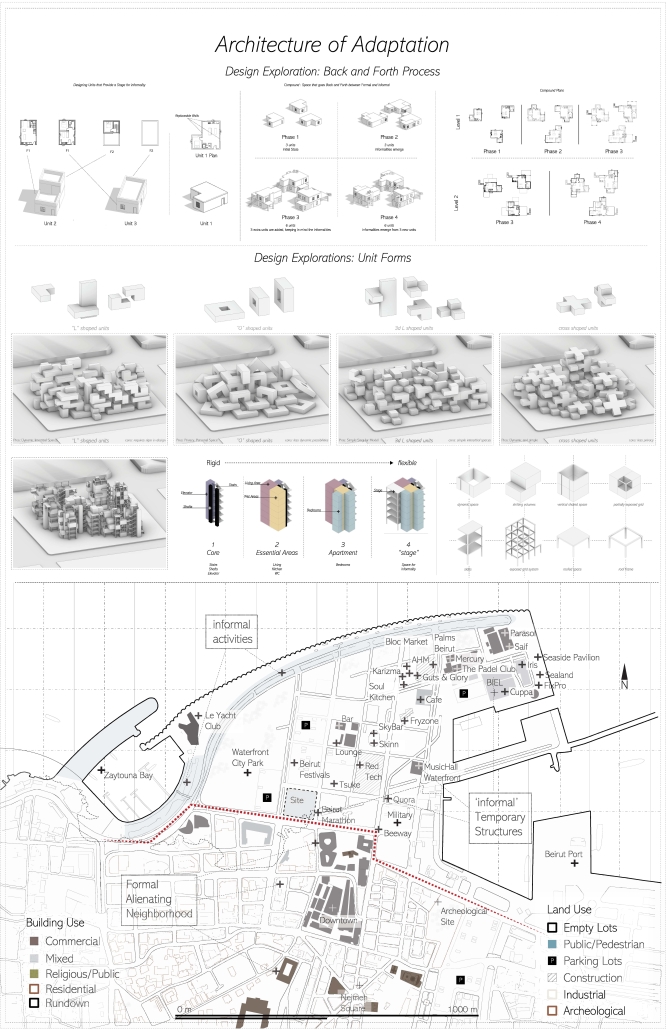
the informal Formal: a third way out by Yamen al Mohtar, B.Arch ’25
American University of Beirut | Advisor: Makram Al Kadi

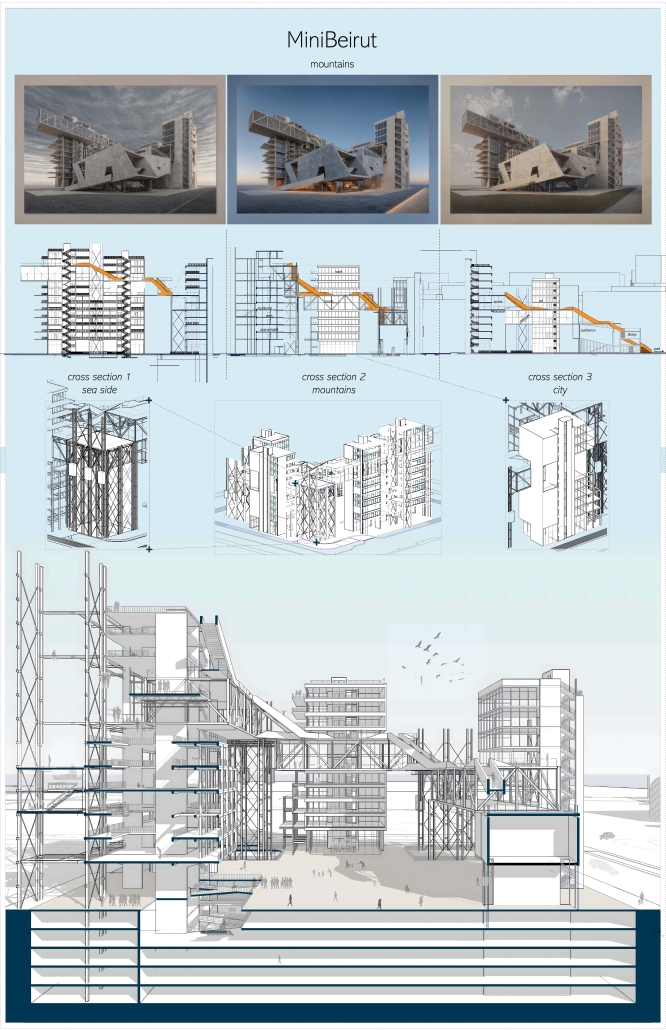
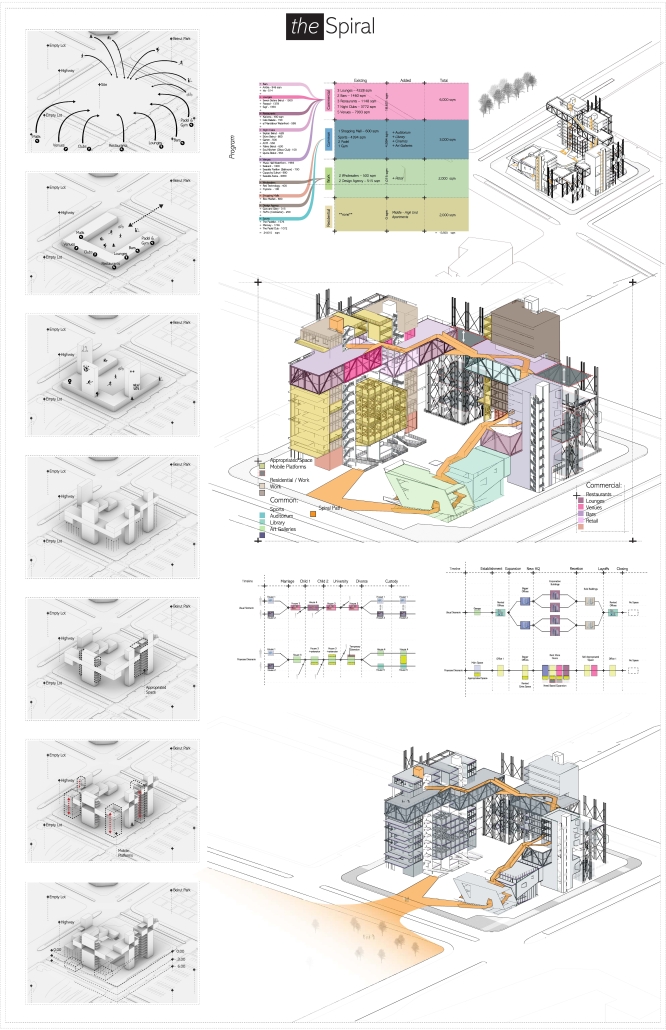
In today’s world, where architecture is designed down to every small detail, spontaneity has been cast aside in favor of control. However, while being true in certain cities, this reality is in no way universal. That is because in most countries and cities, designed architecture is only a fraction of what is built. Most buildings are built without architects, without engineers or professionals, sometimes even without builders. This language of architecture is embodied in various informalities, ranging from informal neighborhoods and slums to temporary structures and “spontaneous” buildings built out of necessity.

This thesis exploration delves into questions regarding this untapped space, asking questions like: What if informality emerges not as a product of circumstance, but as a personalized method of design? What if different classes of society can be brought together through the incorporation of the informal into formal design? How can we use informality as a design method that could be applied universally, providing unique spatial qualities that would otherwise be exclusive to a few? What if there’s a new design process? One which is neither formal nor informal, but one which has the virtues of both and the downsides of none?

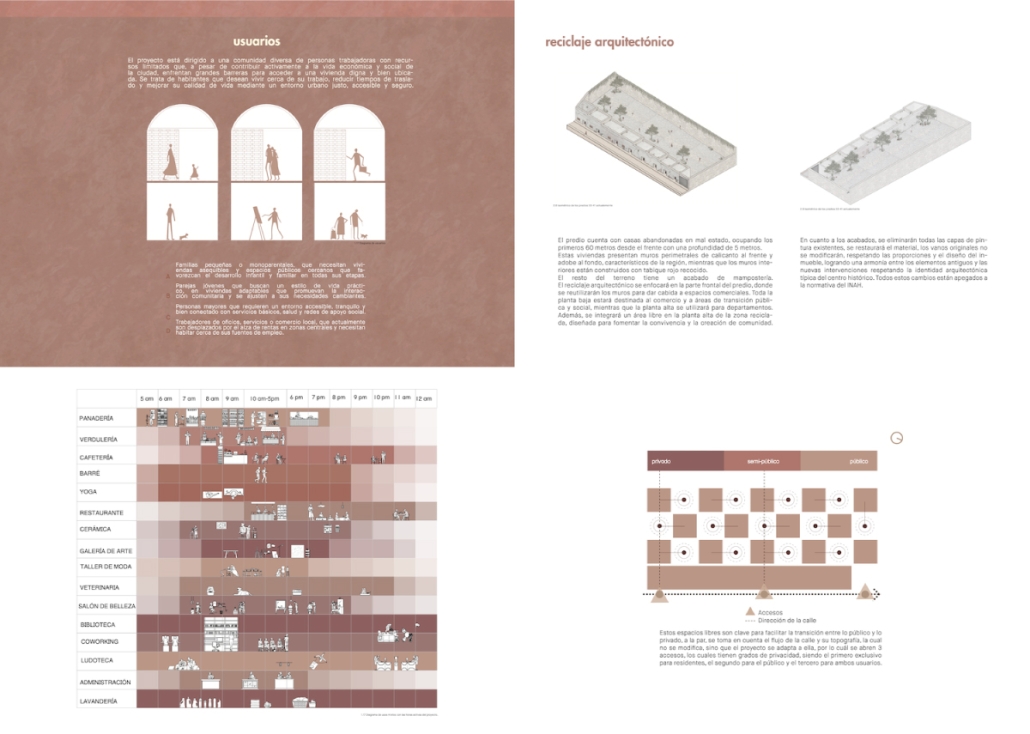
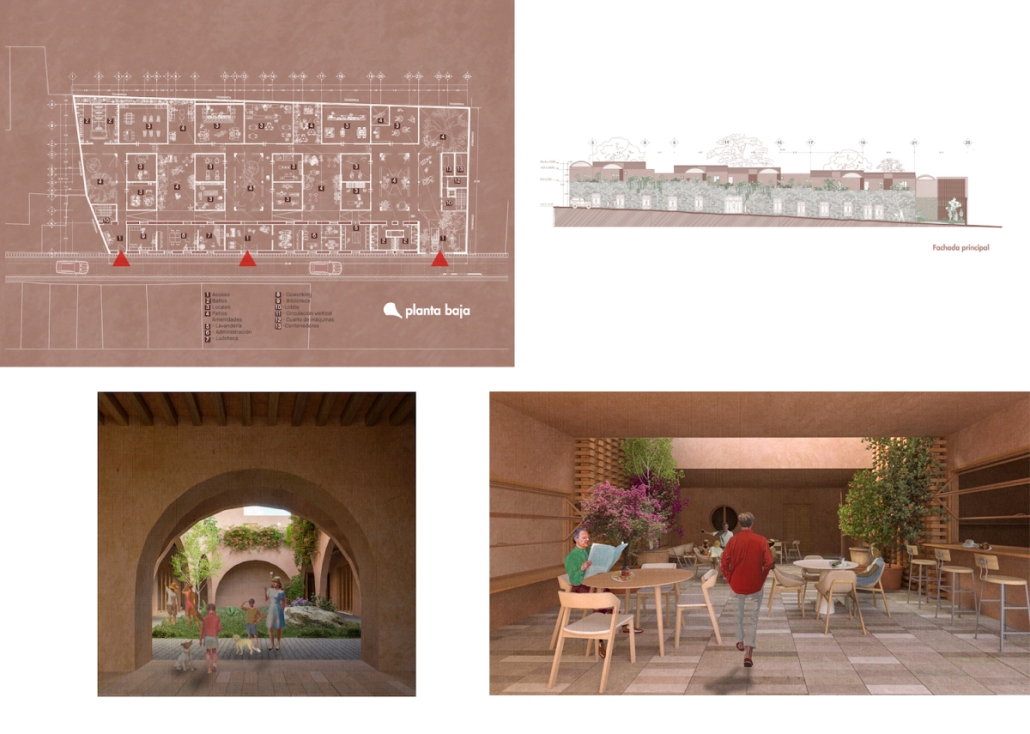
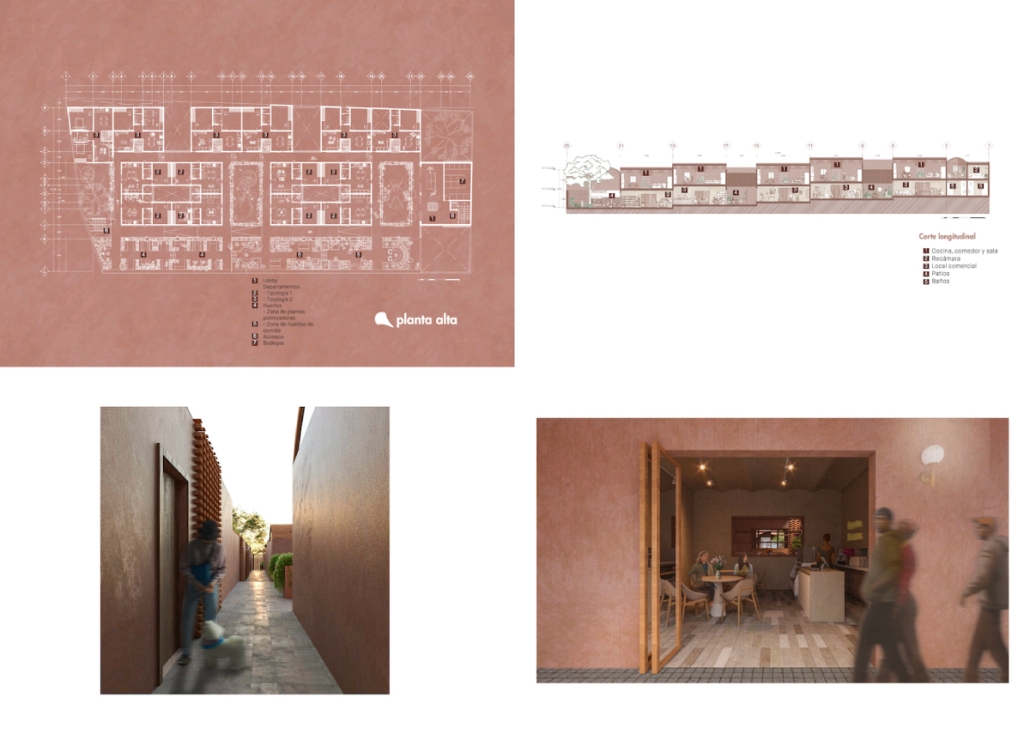
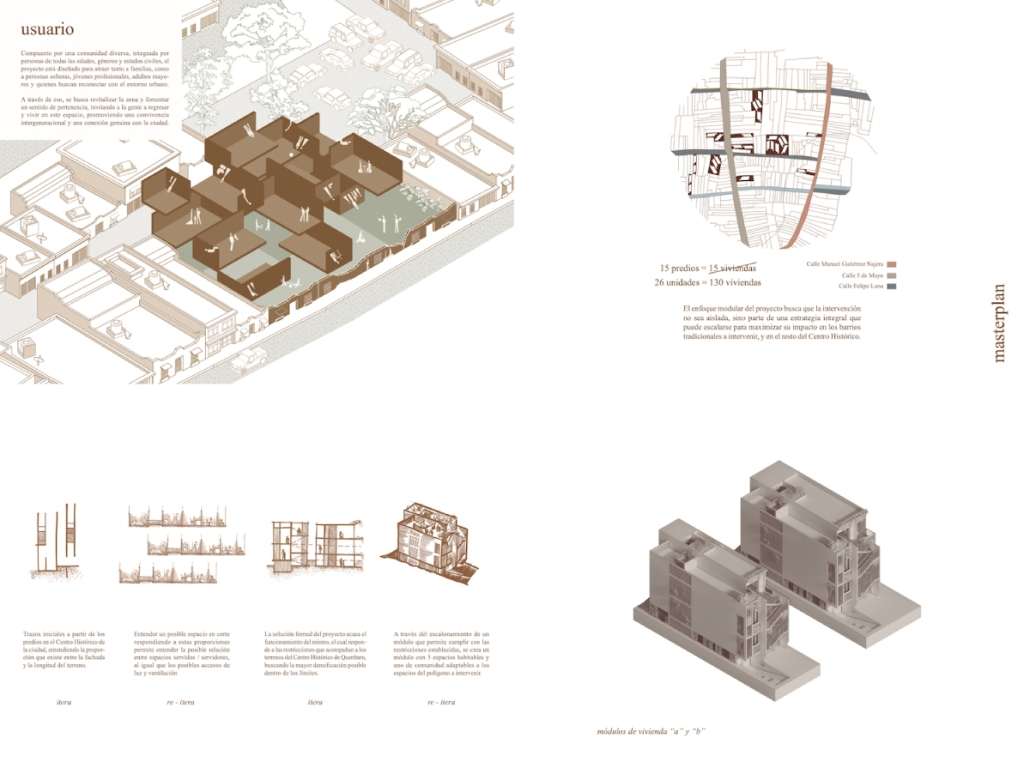
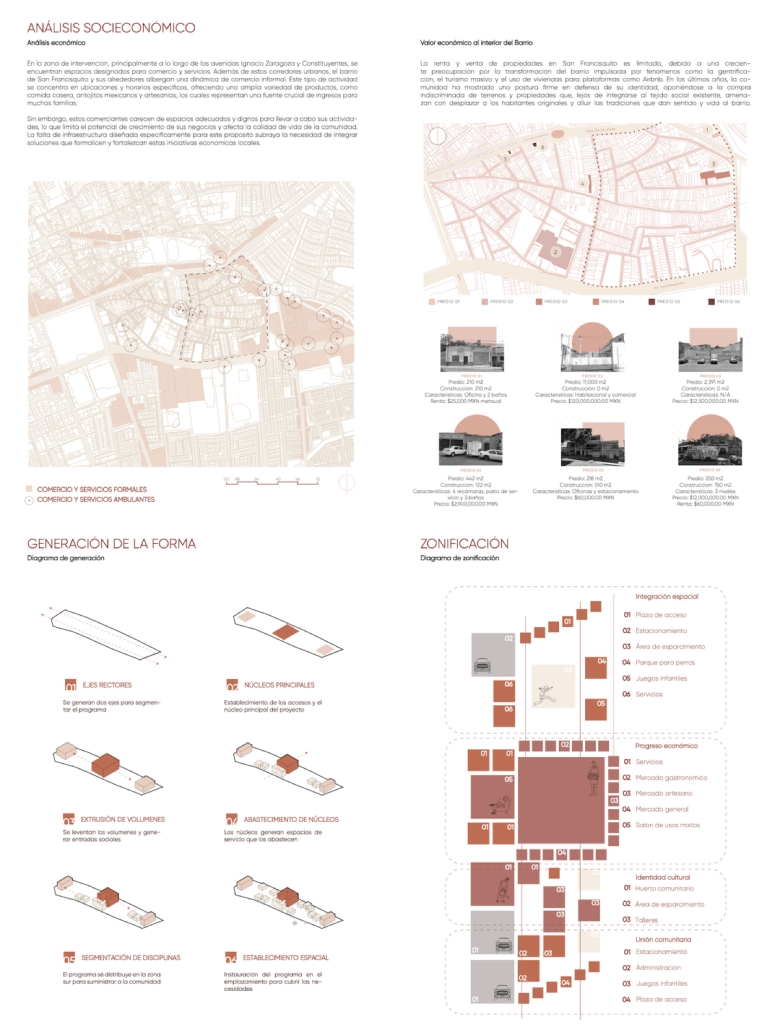
The Corridor, Neighborhood Center by Alejandro Rodríguez Torres, B.Arch ’25
Universidad Anáhuac Querétaro | Advisors: Guillermo Márquez, Patricia Cutiño & Jorge Javier

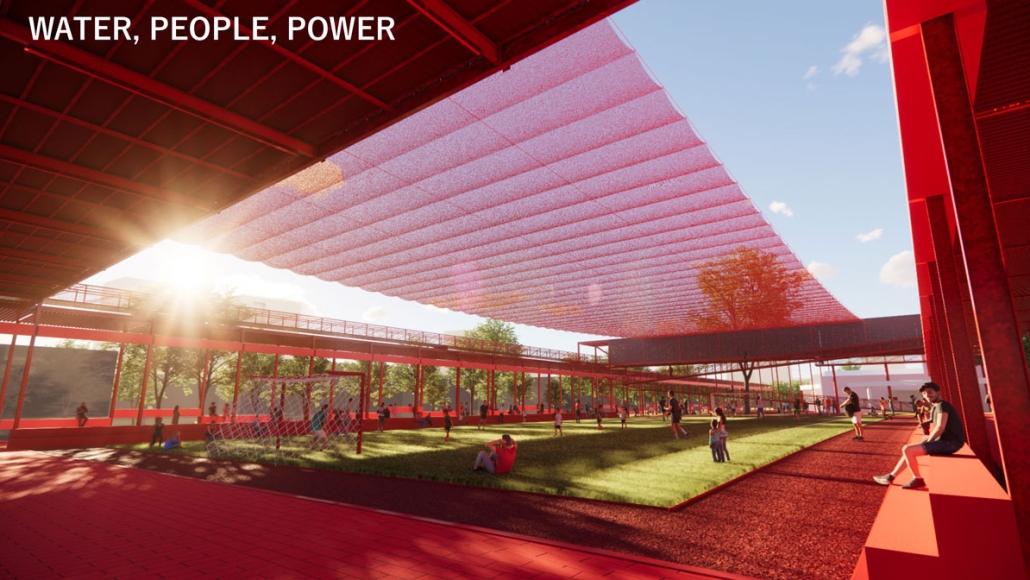
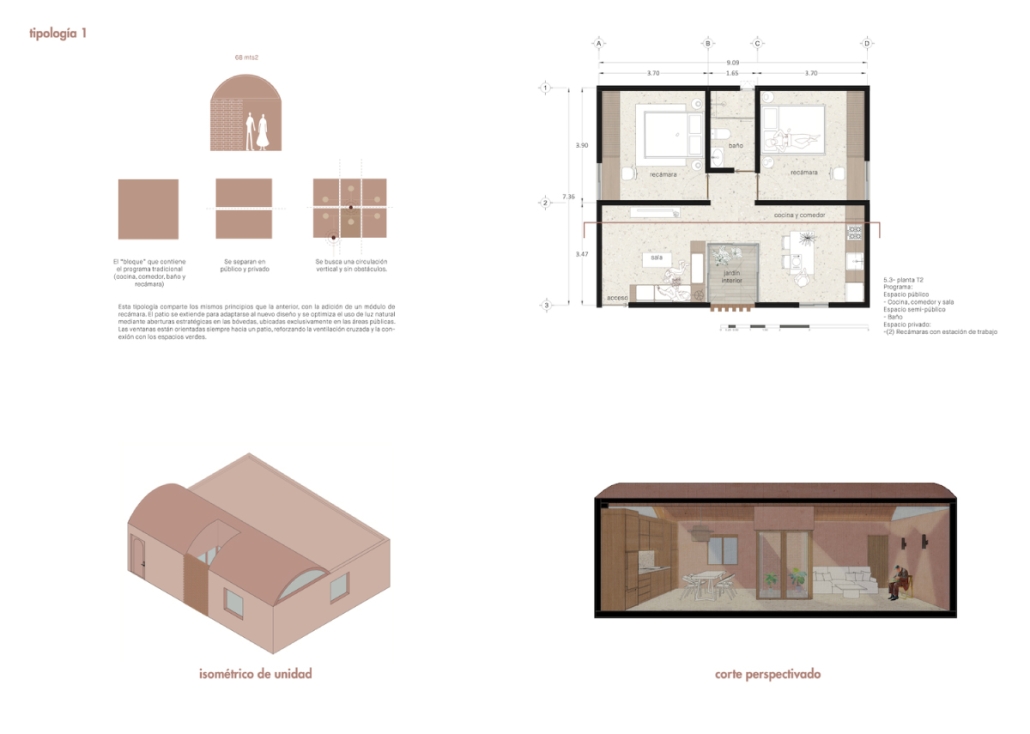
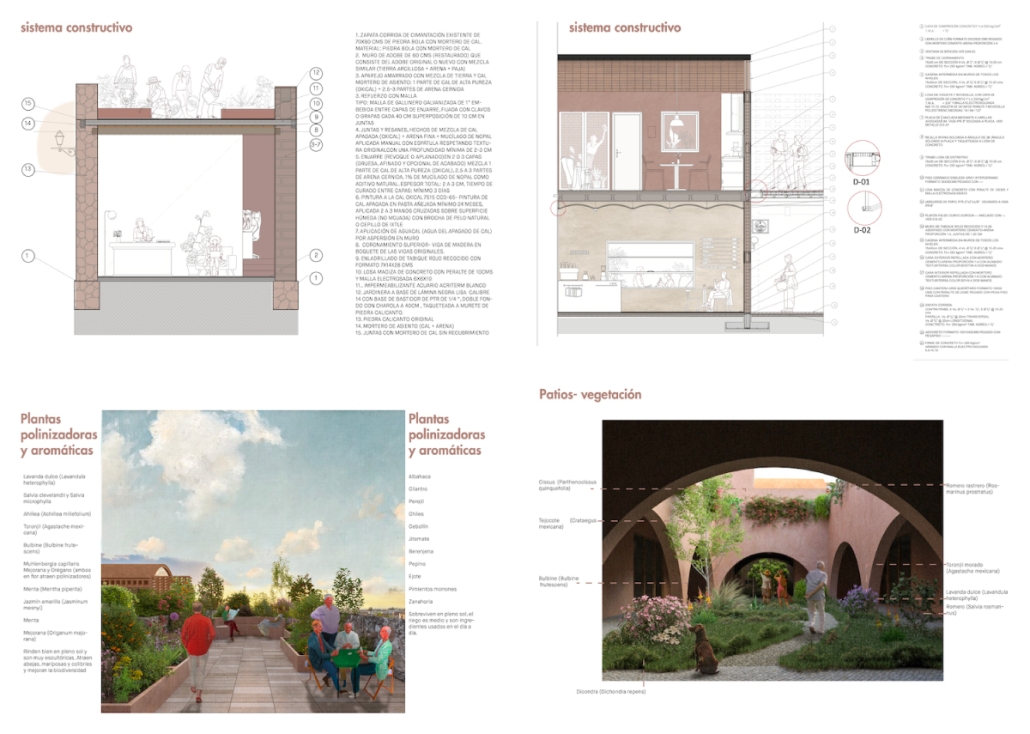
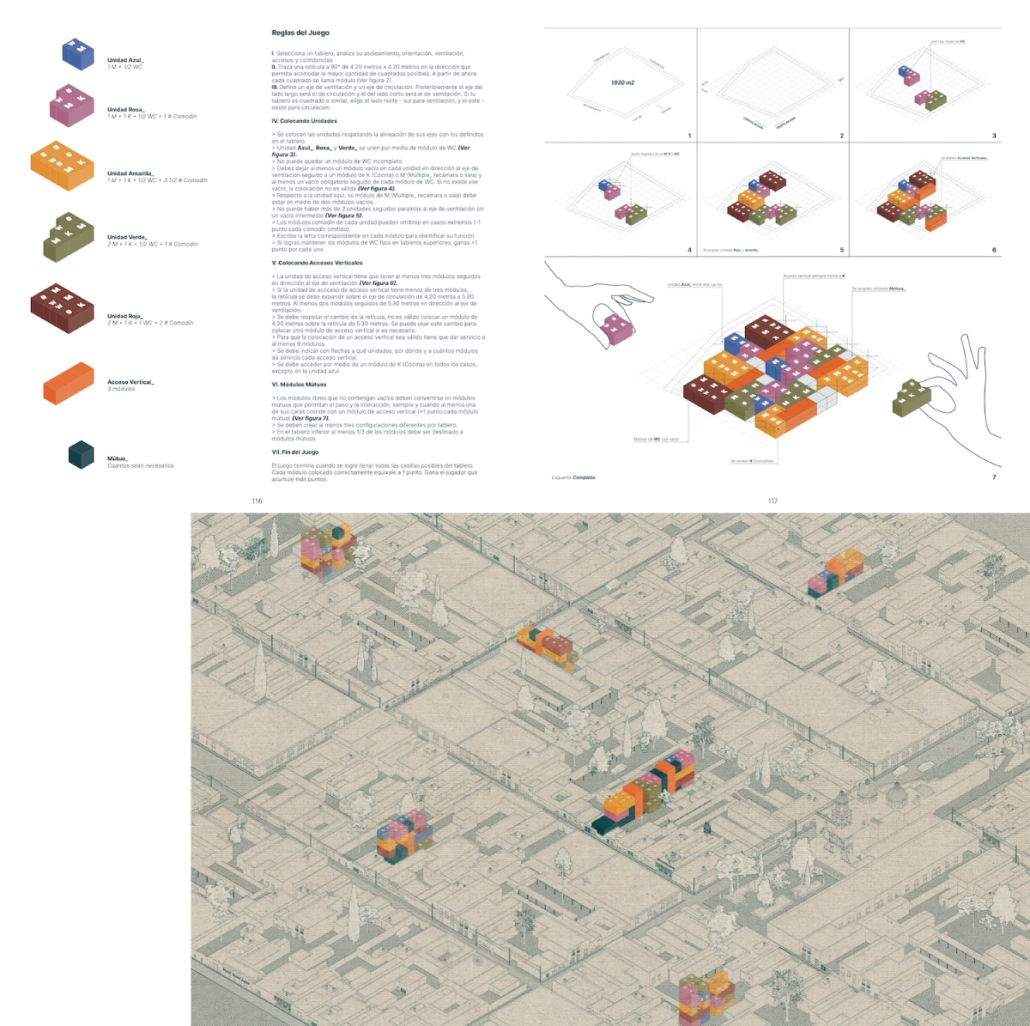
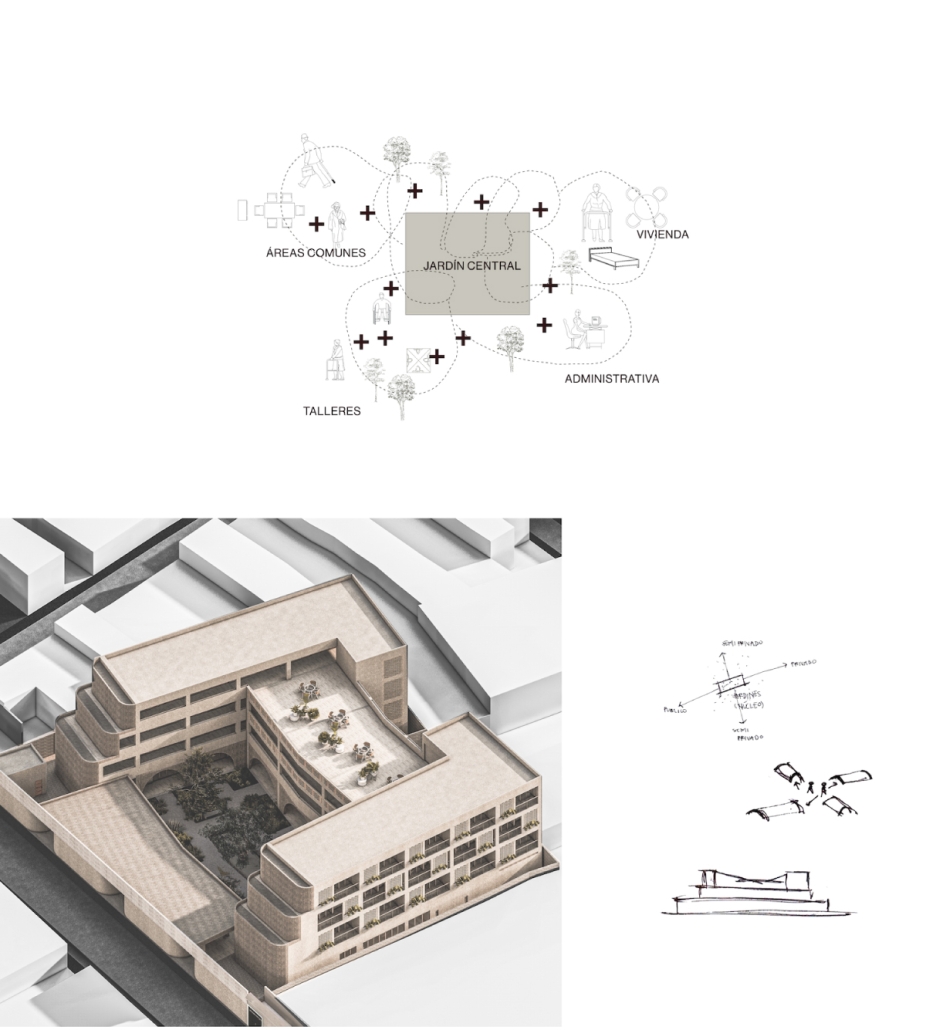
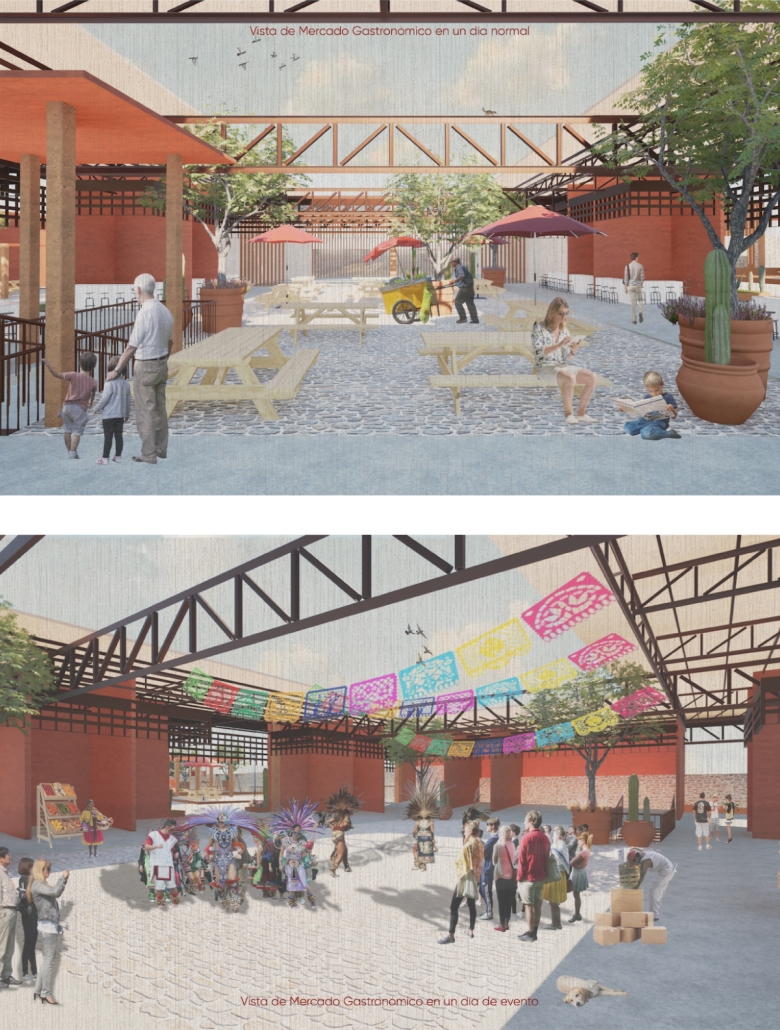
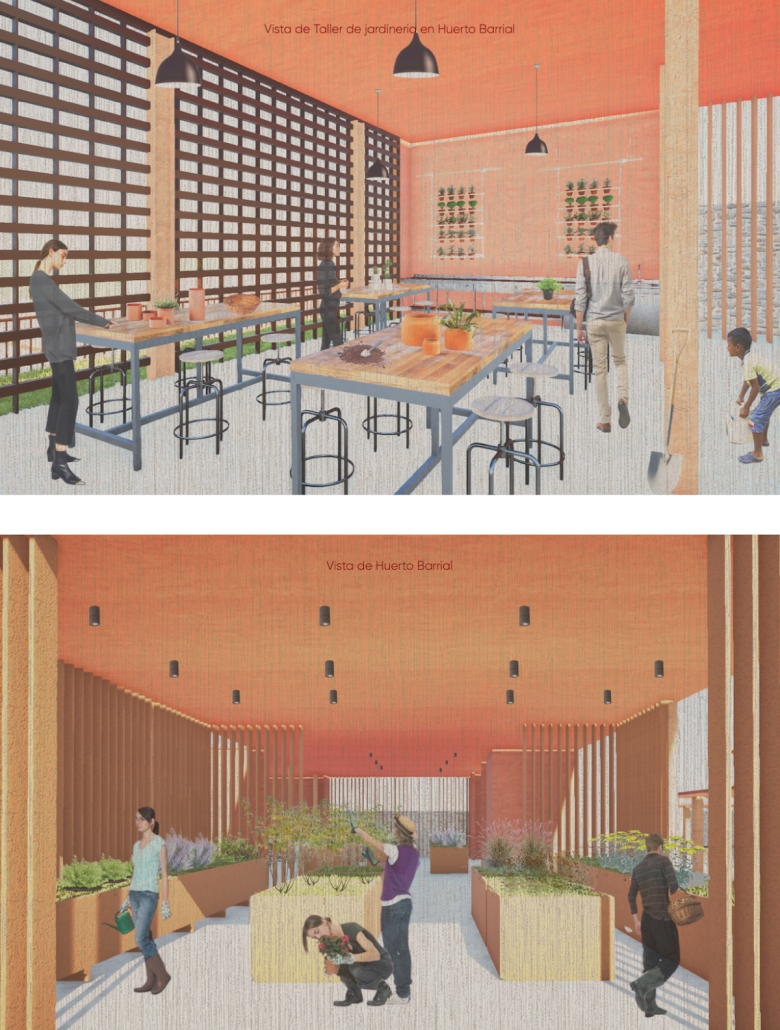
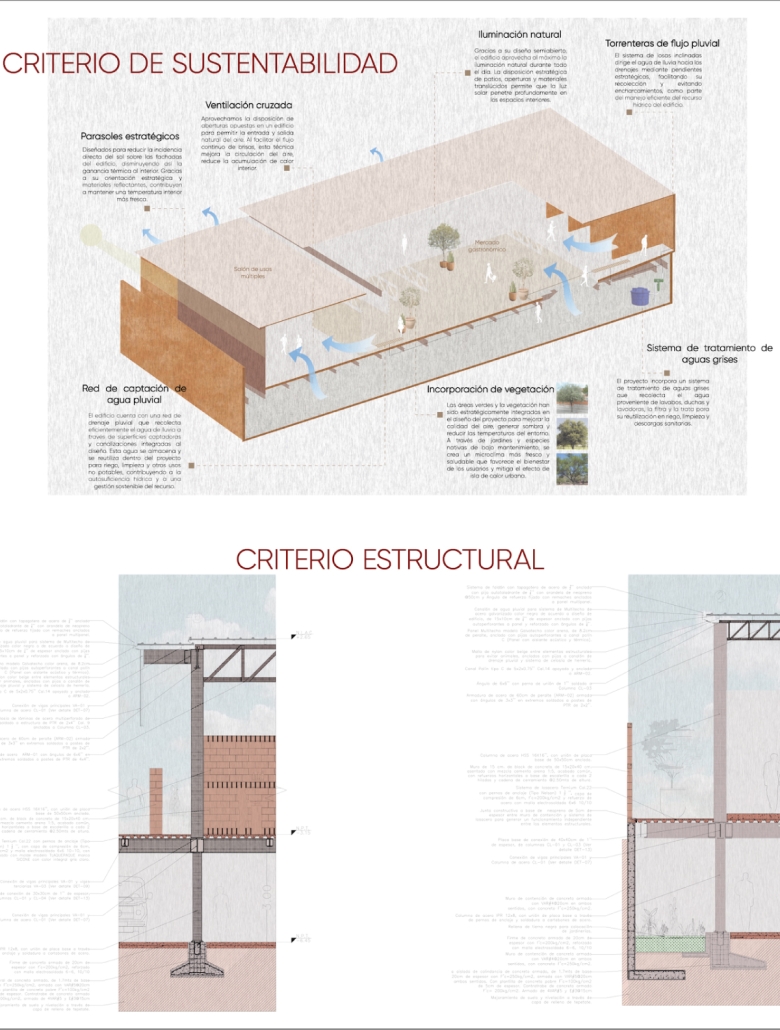
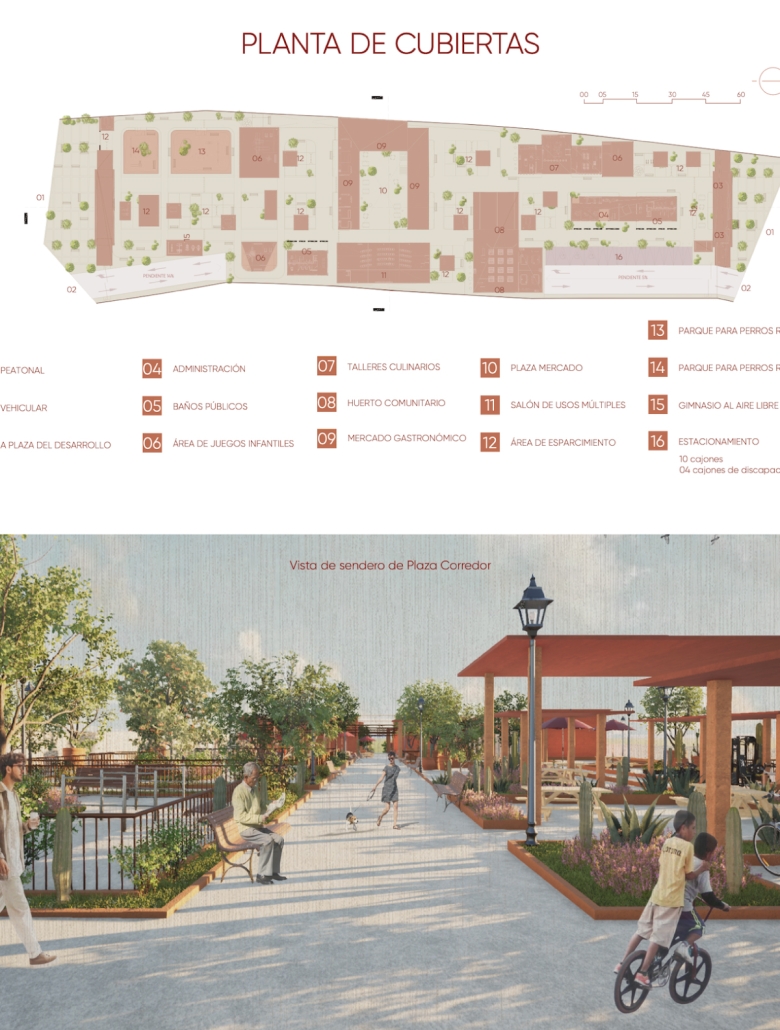
The goal of the project is to meet the need for a dignified central space that honors the history and cultural legacy of the San Francisquito neighborhood. It seeks to strengthen community unity through a specialized program that will position the project as a local and regional landmark. This space will integrate areas dedicated to recreation, culture, gastronomy and coexistence, key aspects to revitalize and strengthen the social fabric of the community.

Located in front of the Divina Pastora parish church, ‘El Corredor’ will become the main square of the neighborhood, housing a food market, culinary workshops and a multi-purpose esplanade. This space will host sporting, cultural, religious and recreational events, consolidating, together with the parish church, as the main cultural and social centre of the San Francisquito neighborhood.

The architectural approach focuses on creating a vibrant and cohesive neighborhood centre that not only revitalizes a neglected environment, but also becomes the beating heart of the community. Designed to bring residents together, our space promotes coexistence and collaboration, while driving local economic development and celebrating the rich cultural diversity of the neighborhood. By integrating recreational, commercial and cultural zones, we have conceived a place where every corner invites interaction, learning and creativity. This project will not only transform the urban landscape but also strengthen community ties, providing an environment where everyone feels included and valued.

Instagram: @atorres025, @arquitectura_anahuac

The Urban Ecology Center by Sydney Tucker, M.Arch ’25
Kansas State University | Advisor: Chad Schwartz

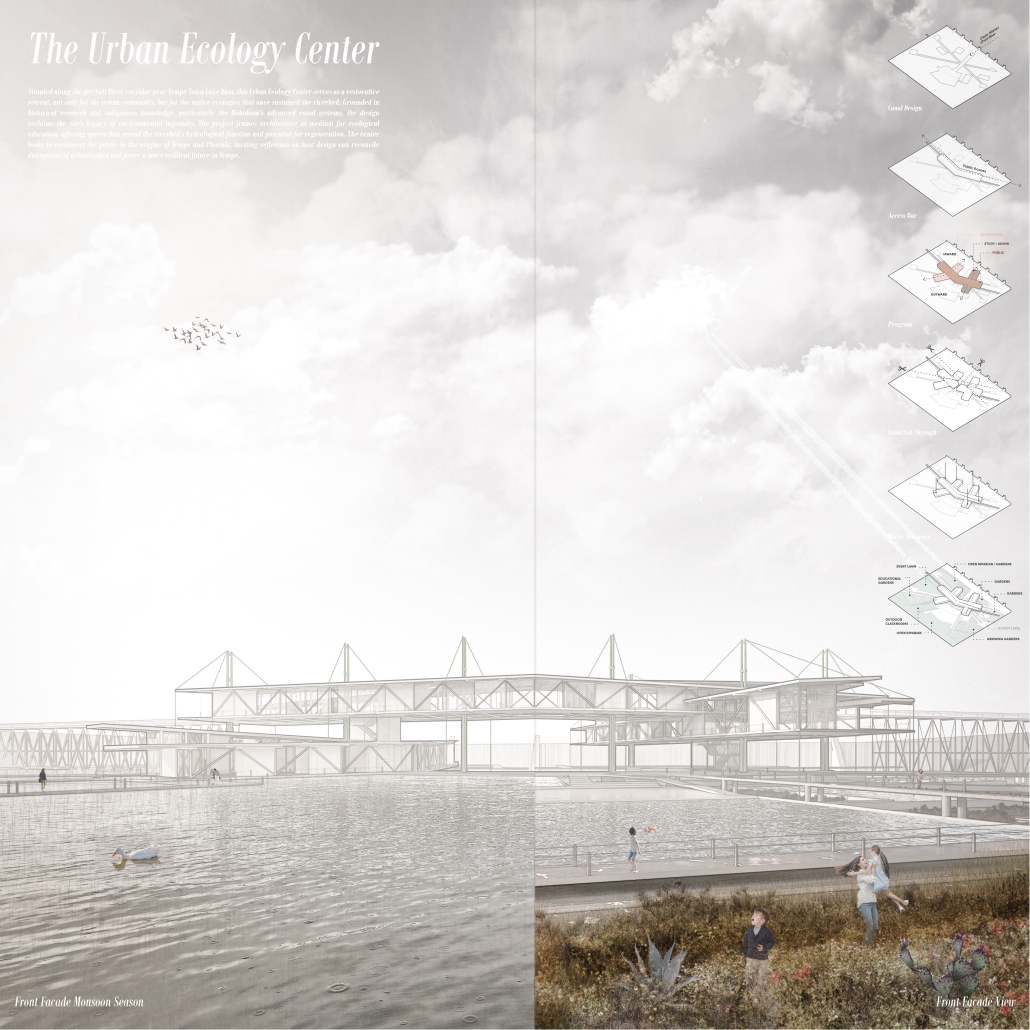
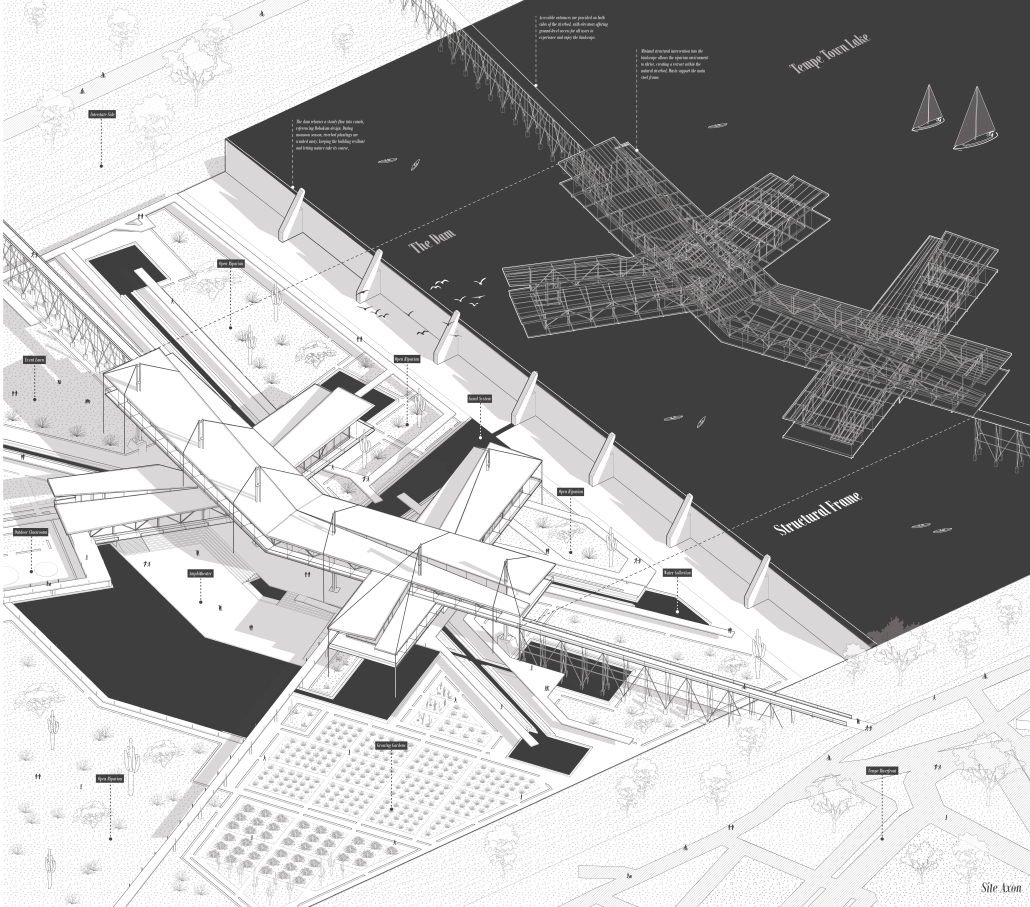
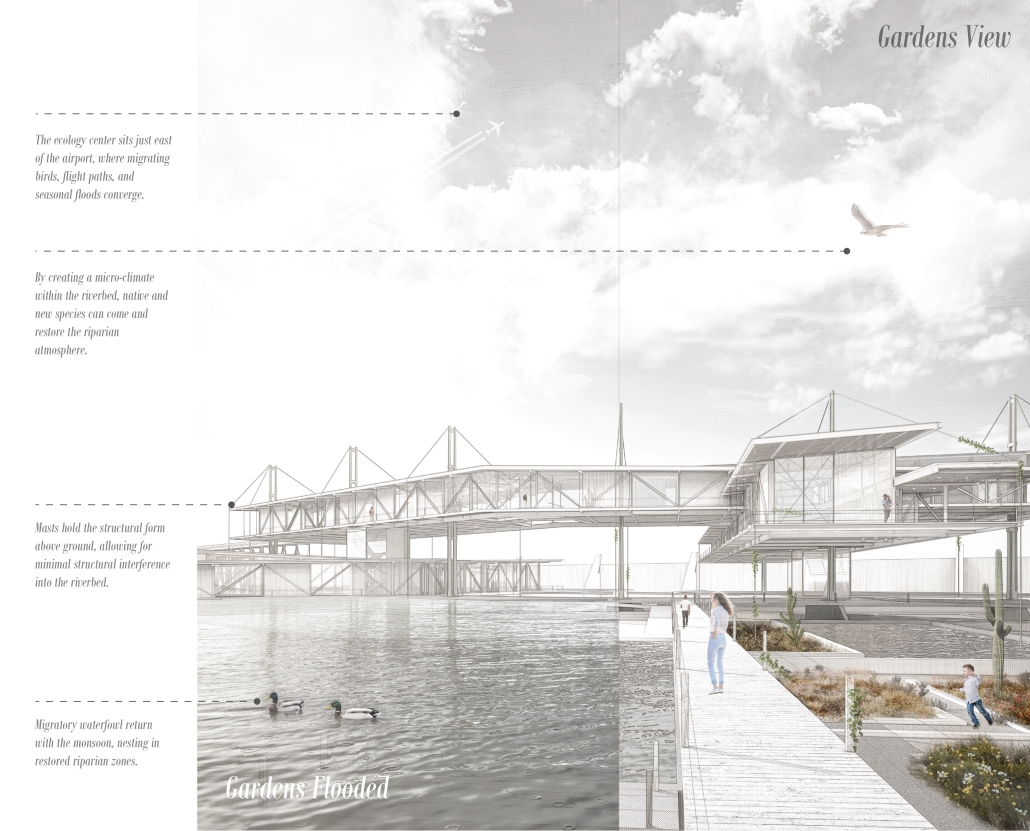
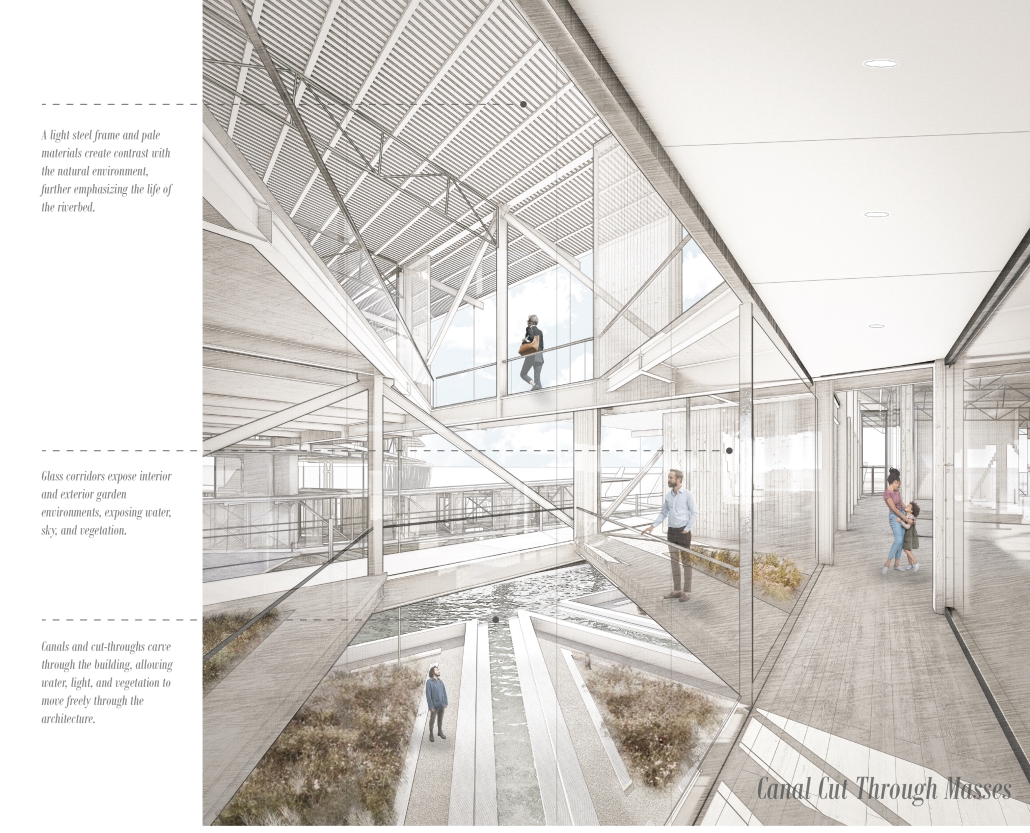
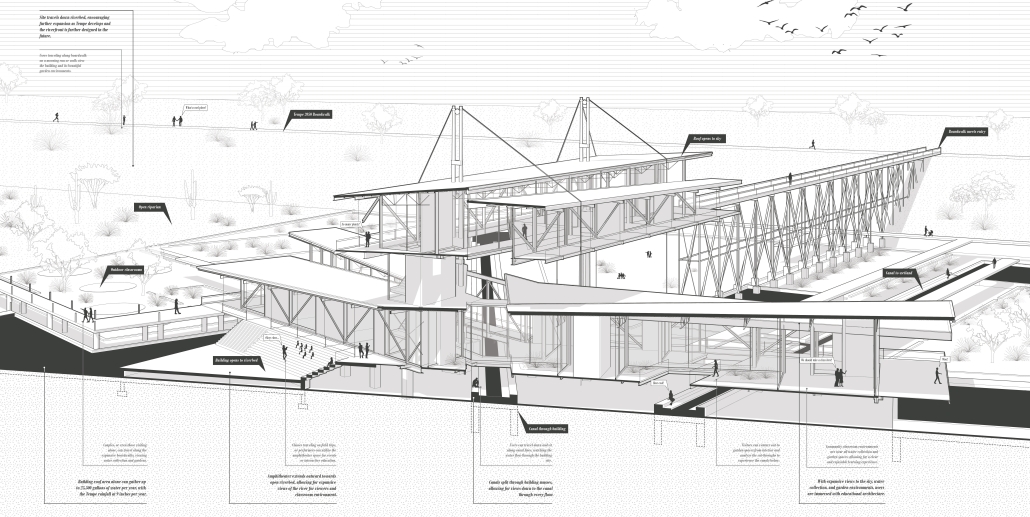
Situated along the dry Salt River corridor near Tempe Town Lake Dam, this Urban Ecology Center serves as a restorative retreat, not only for the urban community, but for the native ecologies that once sustained the riverbed. Grounded in historical research and indigenous knowledge, particularly the Hohokam’s advanced canal systems, the design reclaims the site’s legacy of environmental ingenuity. The project frames architecture as a medium for ecological education, offering spaces that reveal the riverbed’s hydrological function and potential for regeneration. The center looks to reconnect the public to the origins of Tempe and Phoenix, inviting reflection on how design can reconcile disruptions of urbanization and foster a more resilient future in Tempe.

Instagram: @sydneytucker1, @cjs_arch

Eco-corridor by Tinarith Tann, B.Arch ’25
New York Institute of Technology | Advisor: Jeannette Sordi

Far Rockaway, located at the eastern end of the Rockaway Peninsula in Queens, New York, is a coastal community uniquely situated between two bodies of water: Jamaica Bay to the north and the Atlantic Ocean to the south. Despite offering natural beauty, its geographical setting is vulnerable to flooding, especially during extreme weather conditions such as hurricanes, nor’easters, and intense coastal storms.

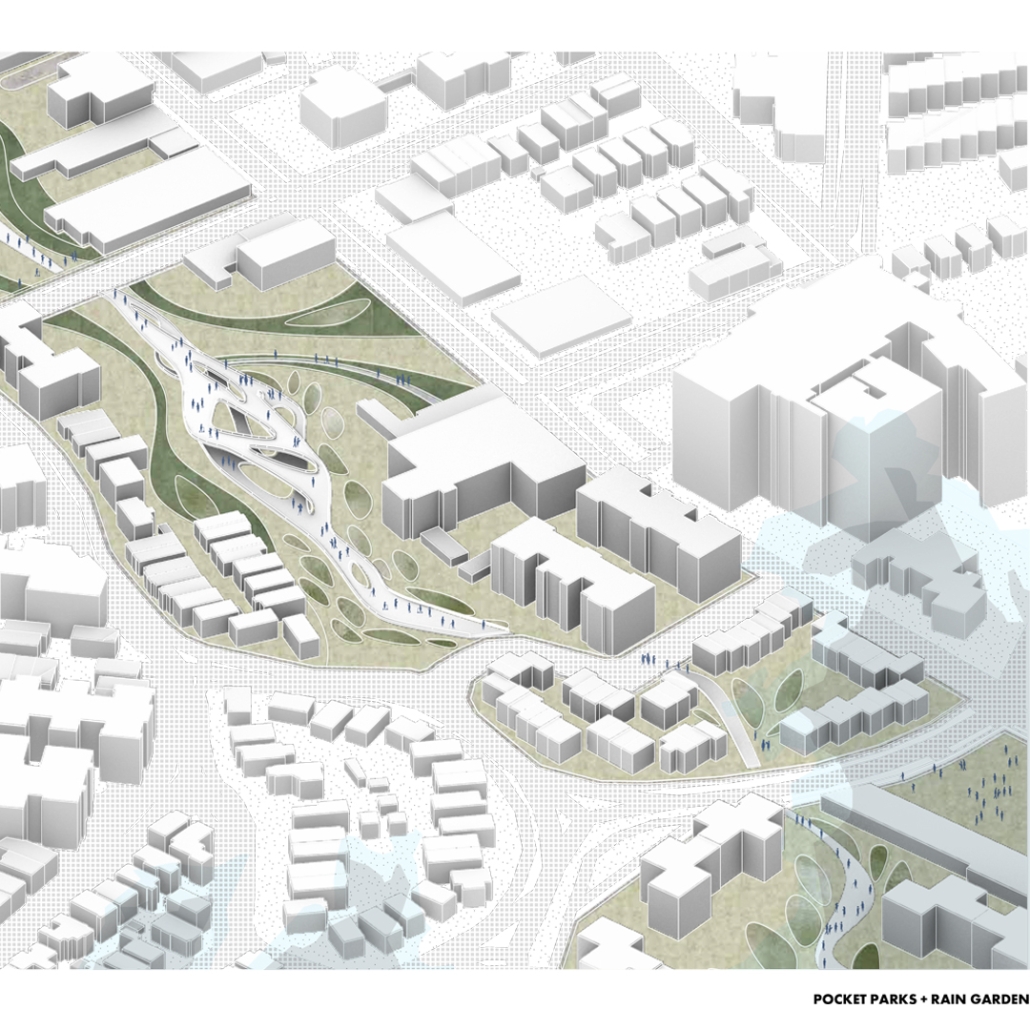
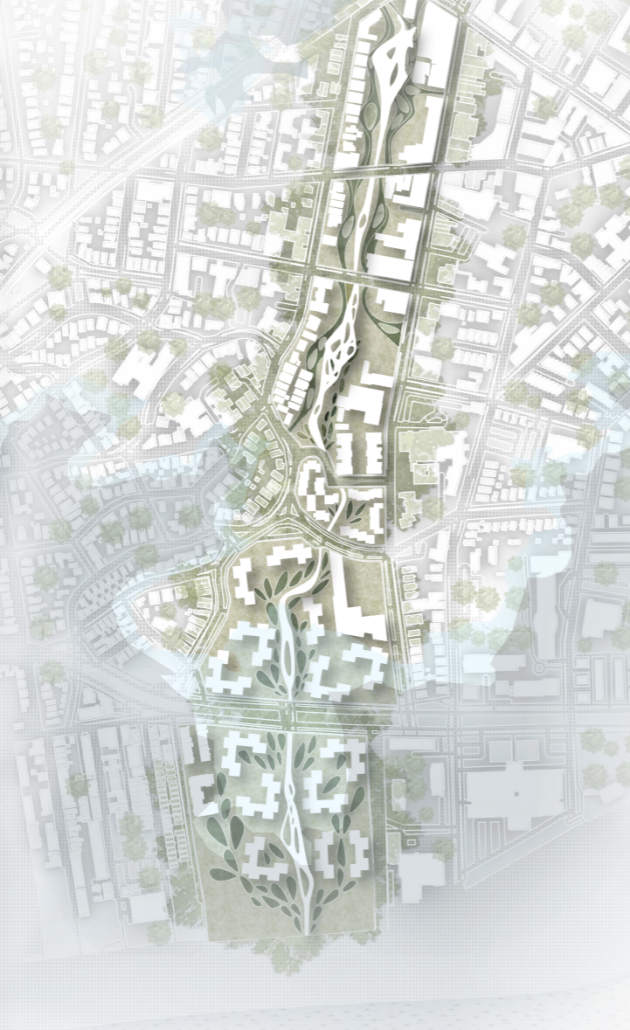
This thesis project designs eco-corridors—living pathways that transform unused urban spaces into a continuous green network stretching from downtown Far Rockaway to the water. These connections will revive neglected areas while addressing multiple challenges at once: managing stormwater and providing people with beautiful, functional natural and indoor spaces.

Click here to learn more.

This project was featured in the NYC Design Week, NYIT Exhibition.

Instagram:  @narith___, @jeannettesordi

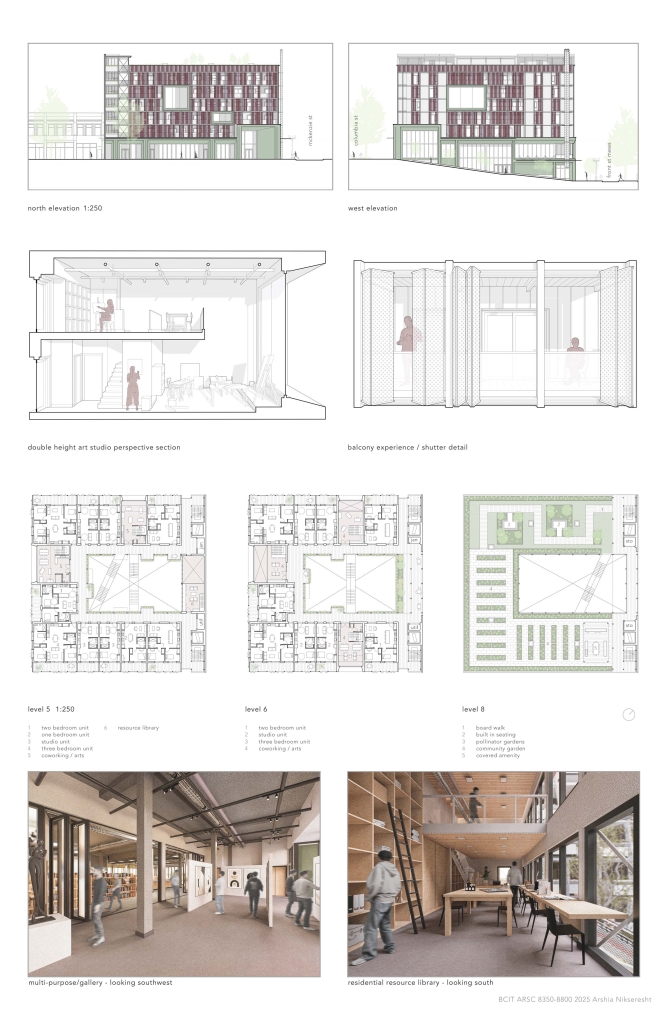
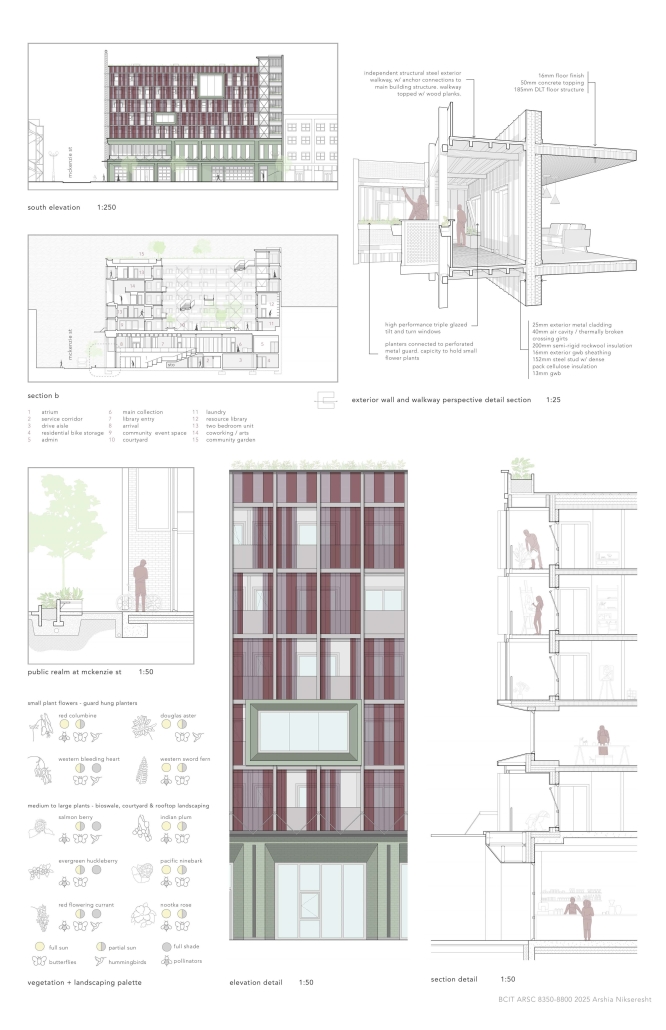
BARN REIMAGINED: Adaptive Reuse as Environmental Stewardship by Kevin Johnson & Leanne Vera, M.Arch ’25
University of Notre Dame | Advisor: Ming Hu

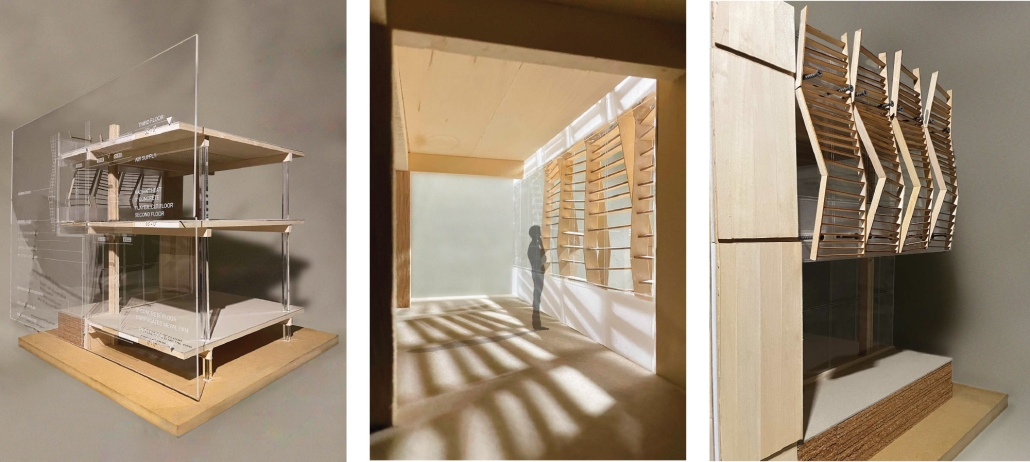
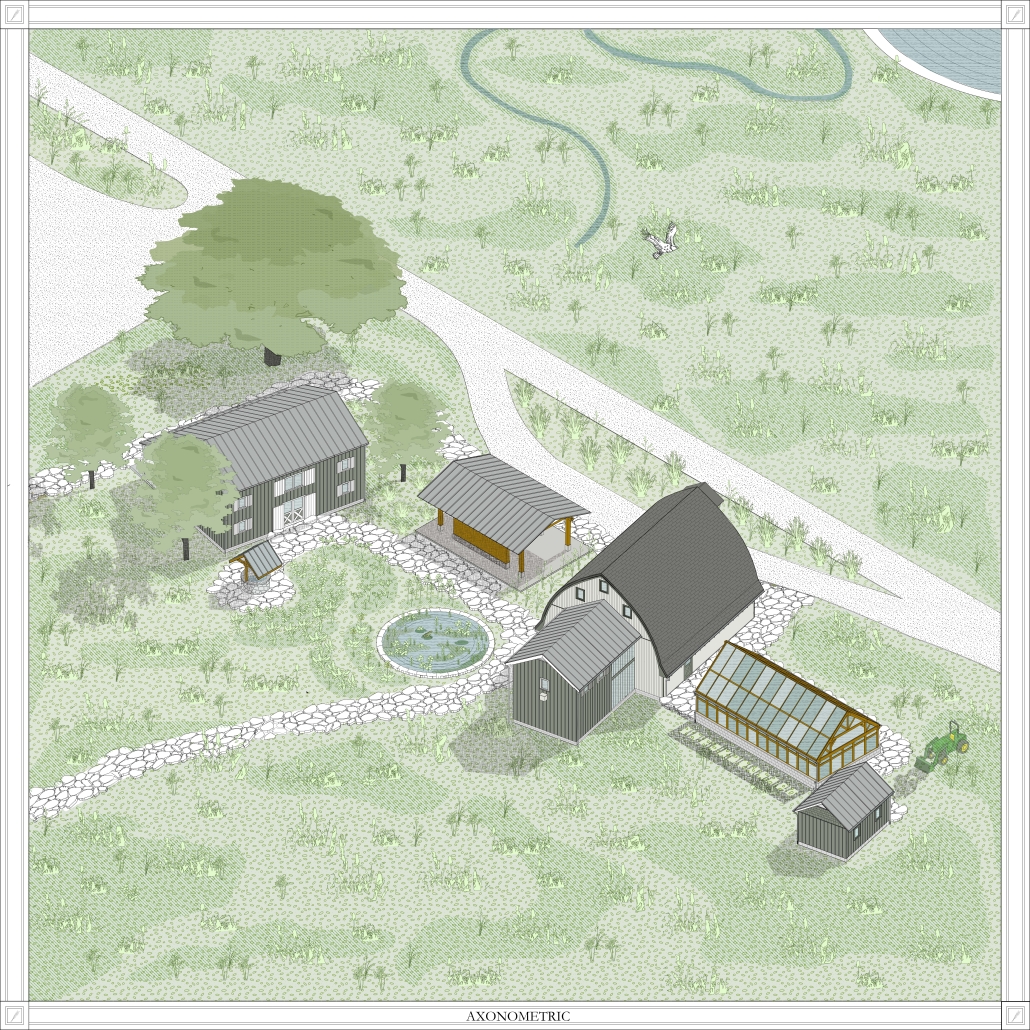
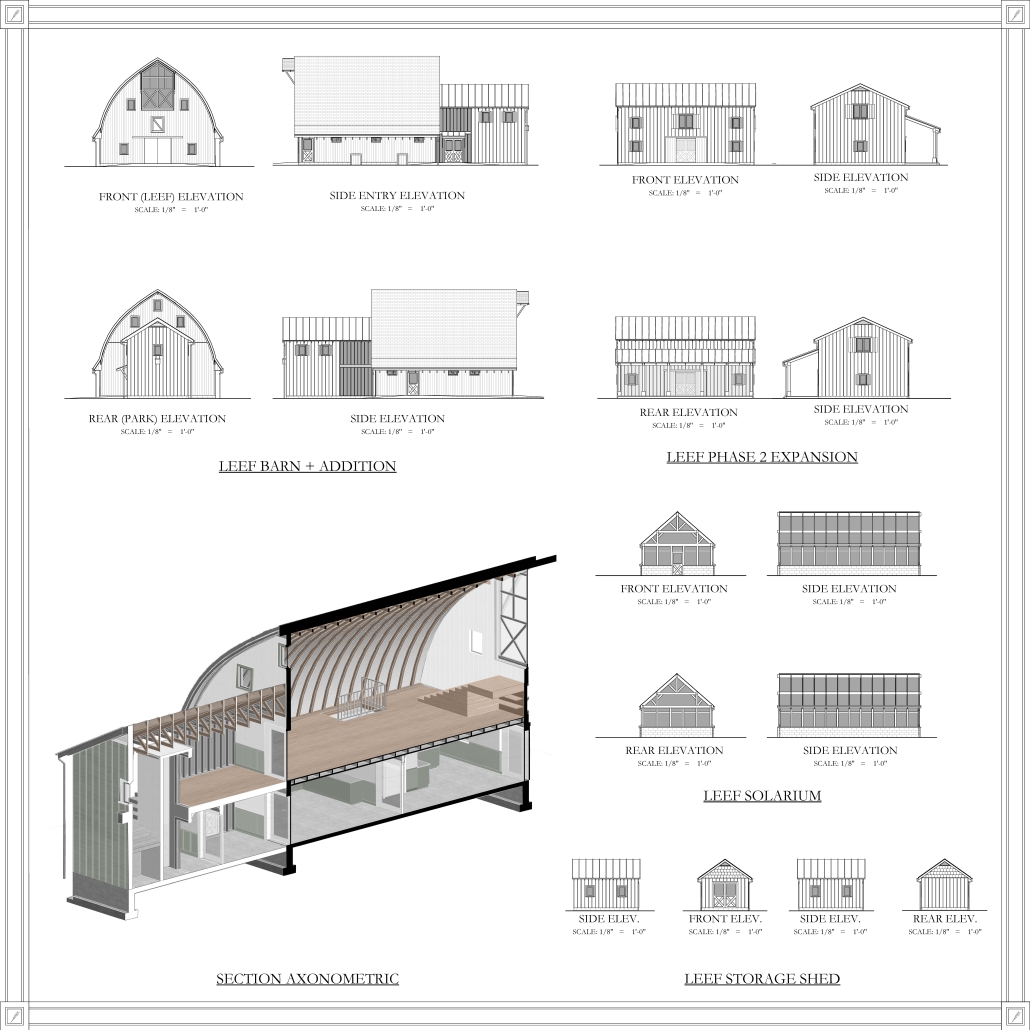
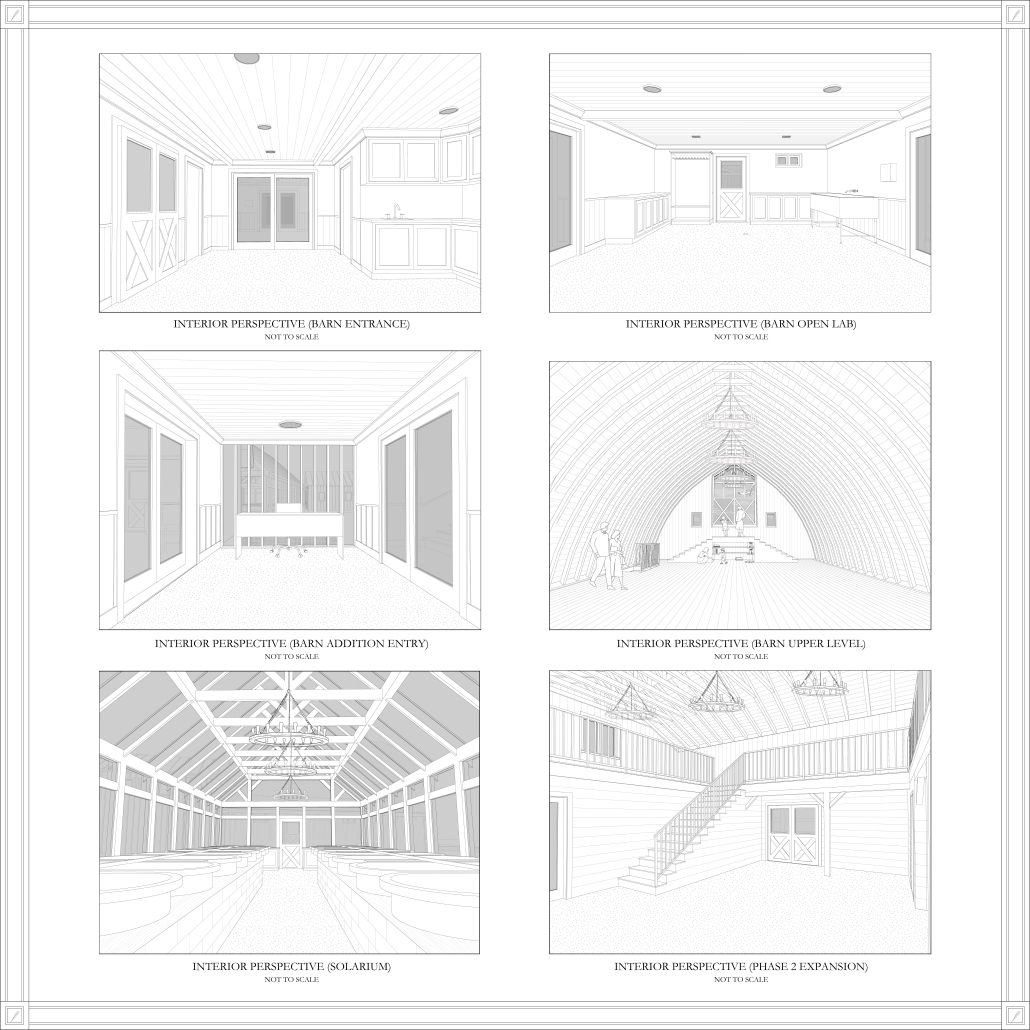
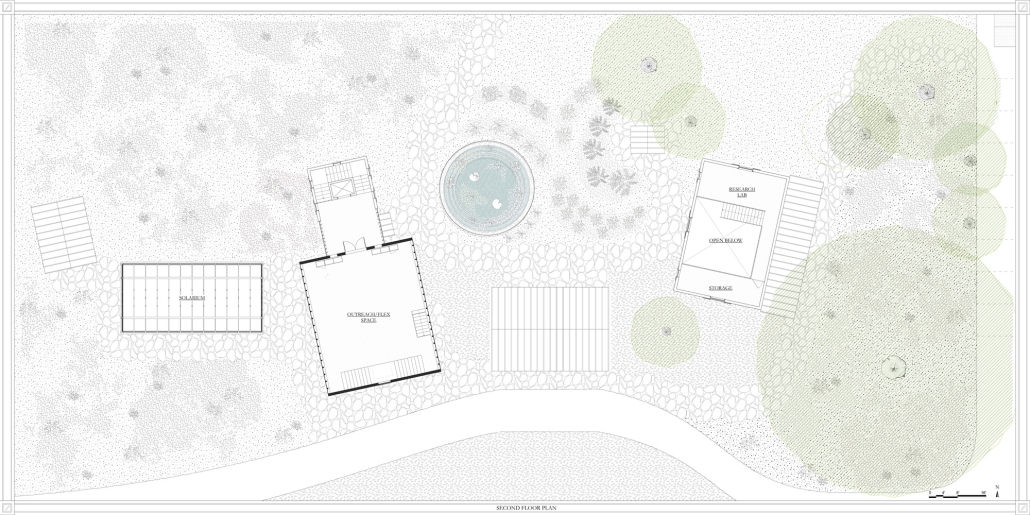
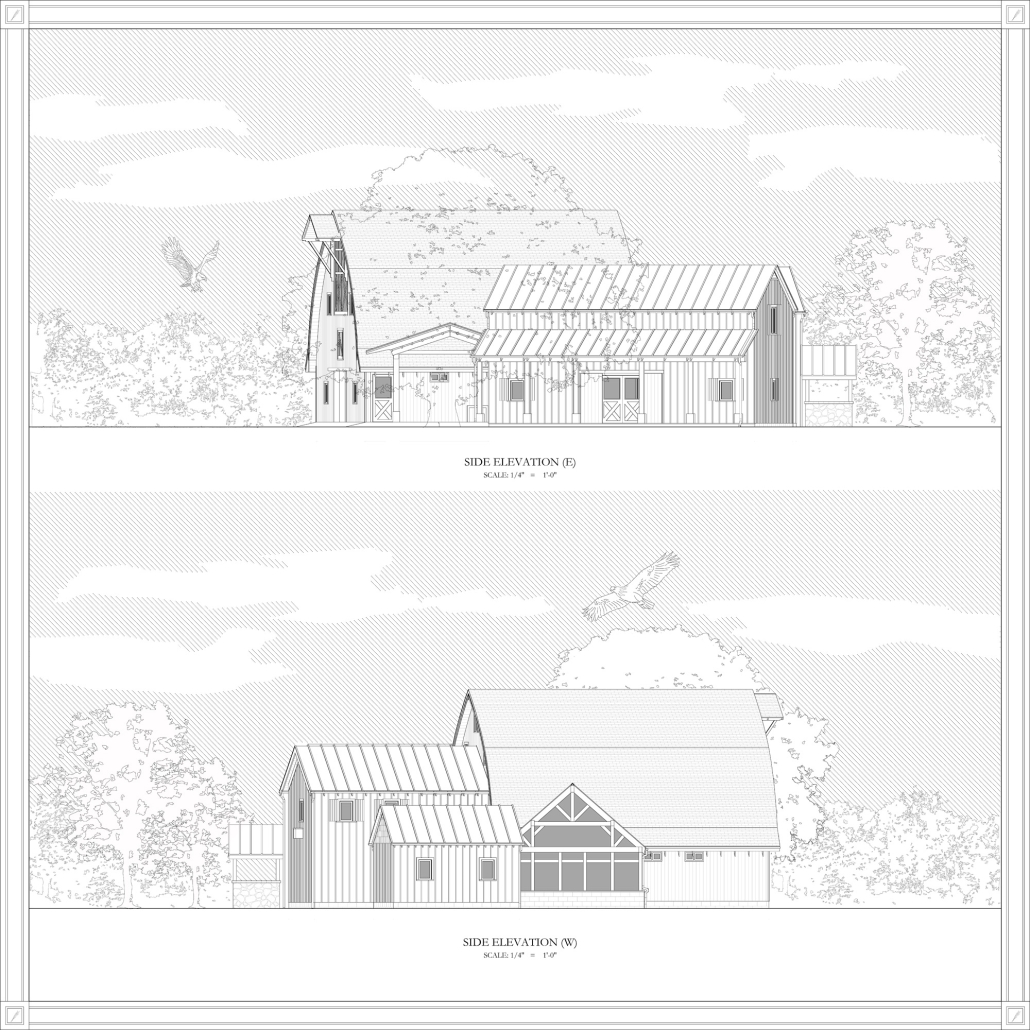
This design aims to propose a barn complex that addresses LEEF’s mission of “Science Serving Society”, creating a functional complex that meets the need for public and private uses, enhances user views towards the Eagle’s Nest, and responds sensitively to the climatic conditions of the site while integrating into the landscape with minimal interventions to appear as if it were always there. At the core of the project, we sought to integrate sustainable design strategies as a link between LEEF’s mission and the architect’s duty to the environment.

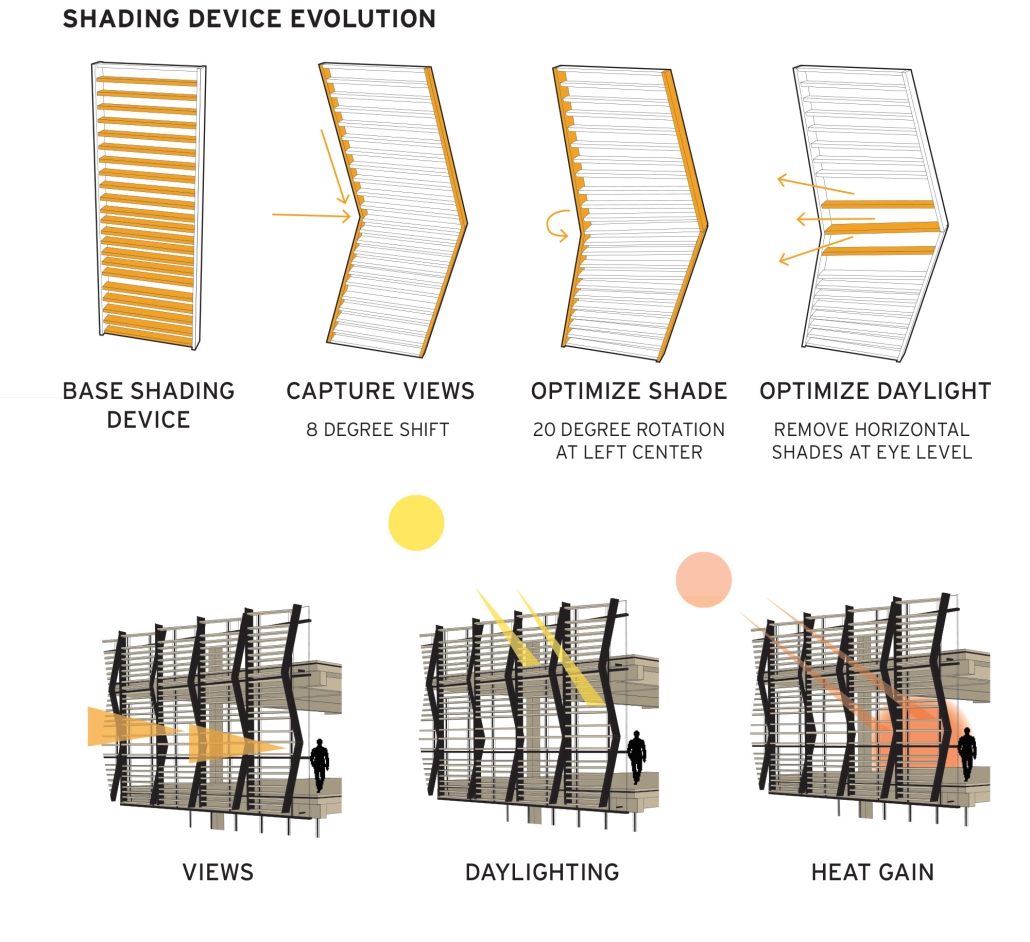
We decided to orient the barn’s front facade, which contains the large triangular window, directly towards the existing Eagle’s Nest, which is a mainstay of the existing LEEF site. This orients the building roughly SE and maximizes the barn’s solar capabilities. The Solarium takes the orientation of the existing pavilion in order to maximize solar gain.

By keeping the building footprints small and separating the massings, we were able to reduce excessive heating, cooling and energy expenses. We also emphasized the importance of the natural prairie habitat as the predominant landscape and tried to minimize additional landscaping. Additionally, we propose utilizing local materials and adding a rainwater collection system for reuse in the LEEF facilities.

Our project embodies a holistic approach to adaptive reuse by thoughtfully preserving the historic Gothic arch barn and integrating it within a sustainably designed complex that supports LEEF’s mission of “Science Serving Society.” By achieving net-zero energy usage, implementing rainwater harvesting, restoring prairie ecosystems, and utilizing locally sourced materials, our proposal not only preserves the historic barn but also sets a precedent for future environmentally conscious adaptive reuse projects. 

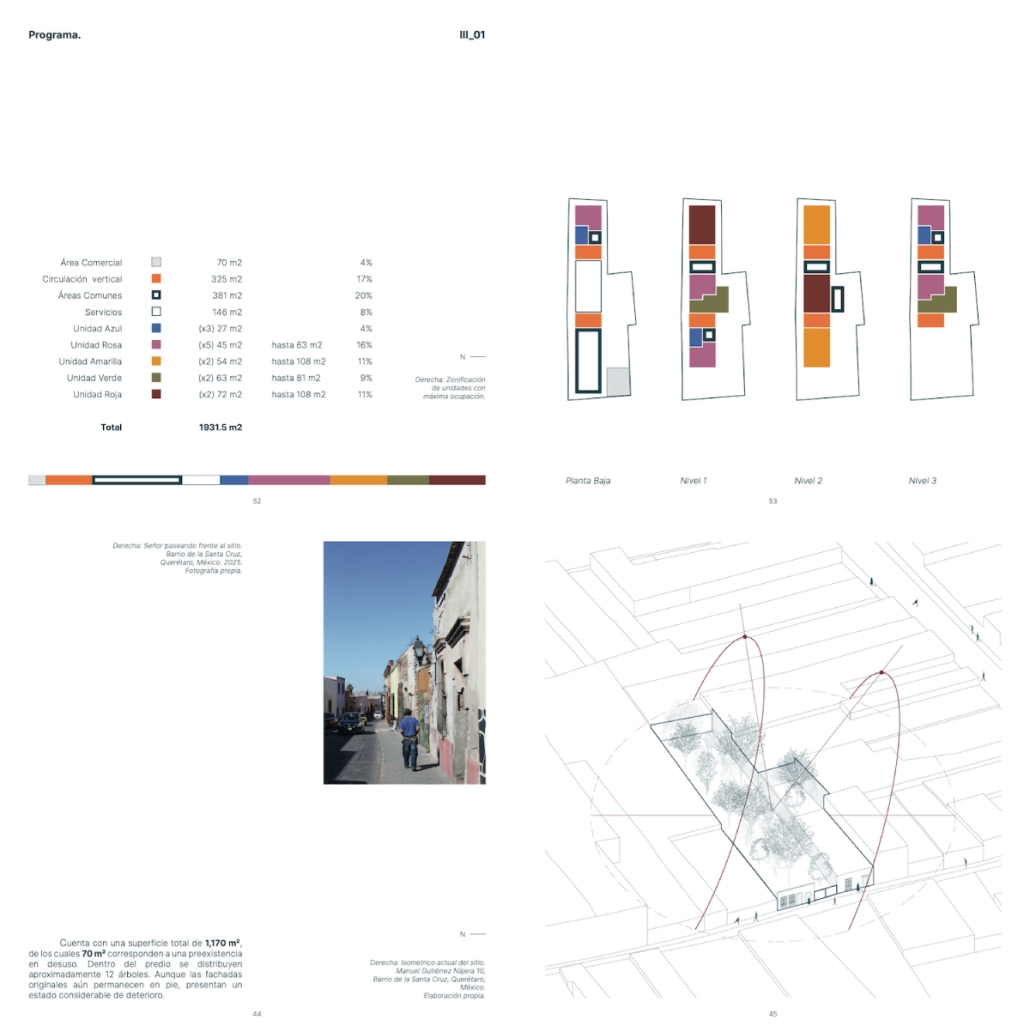
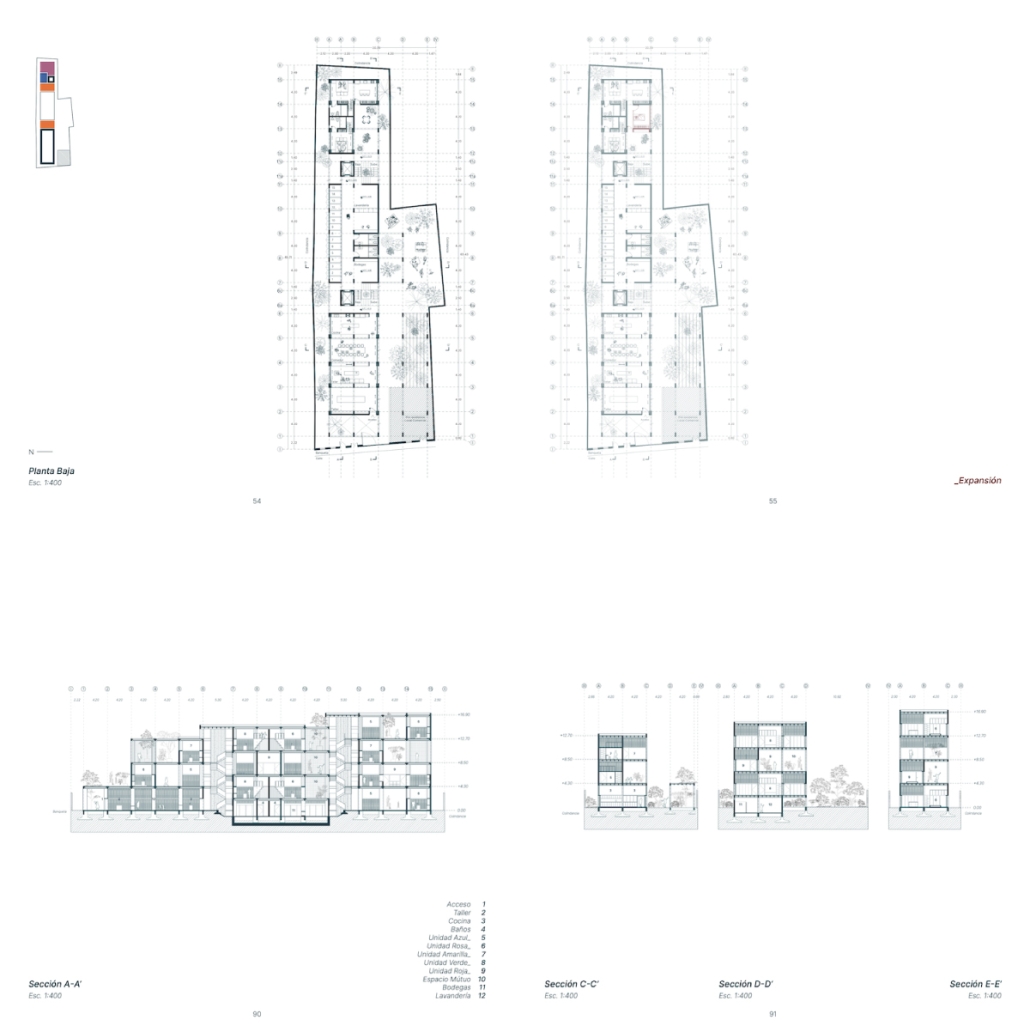
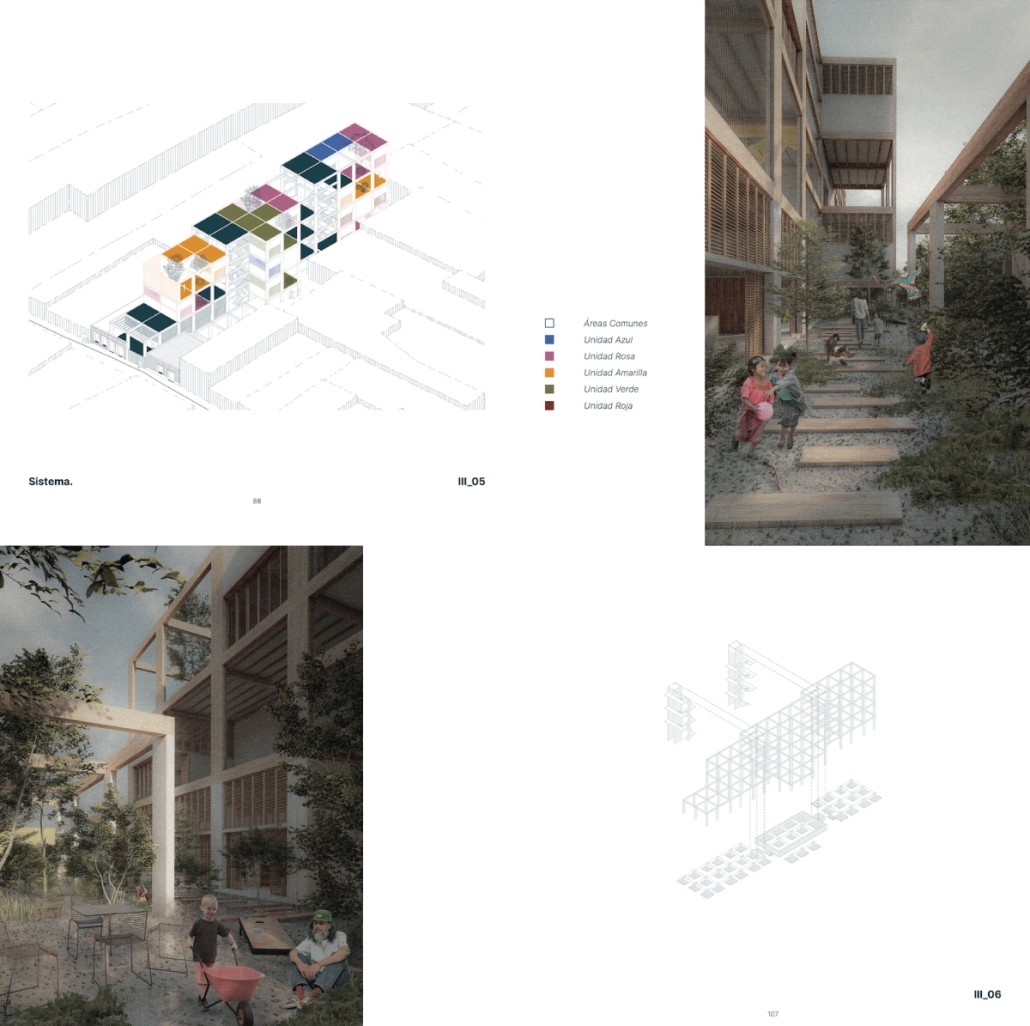
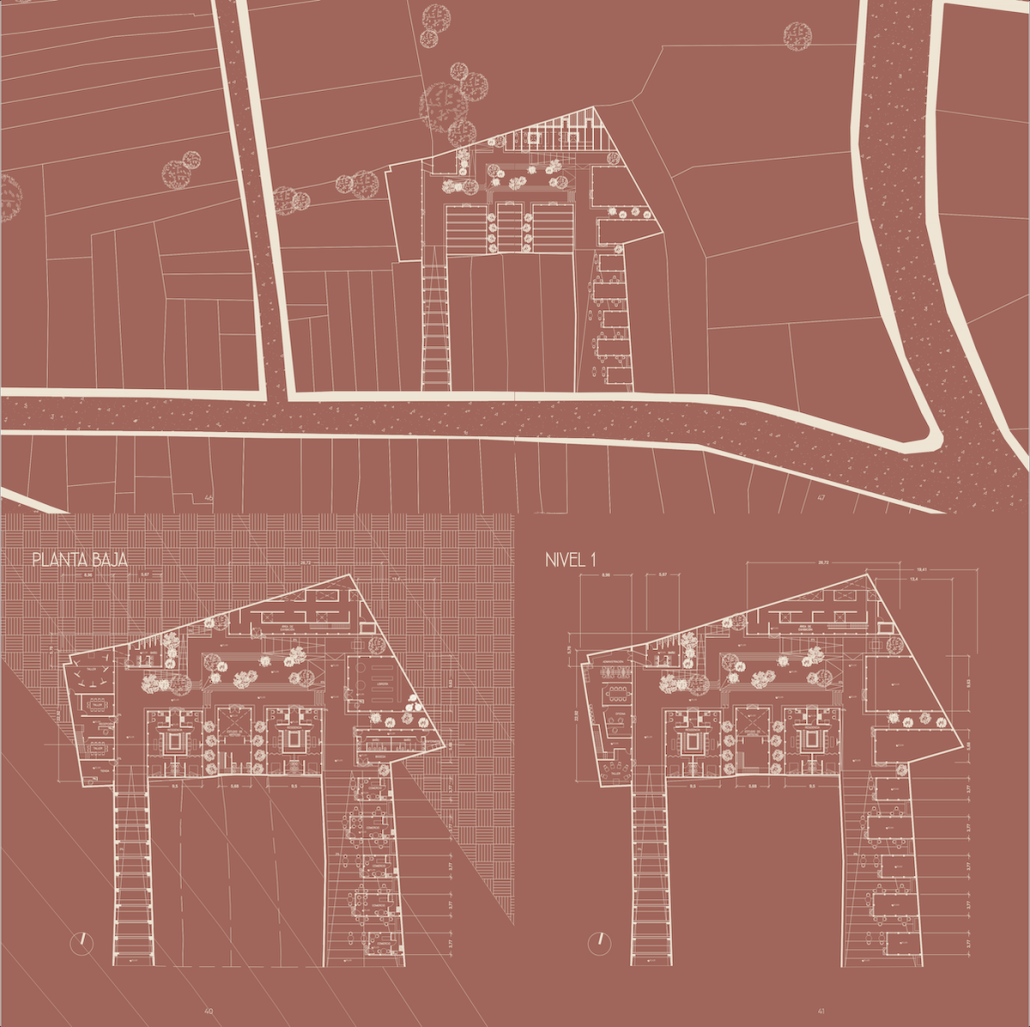
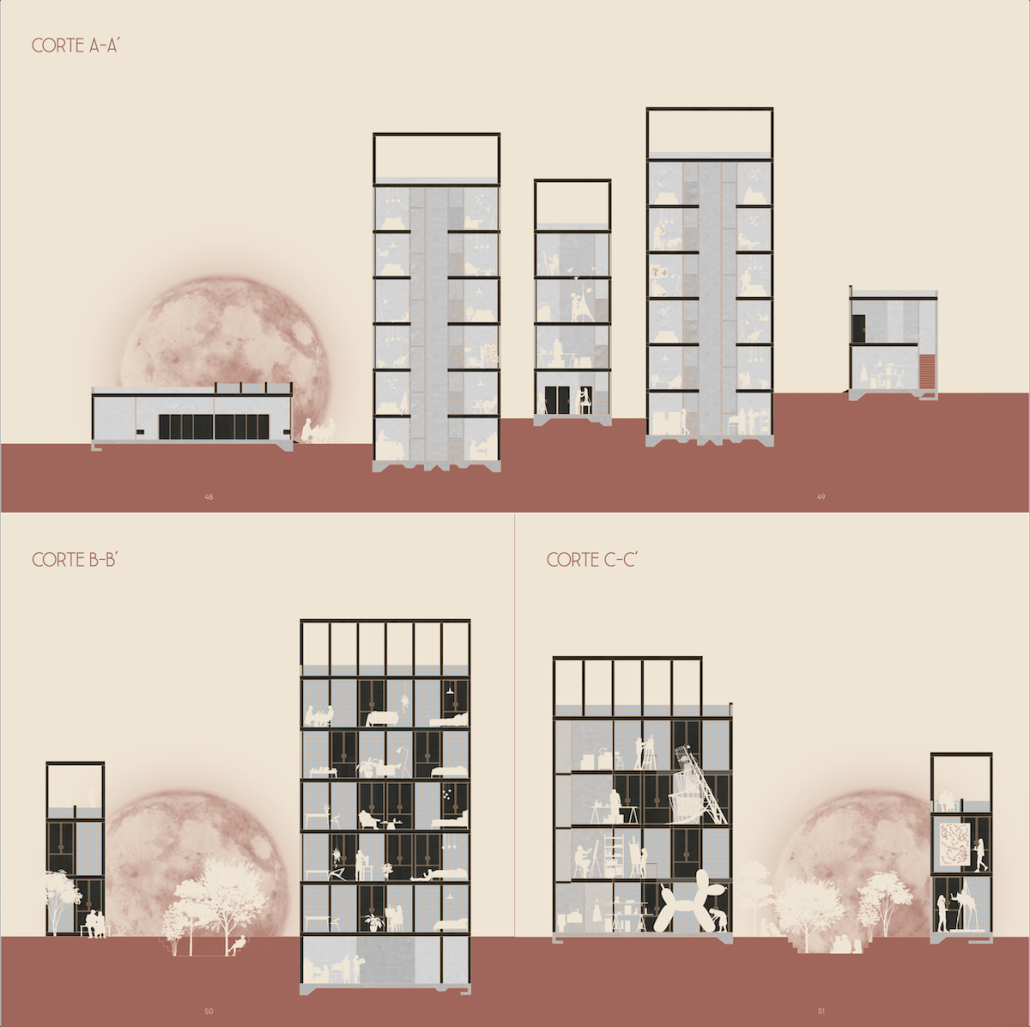
La Factoría del Pueblo, Artist’s temporary internship by Estefania Vizcaya, B.Arch ’25
Universidad Anáhuac Querétaro | Advisors: Guillermo Márquez, Patricia Cutiño & Jorge Javier

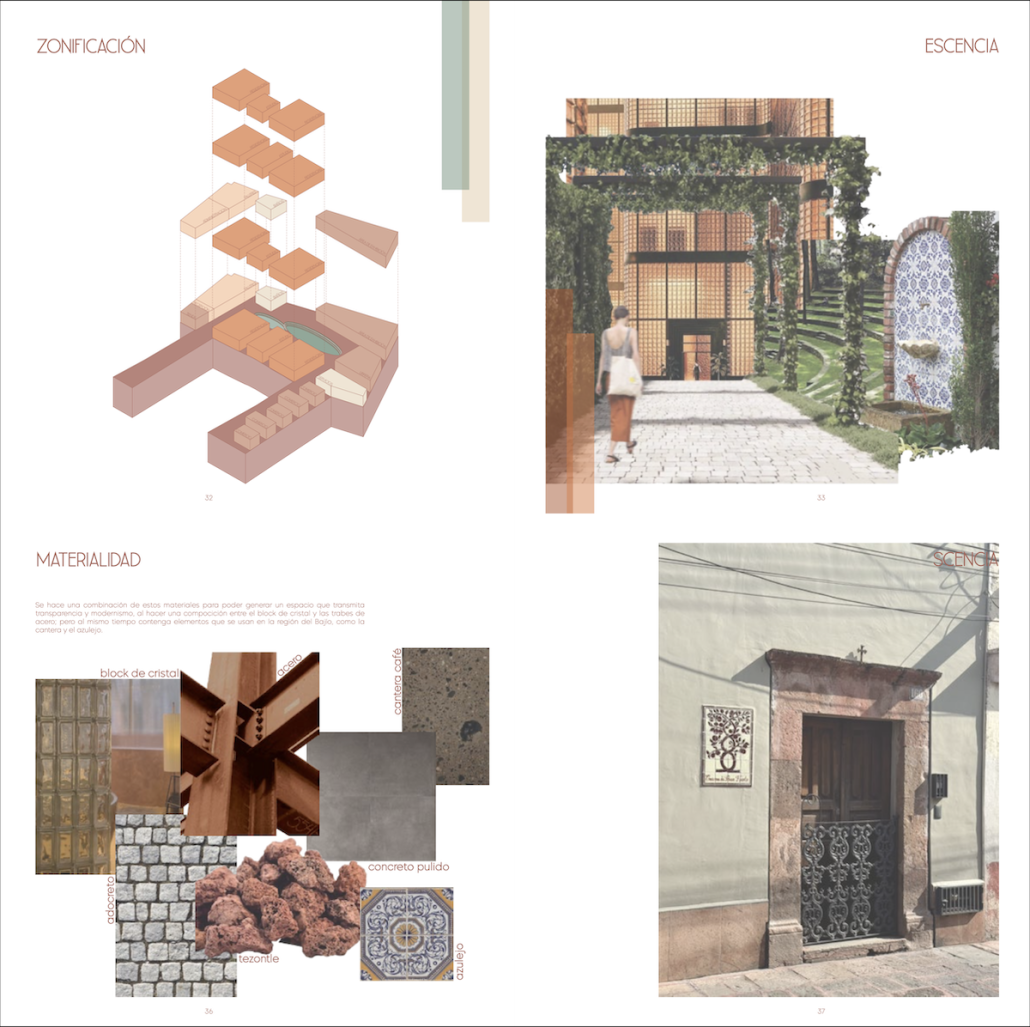
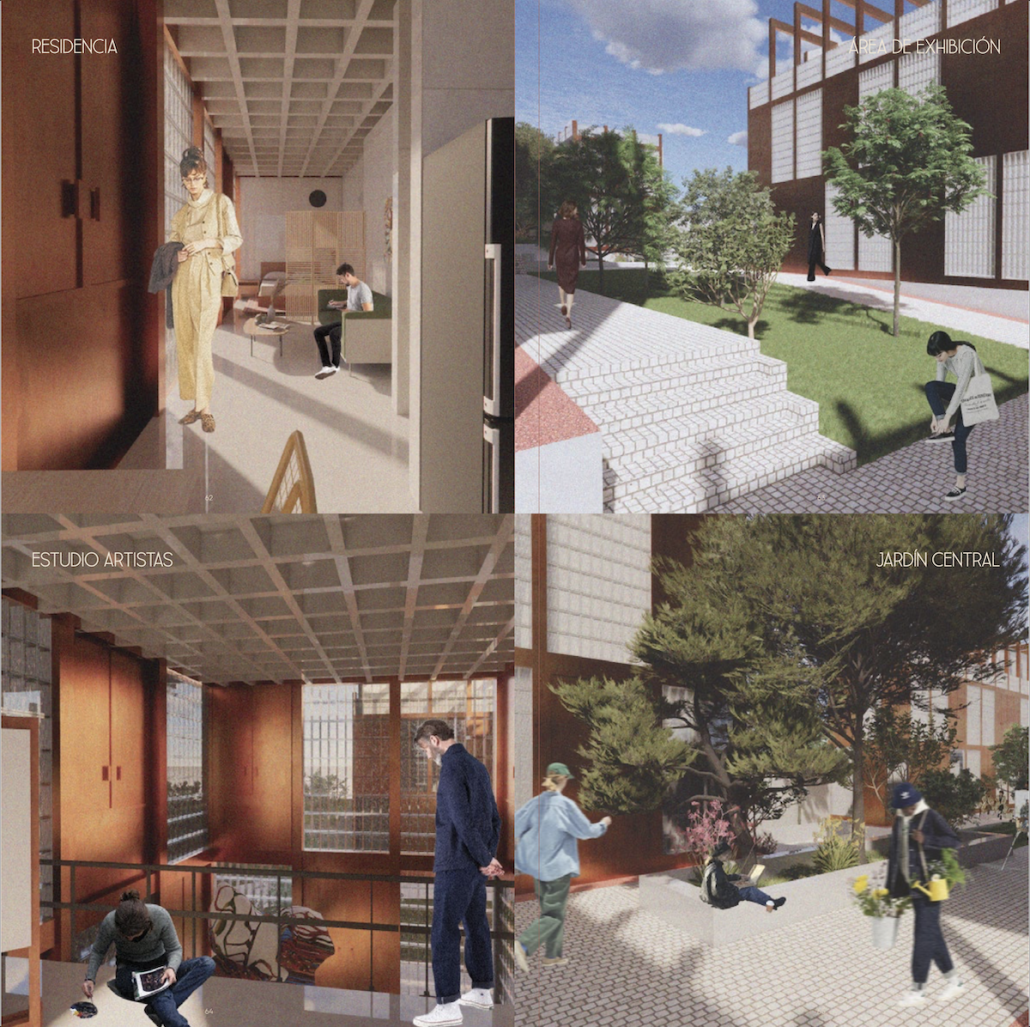
The project “La Factoría del Pueblo” is about La Santa Cruz, and [was] created to provide temporary housing for artists seeking support to grow in the creative sector of the visual arts (painting and sculpture), in addition to creating a community among people who are interested in this subject and want to learn and soak up this art.

The design is sectioned to create different buildings and between them, small niches that help creativity and environment, all of them are united by a central square that has different ways of use, all with the purpose of uniting people who live there or visit the space to create a community. 

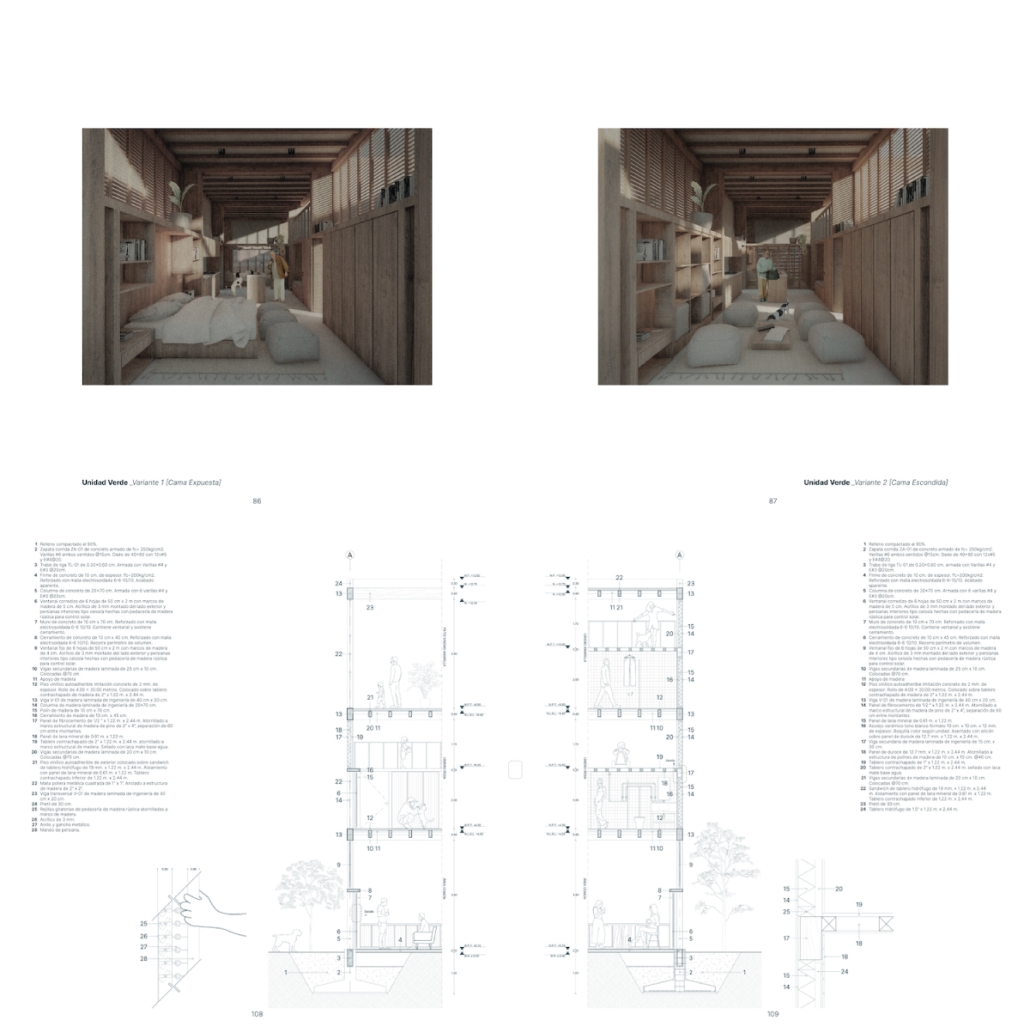
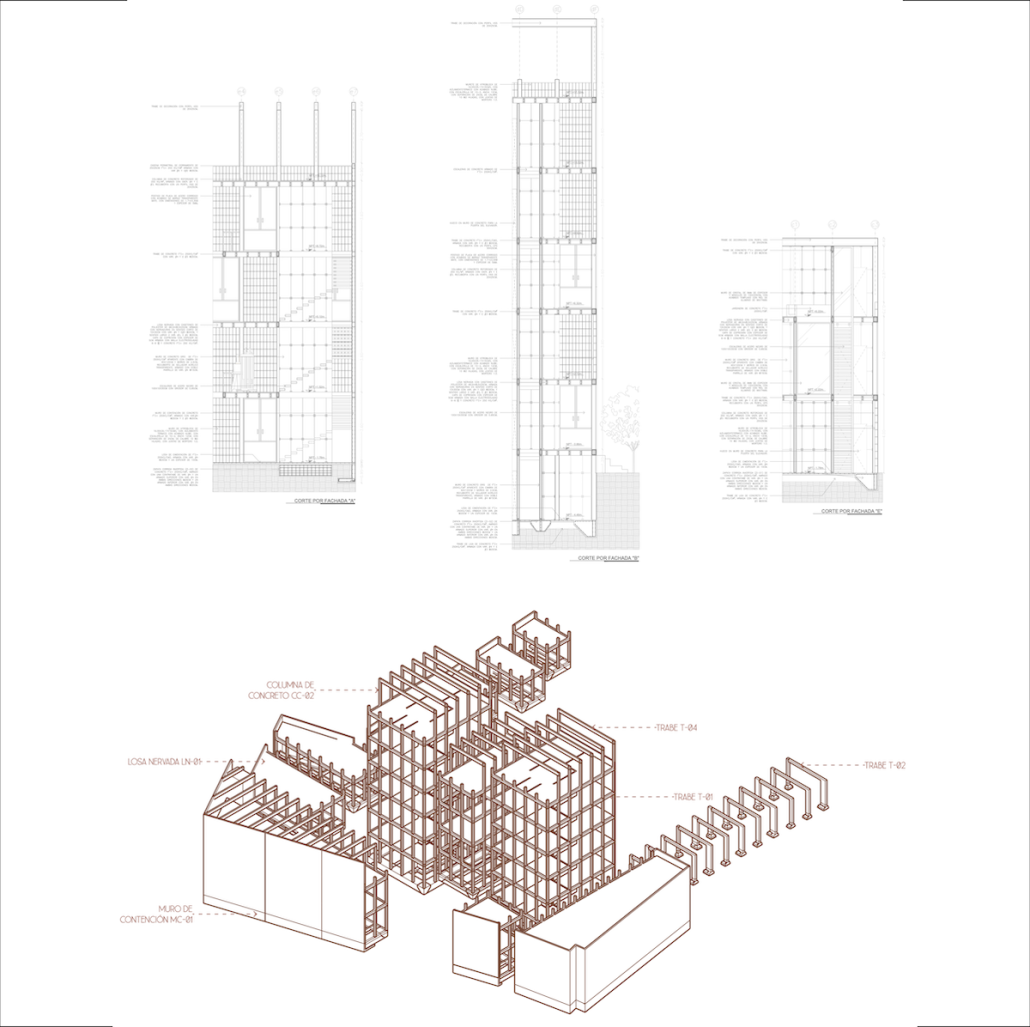
The materiality was chosen to minimize maintenance requirements for the space, as it is social. Therefore, we also created modules with frosted glass brick featuring thermal insulation to provide privacy and comfort to the space. We also have the steel rusted so that the spaces have more color; on the other hand, the materiality of slabs and walls is of apparent concrete. But also with the exteriors, the circulation is of paving stone, which is used locally for the different spaces.

Finally, the construction system is very important; the concrete was fused with steel, which led to having columns of HSS beams that are poured with concrete and perimeter beams covered with CPS profiles. In this way, it is possible to make a union with the apparent ribbed slab that has a support for the concrete retaining wall.

Instagram: @fannyvizcaya, @arquitectura_anahuac, @arqwave

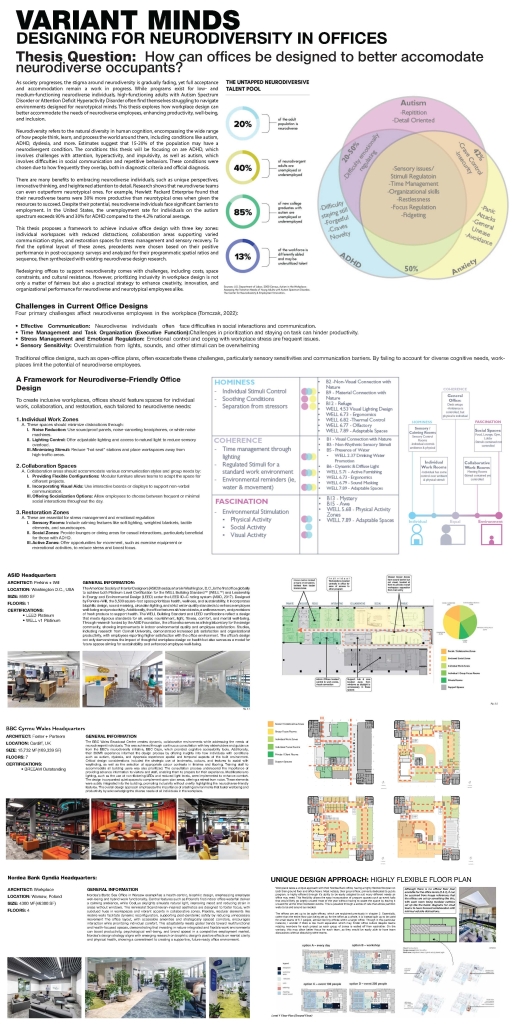
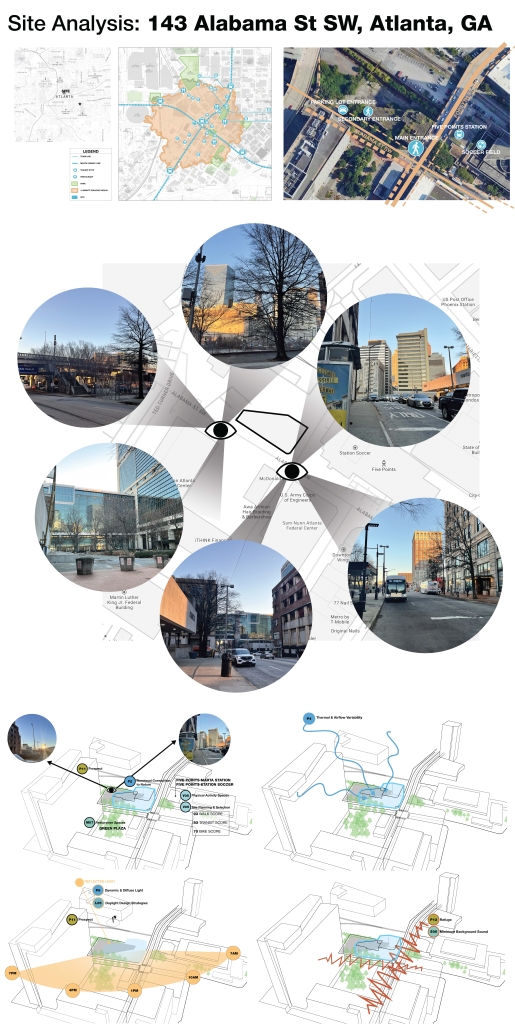
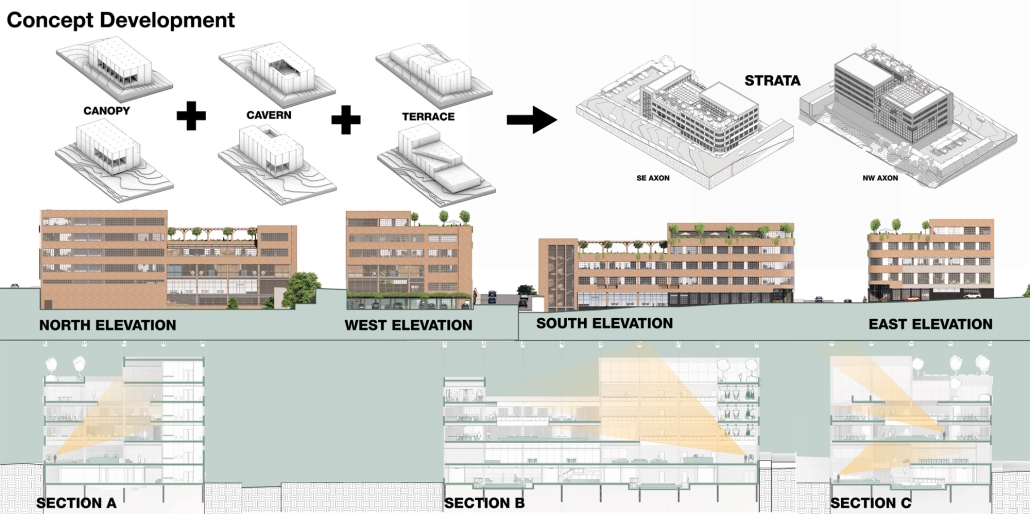
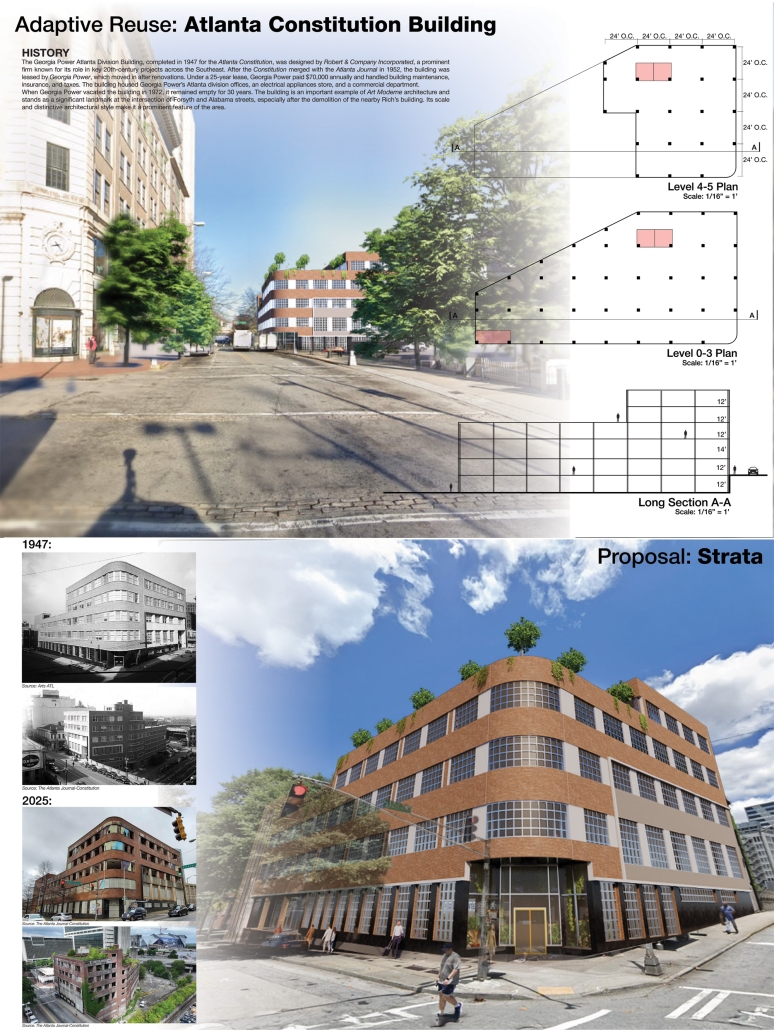
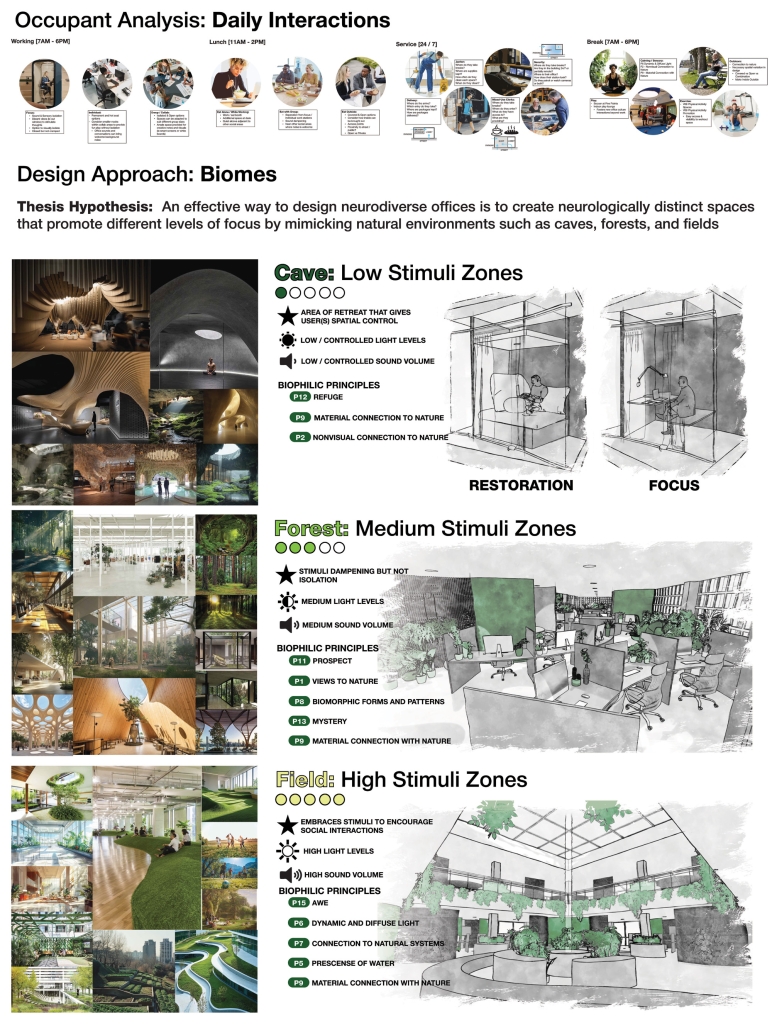
VARIANT MINDS: DESIGNING FOR NEURODIVERSITY IN OFFICES by Maya Schiltz, B.Arch ’25
Kennesaw State University | Advisor: Robin Puttock

As society progresses, the stigma around neurodiversity is gradually fading, yet full acceptance and accommodation remain a work in progress. While programs exist for low- and medium-functioning neurodiverse individuals, high-functioning adults with Autism Spectrum Disorder or Attention Deficit Hyperactivity Disorder often find themselves struggling to navigate environments designed for neurotypical minds. This thesis explores how workplace design can better accommodate the needs of neurodiverse employees, enhancing productivity, well-being, and inclusion.

Neurodiversity refers to the natural diversity in human cognition, encompassing the wide range of how people think, learn, and process the world around them, including conditions like autism, ADHD, dyslexia, and more. Estimates suggest that 15-20% of the population may have a neurodivergent condition. The conditions this thesis will be focusing on are ADHD, which involves challenges with attention, hyperactivity, and impulsivity, as well as autism, which involves difficulties in social communication and repetitive behaviors. These conditions were chosen due to how frequently they overlap, both in diagnostic criteria and social diagnosis. There are many benefits to embracing neurodiverse individuals, such as unique perspectives, innovative thinking, and heightened attention to detail. Research shows that neurodiverse teams can even outperform neurotypical ones. For example, Hewlett Packard Enterprise found that

their neurodiverse teams were 30% more productive than neurotypical ones when given the resources to succeed. Despite their potential, neurodiverse individuals face significant barriers to employment. In the United States, the unemployment rate for individuals on the autism spectrum exceeds 90% and 30% for ADHD, compared to the 4.2% national average.

This thesis proposes a framework to achieve inclusive office design with three key zones: individual workspaces with reduced distractions, collaboration areas supporting varied communication styles, and restoration spaces for stress management and sensory recovery. To find the optimal layout of these zones, precedents were chosen based on their positive performance in post-occupancy surveys and analyzed for their programmatic spatial ratios and sequence, then synthesized with existing neurodiverse design research. Redesigning oces to support neurodiversity comes with challenges, including costs, space constraints, and cultural resistance. However, prioritizing inclusivity in workplace design is not only a matter of fairness but also a practical strategy to enhance creativity, innovation, and organizational performance for neurodiverse and neurotypical employees alike.

This project was recognized as a Thesis Finalist (Top 5 of 90+).

Click here to learn more.

Instagram: @mayaschiltz, @robinzputtock

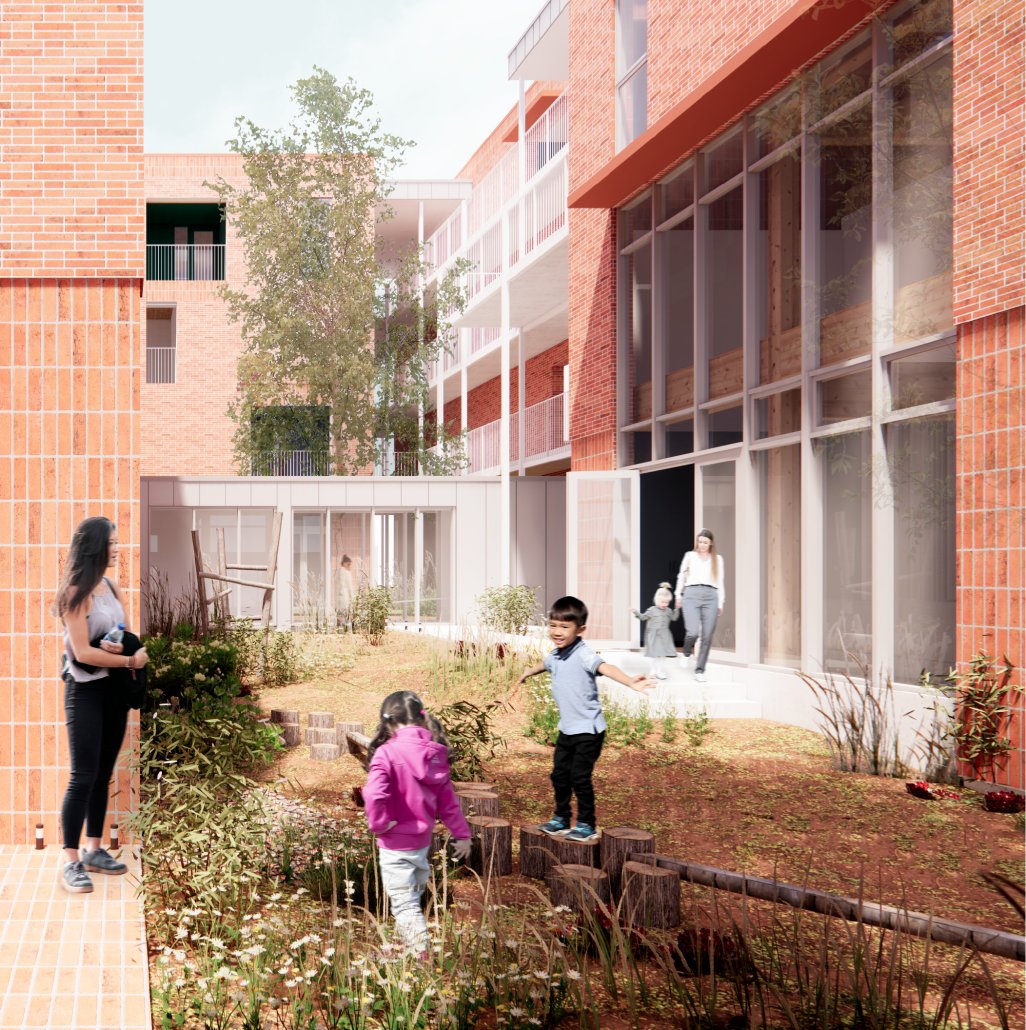
Urban Poverty: The Villas in Argentina by Lizbeth M. Padilla-González, B.Arch ’25
Pontifical Catholica University of Puerto Rico | Advisors: Jesús O. García-Beauchamp & Pedro A. Rosario-Torres

Urban poverty has emerged as a complex challenge affecting millions globally, profoundly impacting residents of informal settlements and marginalized neighborhoods. This multifaceted issue extends beyond economic deprivation to encompass inadequate access to essential services, substandard housing, food insecurity, limited educational opportunities, and systemic social exclusion. These challenges are intrinsically linked to economic inequality, spatial segregation, and evolving urban structures.

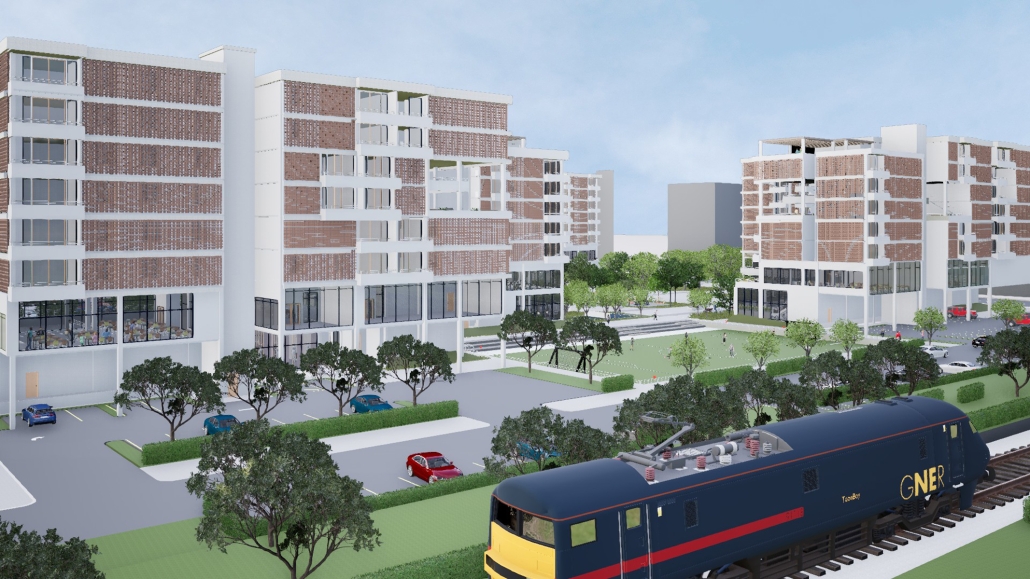
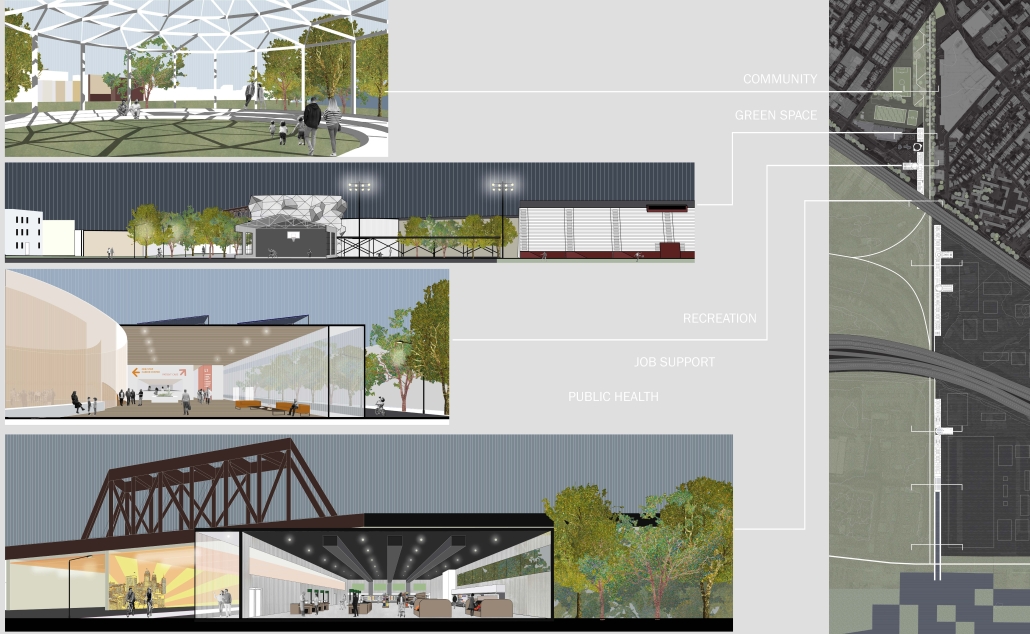
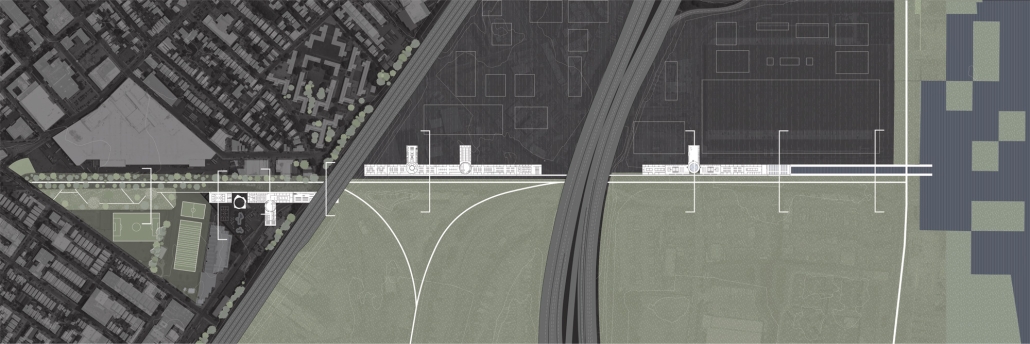
This architectural proposal addresses these challenges within Villa 21-24 (Villa Zavaleta) in Argentina through a comprehensive urban master plan that reimagines the existing urban fabric. Drawing inspiration from the consolidated city’s formal grid system, the design introduces strategic reorganization that enhances spatial articulation, improves connectivity, and establishes a foundation for transformative architectural interventions.

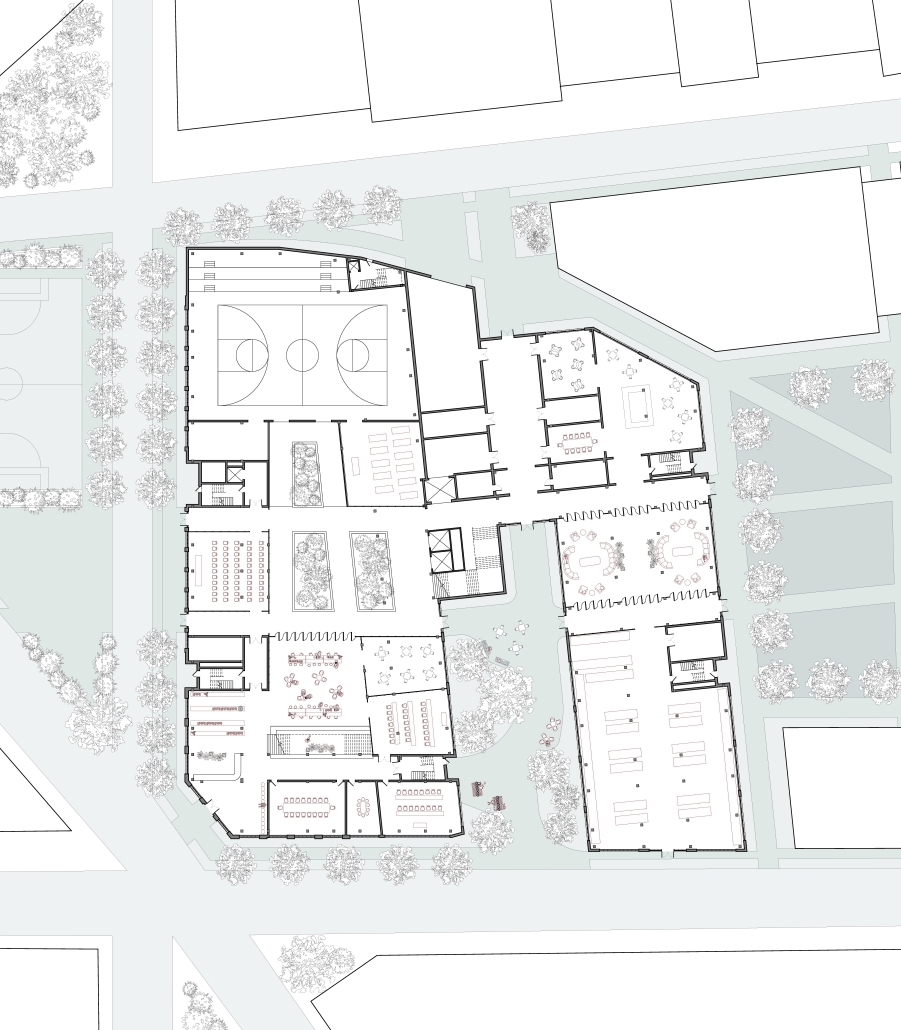
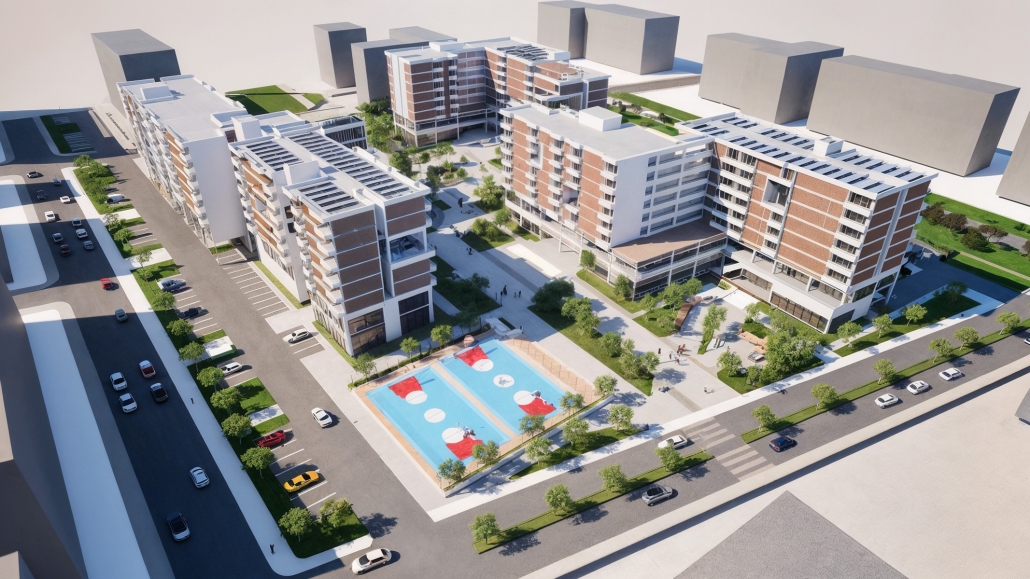
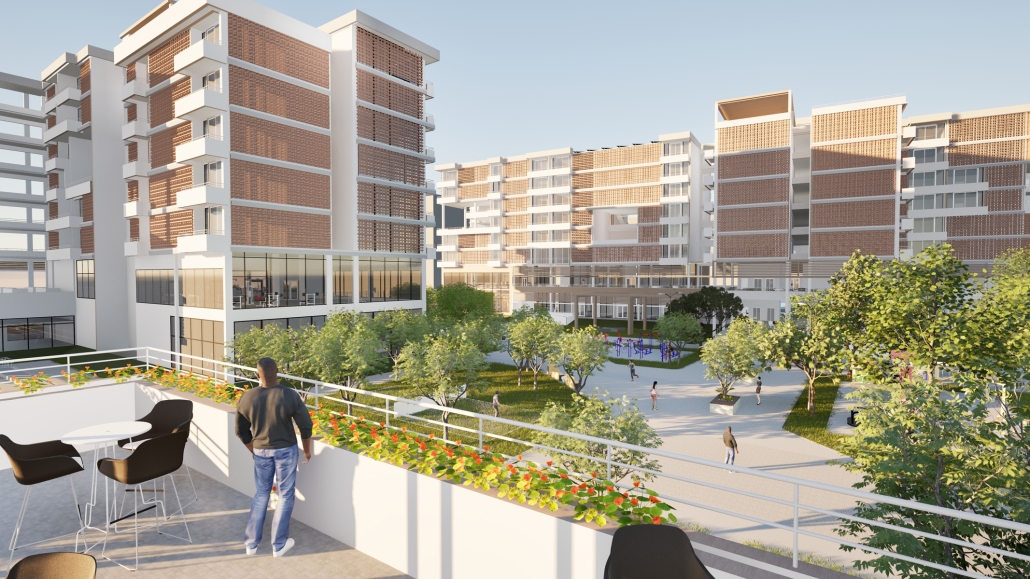
The project’s cornerstone is a major linear park traversing the settlement from north to south, serving as both an organizing spine and vital public space for community cohesion. Three strategically positioned mixed-use buildings line this central corridor, creating a dynamic interface between public and private realms. The ground and second levels house essential community programs, including dining facilities, technology education centers, libraries, vocational workshops, gymnasiums, children’s recreation areas, and flexible rental spaces for local entrepreneurs. These elements were selected through comprehensive community needs assessments to strengthen social networks, enhance quality of life, and foster comprehensive development pathways.

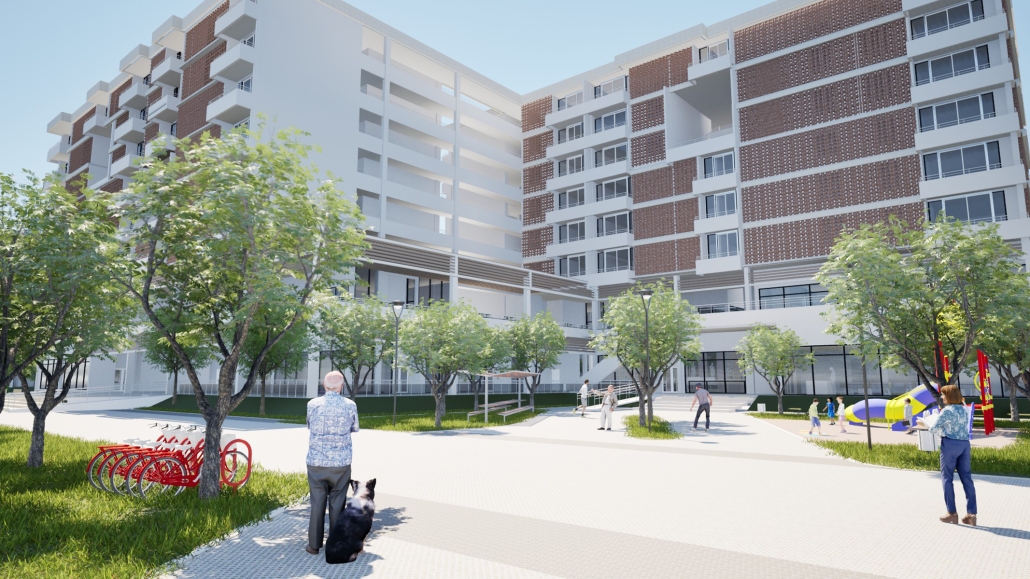
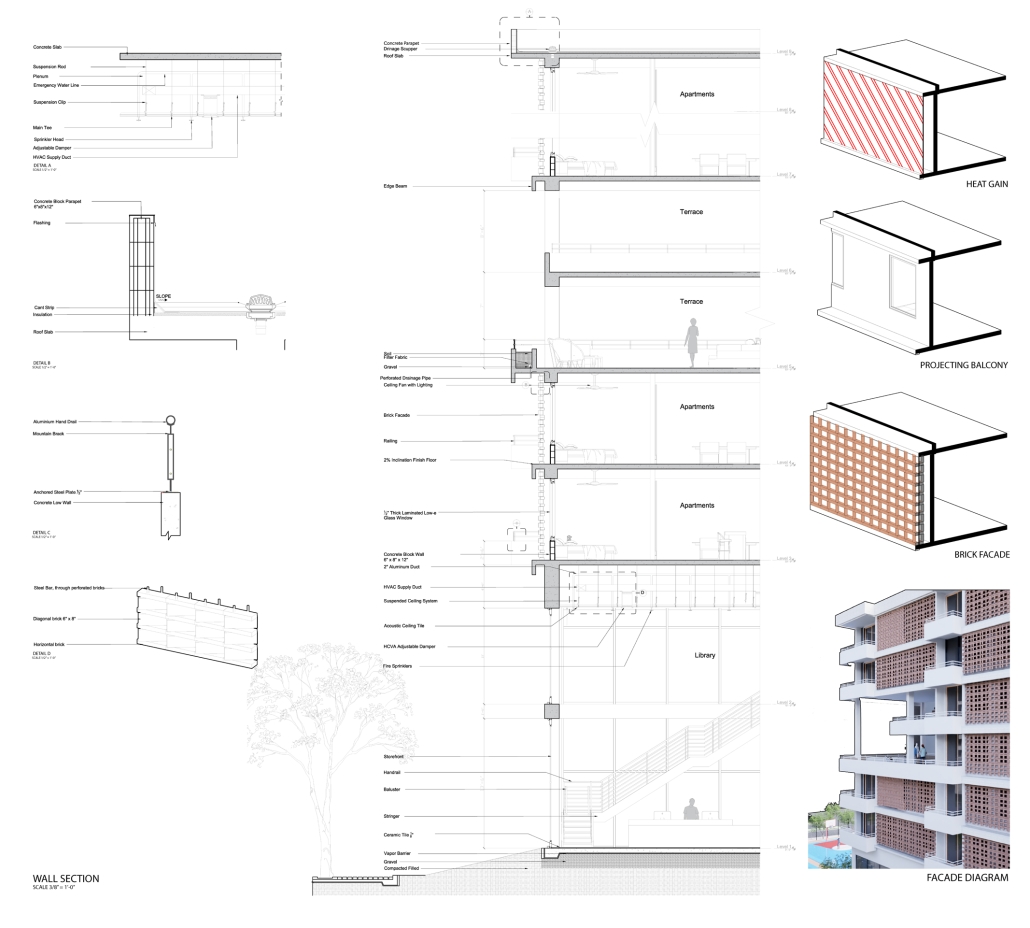
The upper levels accommodate diverse residential typologies, from studio units to three-bedroom apartments, serving varied family structures within the community. Each dwelling incorporates terraces and balconies strategically oriented toward recreational areas, fostering visual connections with green infrastructure and reinforcing the relationship between private living spaces and communal areas. The buildings employ a brick façade system providing effective solar protection and thermal regulation while maintaining authentic integration with the existing urban landscape, where brick represents one of the most prevalent and culturally significant building materials in the region. This material choice exemplifies the project’s commitment to environmental responsiveness and contextual sensitivity.

Click here to learn more.

Instagram: @Lizbethmarie_1

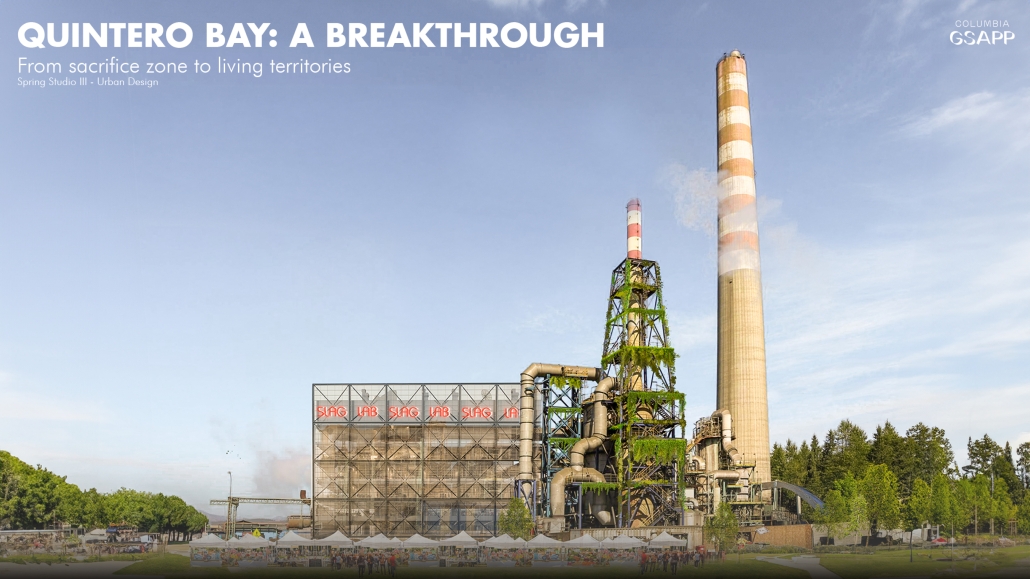
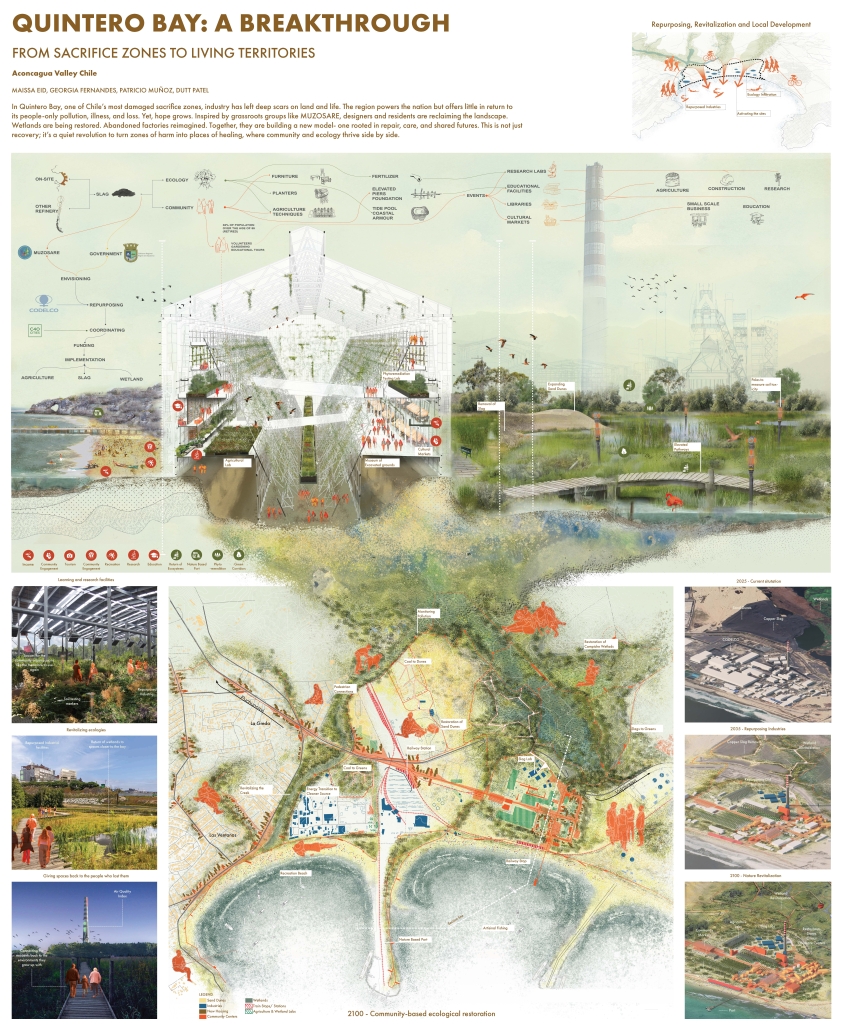
Quintero Bay: A Breakthrough by Georgia Fernandes, Maïssa Eid, Patricio Munoz & Dutt Patel, M.S.AUD (Masters of Science in Architecture and Urban Design) ’25
Columbia University | Advisors: Kate Orff, Geeta Mehta, Gabriel Vergara, Sebastian Delpino, Emanuel Admassu & Lucas Coelho

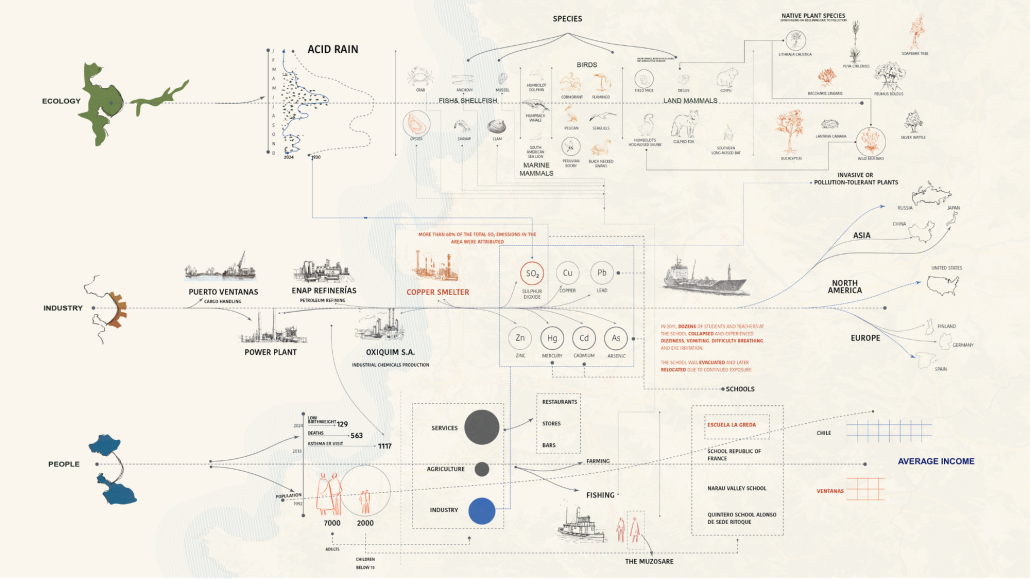
Quintero Bay, once a thriving coastal ecosystem in Chile, has become one of the country’s most heavily polluted sacrifice zones. Years of industrial activity have contaminated the air, land, and sea, deeply impacting the health and livelihoods of its residents. The region powers 7% of Chile’s energy, yet the communities living here have received only environmental harm in return.

Our project, inspired by the work of local feminist collective MUZOSARE, envisions a future rooted in healing and co-existence. Rather than erase the industrial past, we aim to repurpose it. The phased closure of the Codelco copper smelter offers a unique opportunity to restore wetlands, uncover buried sand dunes, and adapt former factories into community hubs for housing, research, culture, and ecological stewardship.

Guided by the principles of revitalizing, repurposing, and community development, the design introduces green corridors, nature-based ports, and SLAG LABS to transform industrial waste into public infrastructure. Residents can participate in restoration through income or social credit-based programs, reactivating the local economy while building environmental resilience.

This is not just a vision for Quintero Bay—it’s a model for all sacrifice zones. By integrating policy, ecology, and community leadership, the project offers a blueprint for transforming places of harm into living territories of shared futures.

This project won the Lucille Smyser Lownfish Memorial Prize.

Instagram: @g__fernandes, @misssoouuuu, @pamb.070, @duttpatel108, @mehtageeta999, @sdelpino_arq, @gabrielvergarag, @lucascoelhonetto, @eadmassu

Rhythmic Ribbons by Tadhg McDonald, M.Arch ’25
Lawrence Technological University | Advisor: Masataka Yoshikawa

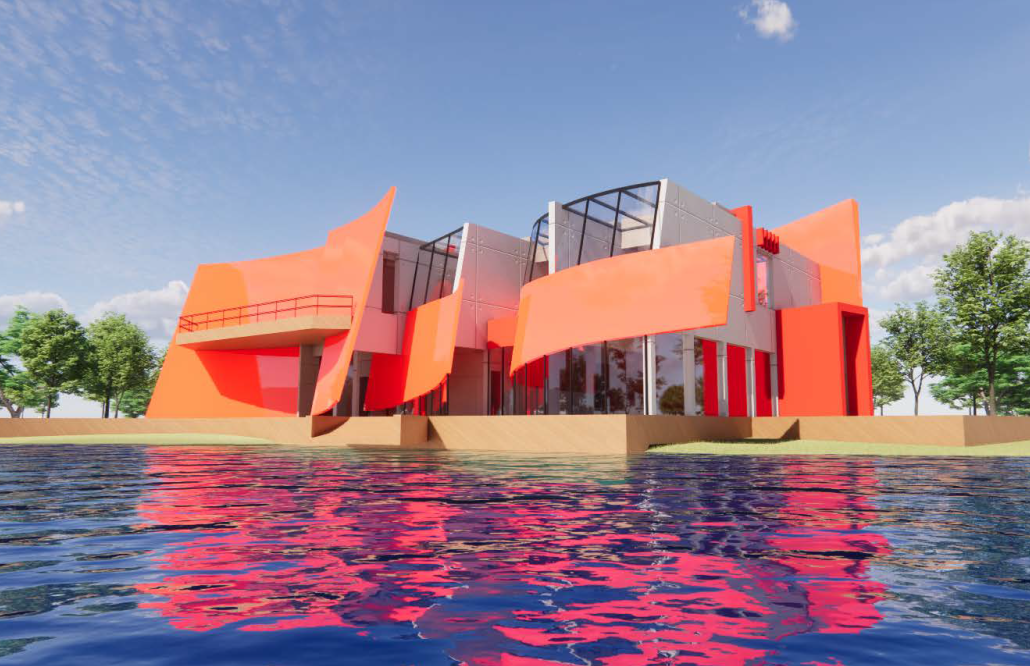
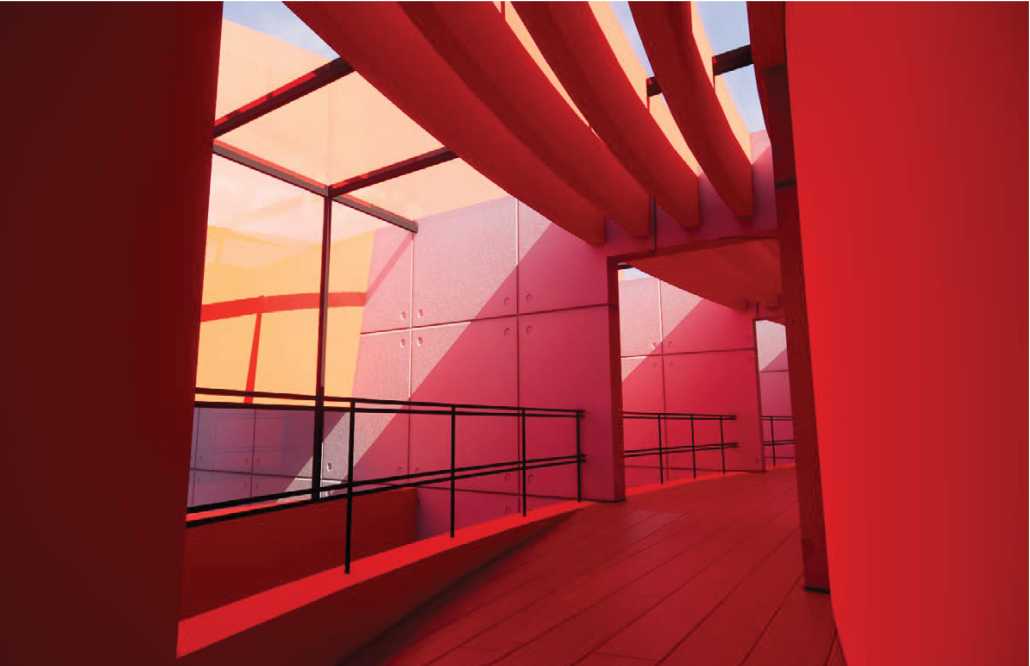
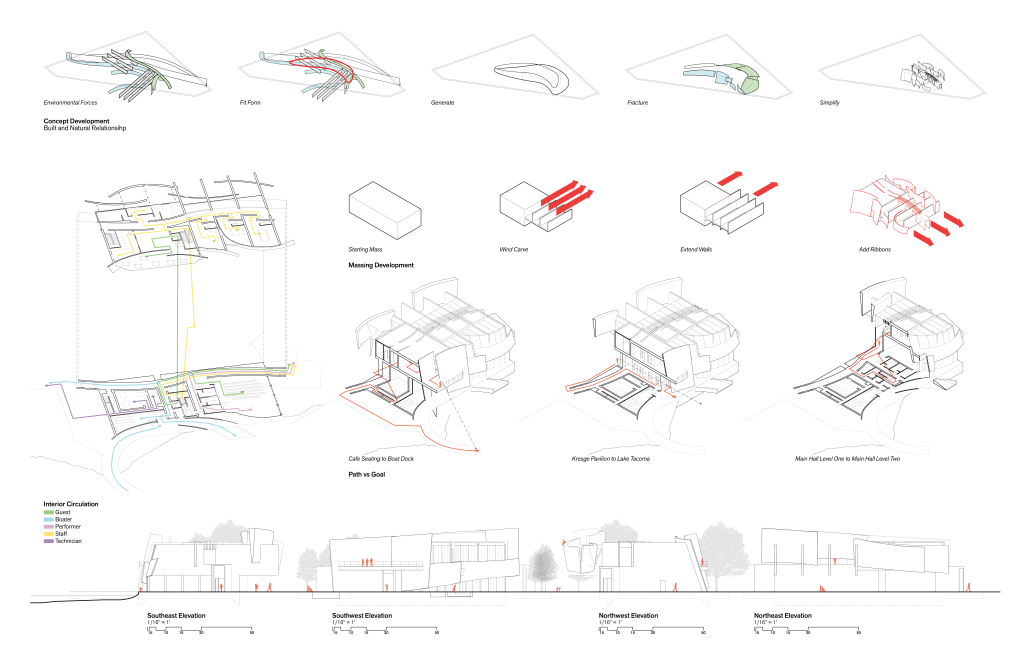
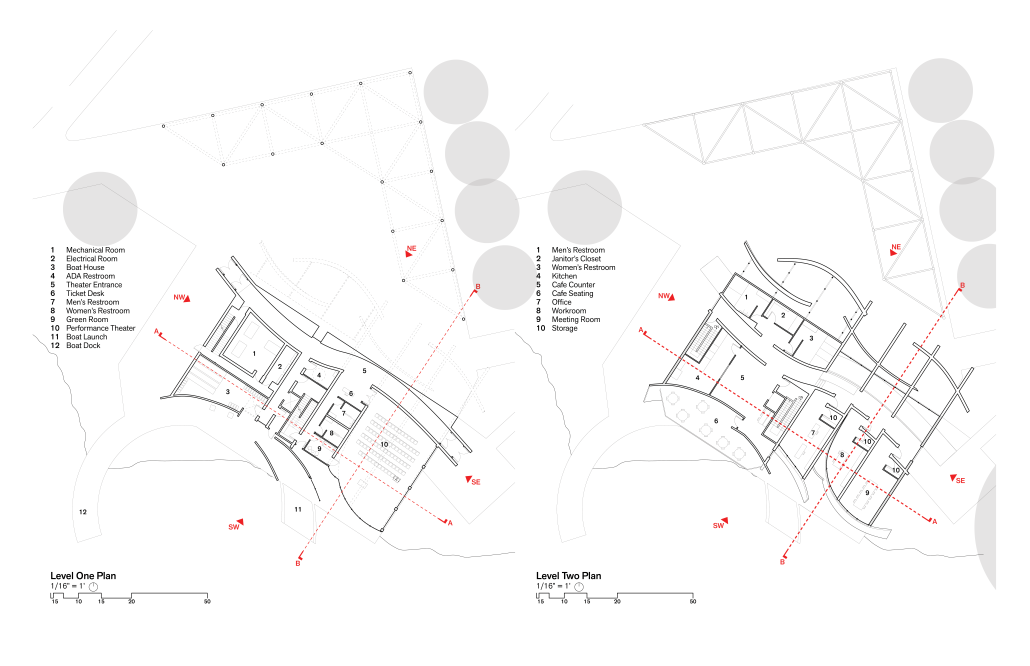
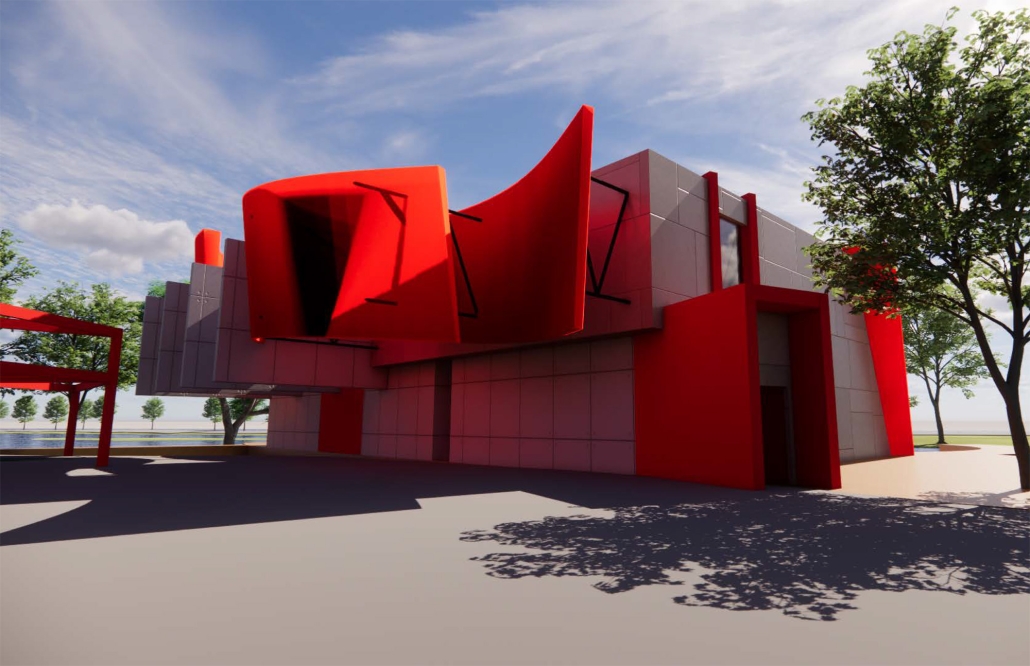
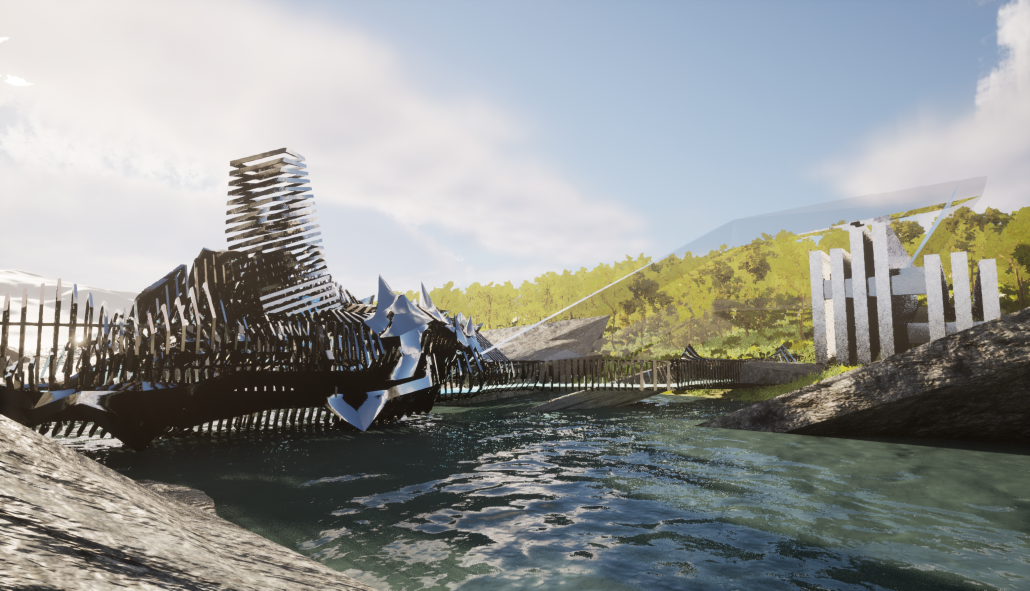
The goal of this design was to highlight the site’s seclusion from the rest of Belle Isle and how it is reinforced by the relationship between the existing built and natural environments. This relationship influenced the formal design elements through the utilization of both orthogonal and curved walls. The orthogonal walls represent the built environment, while the curved walls represent the natural [environment.] The main generator for the site’s seclusion was the journey that any site visitors have to travel in order to reach the secluded core of the site. From the parking lot, the visitor can partially see all of the stunning views of the site, but they do not get the full experience until they have passed through the lines of trees and the Kresge Pavilion. This idea of Path vs. Goal was heavily influential for the interior design of this new construction. Overall, the site’s inherent seclusion, journey, and built and natural confines create a uniquely private experience for all visitors.

Instagram: @ta.dhg, @masataka.yoshikawa

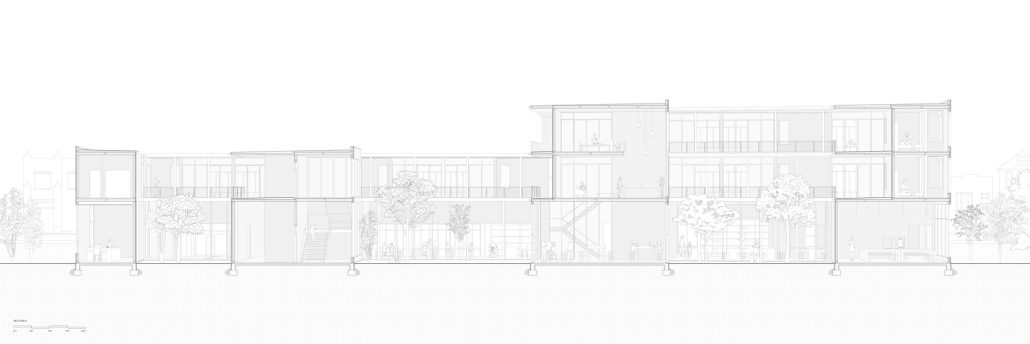
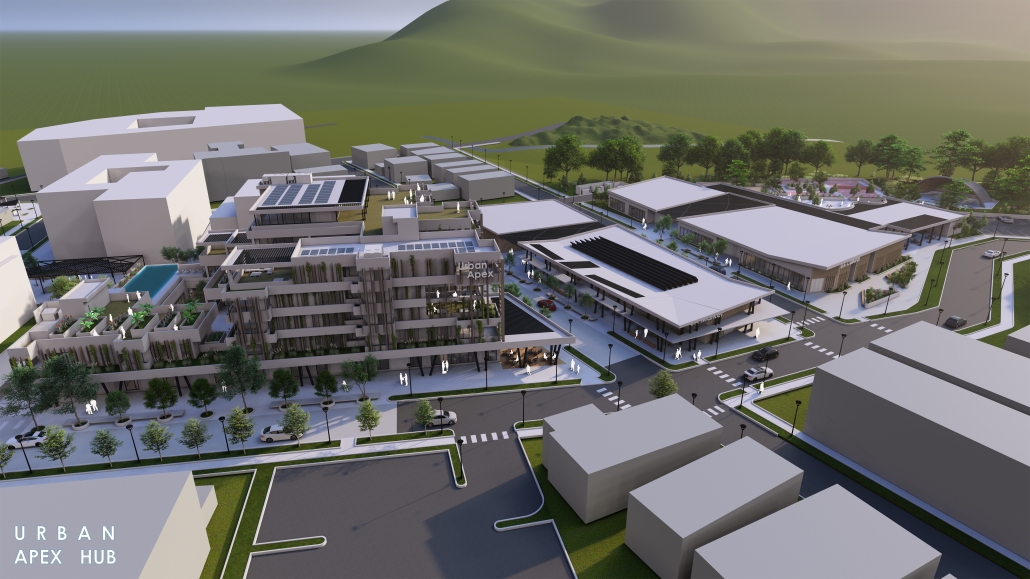
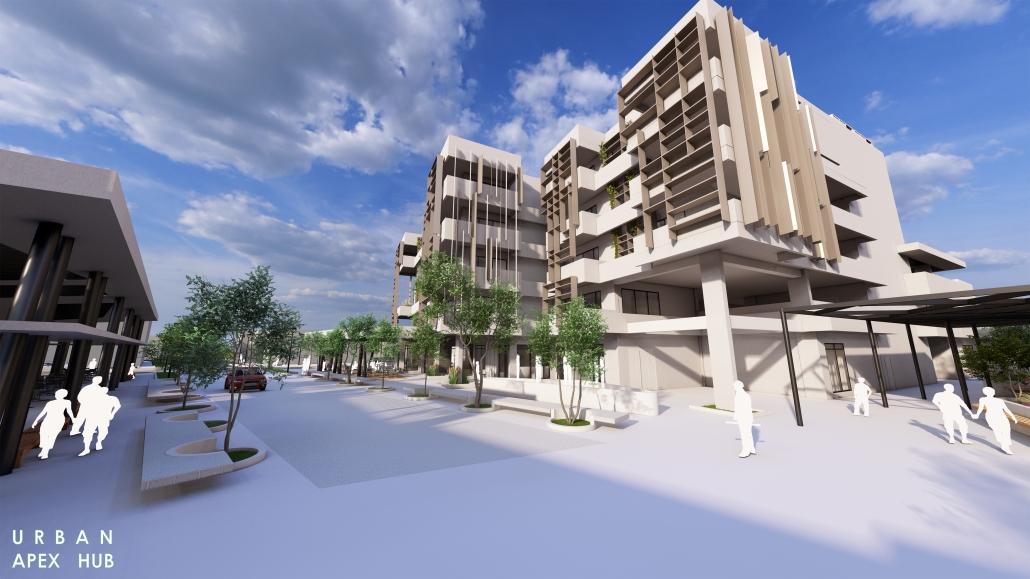
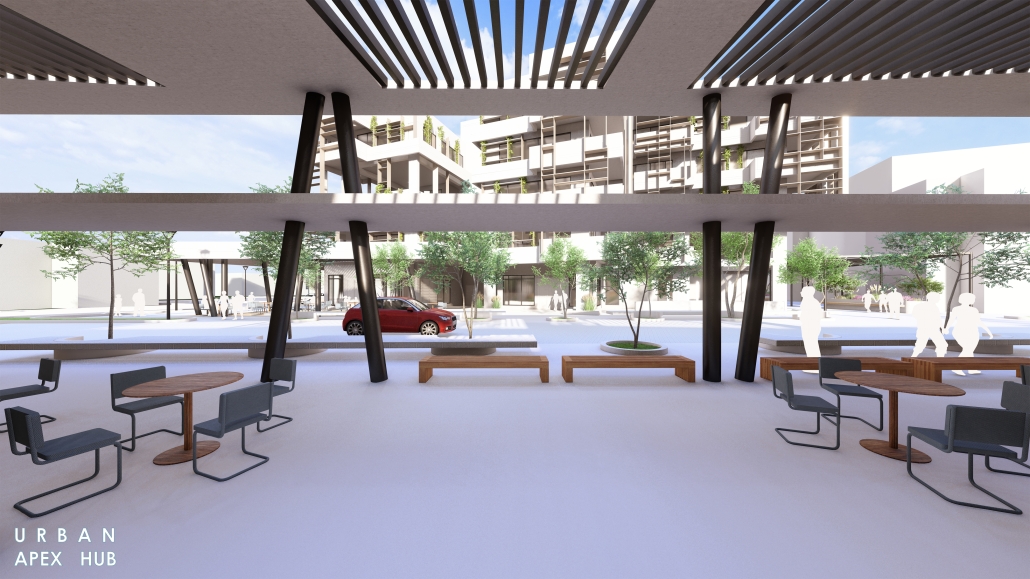
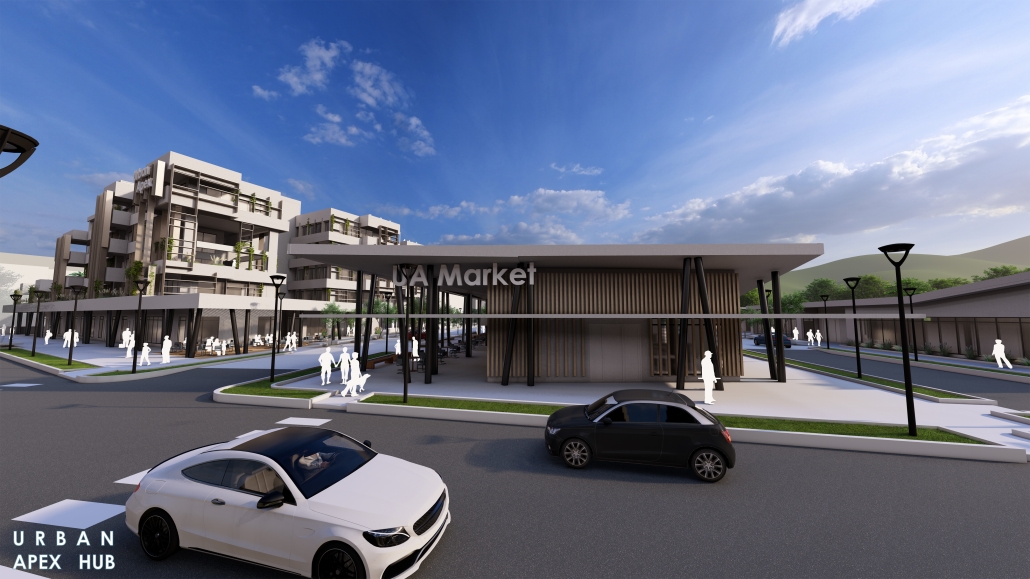
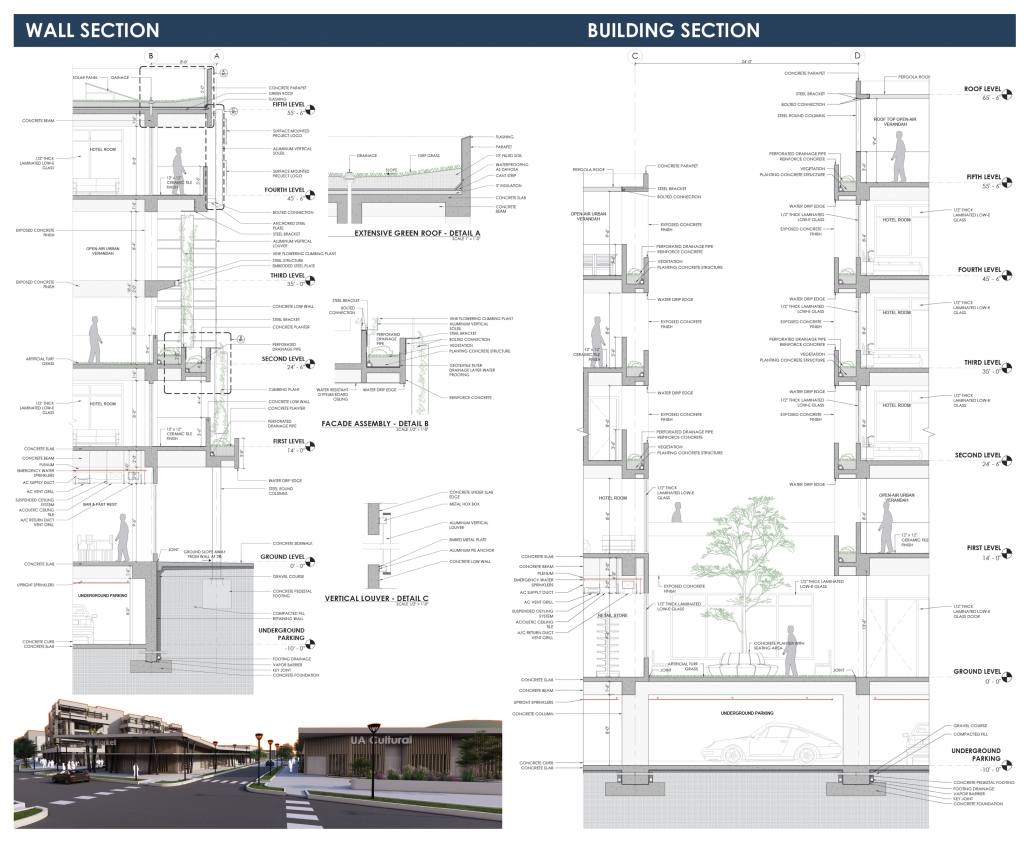
Urban Apex Hub – Sustainable Tourism: A Path to the Reconstruction of Urban Spaces by Louis Y. Sepúlveda-Homs, B.Arch ’25
Pontifical Catholica University of Puerto Rico | Advisors: Jesús O. García-Beauchamp, Pilarín Ferrer-Viscasillas & Pedro A. Rosario-Torres

Urban decay is a persistent condition in many contemporary cities, leading to the deterioration of physical infrastructure, the disappearance of cultural identity, and the disconnection between communities and their environments. This capstone investigates the potential of sustainable tourism as a catalyst for the reconstruction of such spaces, proposing an architectural and urban intervention that integrates ecological, cultural, and economic dimensions. Titled “Urban Apex Hub – Sustainable Tourism: A Path to the Reconstruction of Urban Spaces,” the project is located in the deteriorated historic center of Río Grande, Puerto Rico, a site marked by abandonment, weak pedestrian infrastructure, and lack of public activation.

This research explores the intersection between landscape urbanism, urban obsolescence, and ecotourism as strategic tools to regenerate neglected urban cores. Drawing from the theories of Charles Waldheim on landscape as a framework for urbanization, Kevin Lynch’s concept of urban obsolescence, and Richard Butler’s tourism area lifecycle model, the proposal envisions a hybrid public space that merges architecture and nature. The program includes an eco-conscious hotel, a cultural center for local expression and education, and a public market that supports local entrepreneurship and food sustainability.

The methodology combines site analysis, ecological mapping, and community engagement to develop a masterplan focused on walkability, stormwater management, cultural preservation, and green infrastructure. Key spatial strategies include the use of interior gardens, green roofs, permeable surfaces, and open-air courtyards that enhance microclimates and support social interaction. The project also addresses tourism from a critical lens, proposing a model that attracts ecotourists to under-visited urban areas while empowering local communities.

Urban Apex Hub reimagines tourism as more than a temporary activity; it becomes a long-term drive for environmental stewardship, cultural resilience, and economic regeneration. By rooting the architectural proposal in the specific ecological and social context of Río Grande, the project demonstrates how sustainable tourism can actively participate in reconfiguring urban identity and restoring meaning to forgotten spaces. Ultimately, this research advocates for an architecture that is not only responsive to climate and place, but also capable of reshaping the narrative of urban decline into one of collective renewal.

Click here to learn more.

Instagram: @arch.louis_yarell

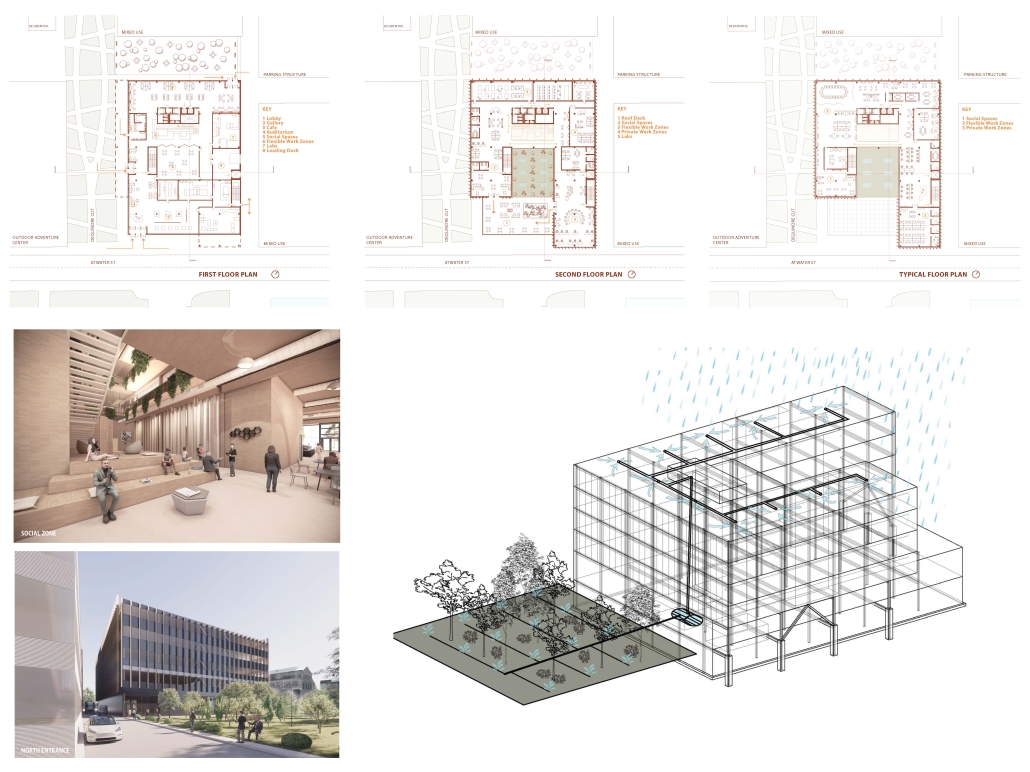
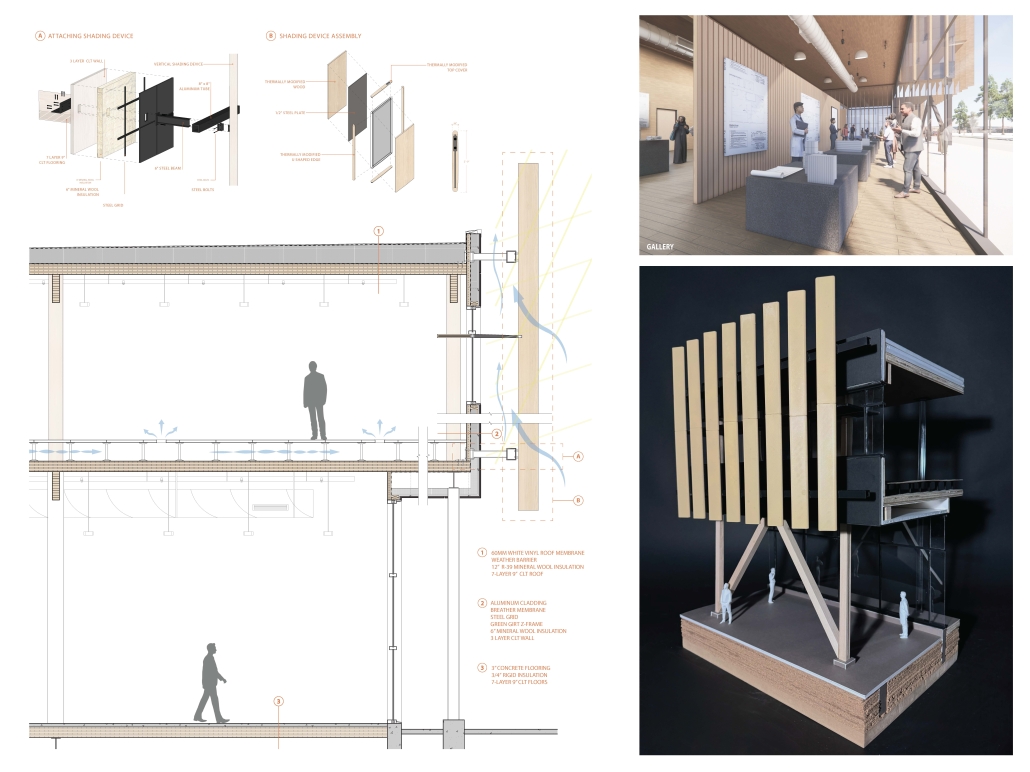
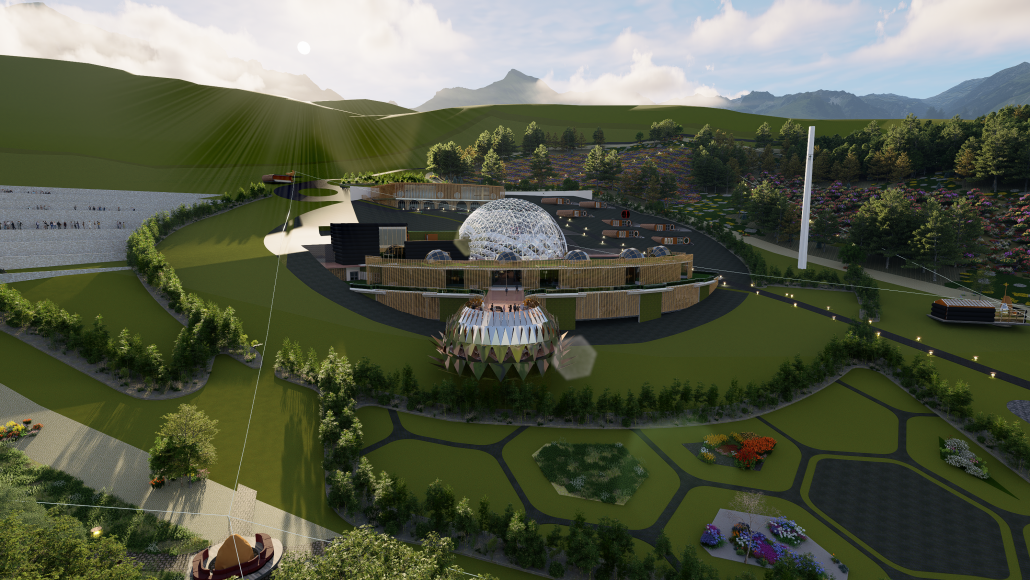
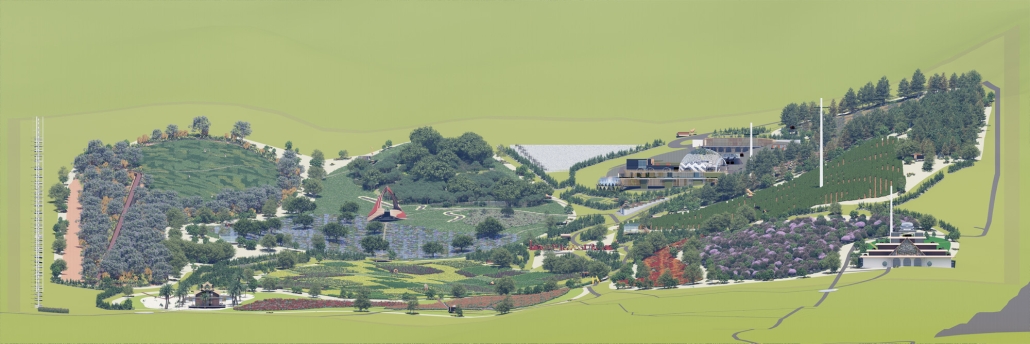
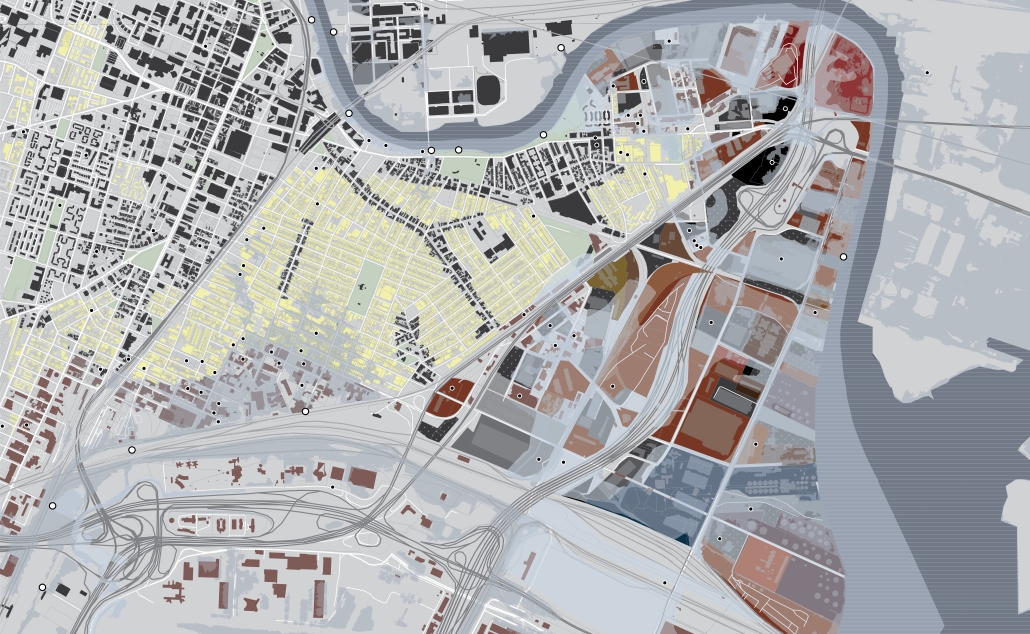
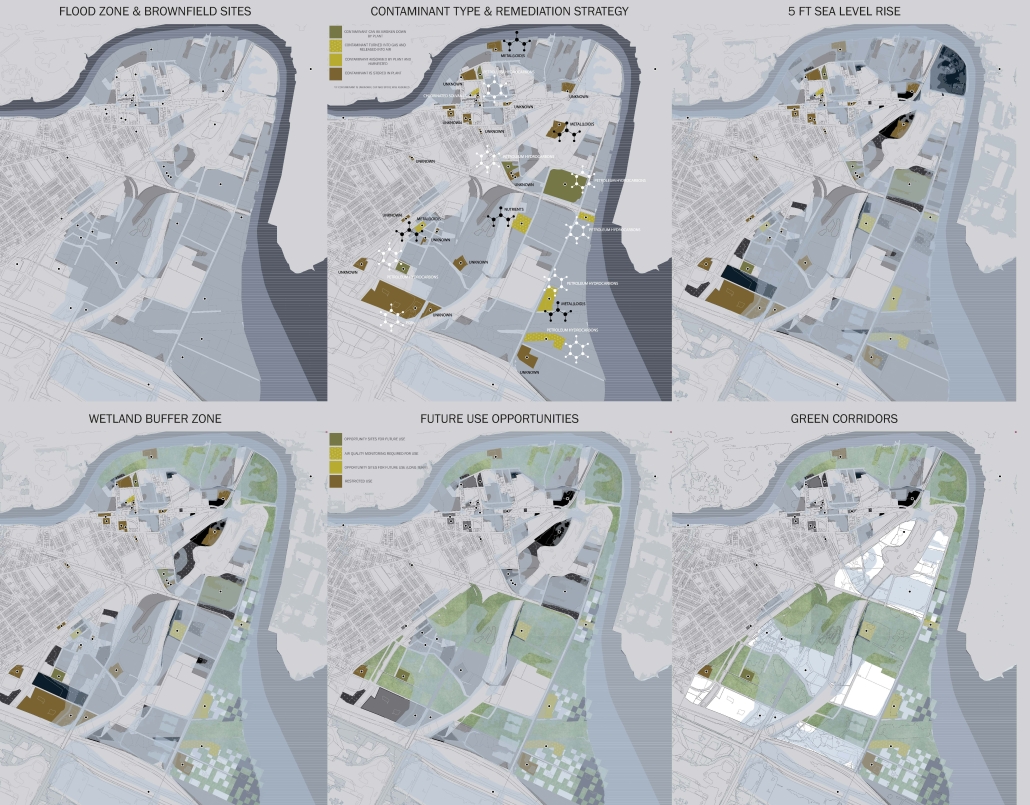
Ecologies of Extraction: Reclaiming Industrial Landscapes for Ecological and Social Renewal by Anna MacDonald, B.Arch ’25
Wentworth Institute of Technology | Advisor: Lauren McQuistion

The remediation of declining industrial landscapes in cities can serve as a catalyst for reimagining the urban fabric through the establishment of resilient infrastructure and renewed community connections. Newark’s industrial zone exemplifies the tensions and possibilities of this transformation, revealing how design, policy, and environmental strategies can converge to reshape industrial spaces. Industrial landscapes have long been shaped by economic shifts, ecological negligence, and urban expansion. As industries shrink or relocate, their physical remnants—factories, warehouses, rail lines, and contaminated land—present both challenges and opportunities for urban and ecological transformation. 

The transition to sustainable, post-industrial cities requires strategies that integrate environmental remediation, adaptive reuse, and equitable redevelopment. Newark, NJ, serves as just one extreme example of the contaminated, underutilized industrial landscapes that permeate U.S. cities, and regulatory agencies must implement a framework for transforming modern industrial zones through sustainable infrastructure, ecological restoration, and social equity. Strategic interventions explored in this study establish a model for cities to move beyond extractive histories toward climate-conscious and socially inclusive futures, demonstrating how industrial spaces can evolve into regenerative landscapes.

This project won the ARCC King Award, Wentworth School of Architecture and Design: Design Excellence Award.

Instagram:@annarmacdonald, @mc.quistion

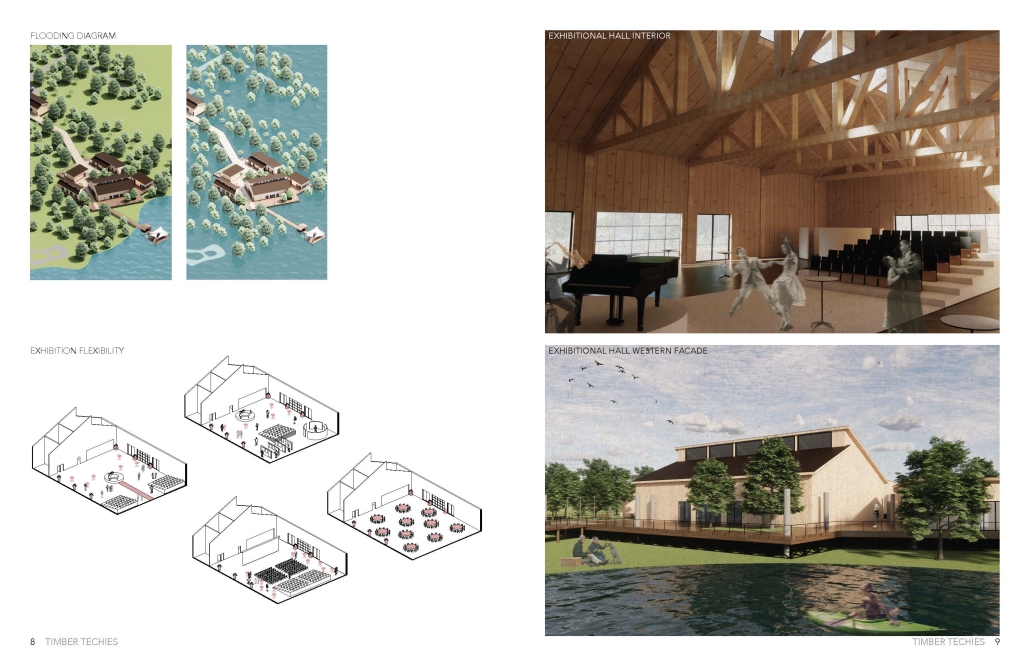
WHEN THE LEVEES BROKE by Madisyn Hunter, M.Arch ’25
Florida A&M University | Advisors: George Epolito, Andrew Chin & Ronald B. Lumpkin

WHEN THE LEVEES BROKE: THE IMPACT OF HURRICANE KATRINA ON THE CREATIVE PROCESS OF MUSICIANS AND THE EVALUATION OF ARCHITECTURAL LANDSCAPES

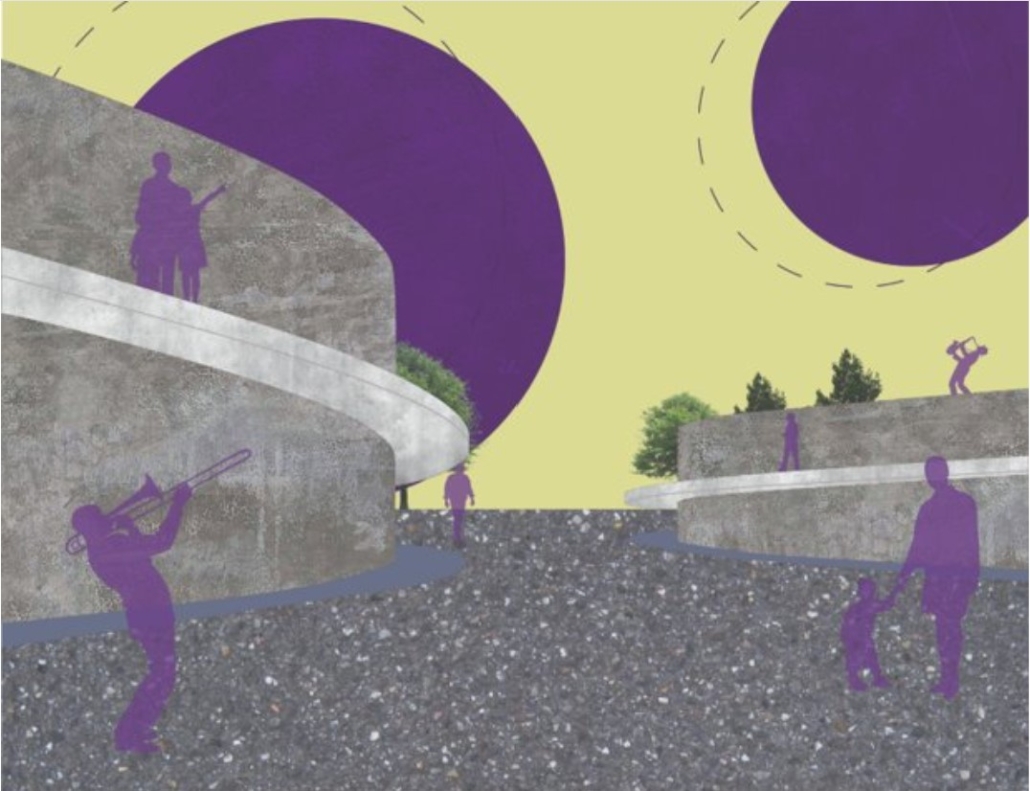
This thesis examines the intersection of architectural innovation and cultural resilience in the wake of Hurricane Katrina, focusing specifically on its impact on the creative processes of young musicians in New Orleans. The project investigates how architectural design can serve as both a physical and emotional safeguard against future natural disasters, while simultaneously nurturing cultural expression and healing.

Following Katrina’s devastation, rebuilding efforts largely favored traditional architecture over progressive design solutions—often reinforcing systemic inequities and overlooking the creative lifeblood of the city’s youth. Yet, in the face of limited resources and widespread destruction, many musicians returned to their craft, channeling trauma into vibrant, transformative art. This thesis argues that their resilience and creativity were not merely responses to adversity but vital threads in New Orleans’ cultural recovery.

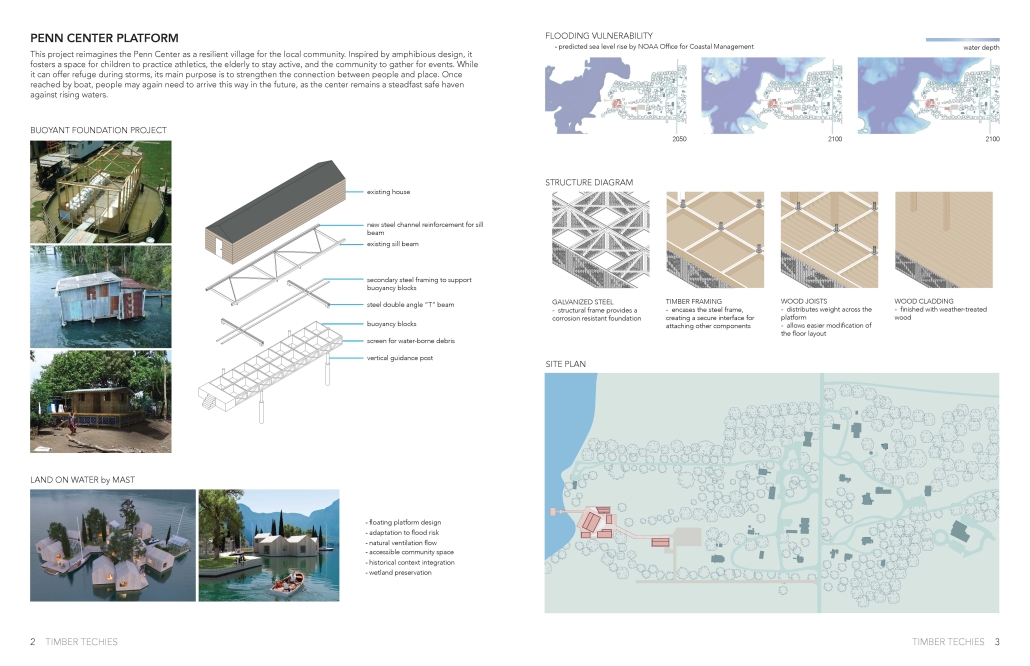
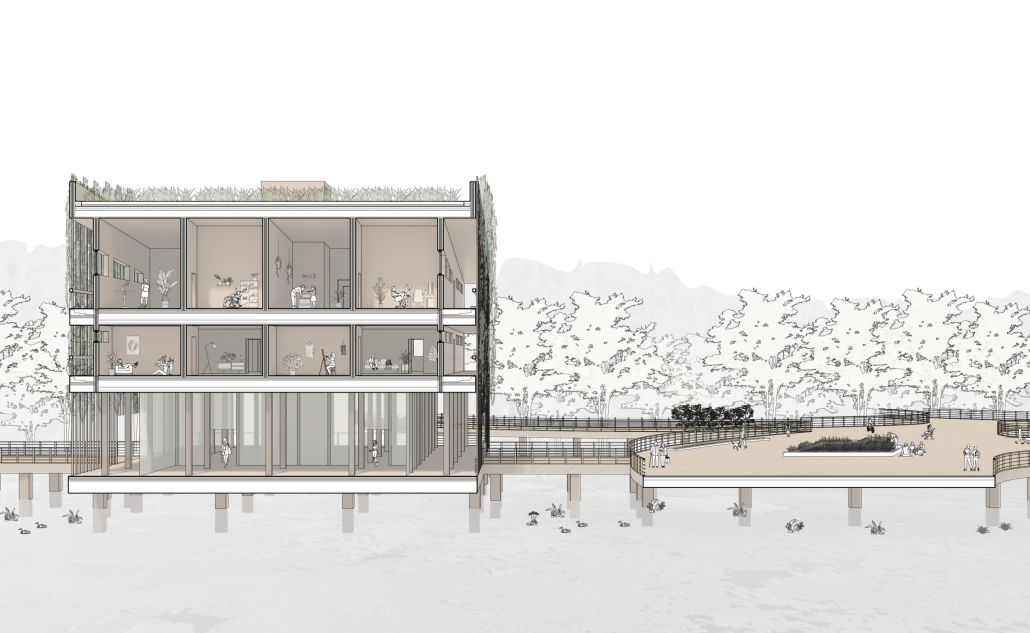
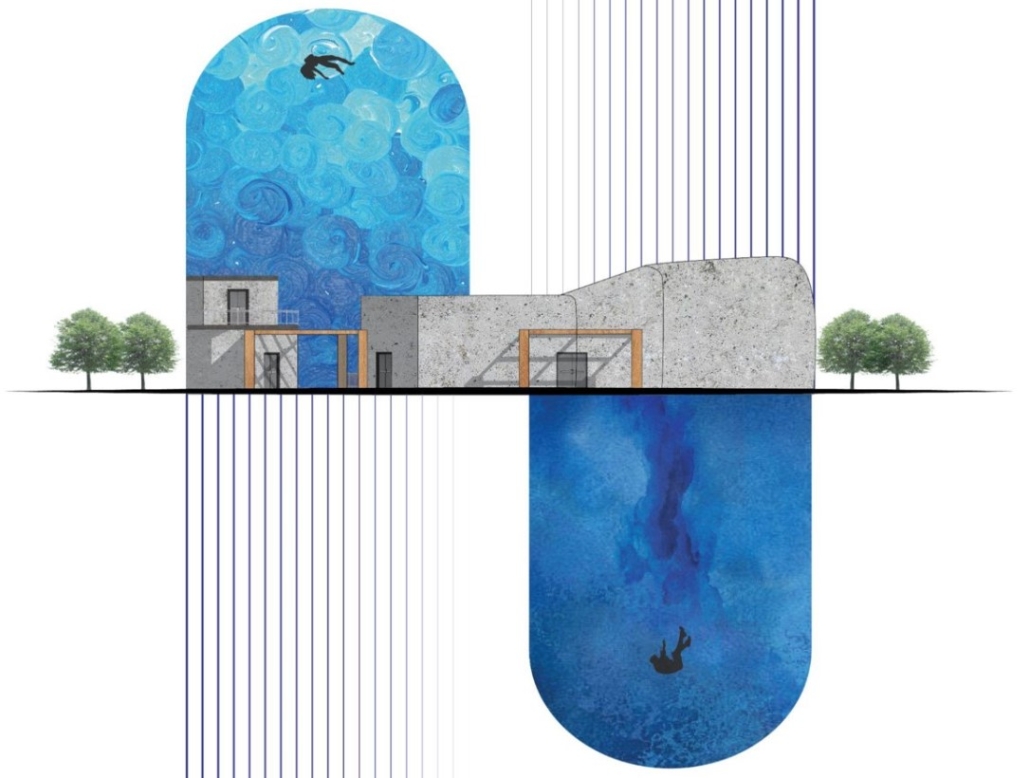
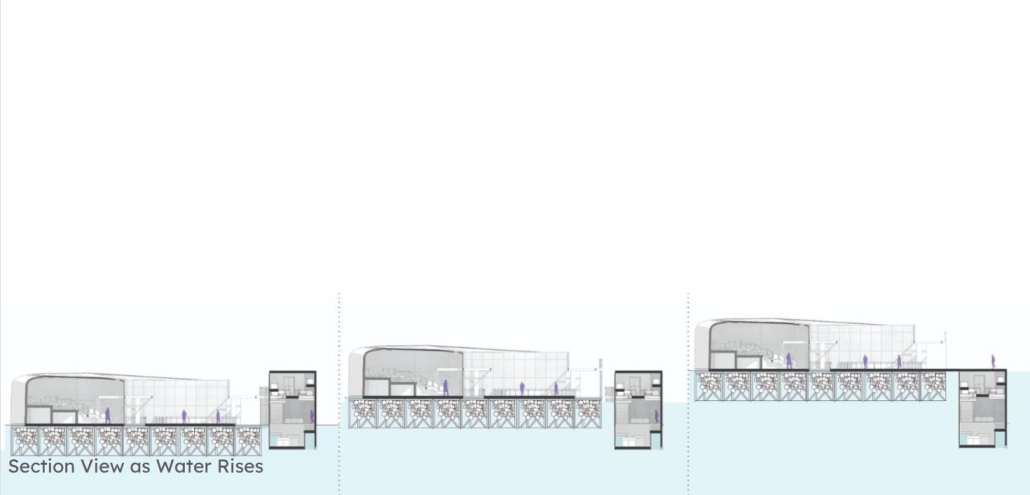
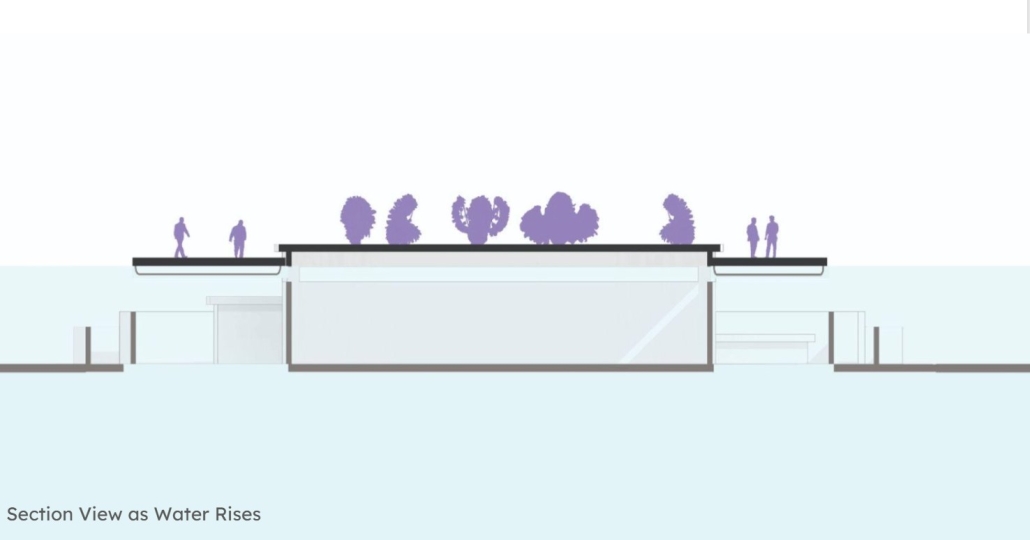
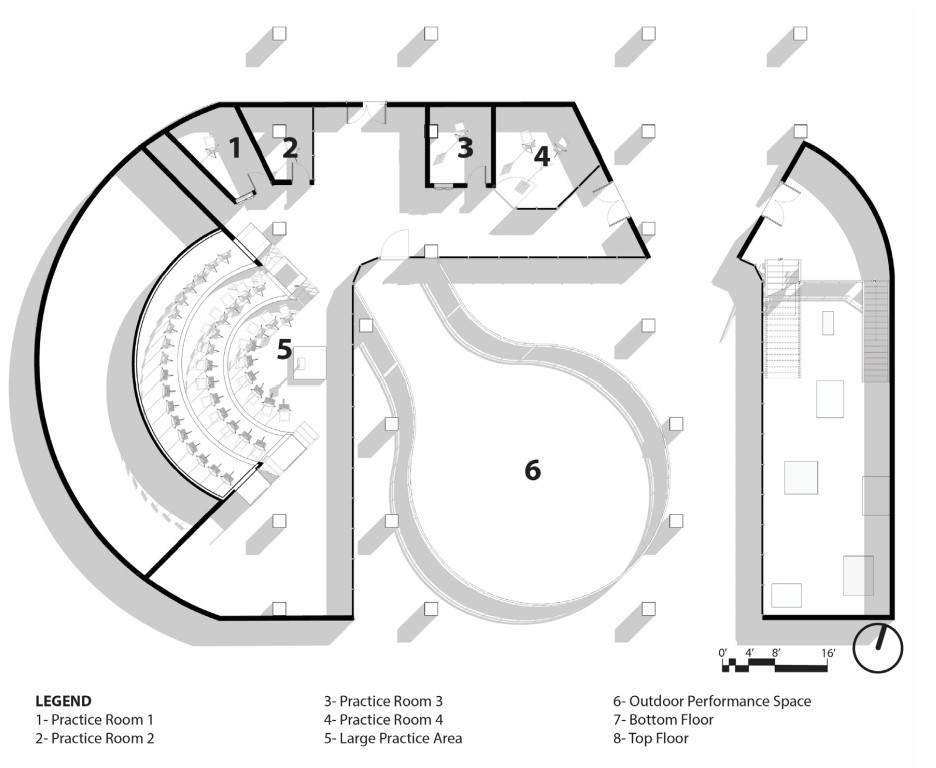
The research combines case studies, archival data, and design analysis to explore how architecture can support post-disaster recovery by integrating cultural spaces within resilient infrastructure. The proposed design envisions floating structures that act as creative havens—spaces for performance, collaboration, and remembrance. These architectural interventions respond not only to storm surge patterns and environmental threats but also to the need for safe, inclusive places that honor the city’s musical heritage and provide psychological support.

Ultimately, “When the Levees Broke” presents a vision for architecture that does more than mitigate disaster—it becomes a catalyst for cultural preservation, artistic growth, and long-term community healing. The thesis underscores that in a city where music is a lifeline, architecture must rise to meet both environmental and emotional needs with equal care.

Instagram: @famusaet, @famu_masterofarch

Lazo by Rafael Martínez Marín, B.Arch ’25
Tecnológico de Monterrey | Advisor: Claudia Berenice Muciño García

The abandonment of Puebla’s Historic Center stems from urban, economic, and social transformations that, since the city’s founding, have triggered segregation and displacement, altering its residential character. In the 20th century, urban sprawl and the creation of new housing zones pushed residents out of the center. This trend was deepened by economic crises, weak public policy, and a lack of housing incentives, leaving many buildings in disrepair and community life fractured.

In recent decades, the city’s designation as a World Heritage Site and the growth of tourism have transformed the center into a commercial hub, further reinforcing residential abandonment and neglecting the development of its original neighborhoods.

This study focuses on the Analco neighborhood, a place deeply affected by these dynamics. It now faces advanced deterioration and insecurity. Through documentary research, interviews, comparative analysis, and analogous case studies, the project identifies patterns, challenges, and opportunities that have shaped Analco’s transformation.

As a response, the architectural project “Lazo” proposes a strategy to reconnect the neighborhood with its people. Situated on two plots separated by a street, the design links them through a habitable bridge that becomes both a symbolic and functional connector. This elevated structure hosts cultural, educational, and social programs that strengthen community bonds.

More than a finished object, the project is conceived as an open and adaptable system, shaped through community involvement. Public space is the core of the proposal, with plazas, open workshops, and shared courtyards designed to encourage interaction and daily use. The program includes classrooms, artisan workshops, a communal kitchen, and exhibition areas—spaces that promote learning, creativity, and the transmission of local knowledge.

The bridge redefines the street not as a boundary but as a space of encounter, promoting pedestrian movement and intergenerational exchange. “Lazo” becomes not just a building, but an infrastructure of care, identity, and continuity—an active agent in the regeneration of one of Puebla’s most historic yet neglected neighborhoods.

The capstone was recognized as Best Generation Project by Tecnológico de Monterrey.

Instagram: @rafamtz._, @arq.pue.tec

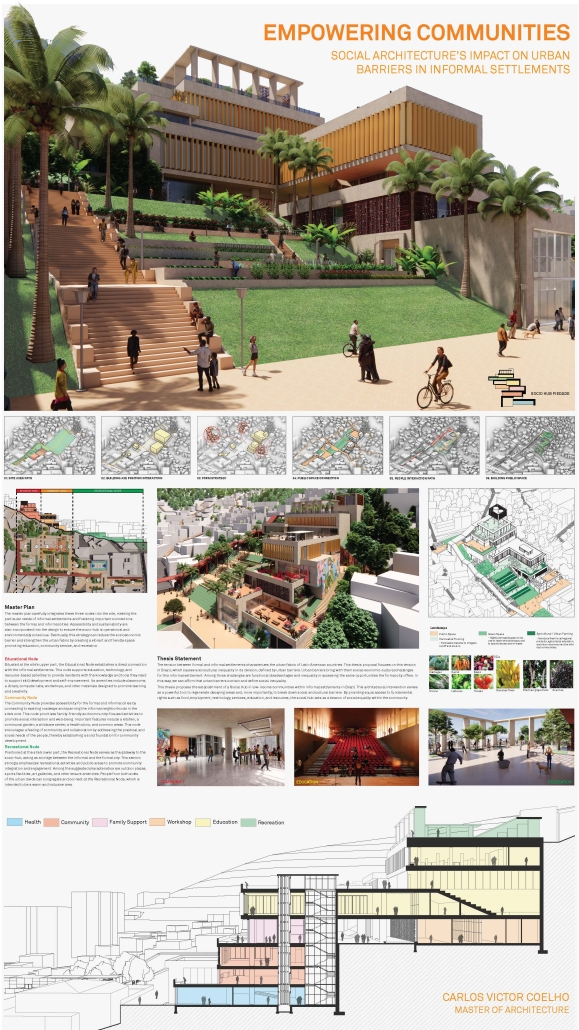
Empowering Communities by Carlos Victor Coelho, M.Arch ’25
Boston Architectural College | Advisors: Ralph Jackson & Ian F. Taberner

SOCIAL ARCHITECTURE’S IMPACT ON URBAN BARRIERS IN INFORMAL SETTLEMENTS

This thesis proposal focuses on the tension between formal and informal settlements in Latin American countries, particularly in Brazil, where urban barriers contribute to sociocultural inequality. These barriers, including spatial, economic, and political exclusions, create challenges for informal settlements, such as infrastructure disadvantages and limited access to opportunities. By asking the following questions, this proposal suggests establishing a social hub in a low-income community within informal settlements, emphasizing the importance of considering its unique conditions and challenges in planning urban interventions. 

The Social Hub aims to break down social and cultural barriers through social architectural intervention. This intervention will act as a powerful tool to provide equal access to essential resources and services, such as food and water. The initiative also aims to promote social equality and inclusion. This proposal suggests establishing the social hub in an informal settlement in Vitoria, ES, Brazil. To achieve its goal, the proposed site, approximately 1.8 acres, is situated in a sloped informal neighborhood within the heart of the city and the Historical center, rich in cultural and historical relevance.

Methods of Inquiry:

– How can social architecture in informal settlements increase the quality of life and social equality?

– What challenges and barriers do urban barriers within low-income communities bring to them?

– How can deconstructing urban barriers through architecture help guarantee needy community residents’ right to the city and ensure integration and equality?

Term of Criticism:

– Does the proposal project help overcome challenges such as the urban barrier within the community?

– Does the proposal present a structure that fulfills the community’s significant needs, such as food access, education, and public space?

– Does the project offer a structure that encourages the community’s involvement and inspires pride and opportunities

This project received Commends for Thesis.

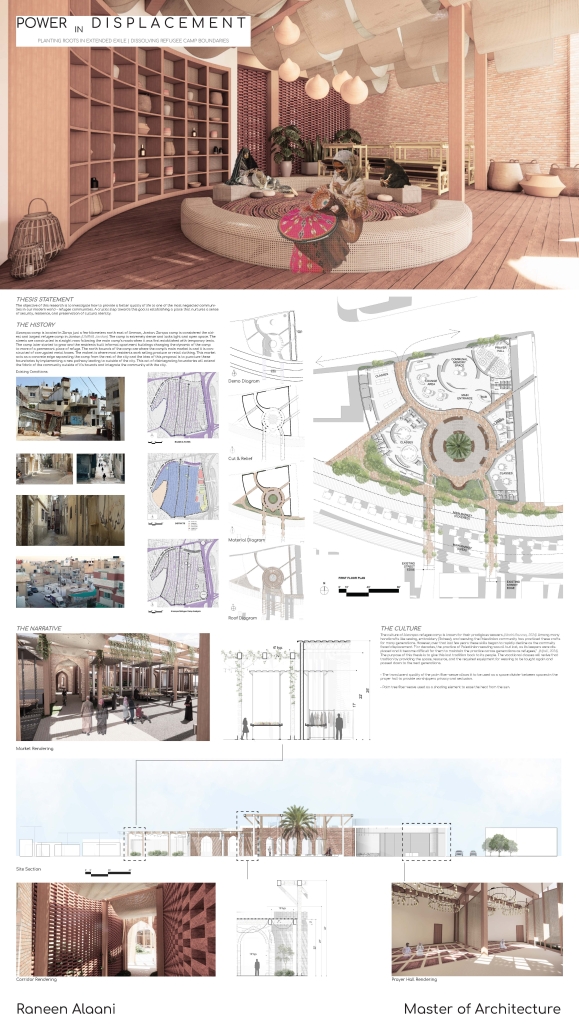
Power In Displacement by Raneen Alaani, M.Arch ’25
Boston Architectural College | Advisors: Lorraine Kung & Ian F. Taberner

Planting roots in extended exile – Disintegrating refugee camp boundaries.

This research investigates establishing a sense of security, resilience, and preservation of cultural identity for Palestinian refugee communities in the Middle East. These communities have been struggling with instability and feeling that they have been uprooted from their homes for many decades. The political status of most of these refugees complicates the issue even further. Palestinian refugees in many Middle Eastern countries fall under the status of “stateless”. This dilemma is not only affecting their social and economic lives, but it is detrimental to their psychological and emotional wellbeing as they continue to feel imprisoned within the intangible boundaries of their refugee camps.

  • Creation of a safe haven to exhibit communal memory that reminisces the homeland
  • A place of attachment that empowers the culture, religion and heritage
  • The use of natural light to invoke healing – peace – tranquility

Methods of Inquiry:

  • Sense of security and stability is restored
  • Refugee community’s youth have aspirations for their future
  • Self-esteem and self worth is restored

Terms of Criticism:

Alzarqaa refugee camp is only a few kilometers outside of Amman, Jordan. It is one of the oldest refugee camps in the region (UNRWA Jordan). Alzarqaa camp struggles with density and lack of job opportunities in addition to water scarcity, lack of resources, and lack of natural light. This thesis proposes a resilience center of approximately 9000 SF just outside the bounds of the camp that acts as a continuation of the community extending just beyond the boundaries of the camp.”

This project received Commends for Thesis.

Stay tuned for Part XII!

2025 Study Architecture Student Showcase - Part X

Architecture tells a story. The capstones and theses highlighted in Part X of the 2025 Study Architecture Student Showcase use texture, material, and spatial configuration as visual narratives. From short films to renderings, each project uses a unique medium of storytelling. The displayed work ranges from memorials inspired by speculative fiction and design interventions using augmented reality to exhibitions on womanhood and visualizations of poetry.
Scroll down for a closer look!

Thread by Thread by Emily Dross, B.Arch ’25
Ball State University | Advisor: James F. Kerestes

“Thread by Thread” is a short film, created as part of the course Cinematic Environments: Uncanny AI, explores hybridized architectural conditions through a speculative and surreal lens. Set in a richly imagined built environment, the narrative unfolds through the movements and interactions of fluffy, stuffed animal-like creatures—anthropomorphic figures that serve as both inhabitants and interpreters of the space. These soft-bodied protagonists navigate a world that oscillates between the familiar and the uncanny, offering a playful yet critical reflection on contemporary architectural and environmental issues.

The project operates within the “fuzzy space” between realism and speculation, where exaggerated materials, textures, and spatial configurations provoke questions about the future of the built environment. By merging whimsical imagery with architectural inquiry, the film engages themes of technological transformation and post-Anthropocene speculation. The soft, plush inhabitants stand in stark contrast to the often rigid, industrial aesthetic of traditional architectural spaces—suggesting alternative, more empathetic ways of occupying and designing environments.

Through visual storytelling, “Thread by Thread” reflects a critical position on how architecture might respond to pressing global concerns while embracing unconventional narratives and mediums. Ultimately, the film is a provocative gesture—one that reimagines the role of architecture in shaping not only physical space but also cultural and emotional landscapes. It invites viewers to question the boundaries of architectural representation and consider the value of softness, fantasy, and hybridity in the discourse of design.

Instagram: @em.dross, @jameskerestes

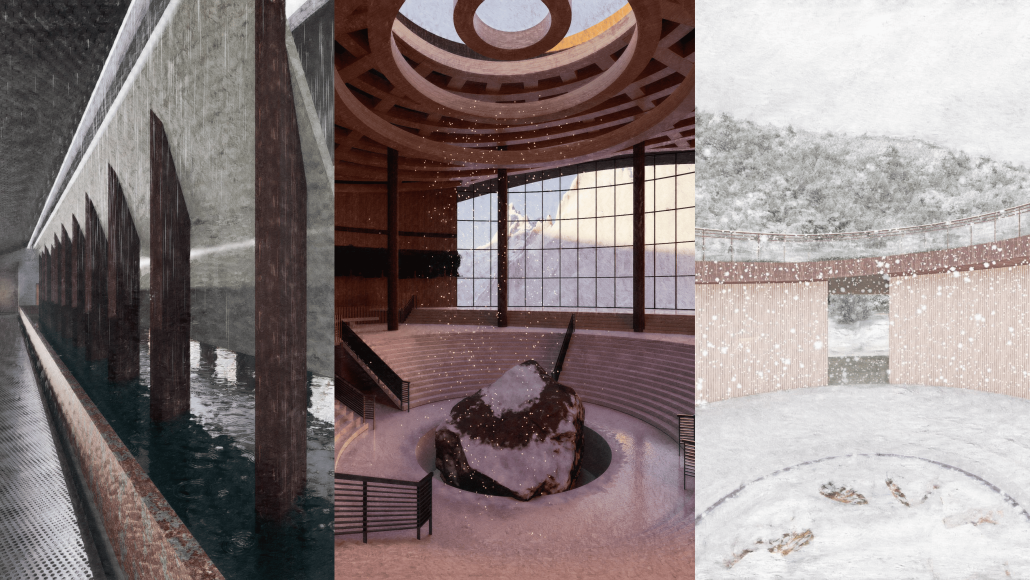
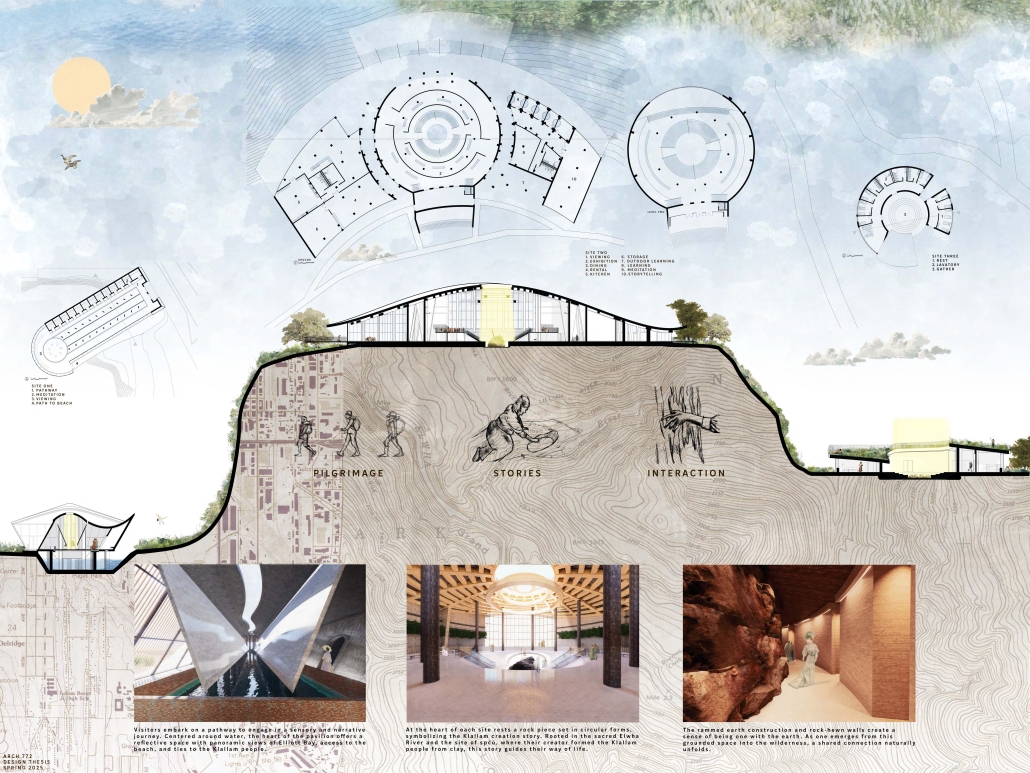
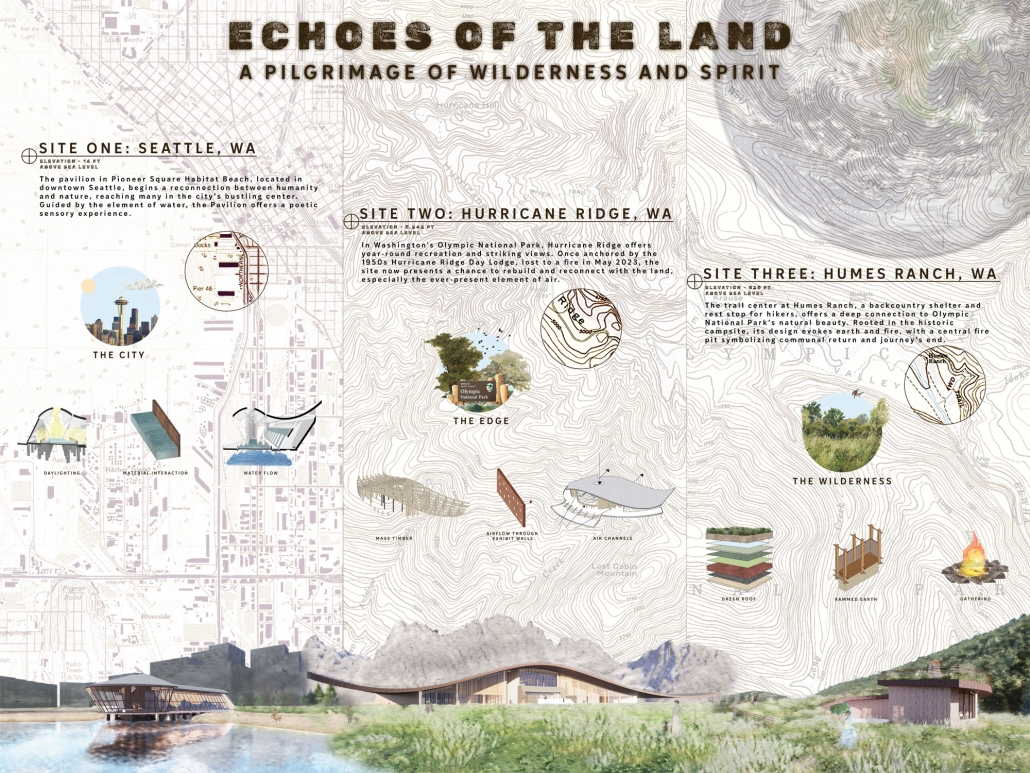
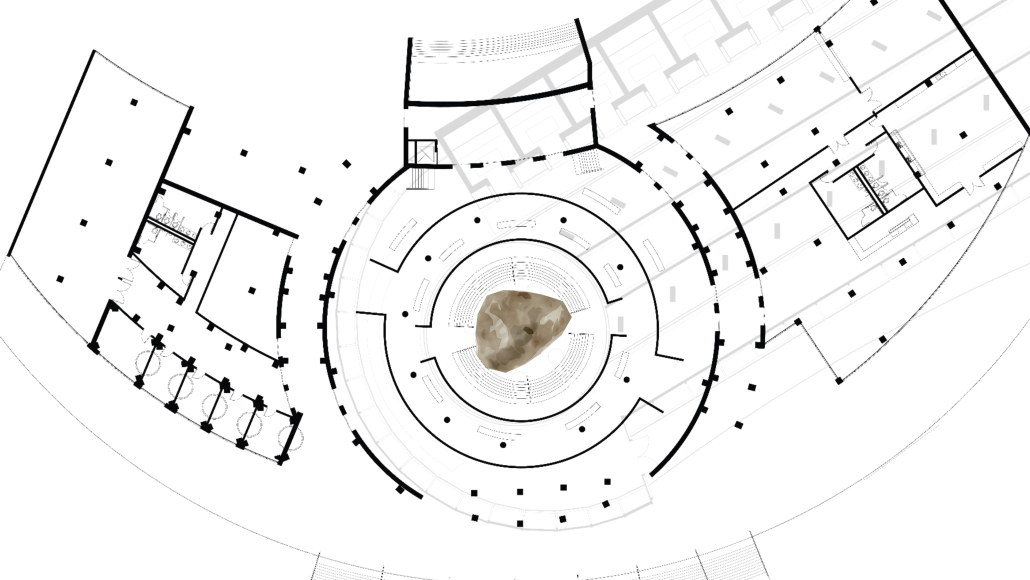
Echoes of the Land: A Pilgrimage of Wilderness and Spirit by Andrea Frank, M.Arch ‘25
North Dakota State University | Advisor: Stephen Wischer

This thesis explores how architecture can bridge humanity and the natural world, restoring a connection eroded by technology, overconsumption, and distraction. While cities offer curated encounters with nature, they cannot replace the deep peace found in wilderness. This connection is essential to humanity’s survival. If humanity fails to understand its relationship with the environment and engage with it responsibly, it jeopardizes the ecological balance of the world and humanity’s own existence.

Architecture, once in dialogue with nature, now often serves function, spectacle, or profit. This work reimagines architecture as a mediator that fosters kinship with the earth through a threefold approach: a pilgrimage across city, edge, and wilderness; poetic uncovering of ancient site stories; and sensory engagement with the four classical elements. In doing so, architecture becomes a vessel for atmosphere, memory, and meaning, guiding individuals to a deeper awareness of themselves and their world.

This project received an AIA Medal for Academic Excellence.

Instagram: @andrea.frank10

A Place for Pilgrimage by Andy Packwood, B.S. in Architecture ’25
University of Virginia | Advisor: Peter Waldman

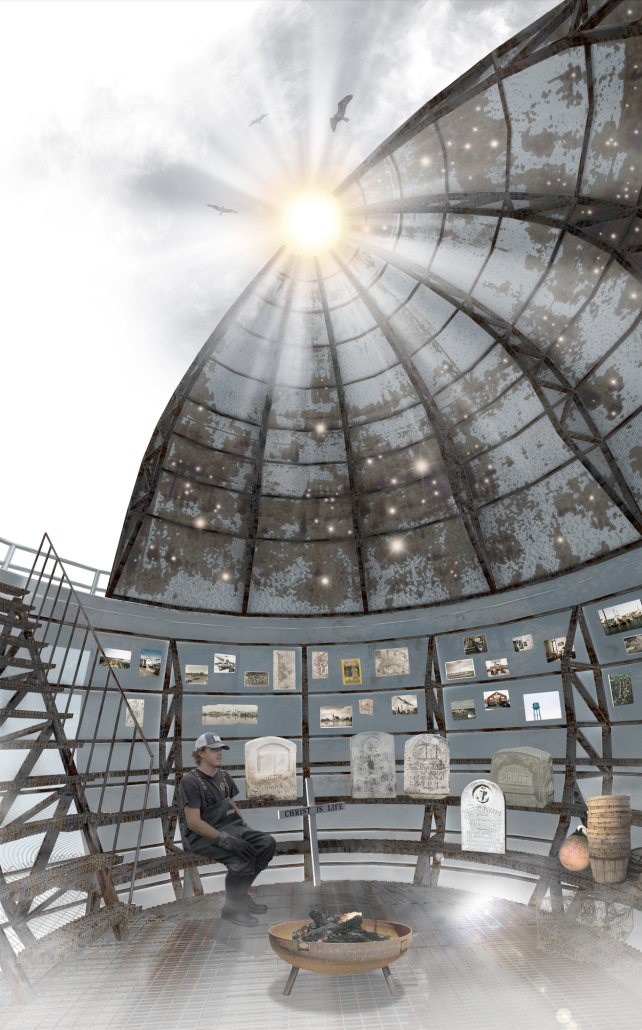
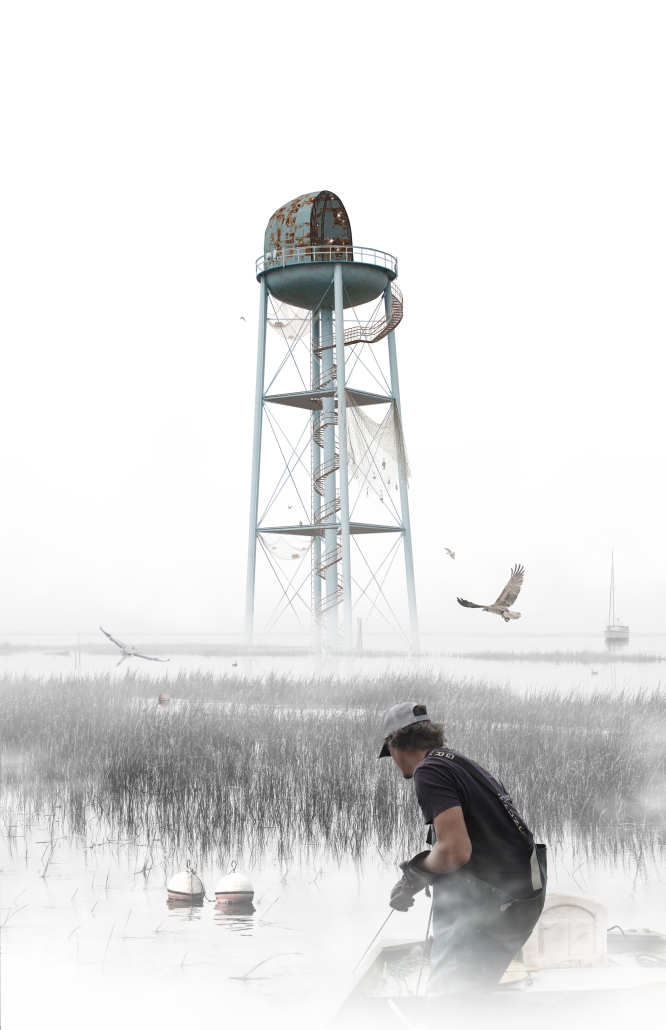
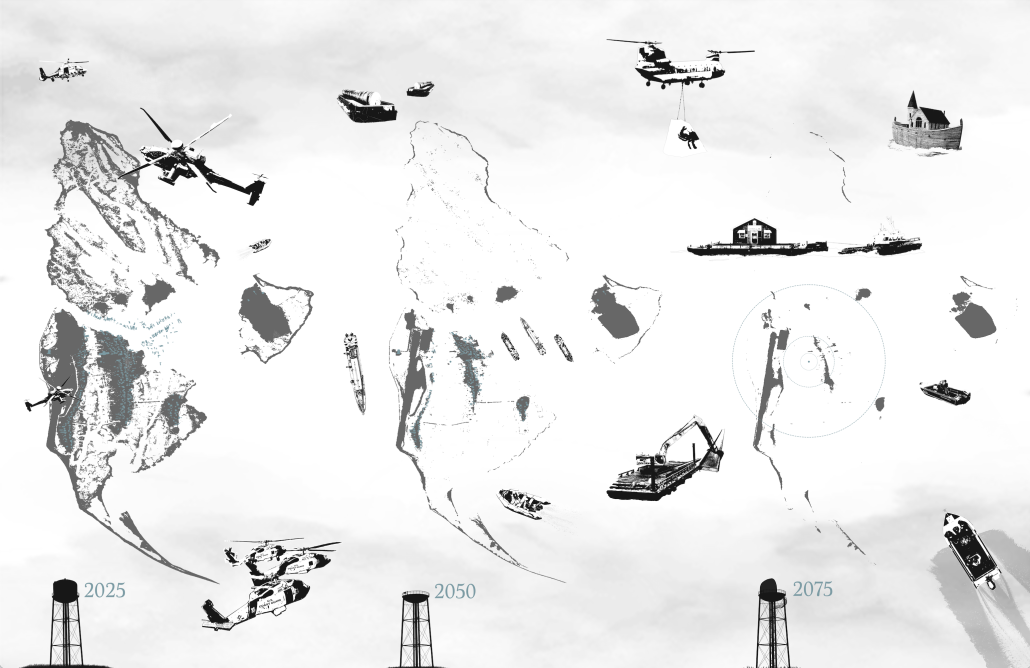
The project synthesizes two years of fascination for and research into the climate-threatened coastal community of Tangier, speculating as to what will ultimately happen to rural, low-income American communities in the wake of inevitable sea level rise. My interest lay not in the proposal of any sort of savior infrastructural solution, not in the proposal of a managed retreat plan, nor in the design of a mainland relocation for displaced refugee residents. I chose to develop a memorialized destination that could still exist on the island long after its ridges have turned to marsh, its homes have been barged away, and normally perceived connotations of inhabitability have all but vanished. I chose to create “A Place for Pilgrimage”, inspired by my own pilgrimage of El Camino de Santiago this past March.

Simply put, the proposal is an adaptive reuse of the tallest structure on Tangier: its water tower. Adding a spiraling staircase and pushing the structure fifty years into the unknown, the design creates a single space in the sky through the removal of half of the tower’s upper dome. The approach is incredibly important; much of the final pin-up focused on rendering this pilgrimage step by step. Starting from the dock of the mainland resettlement, looking out into the Chesapeake Bay, a line of buoys trails towards the horizon. A bird soars toward the tower in the distance, the vestiges of marsh poking out of the water. Cameron Evans, current vice mayor and young watermen of the Island, embarks as this future pilgrim by skiff. He carries with him a gravestone; many cemeteries on the Island are often inundated by tidal flooding, and residents must move these tombs to higher ground, again and again.

What I have proposed is a final resting place, safe from the heights of sea level rise. A place for generations to visit, to bring tokens of remembrance, to occupy overnight, or to even continue their trade as watermen. Up within the dome of the water tower is a cenotaph for the people, memories, culture, history, and beauty of Tangier. We will need one.

This project was awarded High Honors for Thesis.

Ephemeral Spaces — Presence and Absence by Robin Xiao, B.S. in Architecture ’25
University of Virginia | Advisor: Peter Waldman

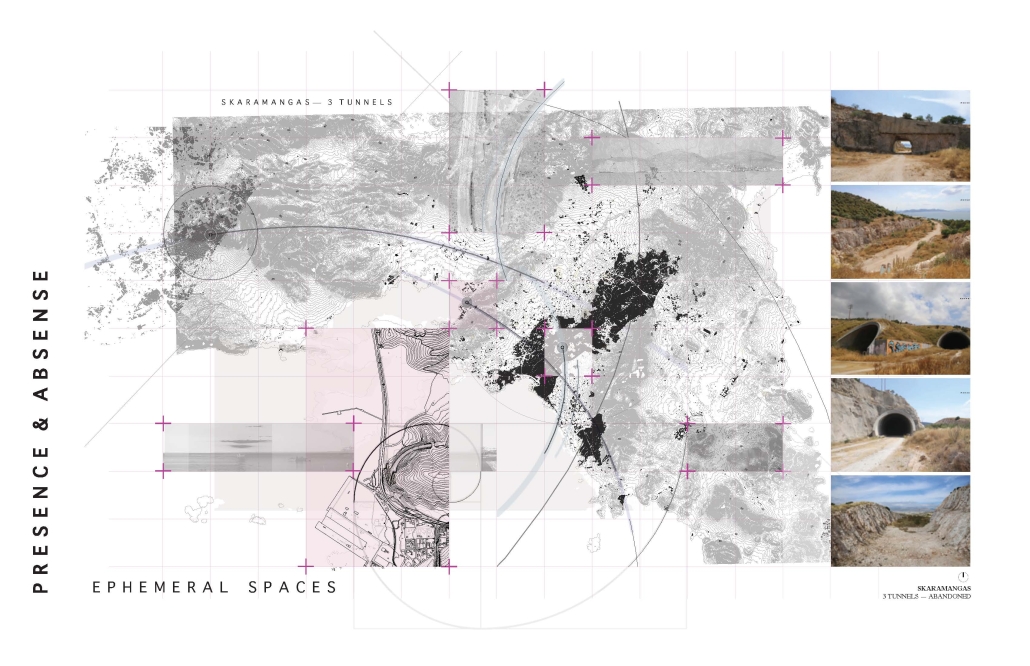
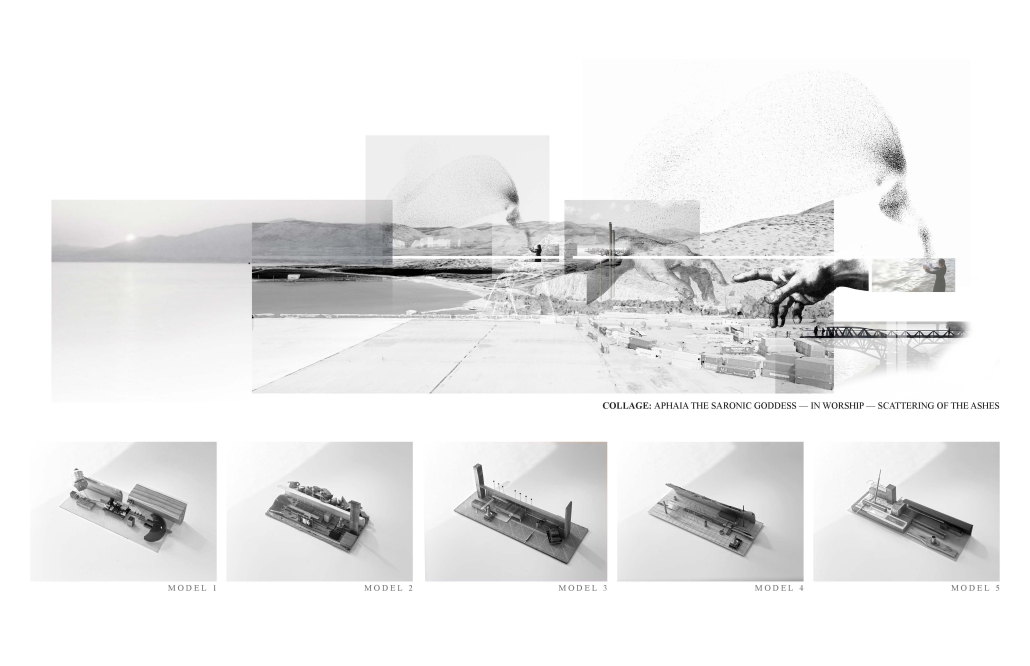
This thesis explores how architecture can emerge from the debris of the everyday to construct a space of ritual and transition—between life and death, presence and absence, memory and forgetting. 

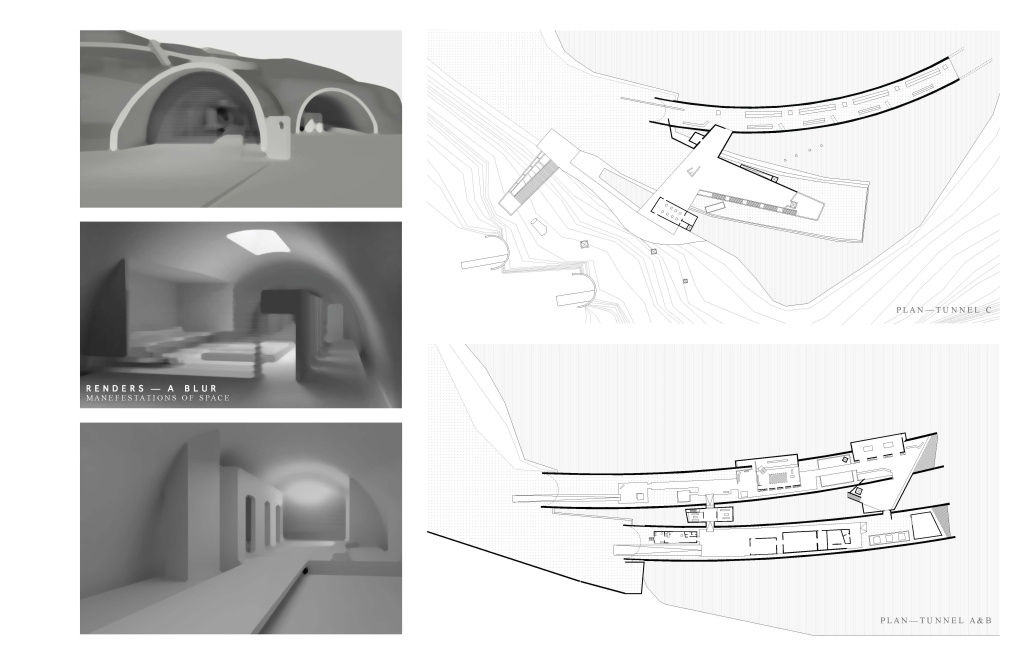
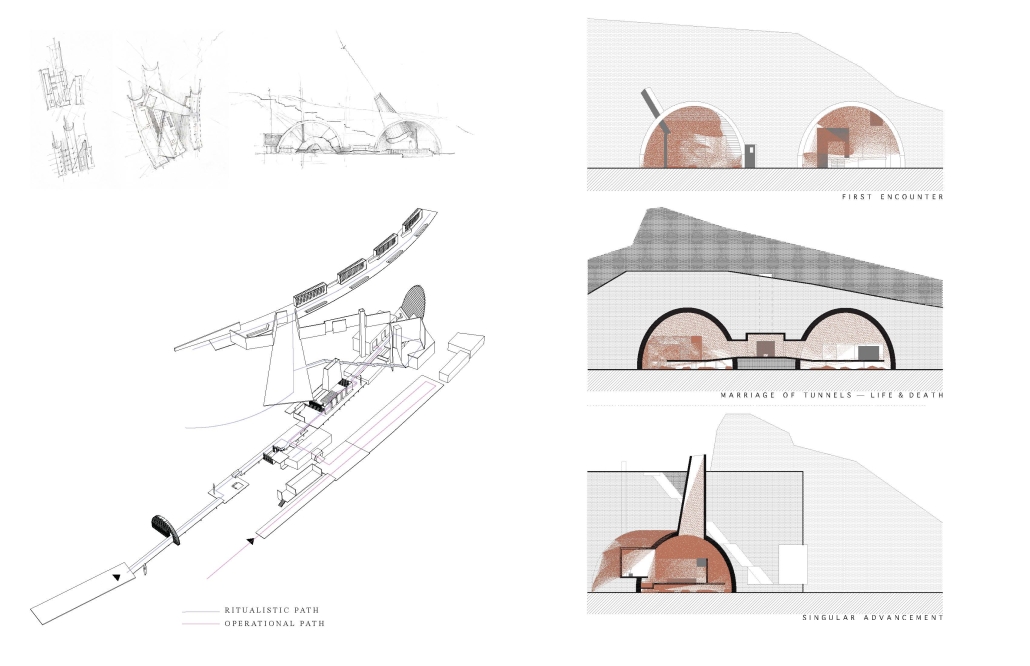
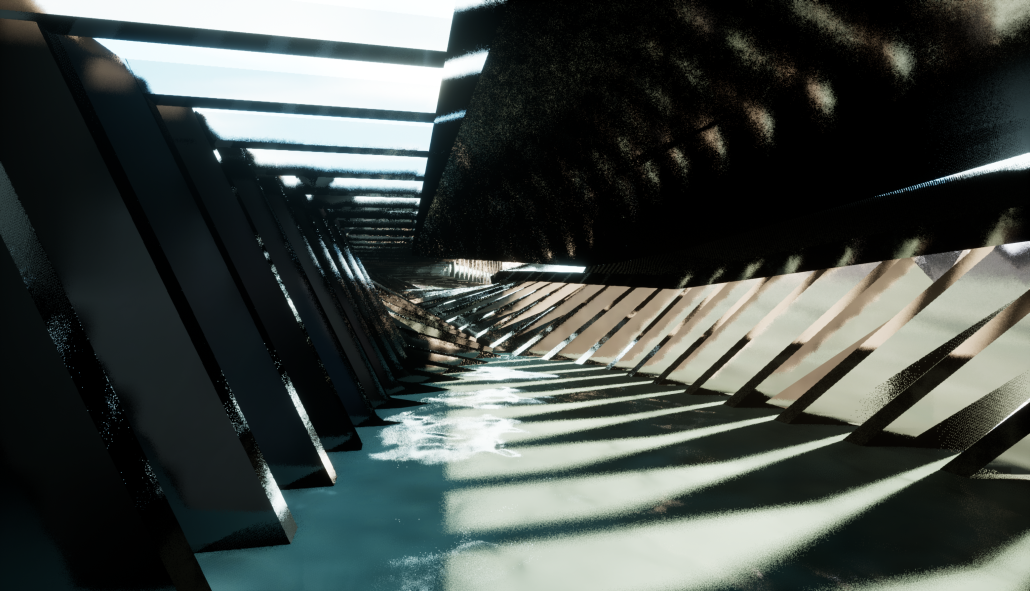
Situated in the post-industrial landscape of Skaramangas, Athens, the project transforms three abandoned military interchange tunnels into a procession of ephemeral architecture: a crematorium, a columbarium, and spaces for reflection, and spaces of pause/entry/exit. 

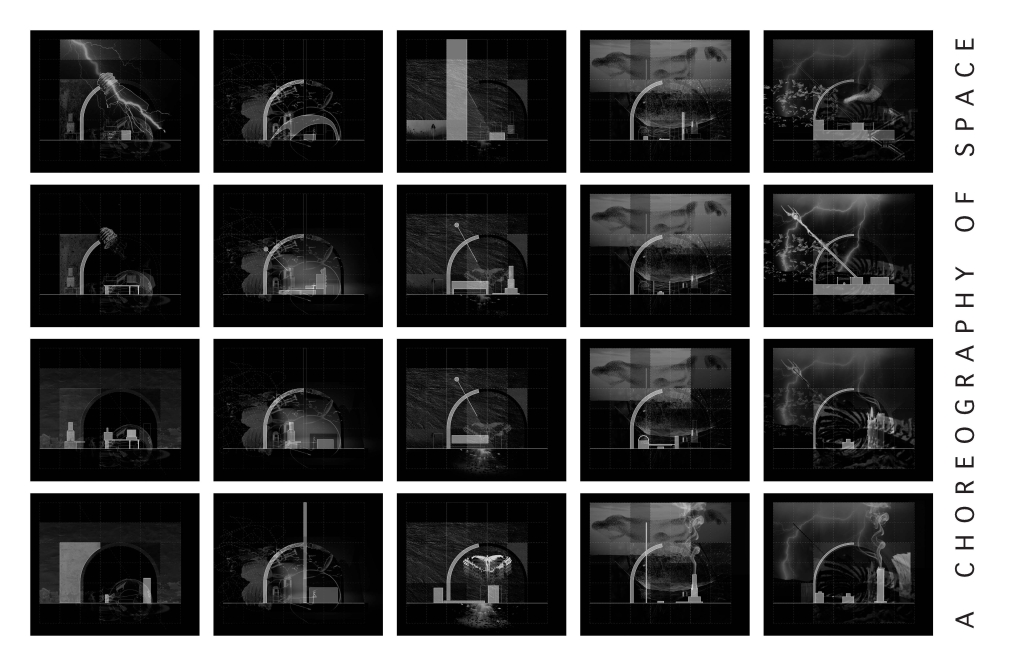
Through a series of five conceptual models, material fragments—broken light bulbs, candles, metal tubing, computer chips, wood scraps—become instruments of spatial inquiry, offering alternative ways to think about temporality, transformation, and the sacred. Each model gives rise to a set of sectional drawings, collaged with elemental forces—earth, fire, air, water—revealing a layered architecture of transition. 

The resulting proposal is not a fixed structure, but a choreography of spaces that invite the living to move with the dead, through tunnels repurposed as thresholds. This work situates ephemerality not as loss, but as an architectural condition of becoming—an act of spatial murmuration shaped by light, material residue, and memory in motion.

This project received High Honors for Undergraduate Thesis.

Instagram: @robinxiaostudio

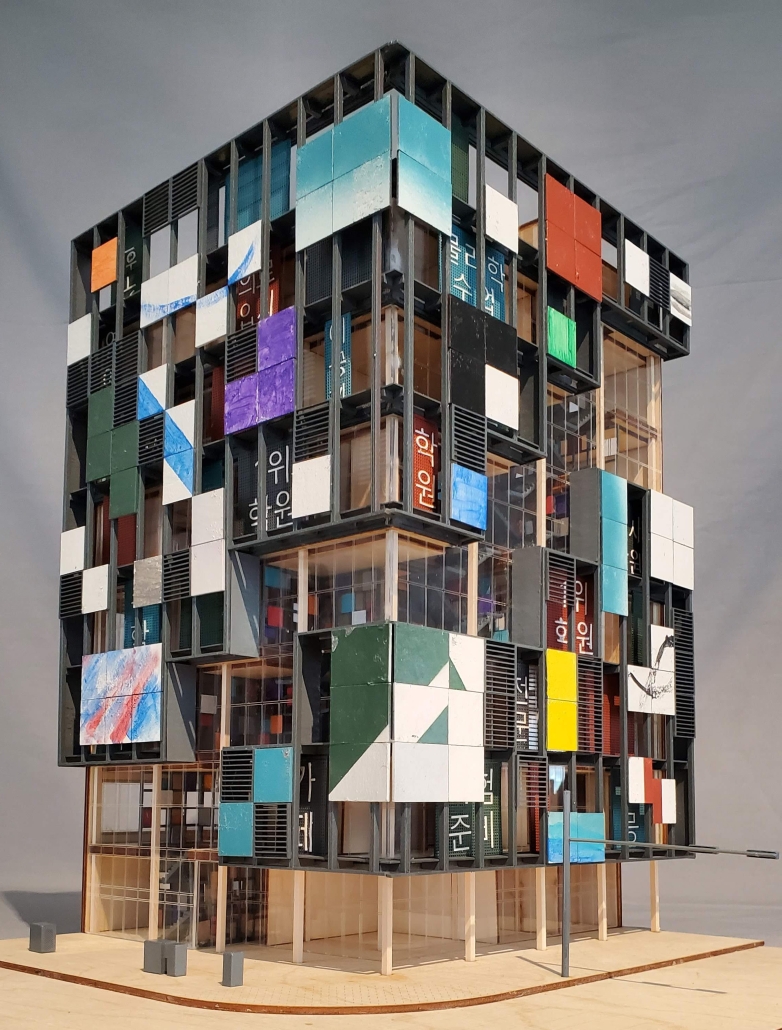
MOVING FUTURES VERTICAL SCHOOL by Alex Hoover & Zach Izzo, M.Arch ’25
University at Buffalo | Advisor: Jin Young Song

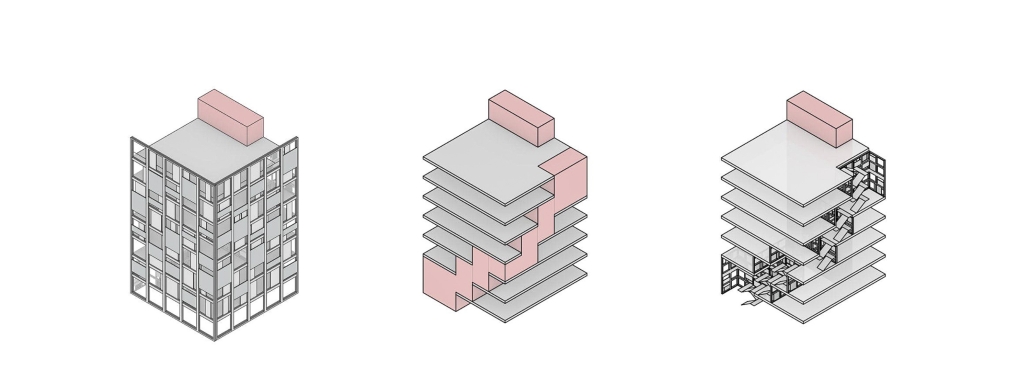
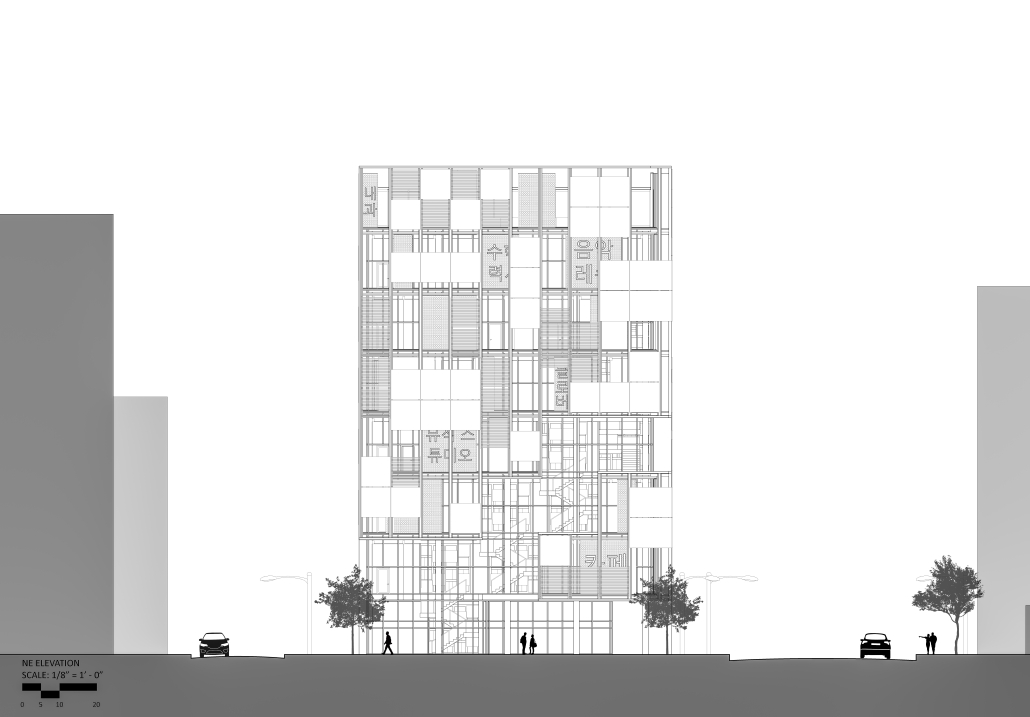
Located in Songdo, Seoul, our project reimagines the typical Korean private educational institutions, known as Hagwon, by prioritizing spatial flexibility and community engagement. Traditional Hagwons often feature cramped, efficiency-driven classrooms. However, research shows that children learn better in environments with diverse spatial qualities—high ceilings, minimal partitions, vibrant colors, and flexible layouts. To address this, we designed a highly adaptable building with movable interior and exterior components. Each main floor features partition walls on ceiling-mounted tracks, allowing spaces to transform easily—from small study rooms to large lecture halls or art galleries. This system ensures both spatial diversity for students and long-term adaptability for future tenants or programs. 

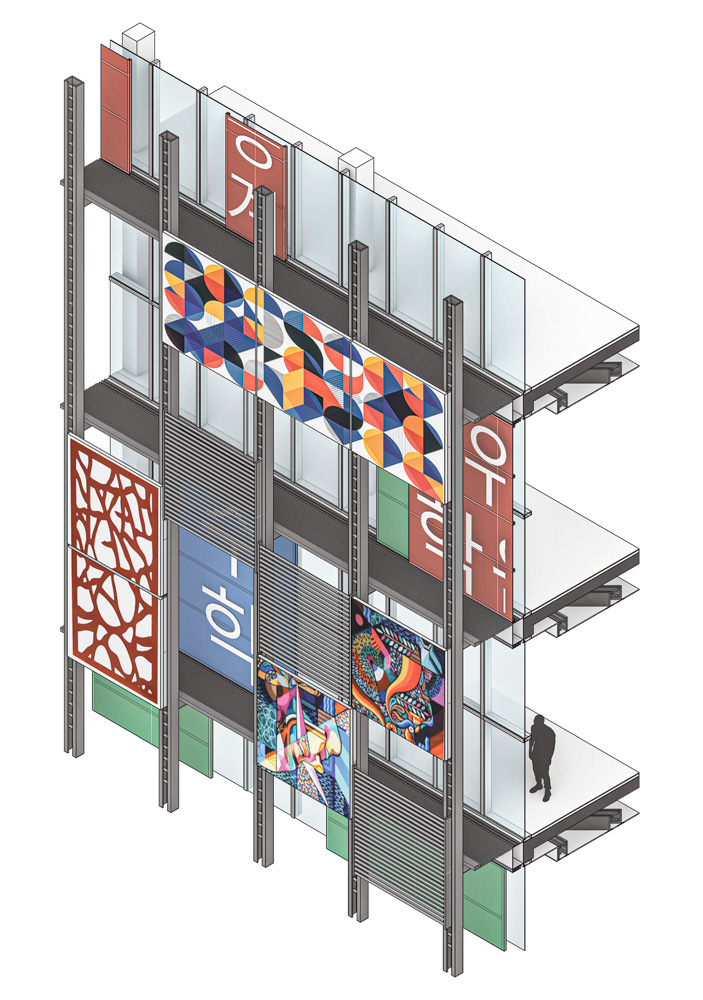
The facade similarly emphasizes flexibility, offering a reinterpretation of Korea’s dense, intrusive urban signage. The three-layer facade system integrates architecture, community identity, and student expression. The outer layer consists of LED media panels and sun-shading devices, configurable to display student artwork or community visuals, establishing the building as a neighborhood landmark. The second layer features sliding perforated metal signage panels, subtly blending information with the architecture rather than overwhelming it. The innermost layer wraps the social stair, visible from both adjacent streets, inviting public interaction and showcasing movement within the building. Smaller panels provide localized signage, such as floor numbers and bulletin boards. Together, the dynamic facade and transformable interior create a learning environment that fosters both community visibility and spatial flexibility, promoting a more engaging, human-centered educational experience.

The project was selected for the Cram Urbanism and Vertical Learning Space International symposium

Instagram: @_alex_hoover, @jinyoung___song  

The Market of Joy by Shefa Quazi, M.ArchD ’25
Oxford Brookes University | Advisors: Toby Smith, Alexandra Lacatusu, Toby Shew, Charles Parrack

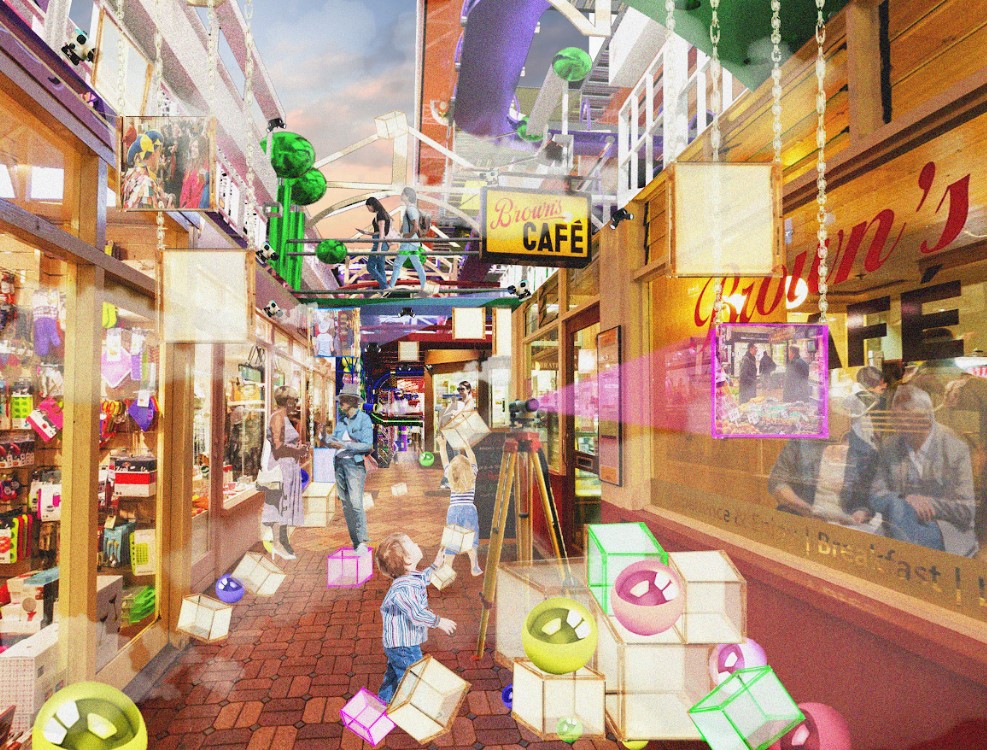
In a world dominated by seamless digital consumption, where screens dictate desires and algorithms predict movement, The Covered Market in Oxford becomes a site of rebellion—a place where reality is glitched, distorted, and reclaimed from commercial control. Instead of a polished, hyper-commercial spectacle designed to guide users into predictable behaviors, the proposed series of interventions hijack the mechanics of digital consumerism and turns them against themselves to exaggerate them into a physical, pseudo-reality. Attempting to readminister the loss currency of joy.

The market transforms into a disruptive, anti-brand arcade—a physical and augmented experience that interrupts, unsettles, and reawakens users to the absurdity of algorithm-driven life. Augmented Reality, typically a tool for corporate control (filters, tracking, gamified shopping), is instead repurposed to create moments of détournement, where the commercial is undermined, and participation leads not to consumption, but to adding weight to reality and human interaction. Overall revaluing the High Street as a whole. 

Instead of guiding users toward consumption, the market becomes a disobedient space, forcing engagement away from passive scrolling and toward critical awareness of spectacle itself. The interactions don’t feed an algorithm—they break it. The market is no longer a relic of pre-digital commerce but a living, evolving site of resistance against digital saturation and corporate control.

This project received the Oxford Brookes University Reginald W. Cave Award.

Instagram: @sheevz_q, @oxarch

The Inner Mechanism by Jared Roberts, M.Arch ’25
Lawrence Technological University | Advisor: Masataka Yoshikawa

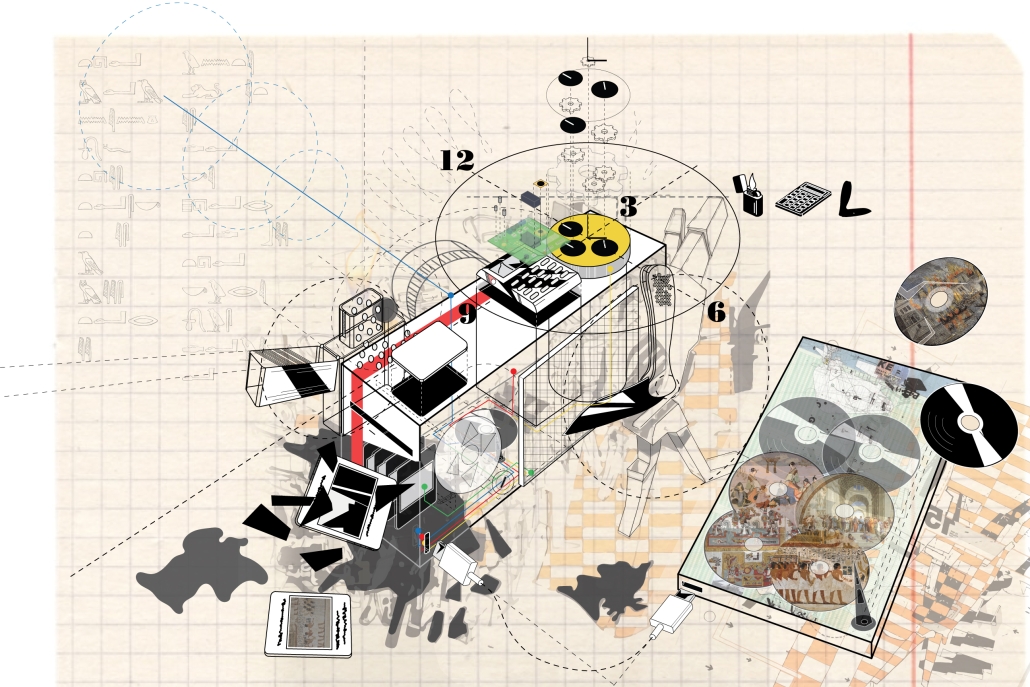
This project sees the physical model and 2D illustration of the hypothetical device abstracted to create architectural forms and spaces. The form derives itself from the concepts dealt with in the inner mechanisms and particularly information storage. The “nested” nature of digital information storage (i.e., nested file folders on a computer) translates to nested architectural forms that sometimes exist within or even overlap other parts of the model. Another concept was that of information’s changes and persistence over time. The form is constructed like a timeline that exists in all three dimensions, inspired by the flow map of Napoleon’s invasion of Russia, which charts various different variables including location, population, time, events and more about Napoleon’s Russian campaign. In the same way, the timeline is a two-dimensional visual representation of information gathered about events in history; this model is a three-dimensional representation of the information gathered and stored by the hypothetical device. 

Instagram: @masataka.yoshikawa

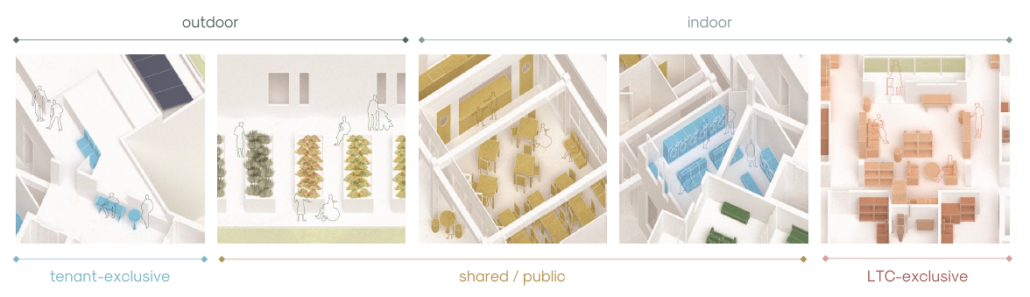
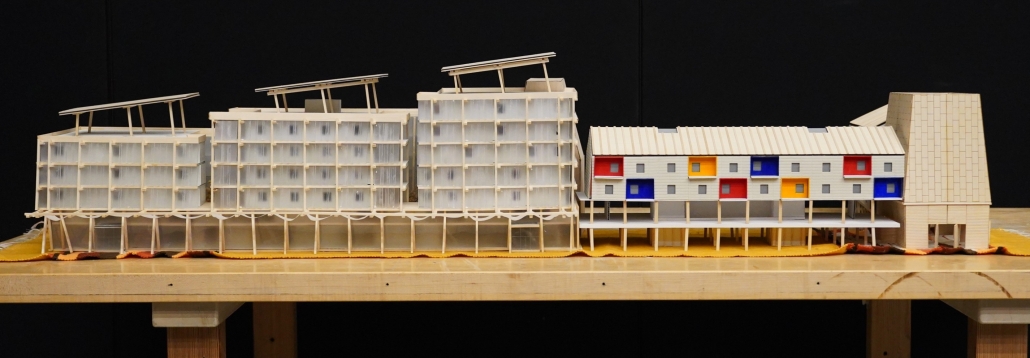
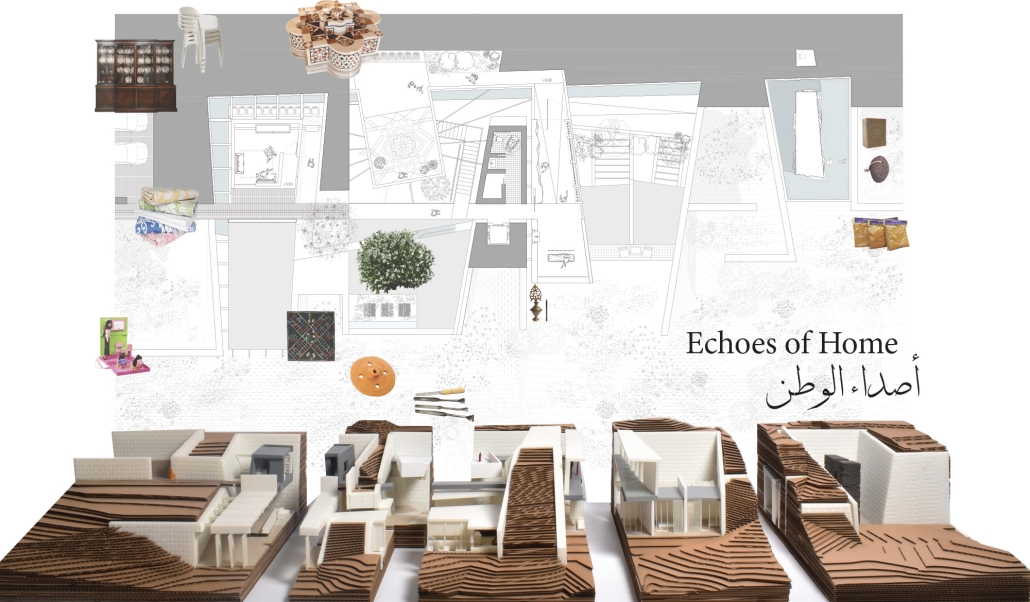
Echoes of Home by Zuha Arab Sabbagh & Rana Abdelhadi, B.Arch ’25
American University of Sharjah | Advisor: Gregory Thomas Spaw

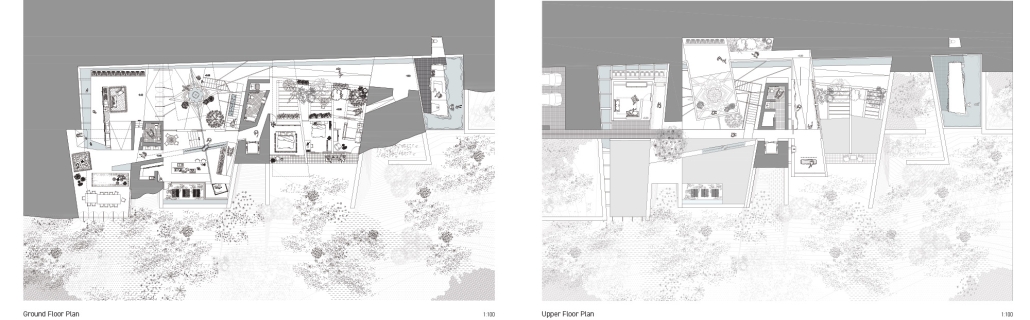
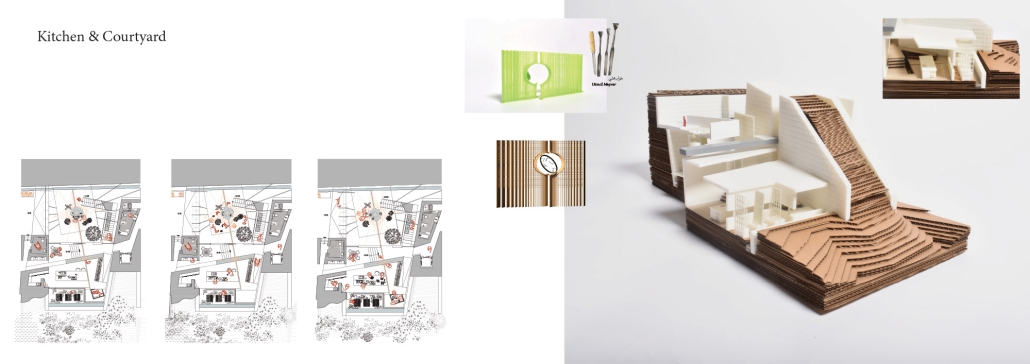
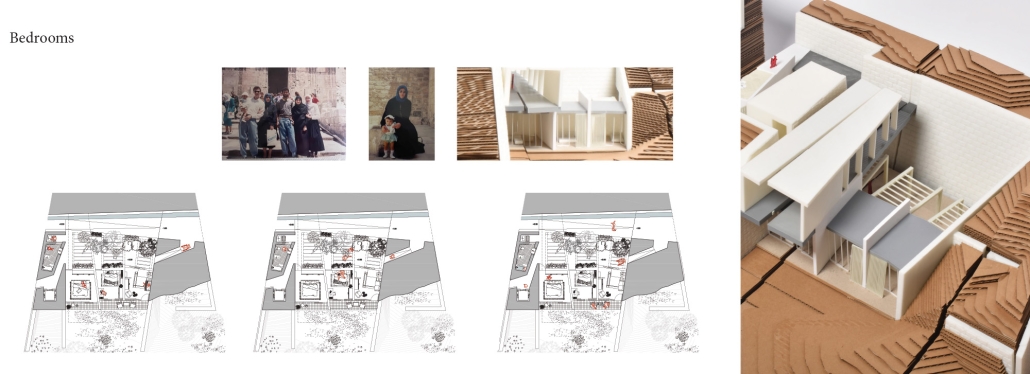
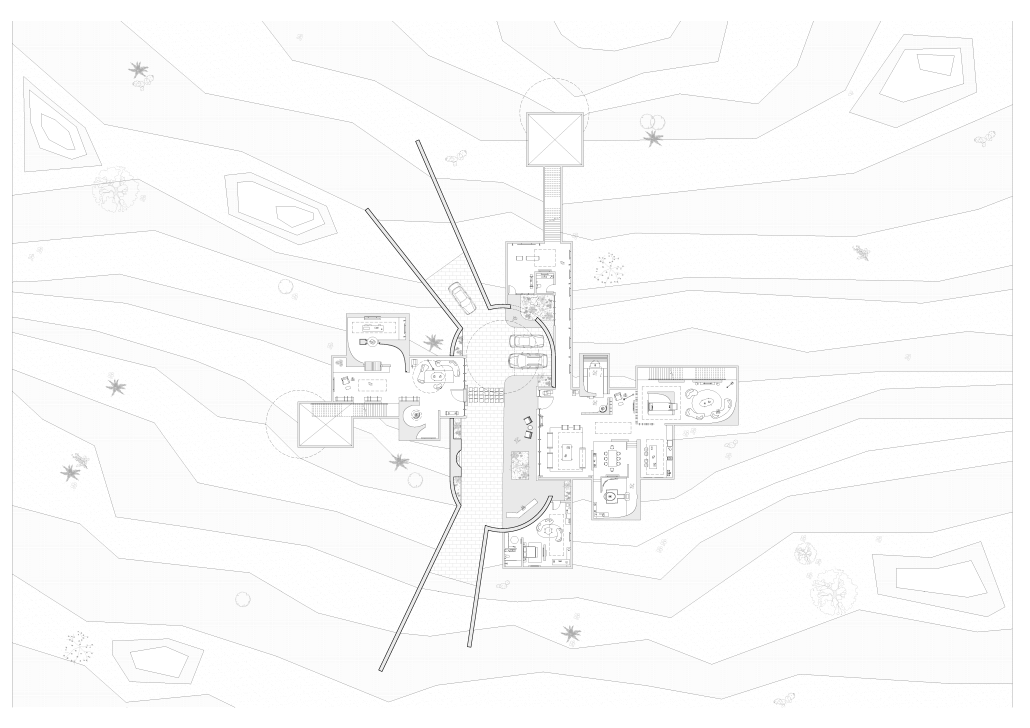
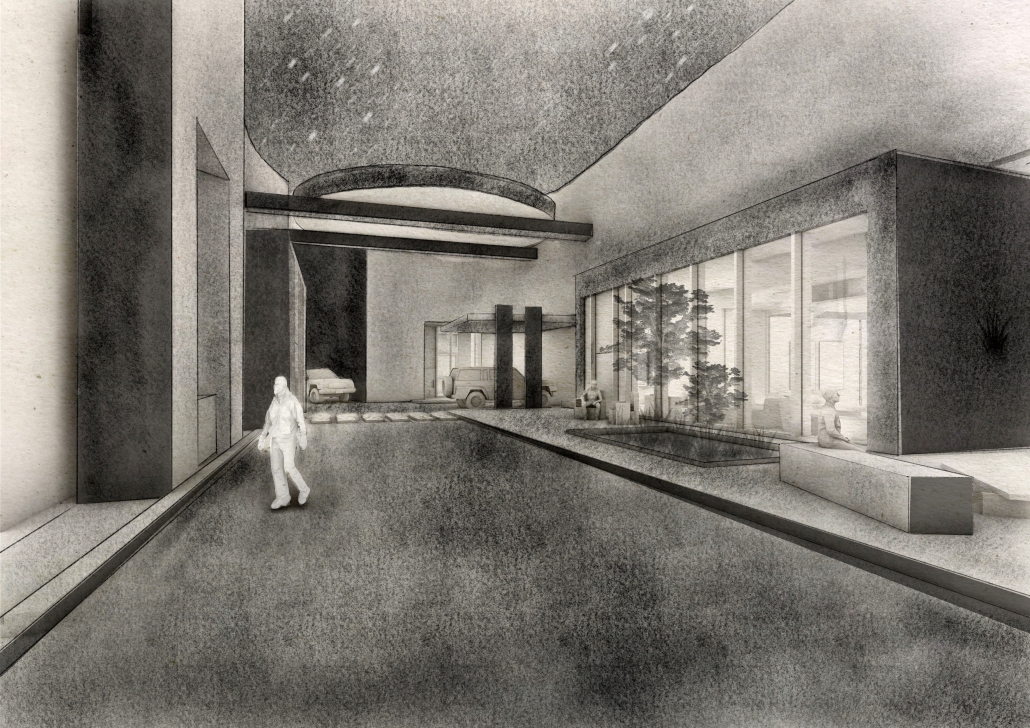
‘Echoes of Home’ responds broadly to displacement in our globalised world. Specifically, on the generational displacement of Syrians. Centralised on the intimate and underappreciated labour of homemaking, the project acts as a recognition and celebration of Womanhood as a discipline. It is designed to mark the story of displacement – building and rebuilding – into an inconstant world. The project tentatively approaches the need to capture the complicated ephemerality in our modern understanding of what ‘home’ is.

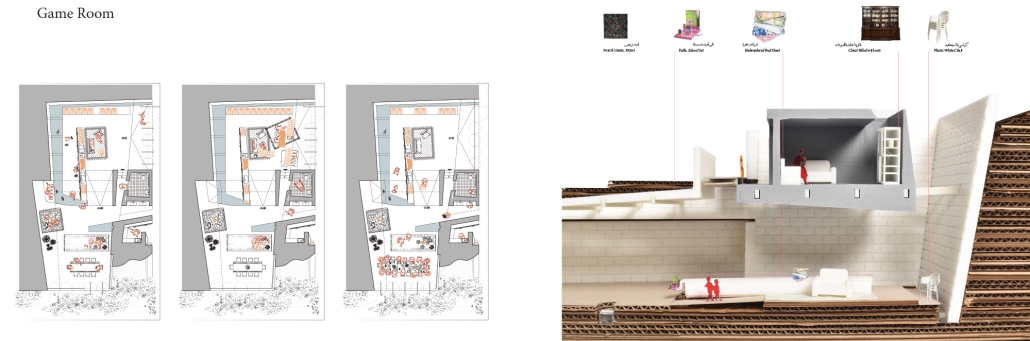
In designing a secondary residence-exhibition, the studio deployed the renaissance phenomenon of the cabinet of curiosities to challenge us to create spatially charged architecture focused on the exhibition of artifacts. We selected fictitious clients, curated a selection of curiosities to display, picked a suitable site, and decided the extent of distinction between the residence and the exhibition.

Designing a residence required an examination of the notion of ‘home’. Historically, ‘home’ has been explored as a vehicle for living and, with the rise of modernism, critiqued as performative. The programs selected recognise the labour of homemaking and extend to capture the performance of hosting and the pleasure of gathering. ‘Home’ has consistently been placed in women’s domain. The practice of homemaking falls under the discipline of Womanhood. The project adheres to the practice and rejects criticism, accommodating for it spatially. The kitchen, game room, bathing space, bedrooms, bathrooms, and guest room all double as exhibition spaces. The integrated spaces create opportunities for gathering and hakawayti (storytelling). Homes tell a story of past, present and future, and the project acts as a natural extension.

Encouraged to design spaces from the inside out, the client and narrative guided design decisions. The Characters: a mother, daughter and grandmother, based on Syrian women in our vicinity, emphasise the generational distinctions in modes of displacement: immigrant, diaspora and refugee. The clients’ stories resemble those of many diasporas. 

Instagram: @gregoryspaw

An Anchor in Time: A Dwelling Reflecting the Interplay of Time and Space by Salma Hani Mubarak Ali, B.Arch ’25
American University of Sharjah | Advisor: Gregory Thomas Spaw

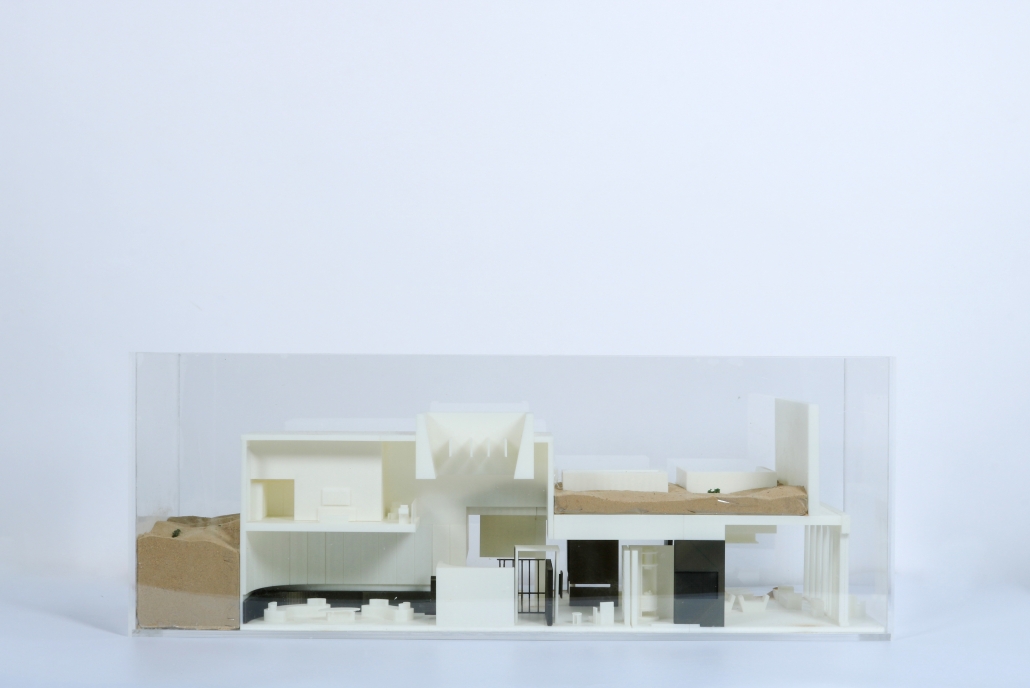
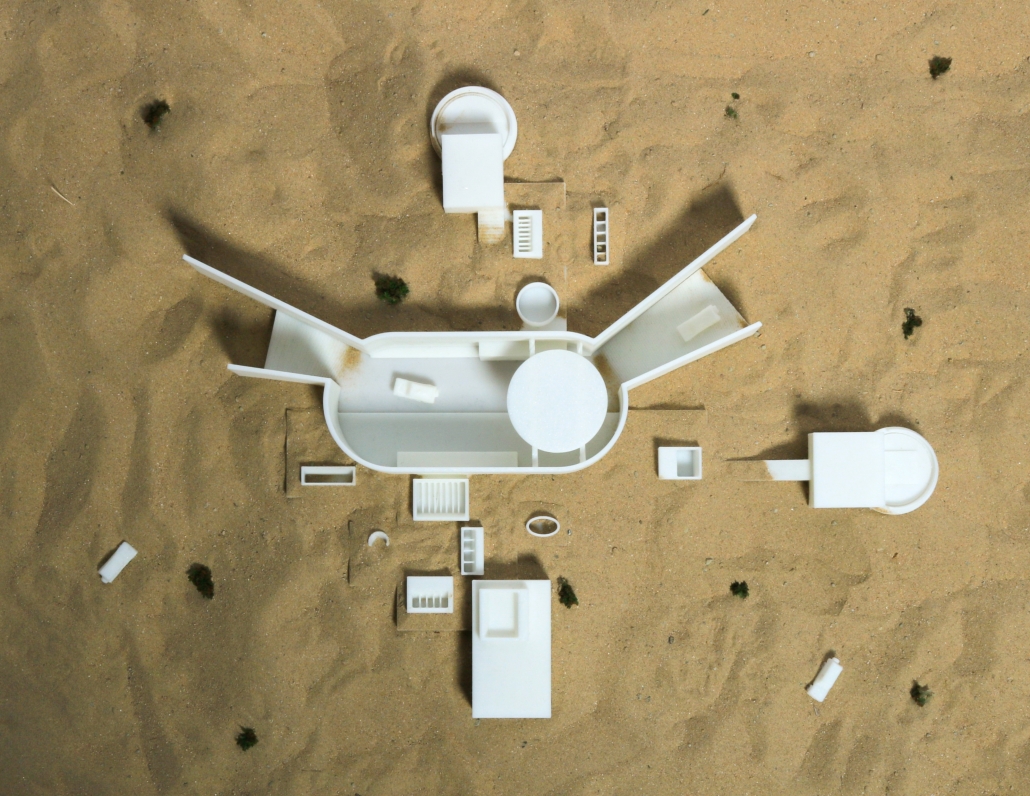
In the vast stillness of the desert, this residence becomes a compass of time—a place where shifting sands echo the dance of the stars, grounding life within the endless drift of the cosmos. The design emerges from the client’s collection of astrological instruments, shaping spatial arrangements that enhance functionality and interaction. Objects inform the layout, with dedicated areas that invite exploration and observation. Strategic openings frame views of the night sky and desert, enriching the experience of celestial observation. This residence serves as both a home and an observatory, fostering a profound connection to the cosmos while celebrating the beauty of time and change. (Text: Salma Hani Mubarak Ali)

Cabinet of Curiosities: Exploring the Ensemble (aka, house of the collector) is an option studio utilizing the 16th-century-18th-century phenomenon of the Cabinet of Curiosities or Wunderkammers (wonder-rooms) as a point of departure to explore the exhibition of ensembles of artifacts with the goal of creating spatially charged architecture.

Working as individuals or in pairs, students had the opportunity to curate their own collection of curiosities and develop a novel architectural language to facilitate the display of the exquisite objects. Associated with the collection was a real or imagined client that served to further drive a generated domestic program. With the scale of the overall proposals being purposely manageable, students had the opportunity to focus on developing architectural assemblies that directly engage with issues of materiality, connections, and details. As such, physical and digital models were heavily employed as tools to study the interplay of elements at a series of scales

This project won the RIBA Gulf: Future Architects 2024 Overall Best Model Award.

Click here to learn more.

 Instagram: @salma.hani.ali, @gregoryspaw

Evermore: A Cemetery For The City by Mo Karnes, B.Arch ’25
Mississippi State University | Advisors: Jassen Callender, David Buege, Aaron White, Mark Vaughan & David Perkes

My uncle died less than two years before I was born. I never met him, but his death is only an obstacle in my ability to know him. Chris was an artist and poet who left behind many things for me to know him by, including a poem entitled Evermore, written during his struggle with AIDS. The meditation is: 

I will walk unlonely,

Holding me up

As I begin to fall,

You Lead the way

And sometimes follow.

Our passage now is

Evermore.

(To be repeated, Unending).

To be ‘unlonely’ is a profound response to the impending, seeming loneliness that is death. Loneliness for those dying and those left behind. Chris’s poem is not just a meditation for himself, but for those struggling with loss. As a dying man, Chris places himself shoulder to shoulder with the reader; their journey is one and the same.

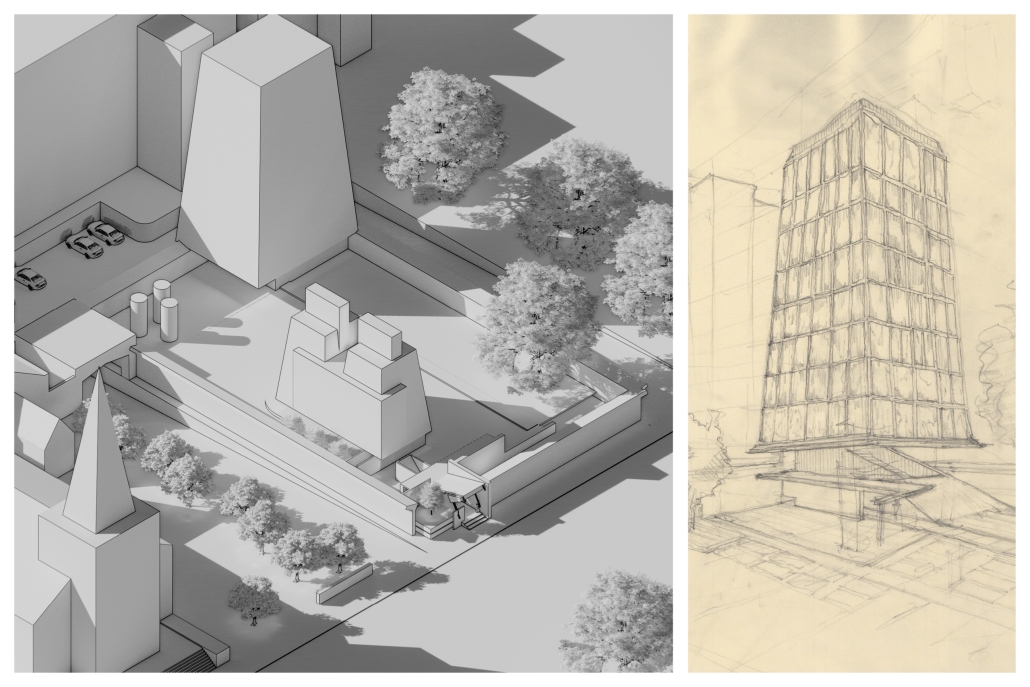
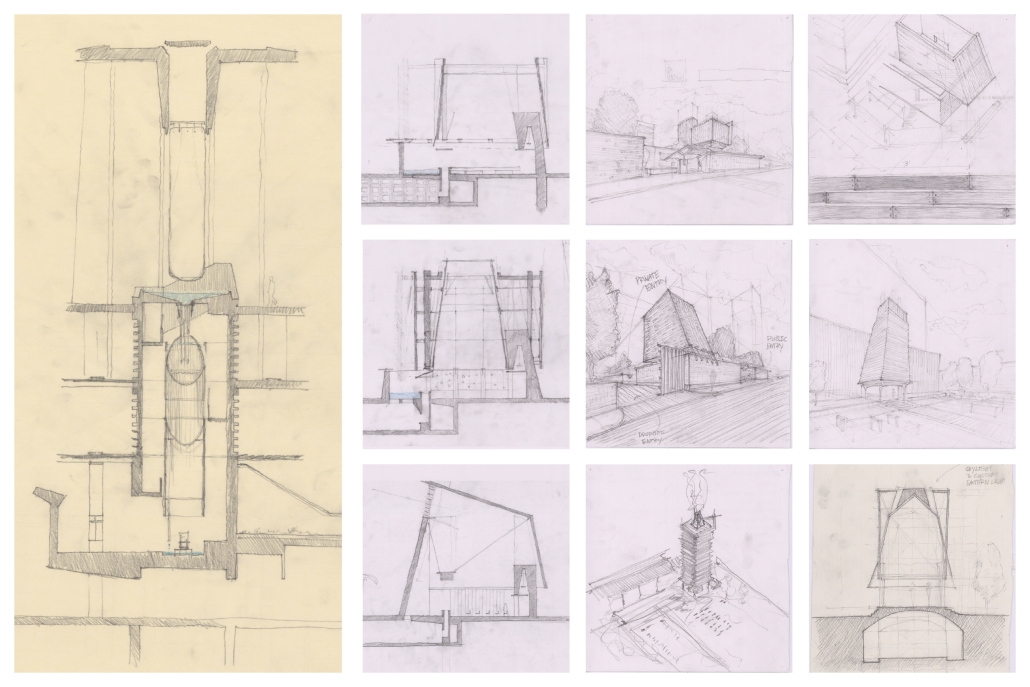
“Evermore: A Cemetery For The City” is a small cemetery complex adjacent to the Cathedral of St. Peter the Apostle in Downtown Jackson, Mississippi. The complex comprises a crematorium, vertical columbarium, and chapel. The site is rectangular, bound on all sides by concrete walls with only one threshold for entry. Two masses seemingly float behind the concrete boundary walls that veil them, the smaller chapel and the larger columbarium. Both stoic in form, they disguise the intricacies hidden in the interiors of their masses.  

The ambition of this project is to integrate the awareness of mortality into the city, while supplying architectural means to confront it. This awareness is not a means of oppression, but an attempt to convey the gift that is life. This cemetery is intended to be a public space where inhabitants can experience the city with citizens who came before them, inducing a relationship with the past, generating an appreciation of those who came before, and propelling the city forward with the intent to befriend and mentor the future.  

This project received the CDFL Capstone Studio Travel Award. 

Instagram: @mo.karnes, @jassencallender

IMAGINATIVE REALITY: INVENTION OF SYNERGISTIC NARRATIVES by Chey Isiguzo, M.Arch ’25
Toronto Metropolitan University | Advisor: Lisa Landrum

Imagination is both an act and a familiar, safe space, evoking nostalgic feelings rooted in our reality. 

This space can become unfamiliar when cultural expressions changes, leading to multifaceted identities and undeveloped narratives. This dynamic contributes to cultural conflict and highlights the juxtaposition of traditional and contemporary African architectural narratives. As a space, imagination can generate narrative 

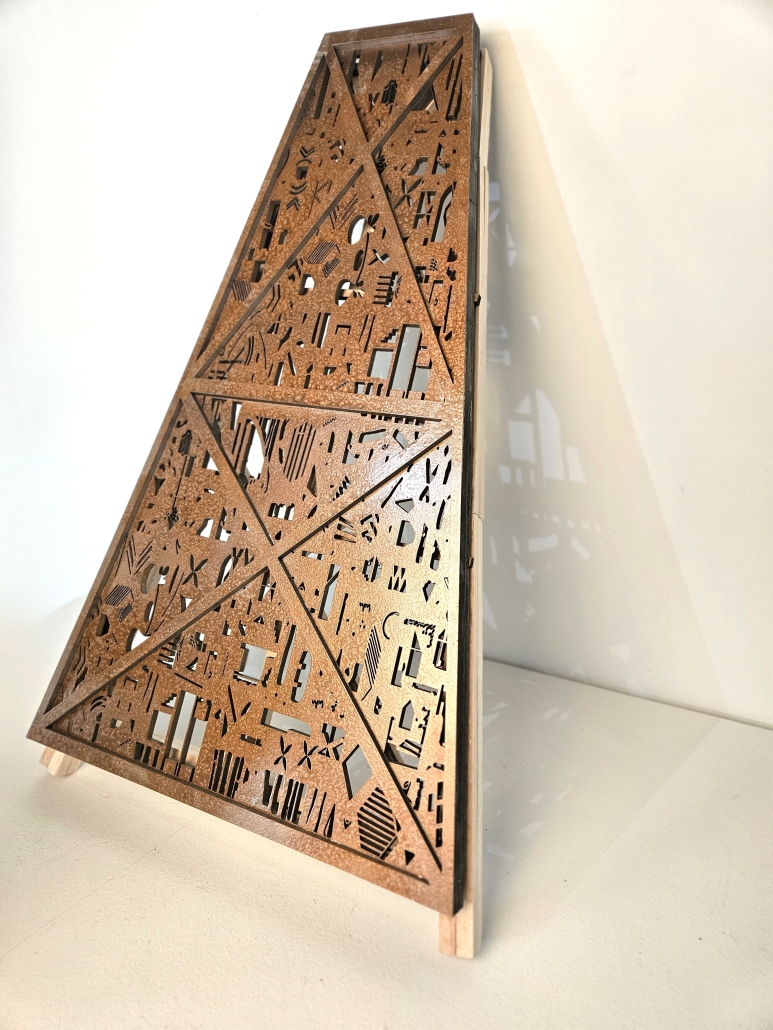
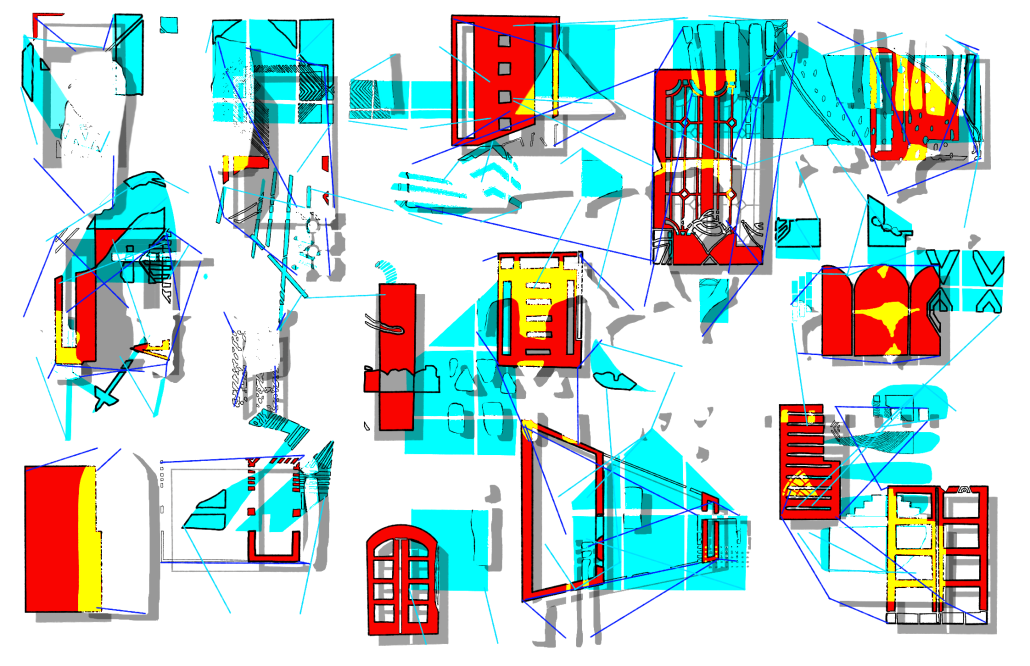
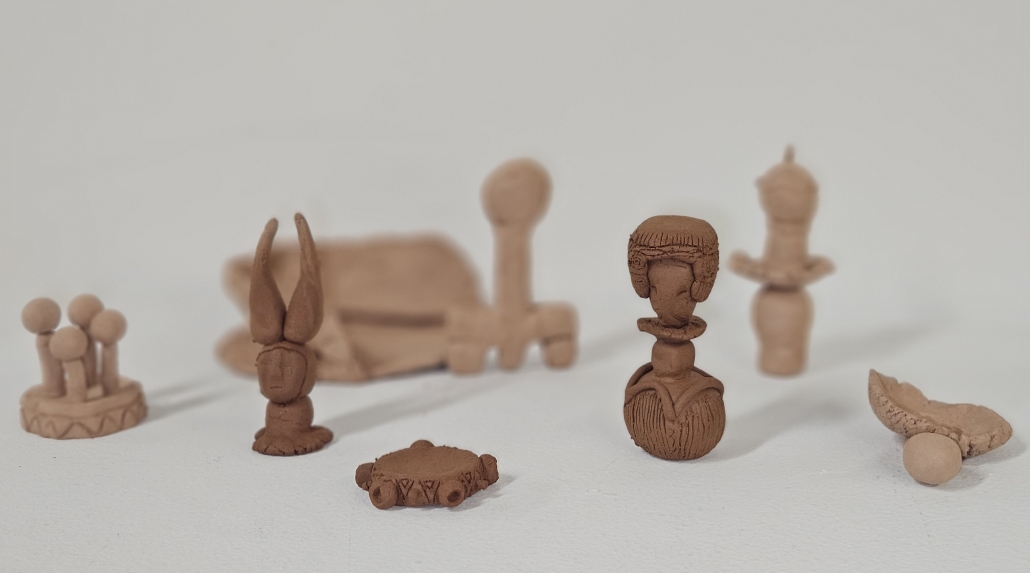
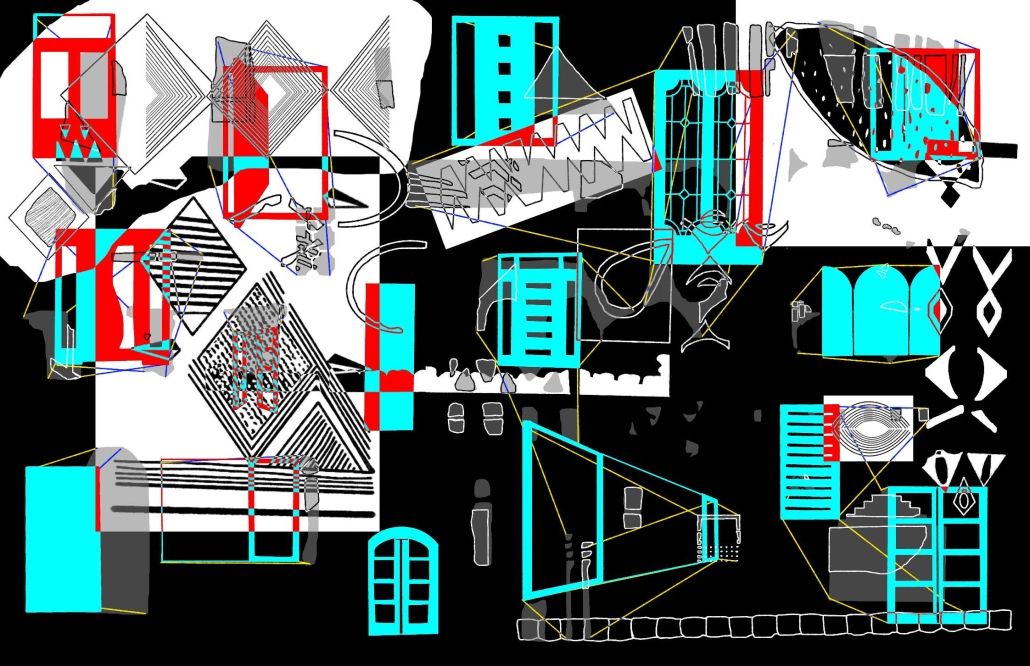
characters and elements by creating synergistic stories that incorporate traditional craftsmanship into contemporary African architecture. The imaginative process consists of three components. Imagining while thinking is an act that uses mental images from memories, dreams, fantasies, or visions to create one’s reality. Imagining while making is the act of craftsmanship used to speculate the distinction between traditional and contemporary architectural narratives through the lens of cultural expressions. Imagining while drawing is an act of translation by utilizing narrative characters—building elements like windows and doors—to dissect fragments of both traditional and contemporary architecture to find new narratives. 

These narrative characters work alongside structural elements, such as walls, roofs, layouts, courtyards, and compounds, to convey new stories that showcase materials and design techniques rooted in Igbo craftsmanship. To develop synergistic narratives, one can explore the evolution of traditional African craftsmanship, particularly within Igbo culture, across ancestral, post-colonial, and contemporary contexts. This exploration reveals how the architectural narratives of traditional and contemporary styles are increasingly distinct. Consequently, this imaginative space becomes a reality that examines the relationship between what is real and what is envisioned through architectural craftsmanship.

Instagram: @sumisi000, @ucisi_studios, @tmu_archgrad

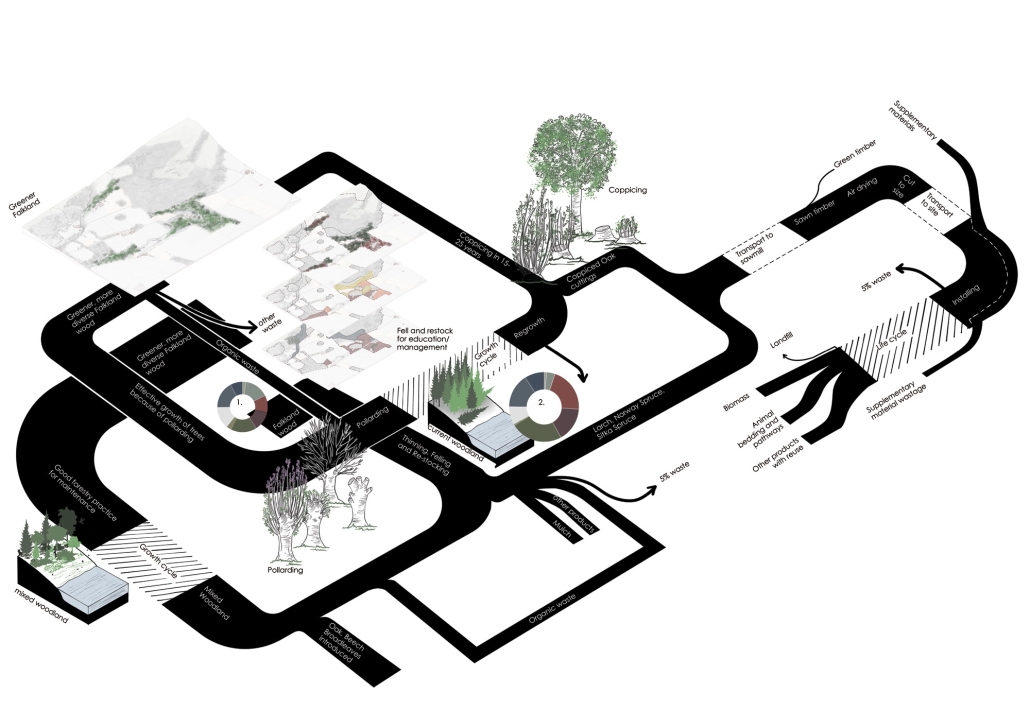
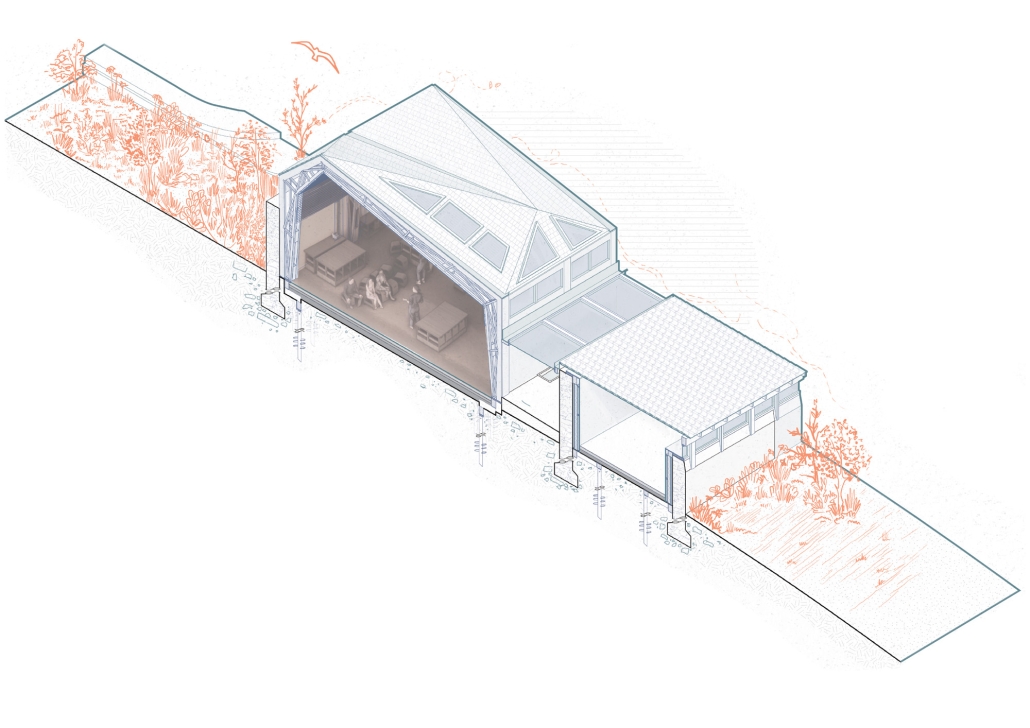
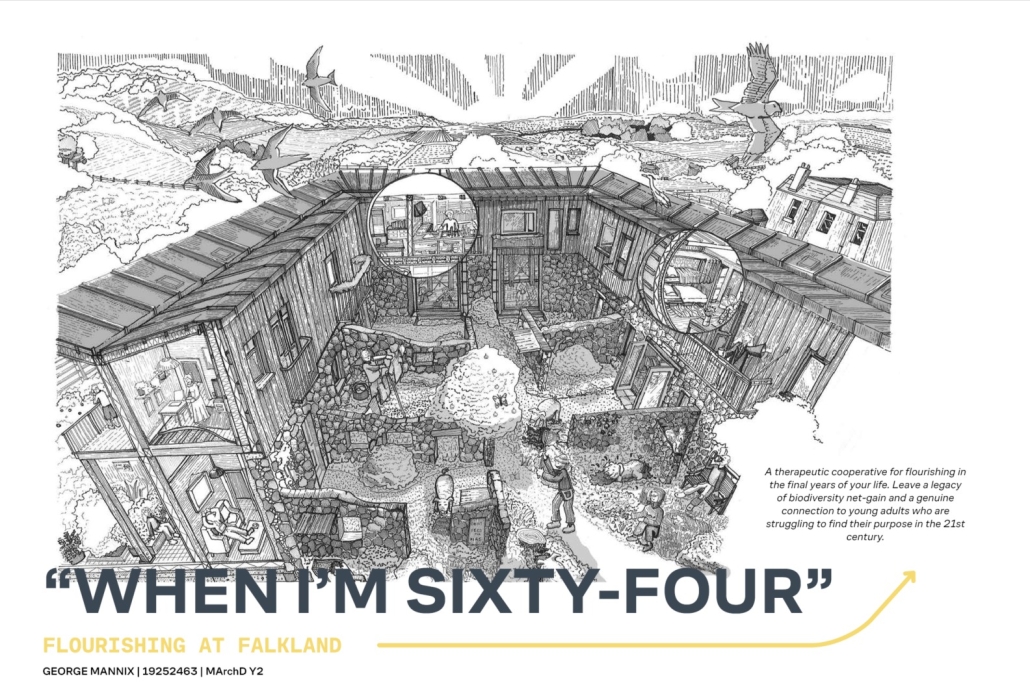
When I’m Sixty-Four: Flourishing at Falkland by George Mannix, M.ArchD ’25
Oxford Brookes School of Architecture | Advisors: Melissa Kinnear & Alex Towler

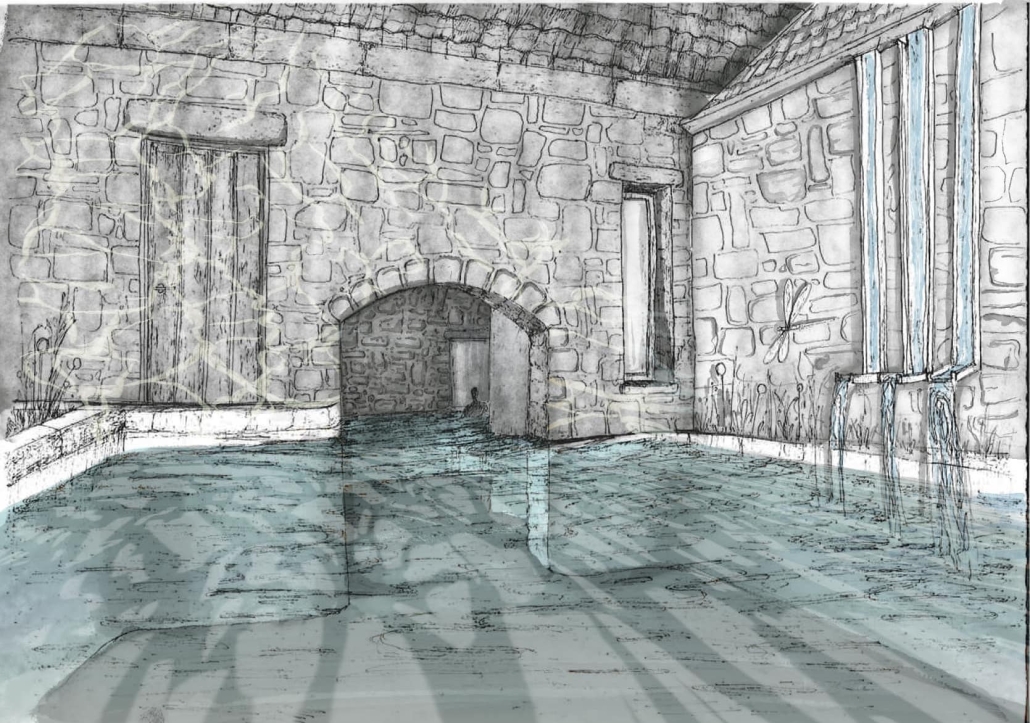
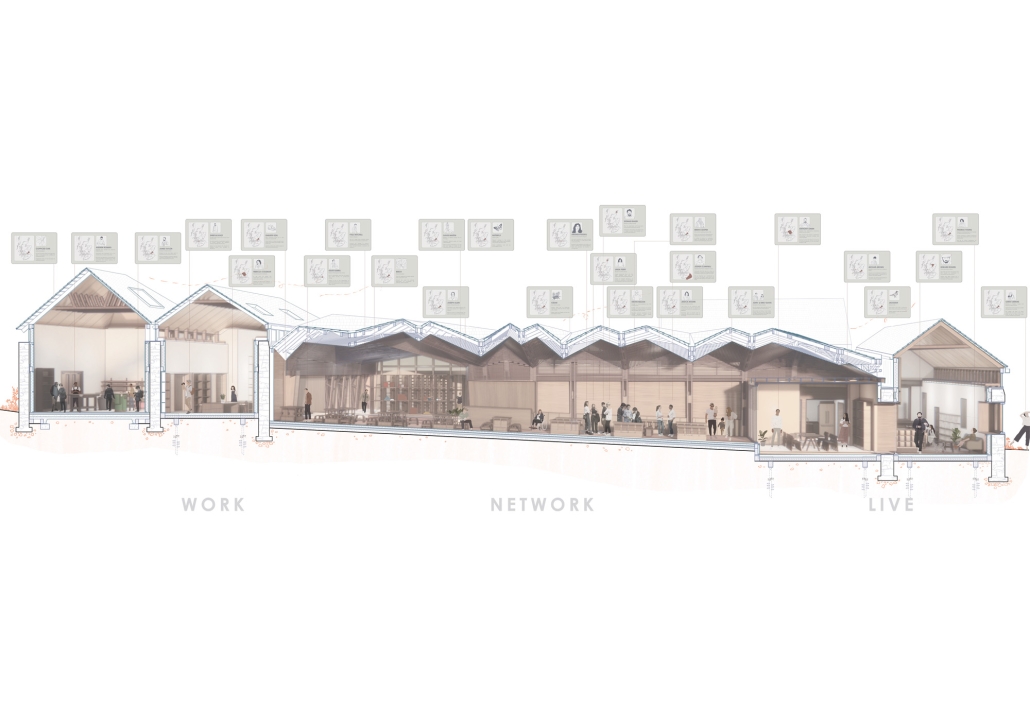
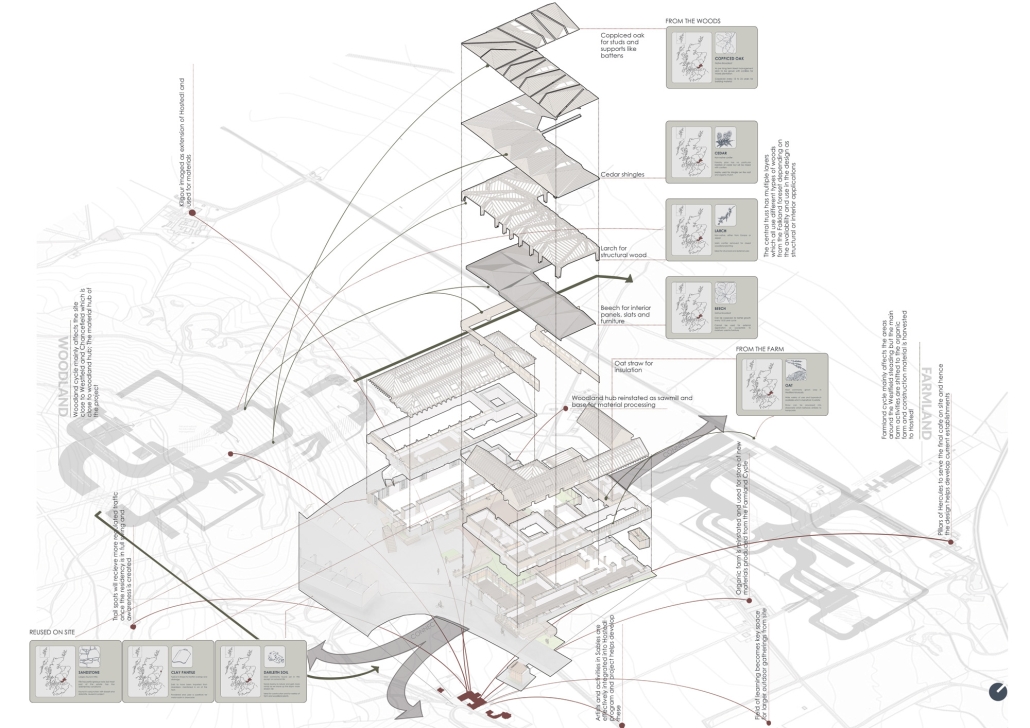
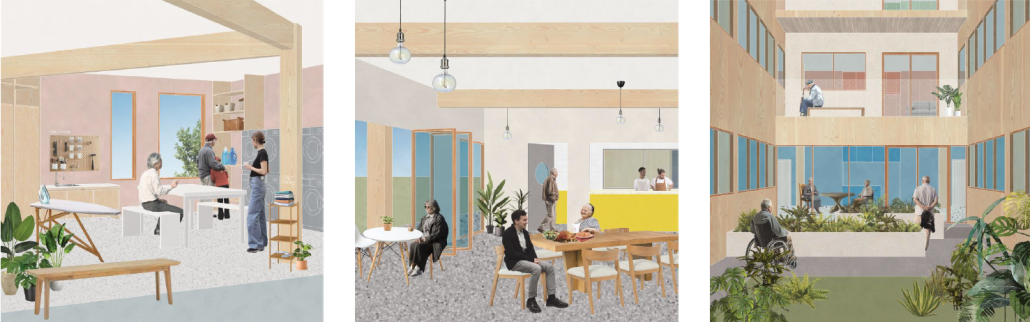
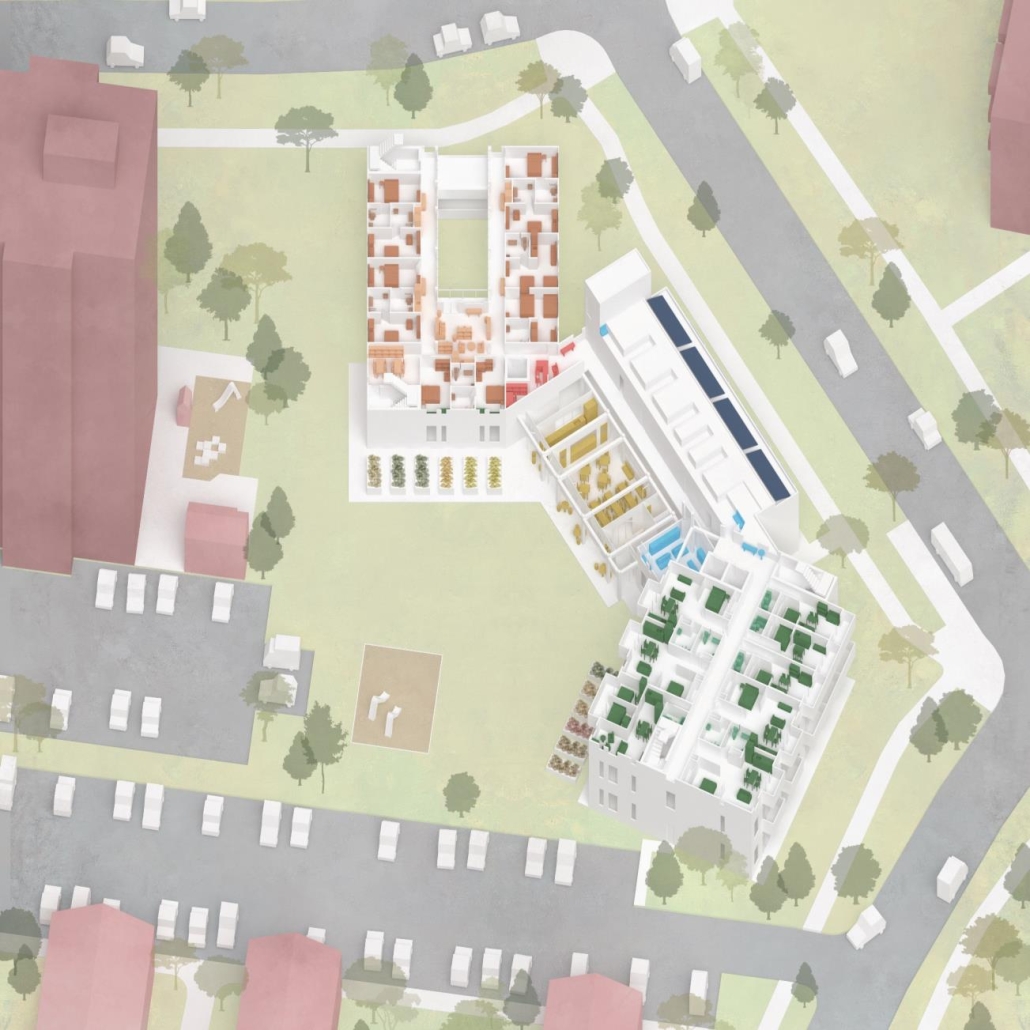
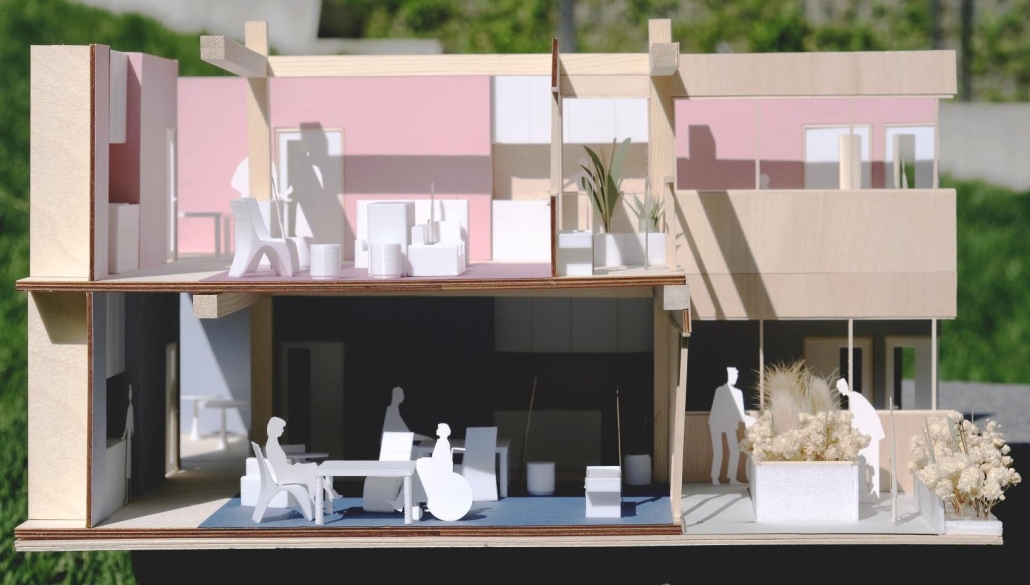
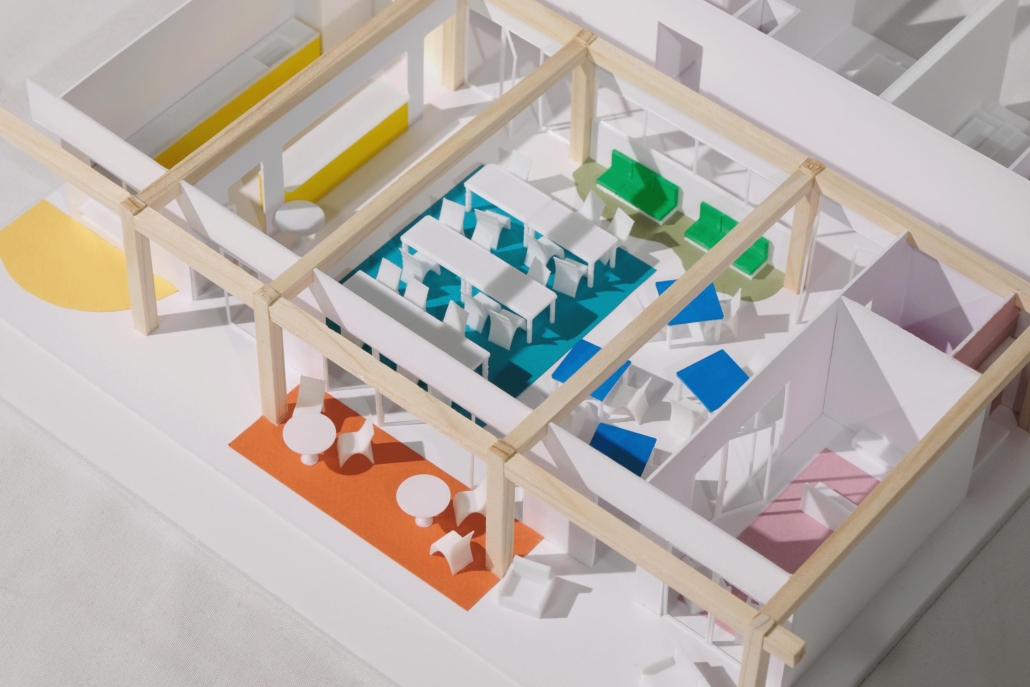
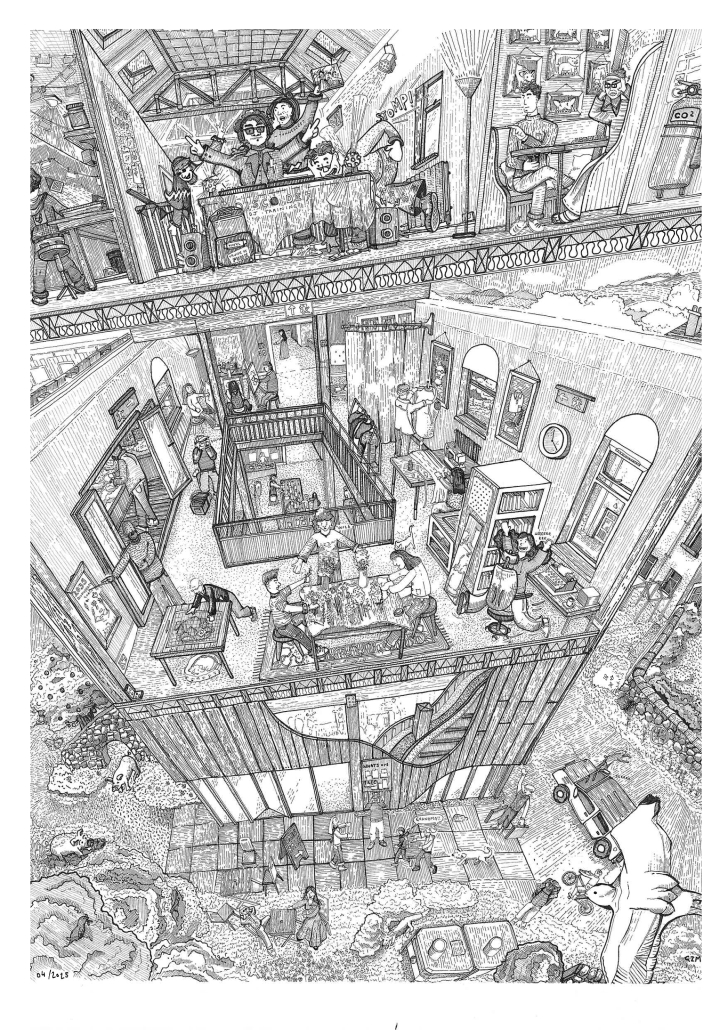
This project proposes a “therapeutic cooperative” that reimagines later life as a time for purpose, legacy, and connection. Designed for people aged 64 and over, the initiative creates a living environment where older adults can flourish by sharing life experiences with younger visitors while contributing to environmental and social regeneration. 

Central to the concept is the cohabitation of residents with Tamworth pigs, which serve both symbolic and ecological roles—facilitating intergenerational dialogue and promoting biodiversity through trophic rewilding.

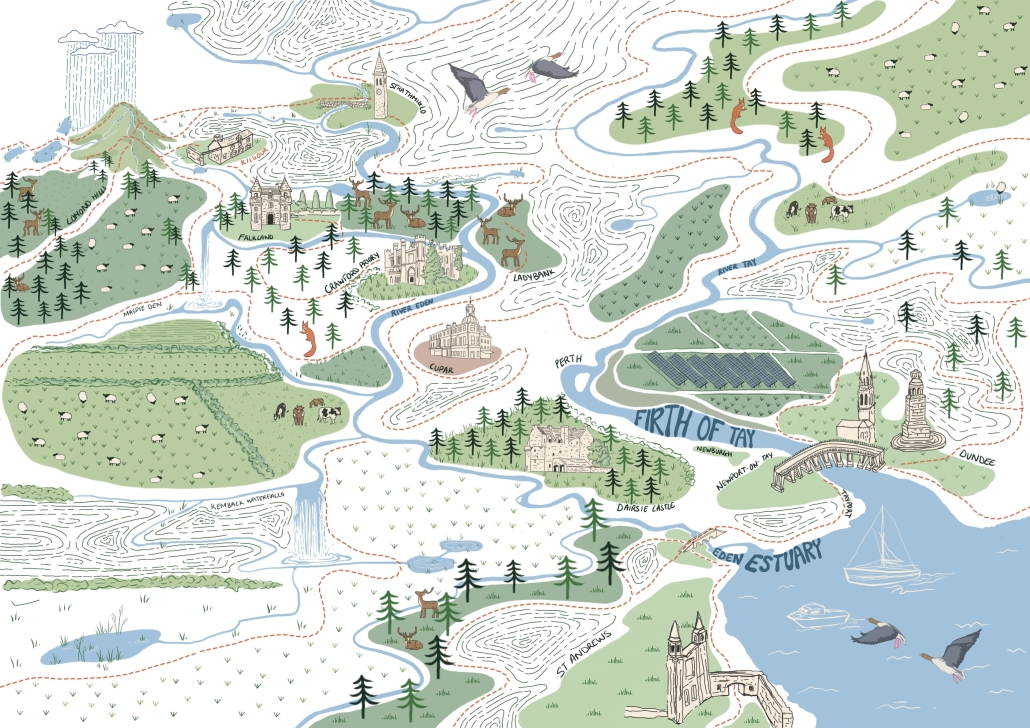
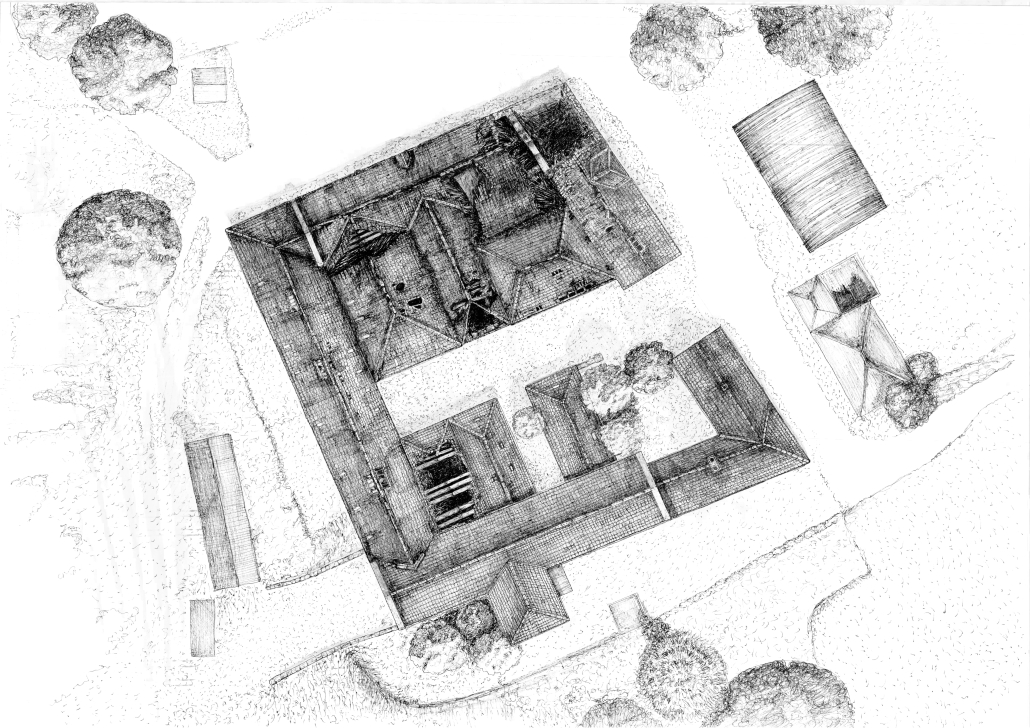
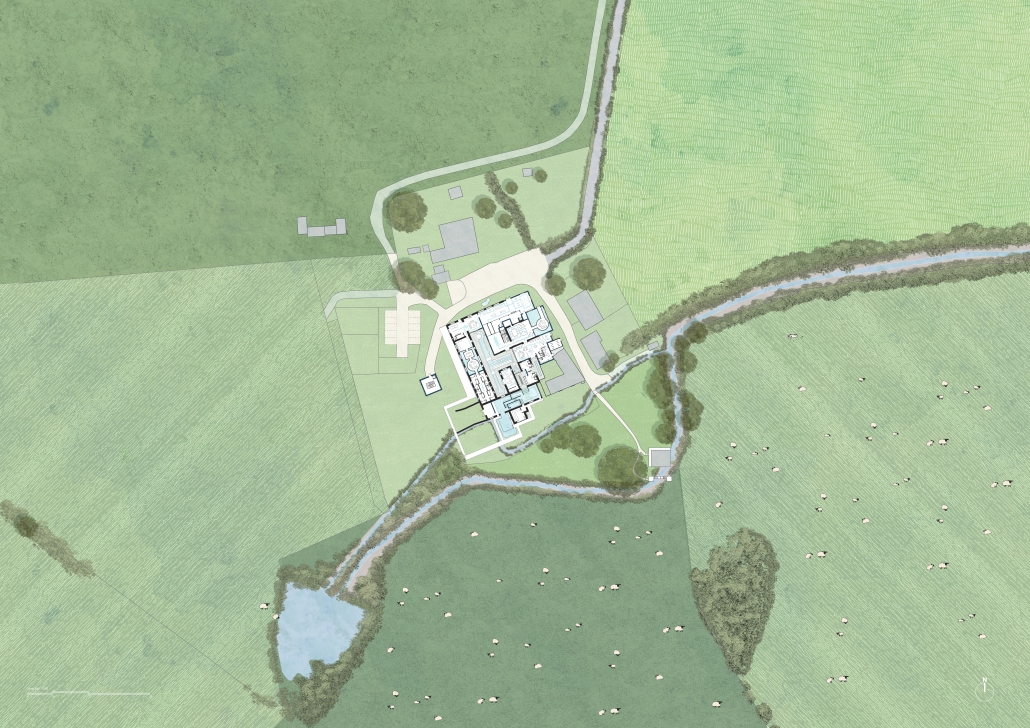
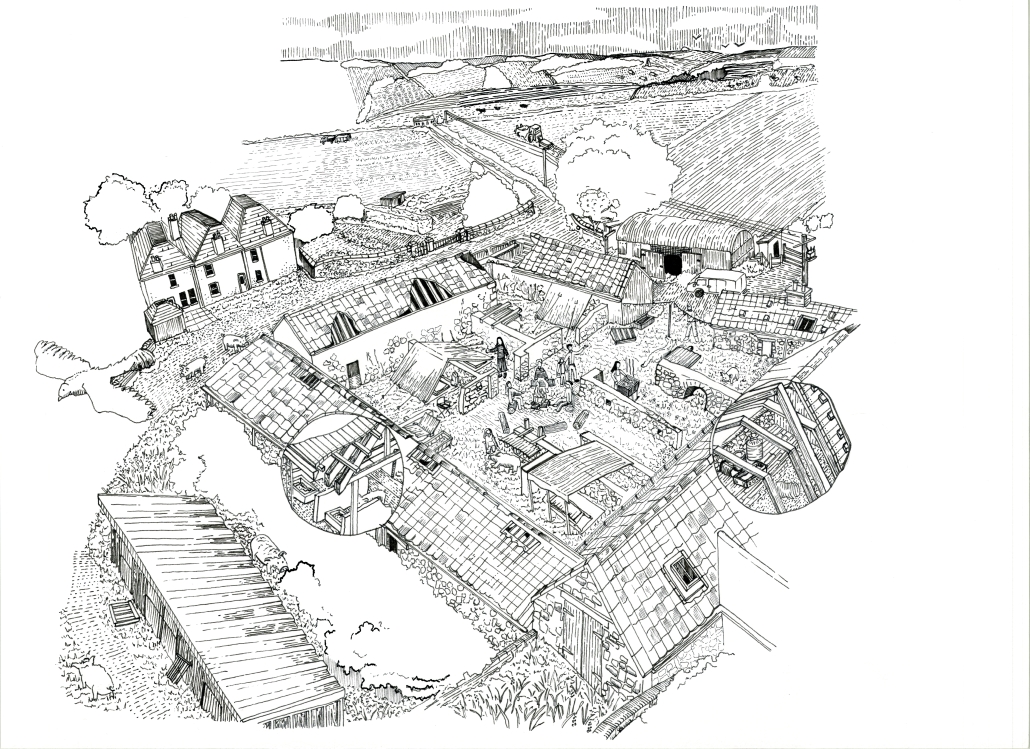
Located at Kilgour, a Victorian farm steading on Scotland’s Falkland estate, the site carries historical significance and a past tied to pig-rearing and the celebration of endings. 

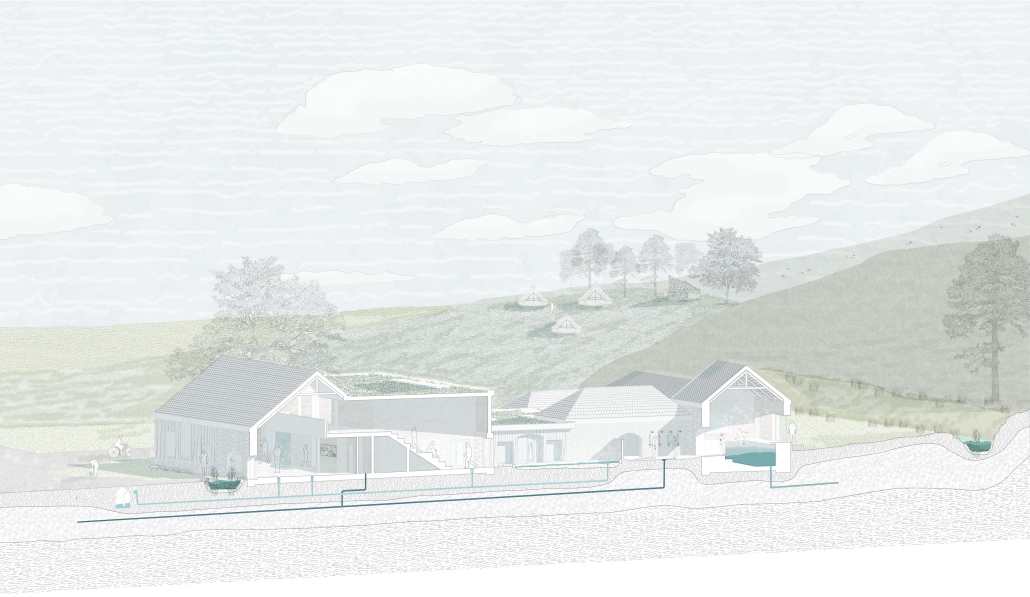
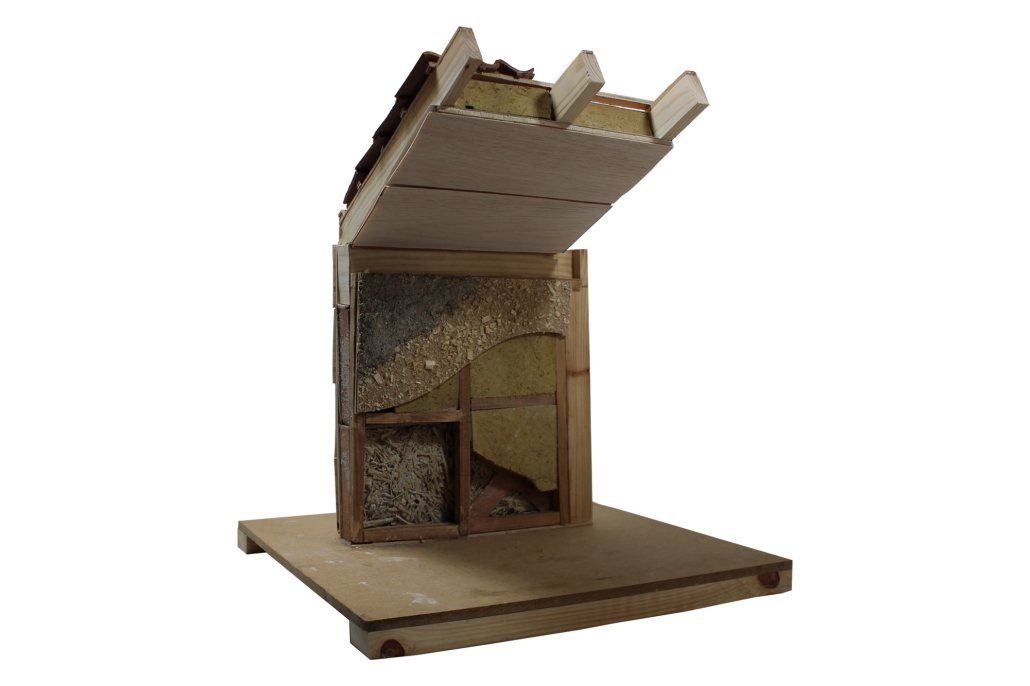
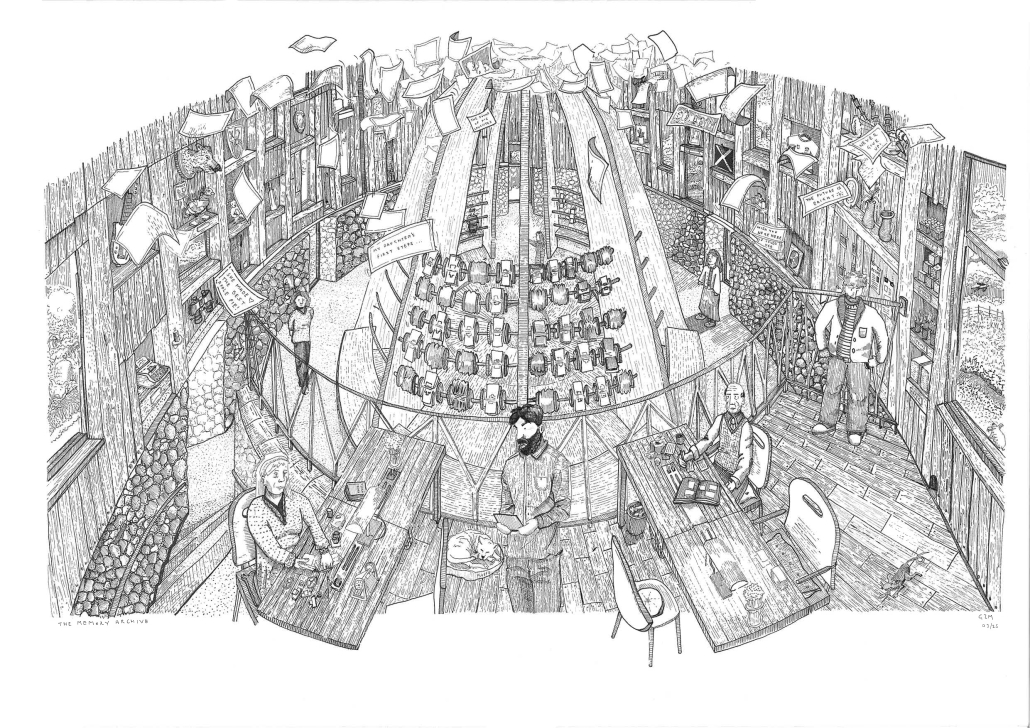
Accommodation includes accessible apartments, communal gardens, and a biodiversity-rich courtyard. Pigs will live in creatively built “Ad-Hog” styes using reclaimed materials. A chapel-like “Memory Archive” will hold personal stories of residents’ lives, offering a space for reflection and remembrance.

The project unfolds in three phases: first, clearing and revitalising the site with community involvement; second, welcoming the first residents and establishing the Memory Archive; and third, expanding the model across Scotland to transform abandoned steadings and boost natural regeneration.

Younger visitors, whom we have dubbed “biodiversity-backpackers,” can stay in on-site hostel lodgings, with the hope of fostering meaningful interaction between generations. Funding comes from elderly participants downsizing their homes, combined with national grants, giving them control over their later years.

Ultimately, this initiative responds to the growing issue of isolation among the elderly in Scotland. By embedding legacy, memory, and biocentric living into the design, it aims to help people see out their days with dignity whilst living with renewed purpose.

This project received the Ackroyd Lowrie Prize.

Instagram: @georgemannix, @ds3_obu

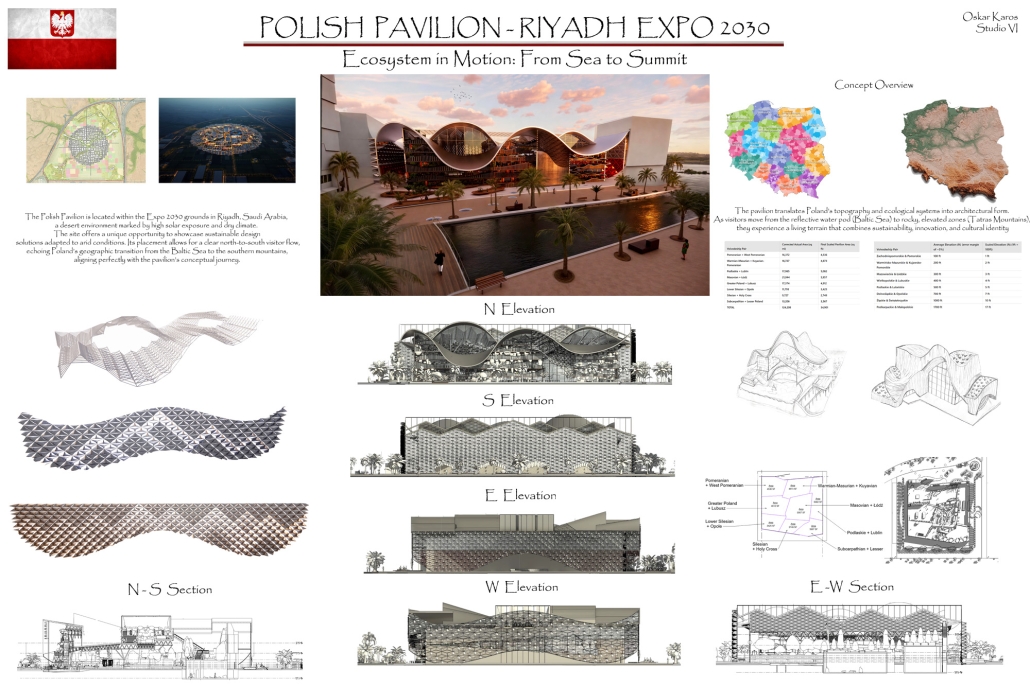
POLISH PAVILION – RIYADH EXPO 2030 by Oskar Karos, B.Sc. in Architecture ’25
University of the District of Columbia | Advisor: Golnar Ahmadi

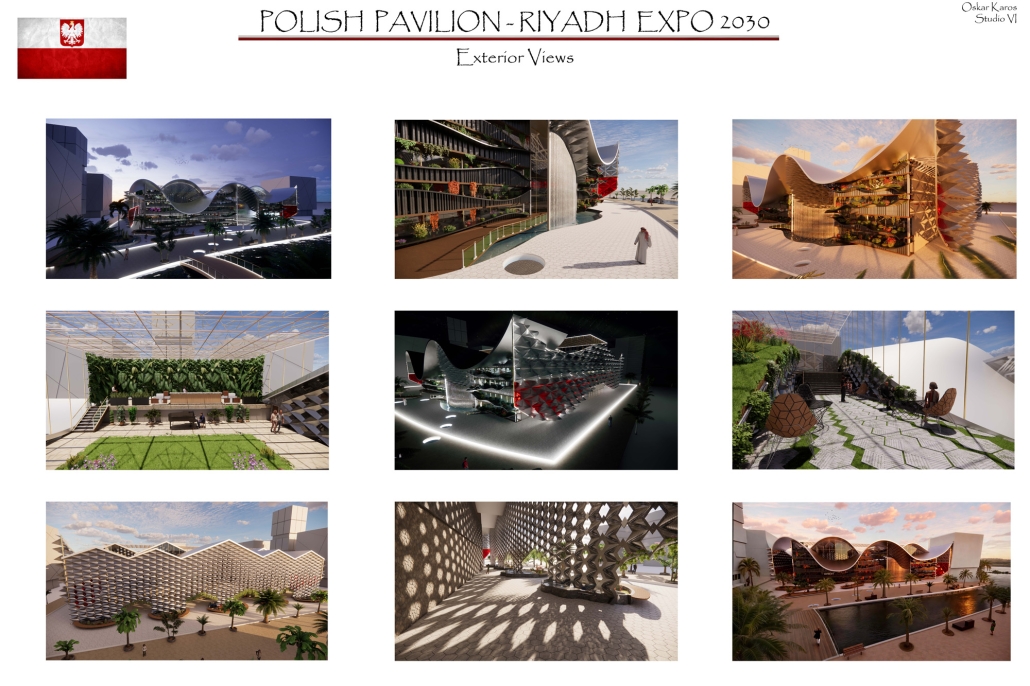
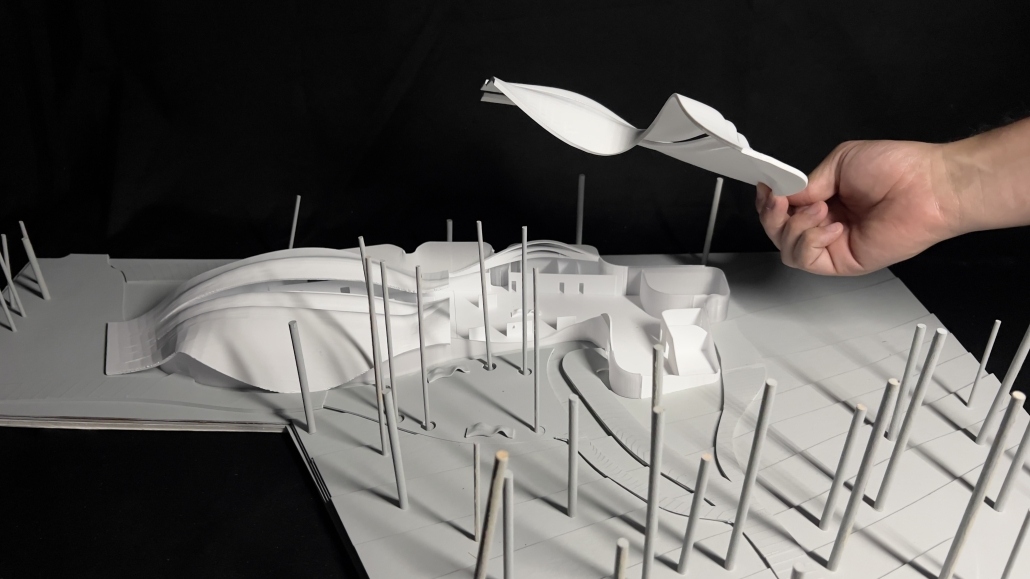
Set in Riyadh for Expo 2030, the Polish Pavilion reinterprets the nation’s geography and ecological identity through architecture. Designed as a living map of Poland, the pavilion invites visitors to journey from the southern Tatra Mountains to the northern Baltic Sea, experiencing the country’s topography, climate, and innovation within one continuous landscape. The project explores how architecture can embody an entire nation’s ecosystem, transforming exhibition space into a self-sustaining organism.

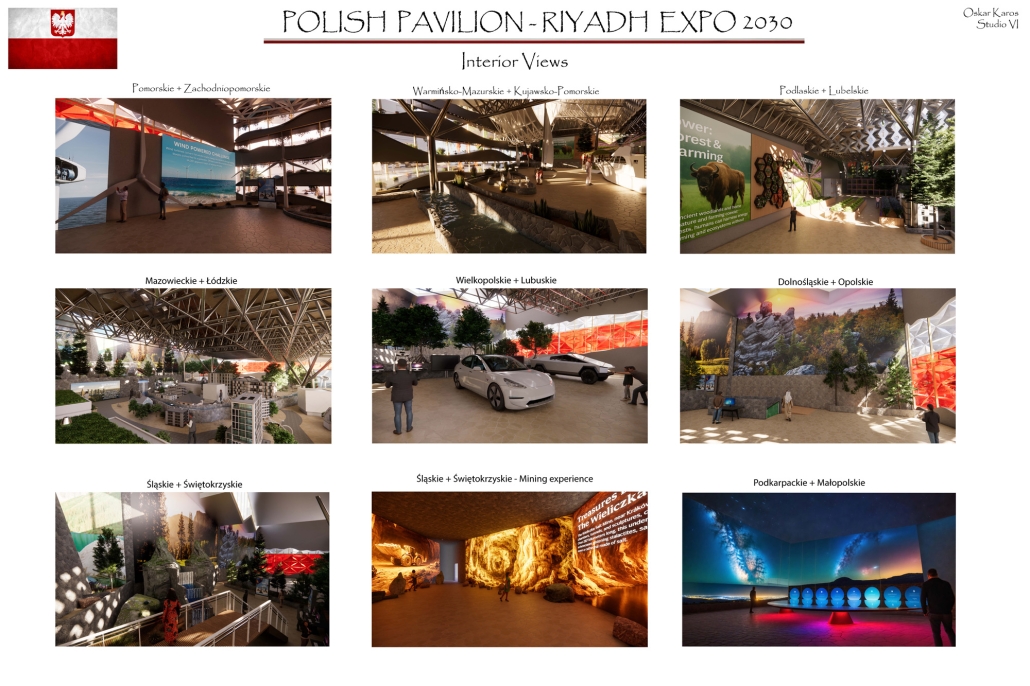
Poland’s diverse terrain—from its rugged mountains to fertile plains and coastal winds—inspired a spatial narrative divided into eight regions. Each represents two neighboring voivodeships, blending their natural and technological identities: wind power in Pomorskie, hydropower in Warmińsko-Mazurskie, sustainable farming in Podlaskie, and smart urbanism in Mazowieckie, among others. 

Visitors move northward along a symbolic Vistula River, linking interactive installations that demonstrate Poland’s leadership in renewable energy, circular economy, and ecological stewardship. Constructed with steel, wood, stone, and glass, the pavilion merges material authenticity with sustainability. A closed water cycle system replicates natural evaporation and rainfall, powering greenery and regulating humidity. The accessible green roof offers shaded paths and aerial views of Poland’s “living topography,” blending innovation with environmental harmony.

Beyond a national exhibition, the pavilion is a statement of coexistence—between people and nature, culture and technology. It celebrates Poland not through static displays, but as a breathing ecosystem where every element, from water to wind, participates in a cycle of renewal.

Instagram: @Golnarahmadi

Stay tuned for Part XI!

In Conversation with JR Jacobs: Decarbonization, Sustainability & Making a Change

Earlier this summer, Study Architecture Summer Intern Maya Fenyk interviewed ​​JR Jacobs, a high school senior with a passion for sustainable architecture. Their conversation covered everything from  JR’s interest in architecture and his involvement with the Stanford Building Decarbonization Learning Accelerator (BDLA) to his process for creating digestible content about sustainable design strategies for high school students. Scroll down to read JR’s insights and words of wisdom!

1. Can you tell us a little about yourself and what drew you to architecture as a field?

My name is JR Jacobs, and I’m a senior at Lick-Wilmerding High School in San Francisco, where I’ve been studying architecture with my teacher and mentor Goranka Poljak-Hoy since freshman year. I really like architecture because it allows me to combine two things that I’ve loved since I was a kid: designing and building. I’m drawn to architecture because it combines creativity, problem-solving, and the possibility of making a real impact on people’s lives. When I design a space, I’m not just thinking about how it looks; I’m also thinking about how people will experience the space and how it connects with its surroundings. It’s the same mindset that I bring to other parts of my life, whether it’s digital music production, furniture and product design, or landscape and interiors. For me, design is always about finding ways to make people’s lives better.

2. How did you first get involved with the Building Decarbonization Learning Accelerator (BDLA)?

I’ve cared about climate change since I was a kid. In 6th grade, I spent an entire semester designing and building a scale model of a sustainable house. That project was when I first learned how much building construction and operations contribute to global carbon emissions. It was also the first time that I saw how architecture could be a huge part in helping to solve climate change. The Stanford BDLA is a non-profit that helps college students in architecture, engineering, and construction management learn about building decarbonization. I thought that the free teaching resources on the BDLA website could also help high school students learn about important aspects of architecture, such as decarbonization and equal access to clean tech. So, I started reaching out to high school architecture teachers across the country to share the BDLA’s resources. Later, I reached out to the BDLA and told them about the emails I’d been sending to architecture teachers, and I asked if I could adapt some of their presentations into videos geared toward high school architecture students. The idea was to make complex sustainability topics more accessible to younger students. They said yes, and since then, I’ve been lucky to work with mentors like Peter Rumsey, Dr. Anthony Kinslow II, and Lindsay Franta. 

3. Your video on Environmental Justice and Equitable Decarbonization touches on powerful themes. What inspired you to focus on that topic?

At first, I didn’t fully understand how much climate change and the built environment affect some communities more than others. Then, I found a Stanford BDLA presentation created by Dr. Anthony Kinslow II that connected the dots between systemic racism, environmental injustice, and building decarbonization. Around the same time, I was volunteering at Second Harvest of Silicon Valley food bank, which provides healthy food to community members in need. I knew that Second Harvest was in the process of constructing a large new food distribution facility, and I started thinking about the connections between that building project and Dr. Kinslow’s BDLA presentation. Making this video just felt like the perfect way to combine my passion for design with my commitment to helping others. 

4. Could you walk us through your process in creating that video—from research and scripting to design and delivery?

I started by studying Dr. Kinslow’s BDLA presentation on the topic. My goal was to adapt it for high school students by focusing on the essential ideas. I watched other videos about environmental racism, redlining, energy burden, and potential solutions, and then I organized everything into an 11-page script. Then I built a 77-slide Keynote presentation with visuals that supported the ideas in the script. I set up a tiny recording studio in my home closet and recorded the voiceover narration. Then I edited the whole thing using iMovie into a 23-minute video. Once the video was done, the BDLA posted it on their website and YouTube channel. I emailed the video to over 50 high school architecture teachers, organizations, and people featured in the video.

5. You also created “Architectural Elements of a Decarbonized Building” for high school students. What was your approach to making these concepts accessible to a younger audience?

My goal was to focus on the essential concepts. The original BDLA presentation that I adapted was pretty technical, which is great for college students but can be overwhelming for high schoolers seeing the ideas for the first time. I wanted high school architecture students to learn about sustainable design strategies earlier in their architectural journeys so that they can apply them to their own projects. So I broke the original BDLA content down into 38 slides covering core design concepts like building orientation, high-performance glazing, shading, and thermal mass. I used simple visuals so the concepts would be easier to understand. The final video is about 9 minutes long.

6. What role do you think education plays in promoting sustainable architecture?

I think education plays a huge role. The buildings we design in the future will have a major impact on Earth’s climate. If we can teach future architects, engineers, and builders about decarbonization today, then those concepts will be included in the buildings of tomorrow. I hope that one day, people will just expect every new building to be carbon neutral. That’s why I’m so excited about bringing the BDLA’s resources to high school architecture programs and students.

7. How do you plan to incorporate the intersection of architecture and climate justice in your future studies?

Before I started volunteering for the BDLA, I didn’t fully understand the social impact side of architecture and design. The way we design can help or hurt people and communities, especially communities that are dealing with historical inequities. Now, equity and sustainability are part of how I think about design, no matter what I’m working on, whether it’s a building, an interior, a product, or a piece of furniture. To me, they’re just part of good design.

8. Has your experience with BDLA or creating these videos changed the way you think about your future in architecture?

Definitely. Once you see how much buildings contribute to climate change, and how building design can create, reinforce, or help reduce social inequities, you can’t unsee it. I know that whatever path I take in architecture or design, I’ll be looking for ways that my projects can have a positive environmental and social impact.

9. What advice would you give to students who want to explore sustainability and social justice through architecture?

If you want to learn about sustainability, I’d start by watching “Architectural Elements of a Decarbonized Building.” For social justice, I’d watch “Environmental Justice and Equitable Decarbonization.” Both videos are on YouTube and the BDLA website. Explore the other BDLA videos and dig deeper into the topics that interest you the most. Also check out groups like NOMA Project Pipeline and the Architectural Foundation of San Francisco. If you’re really interested, look into the pre-college summer programs on Study Architecture. Then find a way to share what you’ve learned. Start a club, take on a project, make a video, or give a presentation at your school. Once you start exploring these topics, you’ll find a lot of people out there who really care about these issues and want to help you make a difference.

You can connect with JR on LinkedIn: JR Jacobs

#ModelMakers: Julia Barreiros do Amaral

Introducing #ModelMakers — a new series highlighting architecture students across the world! Today, we’re featuring Julia Barreiros do Amaral, a B.Arch student at Florida Atlantic University. Scroll to learn more about Julia and her work:

Name: Julia Barreiros do Amaral 

School: Florida Atlantic University 

Degree Program: 5 year Bachelors in Architecture  

Year in School: 4th Year 

Describe Your Design Style: Neo-futuristic Architecture 

Share a Project You’re Proud of: The Flowline Gallery 

What Inspires You?  I’m inspired by how design has the power to shape not only spaces but also the way people think, feel, and connect with the world around them. A well-designed environment can challenge perceptions, spark curiosity, and create meaningful experiences that stay with someone long after they’ve left the space. It’s that potential for design to change minds and elevate everyday moments that drives me to keep pushing my creativity forward.   

What’s Your Student Superpower?  My student superpower is resilience. No matter how many challenges, setbacks, or long nights come my way, I stay committed to reaching my goals. In architecture school, there are moments where things don’t go as planned. Models break, ideas get critiqued, deadlines stack up—but I’ve learned to adapt, problem-solve, and keep moving forward. That persistence not only helps me finish what I start, but it also pushes me to grow stronger with each project. 

Describe The Flowline Gallery:

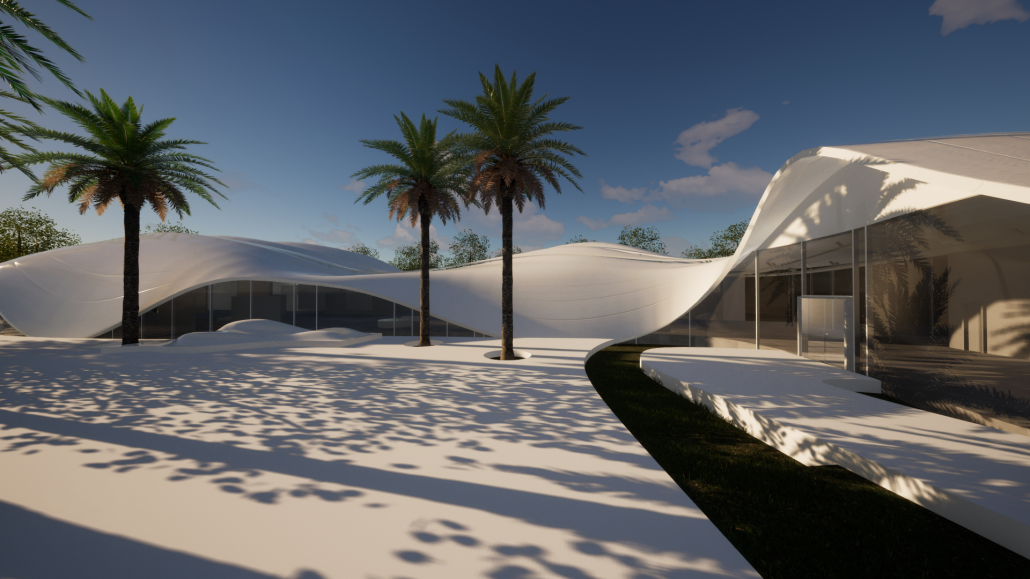
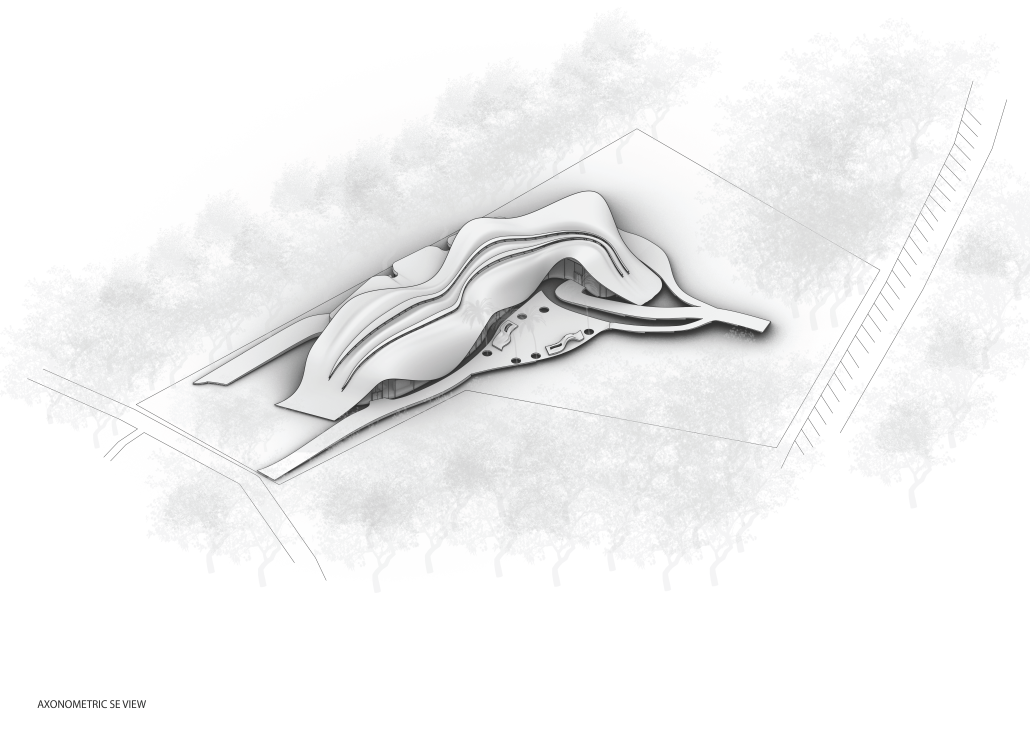
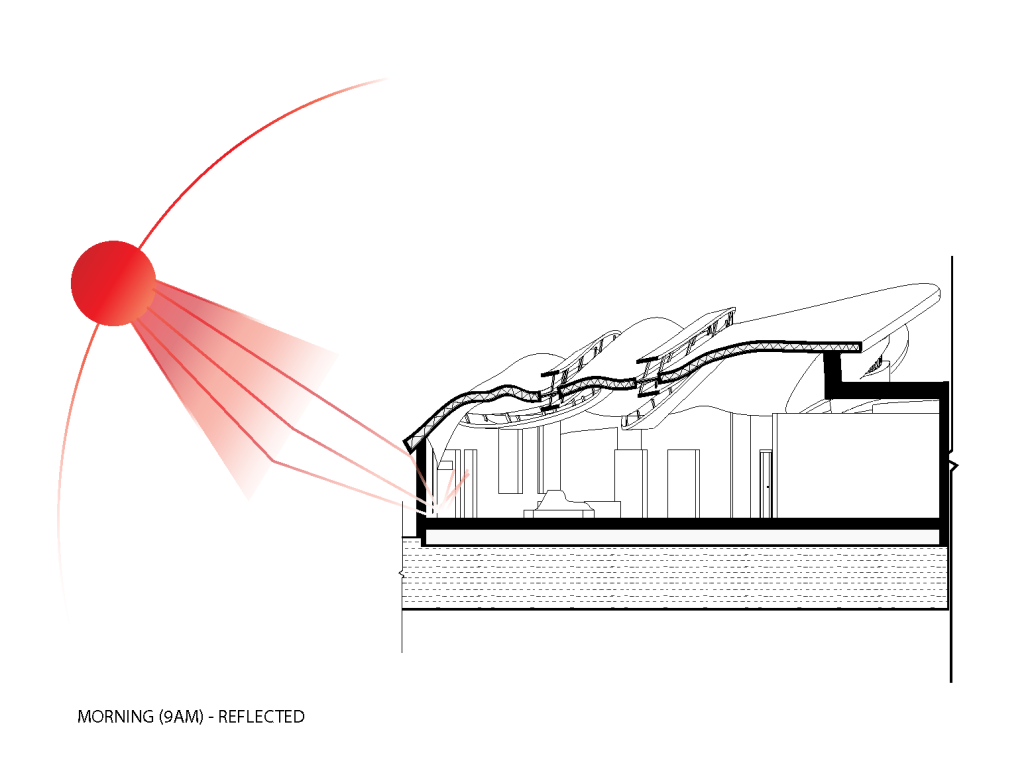
Nestled in Hugh Taylor Birch Park, the Flowline Gallery blends seamlessly with the natural landscape, drawing inspiration from the fluid forms of the ancient Banyan tree. Designed as an immersive experience, the gallery dissolves boundaries between interior and exterior, guiding visitors through curved, light-filled spaces that echo the rhythms of nature. Architecture, art, and ecology converge as pathways mimic meandering roots, and clerestories and skylights invite daylight to animate the space. Rather than imposing on the site, the design responds to its contours, weaving around existing vegetation and framing views of the surrounding forest. Natural light becomes a key spatial element, creating dynamic atmospheres that shift throughout the day. The gallery invites reflection and connection, proposing a model for architecture that is responsive, poetic, and deeply contextual. Flowline is not just a building—it’s a living, breathing continuation of the landscape, where design flows in harmony with nature.

Follow Julia to see more of her work: @Archidesignsbyju

What Is The Biggest Lesson You Learned In Architecture School?

In our last article, “What’s One Thing You Wish You Knew Before Architecture School?”, 25 architecture students shared the advice they wish someone had given them before they started their programs. They gave honest insights about expectations, challenges, and surprises. But what about the lessons that come after you’ve begun the journey?

In this follow-up, we asked the same group of students: “What’s the biggest lesson you’ve learned from architecture school?” Their reflections go beyond drafting and deadlines, as they speak to personal growth, resilience, creative confidence, and the evolving ways students think about design and themselves. Across the 26 responses, eight core lessons emerged—shared themes that reflect the challenges, growth, and transformation students experience throughout architecture school. Whether you’re just starting out or already deep in your journey, these lessons offer a look at the learning that happens when you step into (and stick with) architecture school.

Note: Responses have been slightly modified for clarity and length.

Some of the skills mentioned that our respondents learned in architecture school are unique to the field. However, their intensity and integration into the design process make them especially transferable. These lessons don’t just shape you as a future architect; they prepare you for almost any path you take and equip you with tools that are just as valuable in life as they are in practice. This is mostly due to the fact that:

1. Architecture is not a solitary discipline, it’s shared, social, and deeply interconnected.

[Architecture school’s] value goes far beyond architecture itself. It doesn’t just prepare you for one specific role—it gives you a way of thinking, a vision you can apply across many professions. If you’ve developed the capacity to collaborate and stay open to working with others, the skills and mindset you gain in architecture school can carry over into a wide range of fields.

—Sam Sabzevari, Toronto Metropolitan University, Class of 2024

Architecture isn’t just about designing pretty buildings; it’s about telling stories, reflecting culture, and shaping people’s lives. I realized that architecture is much more than just form and aesthetics, every design decision carries meaning and responsibility. That shift in perspective made me more thoughtful and intentional in my work knowing the social impact it can have.

—Sara Suliman, American University of Sharjah, Class of 2024

The importance of designing critically and creatively simultaneously. Architectural projects are not solely about making things look beautiful; it’s about solving complex problems with intention, empathy, and adaptability. I also learned the value of iteration; great ideas rarely arrive fully formed, and it is often part of the process of talking with your professors, friends, and peers that leads to innovation.

—Matthew Tepper, University of Virginia, Class of 2024.

Architecture is expansive, interdisciplinary, and all-encompassing. I entered school thinking that architecture is just about buildings and a way to connect the arts and STEM, and I left school knowing that architecture touches all aspects of our lives. Architecture is political and personal; we are implicated within it from the homes we live in to the cities and structures that make up our world. It is poetic and philosophical; it is our bridge between the past and the future, and it helps us understand our relationship with the world and how we continually engage with the environments we are embedded in. It is culture and creativity, narrative power, and most importantly, architecture is activism. It has the capacity to harm or heal, to repair and reconstruct a better world. In the current climatic condition and political state, we are at the crossroads of a future of uncertainty and possibility, and architecture is our tool for change and will have a vital part in moving us towards a future worth fighting for.

Since graduating and starting to work in the profession, I keep finding myself returning to this quote by Dr. Caroline Leaf: “Your purpose is not the thing you do. It is the thing that happens to others when you do what you do.” Our purpose and responsibility as architects goes beyond the designs we make; we have a crucial role in ensuring the health, equity, and well-being of our world and are tasked with building the structures necessary to uphold and sustain these values of good, for each other and for the future that will come after we are gone.

—Catherine Chattergoon, Pratt Institute, Class of 2024


Because architecture is not a solitary discipline, collaboration isn’t just encouraged—it’s essential. As you can see, many of our respondents agree that…

2. Architecture is a collaborative practice, built on relationships, dialogue, and shared vision.

The value of collaboration and feedback. Working with peers and receiving constructive criticism helped me develop my design skills and think critically about my work. I also learned to appreciate the importance of sustainability and social responsibility in architectural design.

—Yaimi L. Cartagena Santiago, Pontifical Catholic University of Puerto Rico, Class of 2024.

Honestly, it’s how essential it is to build relationships—with professors, visiting architects, and especially with your classmates. Some of my closest friendships were formed through long nights in studio, where we not only pushed each other creatively but also supported each other through the inevitable ups and downs. I’m incredibly grateful that, even now after graduating and working in different cities, we still find time to come together, catch up on life, and bond over the experiences we shared in school and the new ones we’re each creating in our professional and personal lives. Seeing how differently people think and approach design has been just as valuable as any technical skill I’ve learned. It’s a reminder that great design rarely happens in isolation; it grows from conversations, collaboration, and a genuine curiosity about how others see the world.

—Dillon Patel, North Carolina State University, Class of 2024

A good design takes time, and is rarely a solo effort. I used to spend hours just thinking about my design, visualizing how I wanted it to look, and how I could accomplish it. The most important step, and the biggest lesson that I have learned to remain consistent even in architecture firms, is that once I’ve built my vision/design, I always take it to someone else to review, whether it be my professor, boss, coworker, colleague, family member, classmates, friends, etc. [They]will be able to see a project through a different lens and point out any flaws where it could be better. Being able to listen to critiques and understanding others’ feedback is, in my opinion, what makes a great architect.

—Mason Ramsey, Marywood University, Class of 2024.

Talent alone will not take you to the endzone. Architecture is about much more. You need to be able to network and become comfortable with being uncomfortable. You need to sharpen your social skills and get over your fear of public speaking. I would say it’s not important, but necessary if you want to get anywhere with this career path.

—Jesus Guillermo Macias Franco, California College of the Arts, Class of 2023

How to work with people.

I understand that many students who are passionate about architecture and design often carry a beautiful, ideal world in their minds. Everyone has brilliant ideas and unique design visions. But once I entered architecture school, I realized that design is never a solitary act—especially in architecture.

From studio critiques and team projects to future collaborations in the professional world, architecture is built upon communication and teamwork. You can’t avoid dialogue or resist collaboration. Design is a language—and without strong communication skills and a willingness to engage with others, even the best ideas remain incomplete.

This is what architecture school taught me most:

Talk to people—because only through communication can your design truly come to life.

—Kai Chen, University of Pennsylvania, Class 2025

Design is not for the designer. Sure, it’s easy to get wrapped up in your own ideas and preferences when designing theoretical studio projects, but it’s important to remember that designers are almost always designing for someone else. We should never lose sight of how our designs impact those who use them —no matter the scale.

—Luke Murray, Mississippi State University, Class of 2024.


And with all that collaboration comes critique. In architecture school, feedback is constant—sometimes encouraging, sometimes tough, but always part of the process. So the best advice to grow (and stay sane) is…

3. Learn to embrace critique, but remain confident and trust yourself along the way.

Critique is where you grow, not where you shrink. In such a beautiful major where each one turns their own ideas into a unique project of their own, opinions arise. And this is where it is important, as architecture students, to learn to accept the critique and take it as an opportunity to question how other architects and peers perceive things. It expands your ideas and therefore your creativity. Architecture has certainly strengthened my personality and turned me into someone confident who is apt to defend their ideas and the value behind them.

—Angela Hanna, Holy Spirit University of Kaslik, Class of 2024

Listening to yourself is just as important as being open to feedback. If you believe in your idea and know it’s strong, stick with it, but stay open. If you receive challenging criticism, it doesn’t mean the project is dead. In fact, sometimes a lot of critique is a good sign. It means your ideas are worth talking about, or there’s a lot of potential. Ask yourself why the feedback landed that way, and refine your work through that lens.

At the same time, don’t hold on too tightly. Some of your best ideas will grow from the pieces of earlier ones you were willing to let go. Trust your gut, make the project make sense, and the rest will follow.

Also: don’t lose sleep over renderings.

—Steven Fallon, Boston Architectural College, Class of 2024 (M.Arch)

Embracing constructive criticism will take you SO far. The more experience you have receiving constructive criticism, the more you will be better able to filter out what is helpful and productive, and what is better applied to other projects. Moreover, the feedback you receive for one project should be applied to all of your projects; that is how you best grow in your practice of architecture.

—Elyssa Hines, Washington University in St. Louis, Class of 2027.

People will have opinions on your work (both good and bad). What one professor hates, another may love. Be confident in your designs regardless of what others think.

—Bailey Berdan, Lawrence Technological University, Class of 2022

The importance of confidence. If you don’t believe in your own idea or design, no one else will. Confidence allows you to present your work with clarity and conviction, and it helps you communicate your design to a wider audience. It’s not just about what you design, but how you stand behind it.

—Anushka Naik, NYIT, MS.AUD Class of 2024.

Failure is part of the process—and often the most valuable part. Projects grow through trial and error, and feedback (even tough criticism) helps you improve. Also, surrounding yourself with motivated, supportive friends from day one makes the stressful moments manageable and the successes more rewarding.

—Louis Y. Sepúlveda-Homs, Pontifical Catholic University of Puerto Rico, Class of 2025.

To trust yourself and trust the process. College is a long process, and you won’t understand the big picture until you realize you’re graduating and well on your way to becoming an architect

—Nick Biser, Marywood University, Class of 2024.


Though I am sure you want to implement advice and grow from the critiques you are given, keep in mind that progress in architecture school doesn’t happen overnight…

4. Growth takes time, so stay patient and committed.

Adopting new skills requires patience and concentration. I knew how to draw before starting my graduate program. However, architecture school required a more advanced level of technicality in representation. I had to master new software, history, and theory by engaging in my course assignments with consistent effort. My hand drawing and digital drafting has improved dramatically because of the work that went into achieving that proficiency.

—Daniel Icaza-Milson, University of Texas, Austin, Master of Architecture 2025

Each level in architecture taught me to adapt, evolve, and shape a better version of myself—just like our designs, we’re constantly a work in progress.

—Rachana Charate, RV College of Architecture, Class of 2023 (M. Arch Urban Design)


You’ll grow faster if you remember to …

5. Stay curious! Ask questions and keep learning.
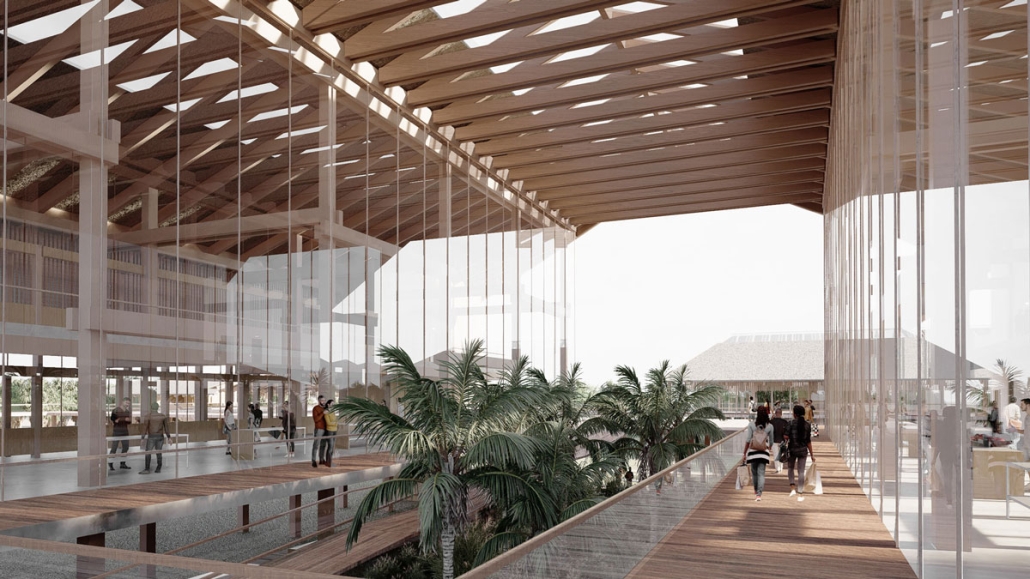
Ask why about all the decisions you make. This will truly help the design and thought process during the design.

—Henry Li, Savannah College of Art and Design, Class of 2024.

You are not finished learning after you graduate! You must be a student for life, and continue to absorb and respond to new information every day. Keep building on your knowledge and stay in touch with your inner student.
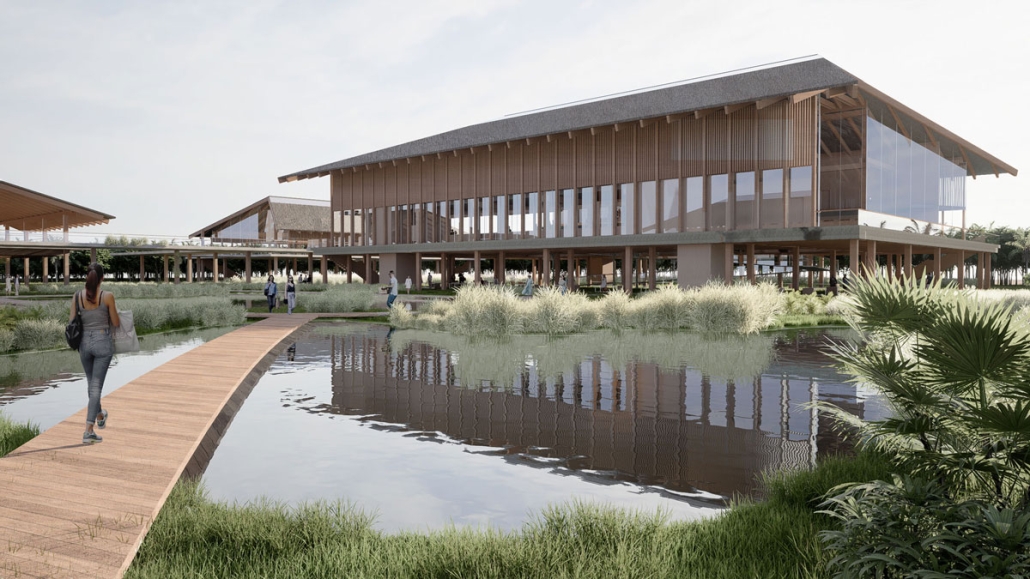
—Sabrina Innamorato, New York Institute of Technology, Class of 2024 (M.Arch)


Beyond personal development and the broader application of skills, you also learn about core values of the discipline, and that includes the fact that…

6. Architecture begins with empathy and introspection.

Architecture must be empathetic. You don’t design for yourself, but for the people who will inhabit those spaces. Every line, every decision, should respond to their needs, contexts, and aspirations. It’s not enough for a project to look good—it has to feel right, function well, and genuinely improve the lives of those who use it. Architecture transforms lives, and for that reason, it must be responsible, sensitive, and accessible.

—Sebastián André Colón López, Pontifical Catholic University of Puerto Rico, Class of 2024.

Architecture school doesn’t really teach you about architecture; it teaches you introspection. To think critically, to approach problems with care, and to find creative, thoughtful solutions.

It teaches you empathy—for the earth and the places we build on and extract from. It teaches you empathy for yourself, for your limits and mental health, and for others—your peers, who become your closest allies and lifelong friends.

It teaches you discipline—the ability to deliver on time, to hold yourself accountable, and to communicate your ideas with clarity and conviction.

To study architecture is to cultivate introspection, a quiet but essential skill that shapes not only the work you do, but also the architect you become.

—Daniel Wong, University of Toronto, Class of 2024


Lastly, but certainly not least, as a field that contains so many multitudes, it is essential to…

7. Appreciate the shades of gray. 

Design is never about finding the “right” answer. It is all about the process of exploring, questioning, and constantly improving. You must maintain an open mind and be self-critical of your design, always asking yourself why you are making certain choices. I also learnt that just because a project has a deadline does not mean it is finished; there is always room to go back and improve it, but you also need to know when to let go. That kind of mindset changed the way I approach design and life in general.

—Razan Almajid, American University of Sharjah, Class of 2024

When it comes to things, especially design, there is no such thing as absolute “correct” or “wrong.” These judgments can only be made within a relative framework. At my school, about 60 students design projects [based] on the exact same site each semester in studio. Yet each student approaches the project with entirely different concepts and scales. By the end of the term, there are 60 completely different architectural proposals gathered on the same site.

The criteria for judging whether these designs are “correct” or “wrong” as architecture are nothing more than relative measures defined within the framework of the studio. What is considered correct within the context of the studio does not necessarily align with what is correct in the context of real-world architecture. In that sense, engaging in discussions about what is ‘right’ or ‘wrong’ within a relative framework turned out to be a valuable lesson.

—Shun Sasaki, Southern California Institute of Architecture, Graduated in 2024

Be precise. Not just in drawings or models, but in language and intent. It’s easy to hide behind complexity or visual tricks, but architecture school taught me that the hardest thing is to be direct—clear in what you’re saying, why you’re saying it, and how it’s being read. That kind of clarity is what actually gives the work weight.

—Anonymous


The journey through architecture school is clearly more than an exercise in mastering technical skills; it’s a profound period of personal and professional transformation. As the reflections from these 26 students reveal, the lessons learned extend far beyond drafting tables and deadlines, shaping not only future architects but also well-rounded individuals prepared for a diverse range of paths.


Ultimately, the skills and mindset gained are universally transferable, equipping graduates with tools that are as valuable in life as they are in practice. Whether it’s the ability to work effectively in teams, articulate complex ideas with precision, adapt to feedback, or approach challenges with a curious and empathetic lens, the education cultivates a unique readiness for an ever-evolving world. Architecture school, it turns out, is not just about building structures; it’s about building character, vision, and the capacity to contribute meaningfully to any endeavor.

What Is One Thing You Wish You Knew Before Architecture School?

Whether you are a middle schooler learning about different careers, a high schooler gearing up for university applications, a rising college freshman ready to start your program in the fall, or an aspiring architecture student looking toward your next steps— you are surely full of questions. What will architecture school really be like? What should I expect…will it match my expectations? What challenges will I face? What moments will make it all worth it? And these questions are just the tip of the iceberg…

To demystify your journey and better prepare you for whatever educational milestone you are ready to embark on, we asked 26 current architecture students and recent graduates a question we hope encapsulates the core of your questioning: What is one thing you wish you knew before architecture school?

We’ve summarized their answers into 12 core themes below. No matter where you are in your architectural journey, we hope these reflections offer insight, reassurance, and a glimpse into what lies ahead.

Note: The responses have been slightly modified for clarity and length.

1. Architecture school may indeed test your patience more than your creativity, but if you embrace the chaos the rewards are boundless.


Creativity is 10% of it, the other 90% is perseverance, patience, and problem-solving. If I ever thought I was a patient person by nature, studying architecture certainly had me re-question that notion. It takes so many ideas, concepts, sketches, drafts, models, etc. before you find the right approach to a project. Architecture is about many answers, many opinions, all of which are beautifully different. This makes us stand out and distinguishes us from other architects, but it’s also what shows how subjective it all is at the same time. This subjectivity is (most of the time) frustrating, especially when you are presenting your project to a board of juries, but it is also something that expands your vision. —Angela Hanna, Holy Spirit University of Kaslik, Class of 2024.


How time-consuming and frustrating it can be. I would spend all day/night meticulously constructing a model that was due the next morning, and while designing these models (as many architecture students can attest) agitation was a very common emotion. There were times when my physical model completely fell apart, when professors told me to redo a model I spent days building, or when Revit did not want to cooperate– meaning I had to spend hours watching YouTube videos on how to fix the issue. Though, as you can see, architecture school can be stressful, I also wish someone had told me how creative and fun it would be. Ultimately, if you have an interest in the concept of how buildings are formed/constructed, and you have a lot of patience, architecture school is definitely your path.
—Mason Ramsey, Marywood University, Class of 2024.


Architecture school is basically a video game—each level is harder than the last and comes with new challenges to unlock. You’ll fail, restart, and rage-quit in your head—but the wins? They feel epic.
—Rachana Charate, RV College of Architecture, Class of 2023.

Despite the frustrations, perseverance is key! Which brings us to:

2. You will get out of it what you put into it.


The first semester of architecture school is like a shock to the system. It’s an intense workload. You’re learning the basics of design, architectural history, taking your Gen Ed courses, and you’re expected to begin designing, all while learning the various software necessary to complete your design drawings. It can be overwhelming, but if you put in the time and effort, you will succeed. You may have to say no to dinner with friends or stay up late to get your work done (I am one of the few architecture students that is vehemently against pulling all nighters), you will have to sacrifice, but the harder you work and the more dedicated you are, the more worth it it will be. —Sabrina Innamorato, New York Institute of Technology, Class of 2024 (M.Arch).

But remember, school is about more than just getting through the academic work. An important part of success is how you interact with the field beyond the classroom. You will have to…

3. Build more than models, relationships matter.


Focus on networking. Try to get teaching assistant positions and build better relationships with faculty and classmates. I attended a small college, and it was easy to network. However, I could have built more bridges with my professors. Later in my degree, I learned that many of my classmates had been employed by faculty. Those opportunities could have been mine as well, but they weren’t because I did not put work into those relationships early on. —Jesus Guillermo Macias Franco, California College of the Arts, Class of 2023.


We’re past the era of becoming an architect in the classical sense. When you go to architecture school, you’re exposed to the long history of the field, and you may start forming this image of the architect as a heroic, solitary figure. But that model no longer reflects the reality of the profession. Architecture today is fundamentally about collaboration, teamwork, and putting your ego aside to work meaningfully with others. You need to work on yourself just as much as you work with your team and surroundings. Building those relationships and connections is essential—especially once you step out into the profession after graduation. —Sam Sabzevari, Toronto Metropolitan University, Class of 2024.

Regardless of the many pieces of advice you will receive in this article, keep in mind that no one experience is the same. Be aware that…

4. Architecture school isn’t a straight line, it’s a messy, evolving journey. Stay open-minded, embrace uncertainty, and let your curiosity guide you.


Every stage of the design and learning journey is unique. Embrace the complexity of the profession, stay curious about emerging mediums and evolving tools, and continue exploring where your interests and strengths lie.
—Matthew Tepper, University of Virginia, Class of 2024.


Go in with more of an open mind. When I first started school, I thought I would be using my computer, rendering fancy buildings, and designing skyscrapers from Day 1. School is a much different and more nuanced process that can take a lot of students by surprise.
—Nick Biser, Marywood University, Class of 2024.


The design process is rarely linear. For each moment you find yourself satisfied with your process and the results, there will likely be another where you question your ideas and approach. For me, the key was embracing those ups and downs and accepting that failure is often part of the process. Stay positive and keep going!
—Luke Murray, Mississippi State University, Class of 2024.

Perspective shifts are part of the learning process, but it seems like personal paradigms shift A LOT in architecture school. Just look how many people said:

5. Architecture school isn’t just about designing—it’s about learning to think differently and adopting a new lifestyle.


It’s not just about designing buildings. It’s about thinking critically, communicating complex ideas clearly—both visually and verbally—and learning to handle uncertainty, especially when presenting your work to professors and critics. Knowing this earlier would’ve helped me face challenges and long nights with more confidence.
—Louis Y. Sepúlveda-Homs, Pontifical Catholic University of Puerto Rico, Class of 2025.


Architecture is not just about design and drawing—it’s a way of life and a way of thinking. It blends emotion and logic, requiring not only creative vision but also analytical rigor. Architecture will take over more than your class time—it will shape how you travel, how you socialize, and how you see the world. You’ll constantly analyze spaces, structures, and experiences through the lens of architecture. So don’t treat it as just a subject or a set of assignments. It should become part of your life—something you genuinely love. Only with that passion can you endure the countless days and nights of designing, drawing, modeling, and revising. With that mindset, you’ll gain a broader perspective—and meet challenges with greater composure and purpose.
—Kai Chen, University of Pennsylvania, Class 2025.


Architecture isn’t just about designing spectacular buildings or creating perfect renderings. I would’ve liked to understand early on that a big part of the journey involves learning to cope with frustration, criticism, and sleepless nights. Architecture is not only about technique or art—it’s a way of thinking. You begin to question everything, from how a community lives to why a window is placed where it is. And that’s okay. You don’t need to have all the answers in your first semester.
—Sebastián André Colón López, School of Architecture, Pontifical Catholic University of Puerto Rico, Class of 2024.


It isn’t just about designing buildings, it’s about learning how to think and design through everyday life and the tools around us. Inspiration often comes from the ordinary, and it’s this connection to daily life that shapes meaningful design. Also, architecture is a continuous learning process. School is just the beginning—there’s no real end to learning in this field.
—Anushka Naik, NYIT, Class of 2024 (MS.AUD).


Architecture school isn’t really about learning how to design—it’s about learning how to think. I wish someone had told us that the real challenge isn’t making things look good, it’s learning how to question—how to ask why something should exist, how it could exist differently, and whether it needs to at all. That shift would’ve helped me waste less time trying to do things the “right” way. —Anonymous.


Architecture school is a commitment to a lifestyle. I found my most successful student work involved transforming the brief into a creative solution that was practical and conceptual. This involved thinking about the project outside of the studio, testing many ideas, and having fun with the process!
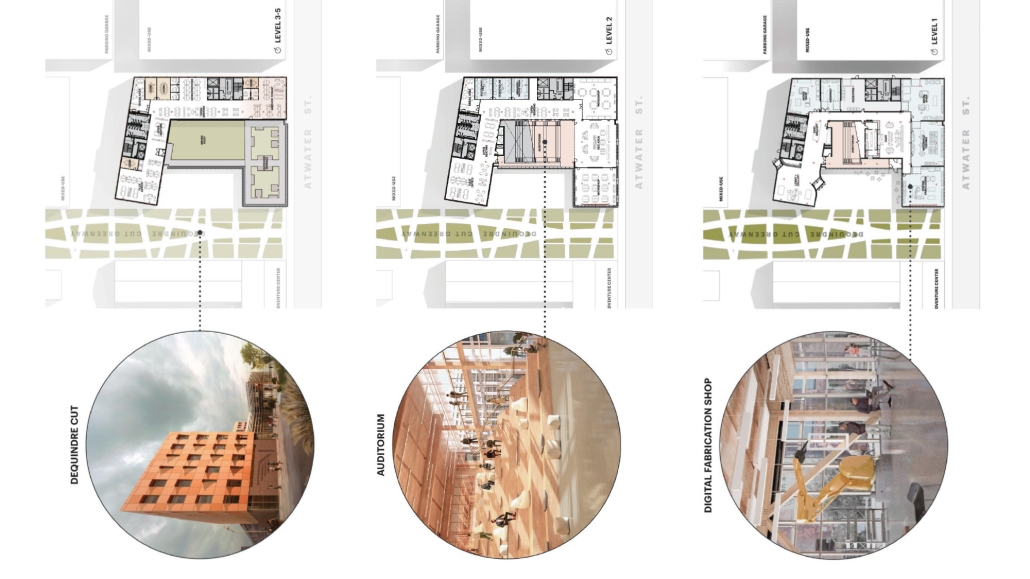
—Daniel Icaza-Milson, University of Texas, Austin, Class of 2025 (M.Arch)


Architecture is not just about making things look beautiful or being good at drawing. It is so much more than that. It is about understanding the theory and philosophy behind design, and the psychology of how people experience and interact with spaces. Architecture requires thinking critically and designing with intention, finding that balance between creativity and logic. Ultimately, it is about creating experiences, not just buildings.                                                      —Razan Almajid, American University of Sharjah, Class of 2024.

Within new mindsets and new fields, don’t lose track of yourself either…

6. Find your niche and involve yourself in your work.


When I started, I was concerned about what I would do if it turned out I was more interested in another subject. But, the scope of architecture is so vast that you will learn about everything and anything you want to. Due to the nature of design, you get to learn all about who and what you are designing for, which opens up a world of subjects for you to study and explore.
—Elyssa Hines, Washington University in St. Louis, Class of 2027.


Bringing ourselves and our perspective of the world into the work we do is essential; our diversity is a strength and a source of inspiration for building new structures and a better future. I spent my first few years of architecture school trying to make projects that I thought would satisfy my professors and drew only from precedents that were regarded as exceptional in the canon of architecture. But when I started to bring my history and lived experience into my work, I realized that our stories, memories, and personal and inherited knowledge are just as important and influential as the formal building expertise we learn about architecture in school. The diverse needs of the future can only be met by honoring the diverse ways we experience the world. Our lived experience serves as a guide, a place of rootedness, and a source for generating new dialogues and possibilities for architecture and our future.
—Catherine Chattergoon, Pratt Institute, Class of 2024.

Adopting a new way of thinking and a new lifestyle based on your profession, as well as involving yourself in your work— no matter how transformative it can be, it can also create some issues. So it is also important to consider…

7. Time-management and boundaries!
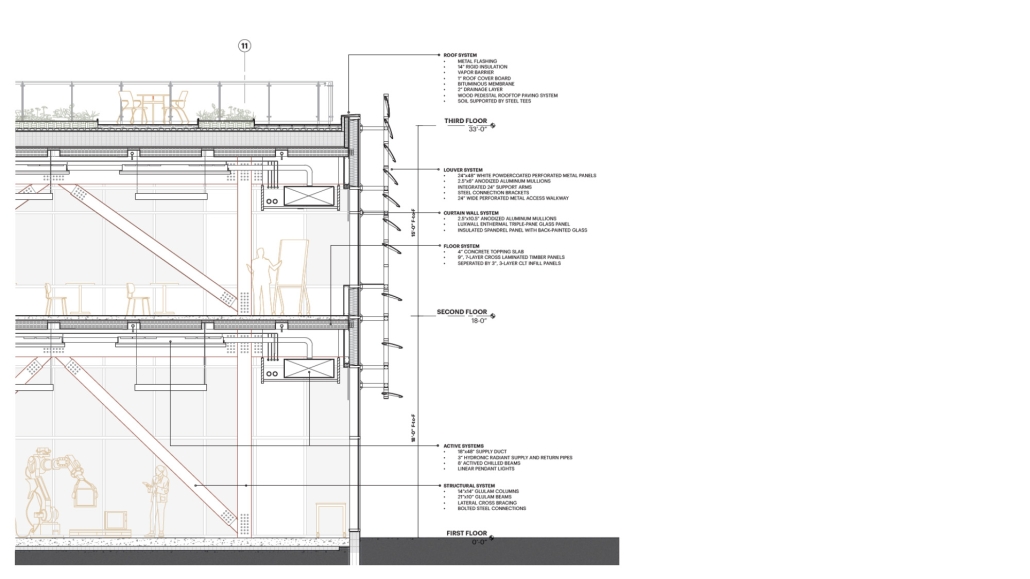

I wish someone had told me about the importance of time management and balancing my priorities when it comes to the learning process of this profession. Architecture school can be intense, and understanding how to prioritize my personal life and manage tasks effectively would have reduced stress and improved my overall experience.
—Yaimi L. Cartagena Santiago, Pontifical Catholic University of Puerto Rico, Class of 2024.

You take a lot of skills with you from education into the workforce, but the line between education and work is often blurred because…

8. Learning doesn’t stop when you are done with your degree. Also, while you are in your degree you should be trying to learn even more.


Books are your friends. If I could do architecture school over again, I would spend more time in the library stacks. There are centuries of architectural thinking, writing, and making that can expand your world and deepen your work. You’re guaranteed to find inspiration in a good library. 

—Steven Fallon, Boston Architectural College, Class of 2024 (M.Arch). 


You need to read more, see more, and think more. Architecture is the major that needs both sensual and rational thought, so more experience will help you with designing and thinking.
—Henry Li, Savannah College of Art and Design, Class of 2024.

But of course…

9. School won’t teach you everything–it’s important to be mindful of that.


[I wish I knew] how different school and practice are in architecture. School is much more theory and design-based based while practice is more technical-based. [I also wish I knew]more about the licensing process post-college! It would’ve been helpful to get a head start during my education, but it was never explained in school.
—Bailey Berdan, Lawrence Technological University, Class of 2022.

Architecture school is also far more than the lessons taught about the field itself. You also learn that…

10. Design is powerful only when it communicates with clarity, purpose, and its audience in mind.


Architecture school is as much about learning how to tell a story as it is about learning how to design. No matter how innovative your idea is, it only matters if you can communicate it clearly and meaningfully. I learned this the hard way — and I think all of us have to — because sometimes the best thing you can do is step back from the drawing board and really ask yourself, “What’s the story I’m trying to tell here?” At the end of the day, architecture isn’t just about creating buildings; it’s about shaping experiences and connecting with people. That’s what makes it powerful — and that’s what makes it so fun.
—Dillon Patel, North Carolina State University, Class of 2024.


Design is a form of communication, and thus, to design architecture is to engage in a conversation by constructing syntax within the language of architecture. Being consciously aware of who the dialogue is with for each project is a crucial perspective when engaging in communication through the language of design. As long as we understand who we are in dialogue with, we can engage in meaningful discussions without becoming confused. What’s important is to clearly identify who you are speaking with through your design.
— Shun Sasaki, Southern California Institute of Architecture, Class of 2024.

To do all of the recommendations listed here so far, there is one key…

11. Stamina.


Studying architecture comes with many hardships—the brutally long hours, the dreaded pin-ups, the caffeinated red-eye crits—all culminating in a final project that one hopes to be proud of. To study architecture is to have stamina. There is a quote by John Hejduk that comes to mind: “Architecture is not a single-line sprint, but rather a marathon. A sprinter sees the world as a flat field, with the end in his sights. He is shallow, and his architecture resists deciphering, interpretation, or reflection. In contrast, the long-distance runner sees the world, the complex paths and valleys of the profession. Their range is extended, and improves with age; their architecture becomes richer and more profound.” My advice is to endure and have the stamina to sustain this journey.
—Daniel Wong, University of Toronto, Class of 2024.

But always remember to not let resilience obscure growth, because…

12. Failure is useful, and mistakes are important.


Design is an iterative process, and failure, especially in the early stages, is not just okay, but sometimes essential. I used to believe I had to get things right from the start, which made me overthink and hesitate. Looking back, if I had understood that iteration and even failure are part of the creative process, I would have spent less time worrying about making mistakes and more time experimenting, learning, and enjoying the journey.
—Sara Suliman, American University of Sharjah, Class of 2024.

Studying architecture isn’t one-size-fits-all; it’s a deeply personal, often unpredictable, and constantly evolving journey. The students and graduates featured here speak with honesty, vulnerability, and hard-won insight. Their reflections reveal not just what to expect from architecture school but how to approach it—with resilience, curiosity, and a willingness to grow through discomfort.

Whether you’re still deciding if architecture is for you, preparing to begin your first semester, or already in the thick of it, remember this: you are not alone in your questions, your doubts, or your hopes. There is no perfect blueprint for success, but there is a community of people who’ve walked similar paths—and they’re rooting for you.

Let these stories be your compass, your caution signs, and your encouragement. Study hard, design with purpose, fail forward, and don’t forget to build a life (as well as buildings).

Like what these students and young professionals have to say? Stay tuned for our “part-two”article, ‘The Biggest Lesson I Learned In Architecture School’, for more advice from this group of students.

15 Design + Build Architecture Programs Across the United States

The academic world is evolving— today’s leading architecture schools are embracing the “pracademics” approach, where theoretical knowledge is deeply intertwined with practical application. This shift is particularly evident at schools that have adopted Design + Build programs. These aren’t just trendy offerings; they’re a direct response to students’ hunger for experiential learning—internships, practicals, and real-world projects that translate into tangible skills. The impact of these programs is undeniable: a recent National Association of Colleges and Employers (NACE) survey highlights that students in these programs enjoy greater post-graduate job satisfaction, accelerated career development, and higher starting salaries.

To help you explore this exciting frontier of architectural education and find the program that best aligns with your ambitions and interests, we’ve compiled a list of 15 Design-Build architecture programs across the United States. This list is non-exhaustive (and in no particular order), but each of these institutions demonstrates a strong commitment to advancing practical education, offering students like you unparalleled opportunities to gain real-world experience and shape the built environment.

1. Auburn University

What truly sets Auburn University apart is its iconic Rural Studio, established in 1993. Rural Studio provides students with an immersive, hands-on experience, focusing on community-driven projects in the West Alabama region. This unique program emphasizes social responsibility and sustainable design, offering students unparalleled opportunities to translate theoretical knowledge into tangible, impactful built works. 

Learn more: https://cadc.auburn.edu/architecture/architecture-degrees-programs/program-of-architecture/rural-studio/.  


(Lions Park Scouts / Auburn University Rural Studio, Image Credit: ArchDaily)

2. University of Kansas 

A cornerstone of the University of Kansas’s practical education is Studio 804, an internationally acclaimed and award-winning design-build program. This unique, year-long capstone experience for graduate students allows them to design and construct a sophisticated building from start to finish. Studio 804 is renowned for its commitment to sustainable, affordable, and inventive building solutions, frequently achieving LEED Platinum certification for its projects and providing students with unparalleled hands-on experience in every aspect of the construction process. 

Learn more: https://designbuild.ku.edu/.


(436 Indiana Street House 2024, Image Credit: Corey Gaffer)

3. Louisiana Tech University

The School of Design at Louisiana Tech University places a strong emphasis on hands-on learning, notably through its ongoing partnership with North Central Louisiana Habitat for Humanity and the MedCamps of Louisiana. This collaboration provides students with invaluable design-build experience, allowing them to contribute directly to community development by designing and constructing homes for families in need. This commitment to practical application and social responsibility ensures that Louisiana Tech graduates are well-prepared to make a tangible impact in the built environment. 

Learn more: http://design.latech.edu.


(Pavilion at Louisiana MedCamps built by Lousiana Tech University students, Image Credit: Louisiana Tech University)

4. University of Nebraska—Lincoln

The University of Nebraska–Lincoln is deeply committed to fostering social responsibility and promoting sustainable building practices through its partnerships with local non-profits. Central to this mission are two distinct design-build studios: FACT (Fabrication and Construction Team) and PLAIN. FACT, led by Professor Jeffrey L. Day, has garnered significant recognition, including the prestigious distinction of winning the ACSA’s first-ever national Design/Build Award in 2013.  PLAIN’s main focus is on using renewable timber as the primary material for their designs. The choice of material connects with the broader scope of the project to promote sustainable designs and engage with the circular community. Both studios provide students with invaluable hands-on experience, bridging the gap between design conceptualization and tangible construction, all while contributing to community needs and advancing sustainable design principles.

Learn more: https://architecture.unl.edu/designbuild-studios/ and https://plaindesignbuild.com/ .


(FACT 26 Solar Mobility Hubs 2022, Image Credit: University of Nebraska–Lincoln)

5. University of Utah

The University of Utah is home to the highly regarded DesignBLUFF program, a flagship initiative within its College of Architecture + Planning. This immersive design-build experience sends graduate architecture students to the remote town of Bluff, Utah, adjacent to the Navajo Nation. Here, students engage in a unique cross-cultural collaboration, designing and constructing full-scale architectural projects, often single-family homes or community buildings, in partnership with local Navajo communities. DesignBLUFF emphasizes sustainable building practices, respect for unique social and cultural needs, and the utilization of local, often salvaged, materials. The program offers an unparalleled opportunity for students to translate their designs into tangible structures, gaining vital hands-on construction skills while fostering a deep understanding of community-engaged design.

Learn more: https://bluff.designbuildutah.org/


(Four Peaks Flexibility as Design Equity 2020, Image Credit: University of Utah)

6. Yale University

Yale University’s esteemed Master of Architecture (M.ARCH.) program boasts a truly unique and enduring design/build tradition: the Jim Vlock First Year Building Project. A required component of the curriculum for all first-year M.ARCH. I students, this project has been an annual undertaking since its inception in 1967. Students work collaboratively to design and construct a full-scale building, typically a dwelling or community-focused structure, for underserved populations in New Haven. This hands-on experience provides an unparalleled opportunity to engage with every stage of the architectural process, from conceptual design and client interaction to construction and project management. The Jim Vlock Building Project is renowned for its commitment to social responsibility, often focusing on affordable housing solutions and contributing to the local community.

Learn more:  https://www.architecture.yale.edu/academics/building-project.


(2024 Jim Vlock First Year Building Project, Image Credit: Bohan Chen and Deming Haines)

7. Parsons School of Design

Parsons School of Design, a part of The New School, offers dynamic design/build opportunities primarily through dedicated courses open to both juniors and seniors. A notable example is their “Design Build: Street Seats” elective, which partners with the New York City Department of Transportation (DOT). In this program, students are tasked with designing and constructing public urban spaces, often in the form of “Street Seats” – temporary installations that transform underutilized street areas into vibrant social hubs. This hands-on experience provides students with a holistic understanding of the design process, from conceptualization and client interaction to material sourcing, fabrication within Parsons’ Making Center, and on-site installation. The program emphasizes urban social and environmental sustainability, encouraging students to consider material lifecycles and community impact. This practical approach allows students to directly engage with real-world urban challenges and contribute tangible solutions to the cityscape.

Find out more information by searching “design+build” in their course catalog here


(2017 New School Parsons School of Design & NY Department of Transportation Street Seats , Image Credit: The New School and students Finnegan Harries and Alyson Thompson)

8. University of Tennessee—Knoxville

UTK’s College of Architecture and Design has built a national reputation for its deeply integrated, community-focused Design-Build Program, making it one of the oldest in the country. The program’s impact is evident in its extensive project portfolio, with over 200 completed structures—from public pavilions to community centers. One recent example includes the Trillium pavilion, a biologically inspired 3D-printed structure designed and built by students in 2022. The Trillium pavilion showcases the potential of recycled polymers to create lightweight, high-strength forms inspired by nature, pointing to a future where architecture draws lessons from biological structures and fosters sustainable building practices.

Learn more: https://archdesign.utk.edu/academics/school-of-architecture/


(2022 Trilium Pavilion , Image Credit: University of Tennessee—Knoxville)

9. University of North Carolina—Charlotte

The University of North Carolina at Charlotte offers a comprehensive suite of architectural and urban design degrees. A key component of its practical education is the City.Building.Lab, which serves as a hub for action-based research and community engagement. Beyond this dedicated lab, the School of Architecture integrates design-build experiences through various seminars, providing students with direct, hands-on opportunities to apply their skills to real-world challenges. UNCC students have notably engaged in impactful projects in both Salisbury and Chicago, collaborating with urban planners to develop tangible solutions for urban environments. This emphasis on community-engaged design and interdisciplinary partnerships prepares graduates to be effective and socially responsible practitioners.

Learn more: https://citybuildinglab.charlotte.edu/ 


(City.Building.Lab Parklets, Image Credit: University of North Carolina—Charlotte)

10. University of Washington

The University of Washington offers a diverse range of degrees within the built environment. While the university is home to the Design Machine Group, which explores digital fabrication and smart environments, its most prominent design-build presence for hands-on construction is within the Landscape Architecture program. This robust design/build initiative was notably established in 1995 by Professor Daniel Winterbottom and provides both undergraduate and graduate students with unique opportunities to engage in the full cycle of design and construction. Projects often involve creating community amenities, emphasizing sustainable practices, and working collaboratively with local groups, both domestically and internationally. This approach ensures students develop a deep understanding of the relationship between design, materials, and real-world impact.

Learn more: https://larch.be.uw.edu/portfolio/designbuild/.


(University of Washington Summer Design Build 2022 in Traena, Norway, Image Credit: Maron Bernardino, Heather Fortunato, Jenna Simpson)

11. Drury University

Drury University stands out with its distinctive “Whole-School” approach to design-build projects, a method believed to be unique in the United States. This integrated curriculum ensures that design-build is not just an elective or a single studio, but a pervasive element throughout the architectural education, involving numerous students and often a broad base of volunteers. The program consistently engages with cutting-edge technology and community needs. For instance, a current initiative sees Drury students working at full-scale with a concrete 3D printer, pioneering the development of low-income housing. This ambitious project is made possible through a partnership with The Gathering Tree, a local nonprofit dedicated to combating homelessness. With this partnership, Drury showcases its commitment to innovation, practical application, and social impact in addressing real-world challenges.

Learn more: https://www.drury.edu/architecture/design-build/.


( 2023 Design-Build Project: Stomp the Blues Out of Homelessness: Cottage for the Unsheltered, Image Credit: Drury University)

12. University of Miami 

A notable component of The University of Miami’s practical education is their Design/Build Program, which focuses on developing leaders for complex building projects with an emphasis on resiliency, sustainability, and innovative project delivery. This approach underscores the idea that architecture is a civic endeavor, fostering a strong sense of community and collaboration. The School of Architecture has showcased nine featured projects undertaken by students, demonstrating their commitment to translating design concepts into tangible, impactful built works. 

Learn more: https://www.arc.miami.edu/academics/graduate/design-build/index.html and see featured projects here: https://issuu.com/umsoa/docs/designbuild-book-10.15.18.


( 2012 Everglades Eco Tent Project, Image Credit: University of Miami)

13. North Carolina State University

North Carolina State University’s College of Design offers a long-standing and public-serving Design + Build program that actively engages students in real-world projects for community clients. The Summer Design + Build Studio is particularly notable, leading student teams through an intensive eleven-week process from inception to completion, encompassing client relations, site planning, design development, construction documentation, permitting, budgeting, and actual construction. This “design-make-design” cycle, as lead instructor Randy Lanou describes it, allows students to immediately experience the tangible consequences of their design decisions, fostering a deeper understanding of the built environment. This dedication to practical, impactful work has garnered significant recognition, including a prestigious Sir Walter Raleigh Award for Community Appearance in the Landscape Design category for their Syme Hall landscape project. NCSU’s Design + Build program is celebrated for its ability to transform conceptual ideas into award-winning, functional, and beautiful spaces that serve the community. 

Learn more: https://design.ncsu.edu/student-enrichment/design-build/ .


( 2019 Syme Hall Landscape Design, Image Credit: North Carolina State University)

14. University of Idaho

The University of Idaho provides valuable design/build opportunities through a multifaceted approach within its architecture program. Students can gain hands-on experience through a dedicated six-credit upper-division and graduate-level studio course, where they work with real clients on real-world projects. Examples of their work include the Hat Ranch Winery and the Moose Creek Warming Hut, demonstrating a commitment to impactful community projects across Idaho. Complementing this, the Idaho Architecture Collaborative, an internal organization within the architecture program, further incubates and facilitates projects that offer practical, tangible building experience. This collaborative spirit ensures that students are deeply involved in the process “from conception to construction,” as the university highlights, developing critical skills in budgeting, client interaction, and material assembly, all while contributing positively to local communities. 

Learn more: https://www.uidaho.edu/caa/programs/architecture/student-opportunities/design-build-program


( 2023 Neuman Forest Environmental Learning Pavilions, Image Credit: University of Idaho)

15. Tulane University

Tulane University offers a unique and impactful design/build experience through its acclaimed URBANbuild program. Established in 2005 in the aftermath of Hurricane Katrina, this award-winning initiative allows students to gain firsthand experience designing and constructing homes for New Orleans’ neighborhoods. The two-semester program immerses students in the entire home-building process, from in-depth research and planning to full construction. URBANbuild emphasizes social responsibility, partnering with local non-profits to address critical housing needs for underserved communities, often focusing on sustainable and affordable solutions. Students learn to translate conceptual designs into tangible structures, gaining vital understanding of the construction process and the role of community engagement in architecture.

Learn more https://studyarchitecture.com/blog/program-spotlight-urbanbuild/ and https://urbanbuild.tulane.edu/.


( Tulane University Urban Build 20 5618 N Miro St, Image Credit: Tulane University)

Whether it’s the pursuit of perfection or the permanence of learned skills, the consistent thread in all these programs is the power of practice. As these 16 design-build programs across the U.S. demonstrate, practical education means getting your hands dirty, iterating, and building. It’s through this immersive, practical application that students not only hone their craft but also solidify the foundations of a successful and impactful career in the built environment.

What Makes Your Hometown Distinct? 12 North American Cities With Unique Architectural Fingerprints

You know that feeling in GeoGuessr when a place just feels familiar—even if you’ve never been there? That’s the power of architecture. Whether it’s the color of the rooftops, the silhouette of the skyline, or the rhythm of the street layout, built environments leave behind a signature. These 12 cities and towns across the United States and Canada stand out for their instantly recognizable architectural styles, local building laws, or cultural histories that shaped how they look (and feel) today.

1. Washington, D.C.

There’s a reason D.C. feels so different from other U.S. capitals: no skyscrapers. Thanks to the 1910 Height of Buildings Act, no structure in D.C. can be taller than 130ft on commercial streets or 90ft on residential streets, with a few exceptions up to 160ft along NW Pennsylvania Avenue. It’s a common misconception that the visibility of the Washington Monument and the Capitol Building were the catalysts for these regulations. However, no height of any existing structure was mentioned in the Act, and the true impetus of the legislation was Congressional concerns over fire safety! Regardless of the motivations, the impacts of the federal law have led to a unique urban landscape that is easily recognizable. 


2. Sedona, Arizona

Amid the red rock cliffs and rust-colored desert, golden arches would’ve clashed. So Sedona’s strict design codes gave the local McDonald’s a makeover: teal arches instead of yellow, to blend with the red earth backdrop. It’s the only McDonald’s like it on the planet, a perpetual reminder of Sedona’s commitment to visual harmony and the power of design to fingerprint a place.


3. Santa Fe, New Mexico

Santa Fe doesn’t just look old-world Southwest—it’s required by law. The 1957 Historical Zoning Ordinance mandates that buildings within the historic district or “H Zone”, which comprises ¼ of the city of Santa Fe,  follow the adobe-like Pueblo Revival or Spanish Territorial Revival style. Think rounded walls, earthy tones, wooden beams, and a look you won’t see anywhere else.


4. Nantucket, Massachusetts

This tiny island is a masterclass in uniform charm– the intense prevalence of grey shingles has even earned the town its nickname of “Grey Lady”. Strict preservation codes and Nantucket’s status as the largest National Historic Landmark District in the contiguous United States means that around 5,000 buildings on the island feature weathered grey cedar shingles, white trim, and colonial designs that harken back centuries to the heyday of Nantucket whalers. Fun fact: Nantucket Island doesn’t have any stoplights on the island, it relies on the flow of traffic to facilitate itself (and its cobblestone streets).


5. San Francisco, California

Though now a quintessential SF landmark, the “Painted Ladies” of San Francisco—Victorian rowhouses in pastel hues—weren’t always as iconic. The “Painted Ladies” initially were a collection of 48,000 homes built in the latter half of the 19th century and the first couple decades of the 20th century. Their polychrome exteriors were even called ‘uncouth’ by architecture critics in 1885! But after damages from the 1906 earthquake, maintenance issues due to two periods of rationing paint during the World Wars, and of course, the changing of styles over the decades, most of the houses lost their pops of color. That was until the 1970s colorist movement that brought the style back to SF, where it persists today. Further popularized through media (Full House anyone?), the “Painted Ladies” are unmistakable as being a signature of The Golden City. In addition to the Painted Ladies, the rest of SF’s architecture is shaped by steep hills, narrow lots, and bay windows.


6. Chicago, Illinois

Chicago is the birthplace of the skyscraper and a proving ground for bold architectural ideas. After the Great Fire of 1871, the city rebuilt with innovation in mind—leading to steel-frame construction, the ten-story Home Insurance Building, and the rise of the Chicago School, which is also known as the American Rennaissance style. Its skyline is a patchwork of styles, from Gothic Revival to sleek modernism to postmodern icons like the Aqua Tower. Add in the elevated “L” trains weaving through the streets, and Chicago becomes instantly recognizable as a city where architecture isn’t just scenery, it’s an identity. I mean– the “Windy City” nickname is attributed to its architecture, with winds off of Lake Michigan being channeled through the tall buildings and narrow streets!


7. Charleston, South Carolina

Charleston feels like a city frozen in time, and that’s its goal. In 1931, it became the first U.S. city to establish a historic district, setting strict preservation rules that still shape the city’s look today. Its signature “single houses,” narrow homes with long side piazzas, were built to catch the coastal breeze, a clever response to the Lowcountry climate. Then there’s Rainbow Row,  a series of pastel Georgian townhouses restored in the 1930s that have become one of Charleston’s most photographed spots. From gas lanterns and wrought-iron gates to cobblestone streets and church steeples, Charleston’s charm is intentional, regulated, and fingerprinted into its architectural identity.


8. Vancouver, British Columbia

When the city is known for a particular urban planning phenomenon, you know its skyline will be instantly recognizable. For Vancouver, that is a city filled with glass and greenery that reaches for the clouds. “Vancouverism,” is a homegrown urban planning philosophy, prioritizing dense, mixed-use development with slender high-rises atop low-rise podiums. This keeps views of the mountains and water intact while maximizing livability. The result? A city that feels both vertical and breathable. Vancouver’s glass towers aren’t just aesthetic—they reflect the surrounding sea and sky, blending the built environment with the natural one. Add in a deep respect for Indigenous design elements, such as the post and beam architecture common in First Peoples’ designs, and you get a city that’s sleek, sustainable, and undeniably one-of-a-kind.


9. New Orleans, Louisiana

New Orleans’ architecture is a vibrant reflection of the city’s diverse cultural history. The French Quarter is instantly recognizable with its wrought-iron balconies, stucco facades, and colorful Creole townhouses, blending French, Spanish, and Caribbean influences. The “shotgun house” is another quintessential New Orleans style, a long, narrow dwelling designed for efficiency on tight lots and to promote airflow in the humid climate. Beyond the Quarter, the Garden District boasts grand antebellum mansions in Greek Revival and Italianate styles. Architectural features like raised foundations and wide verandas are common, adaptations to the city’s subtropical climate. New Orleans’ architectural styles are truly tailored to the rich tapestry formed by its heritage and environment!


10. Quebec City, Quebec

Quebec City stands out as a North American anomaly, a fortified city whose architecture distinctly harkens back to its European roots. As the only walled city north of Mexico, its stone ramparts and cobblestone streets immediately transport visitors to a bygone North American era— or present-day European city. The Old City, a UNESCO World Heritage site, is dominated by well-preserved 17th and 18th-century buildings, showcasing a blend of French Colonial and British architectural styles. Steep, winding streets and narrow staircases connect the Upper and Lower Towns, while features like mansard roofs, dormer windows, and thick stone walls speak to its enduring defensive past and a climate that demands robust construction.


11. Palm Springs, California

Anyone seen Don’t Worry Darling, the blockbuster hit starring Florence Pugh and Harry Styles? If you haven’t, you’re not alone; I haven’t either. But even through just watching the trailers, I clocked Palm Springs as their filming location– and you will too, it’s that iconic. The full embrace of the mid-century modernism style perfectly captures the optimism and innovation of post-war America that the movie uses as a facade for the dystopian! Unlike in the film, Palm Springs remains idyllic, featuring low-slung, rectilinear homes with flat roofs and vast expanses of glass. Natural materials and pops of color are common. The sunny climate led to integral features like breezeways, carports, and swimming pools. This focus on one iconic era, blended with its resort vibe, gives Palm Springs an instantly recognizable and desirable aesthetic.


12. Lunenburg, Nova Scotia

Lunenburg, a UNESCO World Heritage site, boasts a distinct architectural fingerprint rooted in its British Colonial past. Its grid street plan remains largely unchanged since the 18th century, lined with brightly colored wooden clapboard houses. The town’s waterfront buildings further emphasize its historic charm, appearing much as they did centuries ago. This exceptional preservation of its original layout and vibrant, traditional maritime architecture makes Lunenburg instantly recognizable.


So, what does your hometown look like—and why? Every city tells a story through its design. From zoning laws to climate, cultural history to creative rebellion, these places prove architecture is more than aesthetics—it’s identity made visible.

Celebrate Architecture Week 2025 with AIA

This week (April 13-19, 2025), the American Institute of Architects (AIA) celebrates Architecture Week, a nationwide campaign that aims to inspire the next generation of architects (including you!). Architecture Week invites architects and design professionals to share the wonders of architecture with their local communities–with a special focus on K-12 students. 

This year, AIA set a goal to reach over 15,000 K-12 students through outreach and activities. The organization plans to engage students through at least 60 chapters, 120 architecture firms, 350 AIA members, educators, parents, community members, and social media (via AIA). 

Here are three ways you can join the festivities:

1) Connect With Your Local AIA Chapter

AIA has over 200 chapters in the United States and abroad. Many chapters are planning exciting activations and events for K-12 students in their communities. 

20 AIA chapters received 2025 Architecture Week grants to support their community initiatives. AIA California’s Architecture by the Book program introduces children to the world of architecture through classroom visits, book readings, presentations from diverse architects, and other creative activities. AIA Blue Ridge is hosting their annual Kidstruction LEGO event at the Taubman Museum of Art. This free event invites students of all ages to create a city using over 40,000 LEGOs and 300 cardboard bricks. Over in Missouri, AIA St. Louis has various activities scheduled throughout the entire week, ranging from student educational workshops to coffee chats with architects. 

These are just a few examples of the amazing events happening during Architecture Week. Click here to find your local chapter and see what they have planned!

2) Join a Mentorship or Ambassador Program

AIA supports various mentorship programs, including the ACE Mentor Program and the National Organization of Minority Architects (NOMA)’s Project Pipeline. According to its website, ACE has a mission to “engage, excite, and enlighten high school students to pursue careers in architecture, engineering, and construction through mentoring and continued support for their advancement into the industry.” The organization achieves its goal by providing scholarships, internships, and mentoring for students as they pursue career pathways in the industry.

Project Pipeline empowers students by providing hands-on experience through fun exercises where they draw, build models, do research, go on site visits, and more. The program exposes students to the cultural, social, and historical implications of architecture, along with the many ways architecture plays a role in their everyday lives. Through Project Pipeline, NOMA provides summer camps for 6th-12th graders of color across the country. Click here to find a Project Pipeline summer camp near you. 

AIA also supports the She Built Foundation, which offers an Ambassador Program for young girls interested in learning more about the building and construction industry. She Built provides student ambassadors with books and other resources that will allow them to introduce stories and activities to elementary school students. 

These programs can give students like you the opportunity to gain hands-on experience. By pairing with a mentor or becoming an ambassador, you’ll be able to gain firsthand knowledge of the field and develop lifelong relationships. You never know—these connections may even help you as you apply for colleges, internships, and jobs.

3) Browse AIA’s K-12 Resources 

If you’re looking for fun, interactive architecture and design resources, AIA has just what you need! The organization’s K-12 Initiatives Page includes a treasure trove of activities, YouTube channels, online courses, and more. Having access to this resource library will allow you to build your skills and learn more about the field on your own time. The site also includes an interactive map where you can find opportunities near you.

Overall, Architecture Week is a great way to learn more about the field and participate in local events. Whether it’s a meet and greet with an architect in your area or signing up for a mentorship program, we hope this week encourages you on your architecture journey. Be sure to follow AIA on Instagram to stay tuned for updates!