Posts

2025 Study Architecture Student Showcase - Part X

Architecture tells a story. The capstones and theses highlighted in Part X of the 2025 Study Architecture Student Showcase use texture, material, and spatial configuration as visual narratives. From short films to renderings, each project uses a unique medium of storytelling. The displayed work ranges from memorials inspired by speculative fiction and design interventions using augmented reality to exhibitions on womanhood and visualizations of poetry.
Scroll down for a closer look!

Thread by Thread by Emily Dross, B.Arch ’25
Ball State University | Advisor: James F. Kerestes

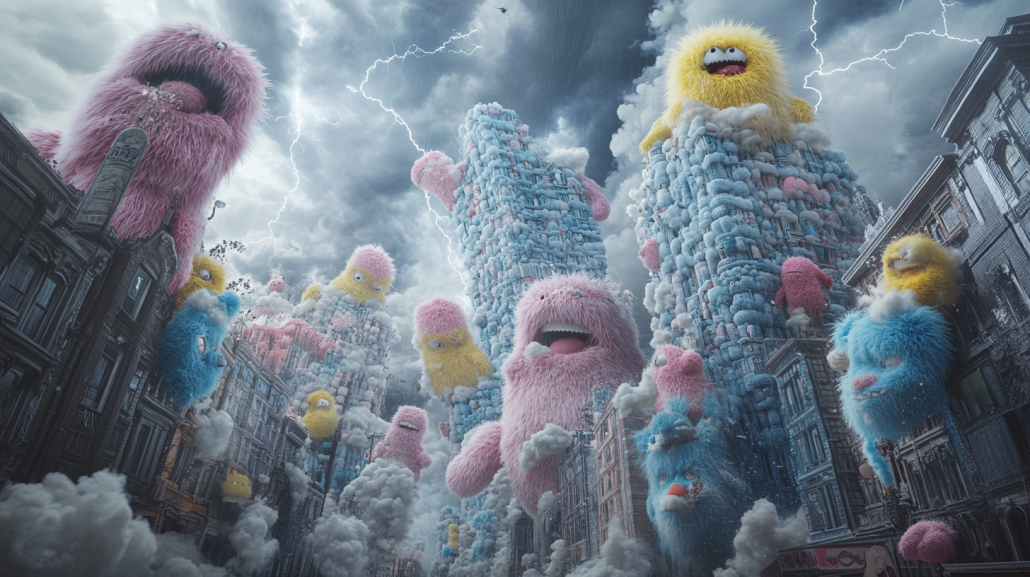
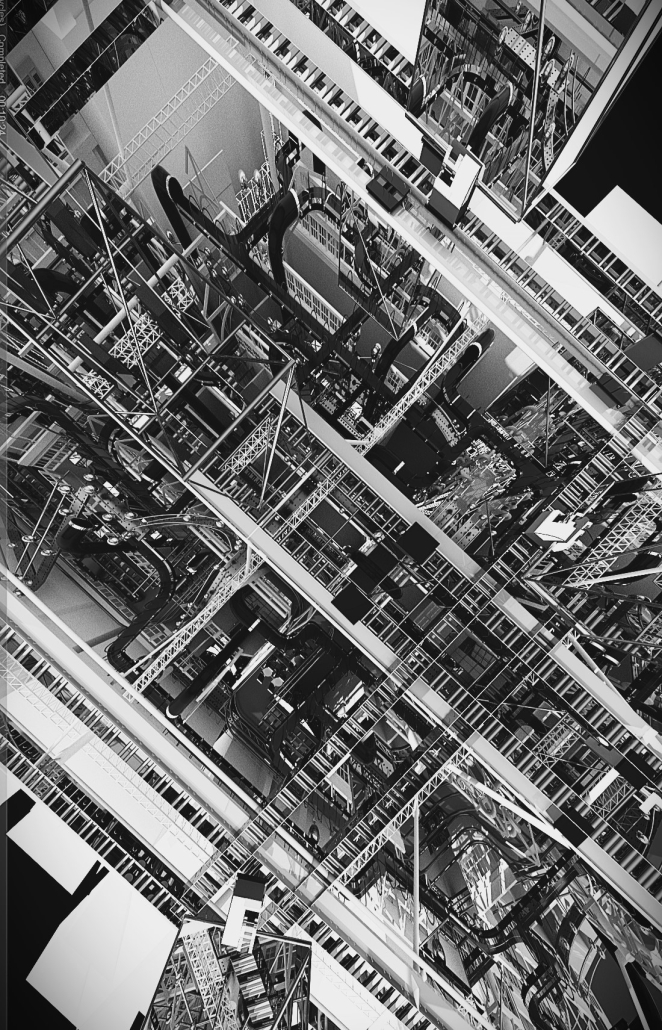
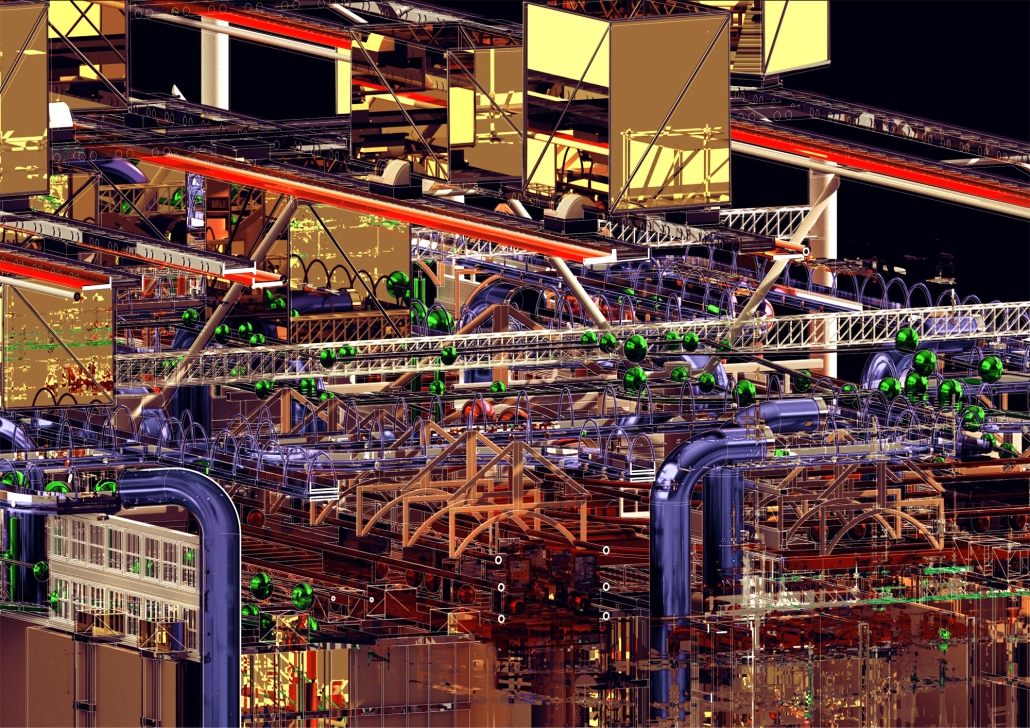
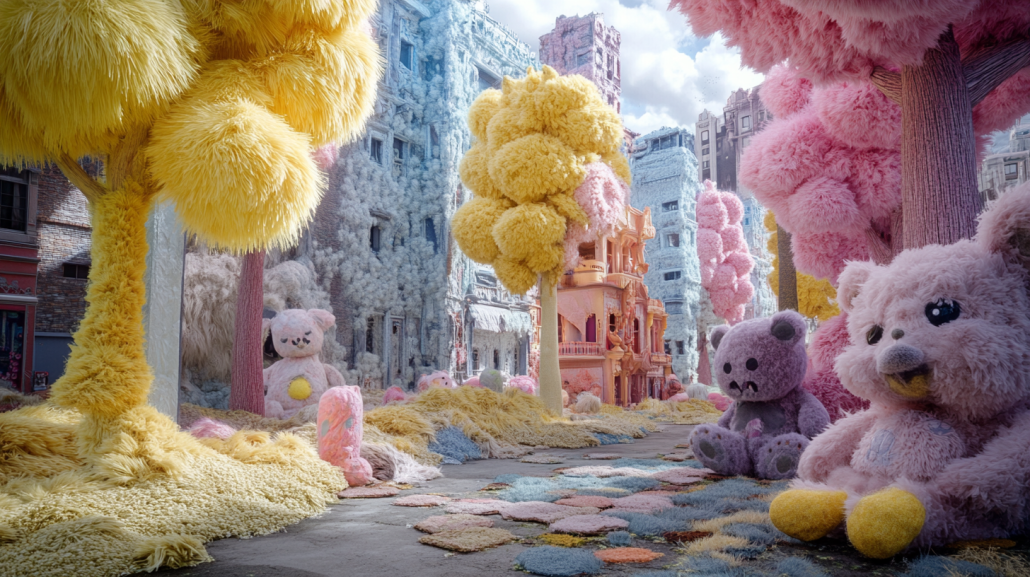
“Thread by Thread” is a short film, created as part of the course Cinematic Environments: Uncanny AI, explores hybridized architectural conditions through a speculative and surreal lens. Set in a richly imagined built environment, the narrative unfolds through the movements and interactions of fluffy, stuffed animal-like creatures—anthropomorphic figures that serve as both inhabitants and interpreters of the space. These soft-bodied protagonists navigate a world that oscillates between the familiar and the uncanny, offering a playful yet critical reflection on contemporary architectural and environmental issues.

The project operates within the “fuzzy space” between realism and speculation, where exaggerated materials, textures, and spatial configurations provoke questions about the future of the built environment. By merging whimsical imagery with architectural inquiry, the film engages themes of technological transformation and post-Anthropocene speculation. The soft, plush inhabitants stand in stark contrast to the often rigid, industrial aesthetic of traditional architectural spaces—suggesting alternative, more empathetic ways of occupying and designing environments.

Through visual storytelling, “Thread by Thread” reflects a critical position on how architecture might respond to pressing global concerns while embracing unconventional narratives and mediums. Ultimately, the film is a provocative gesture—one that reimagines the role of architecture in shaping not only physical space but also cultural and emotional landscapes. It invites viewers to question the boundaries of architectural representation and consider the value of softness, fantasy, and hybridity in the discourse of design.

Instagram: @em.dross, @jameskerestes
Echoes of the Land: A Pilgrimage of Wilderness and Spirit by Andrea Frank, M.Arch ‘25
North Dakota State University | Advisor: Stephen Wischer

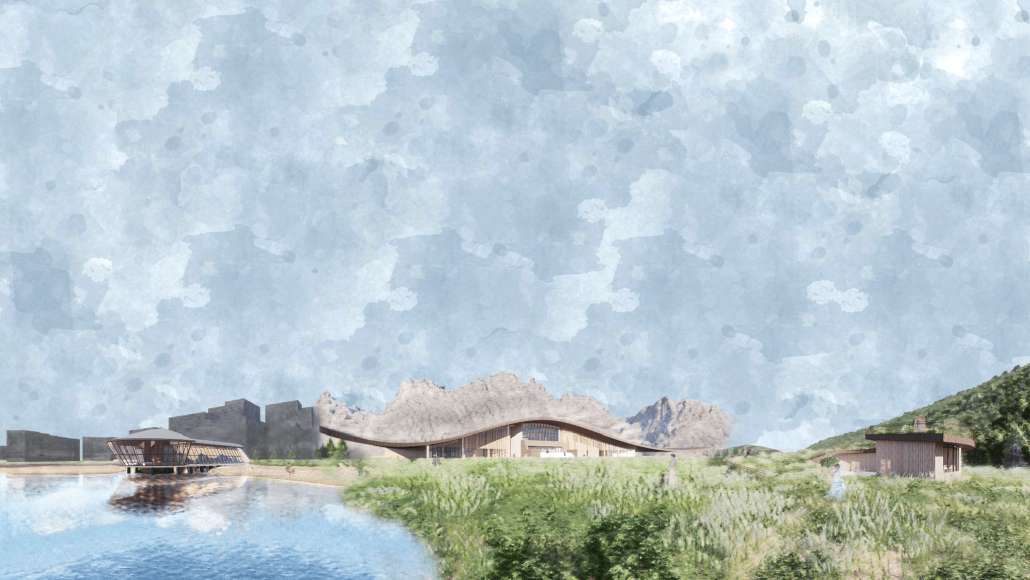
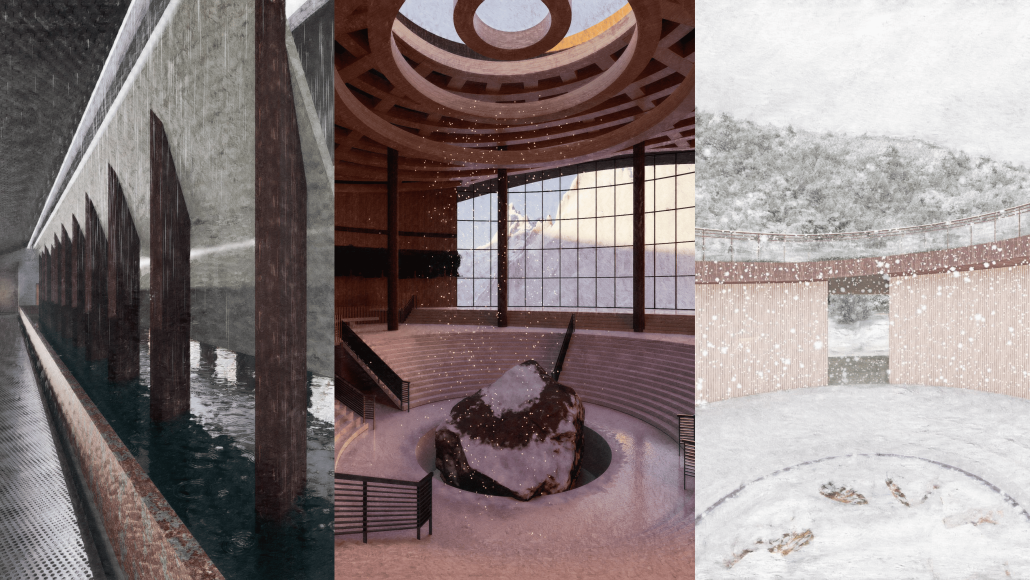
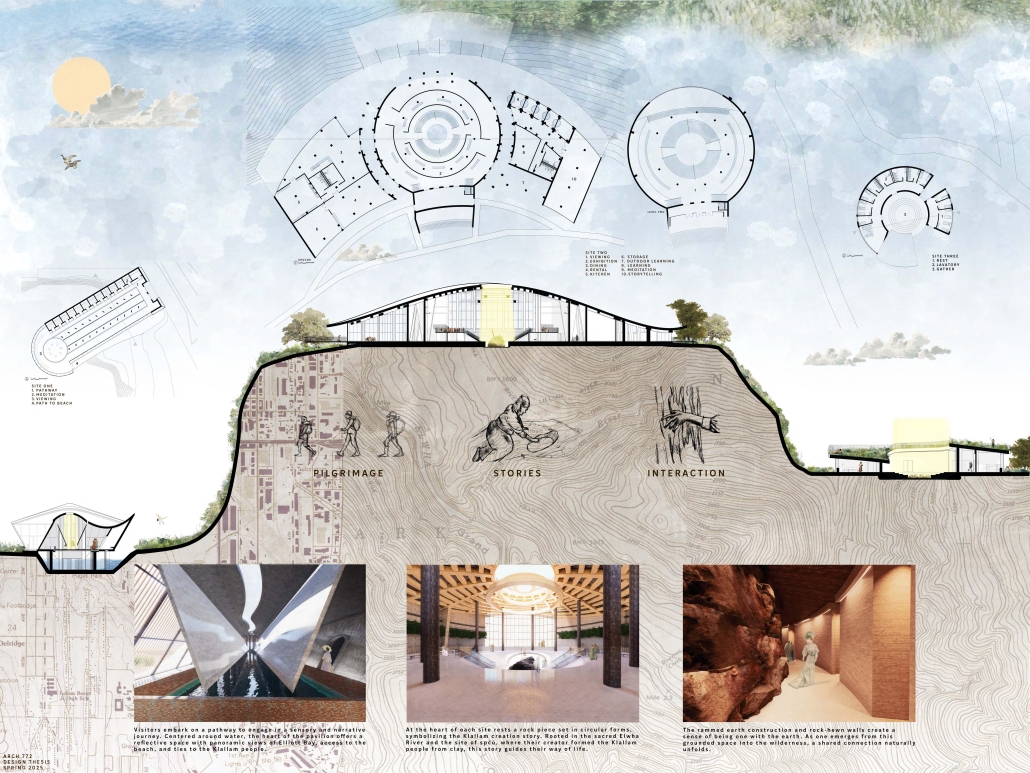
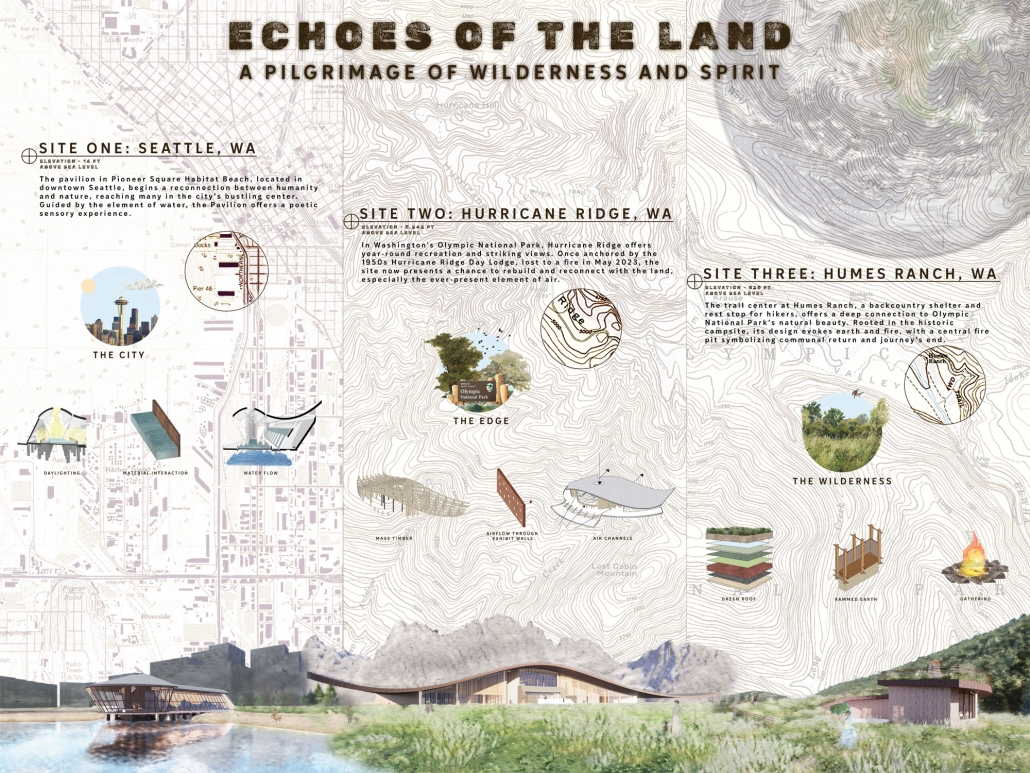
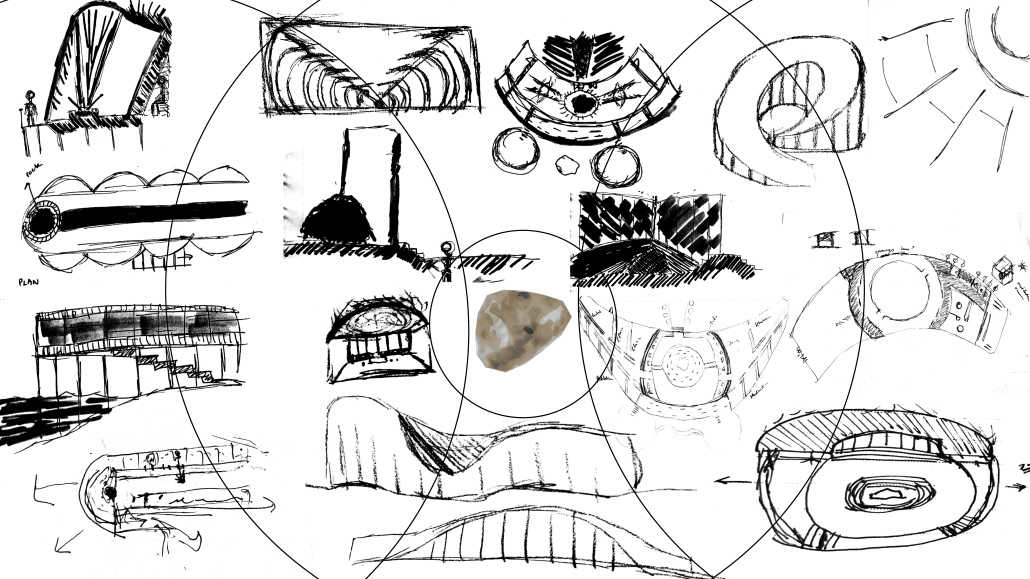
This thesis explores how architecture can bridge humanity and the natural world, restoring a connection eroded by technology, overconsumption, and distraction. While cities offer curated encounters with nature, they cannot replace the deep peace found in wilderness. This connection is essential to humanity’s survival. If humanity fails to understand its relationship with the environment and engage with it responsibly, it jeopardizes the ecological balance of the world and humanity’s own existence.

Architecture, once in dialogue with nature, now often serves function, spectacle, or profit. This work reimagines architecture as a mediator that fosters kinship with the earth through a threefold approach: a pilgrimage across city, edge, and wilderness; poetic uncovering of ancient site stories; and sensory engagement with the four classical elements. In doing so, architecture becomes a vessel for atmosphere, memory, and meaning, guiding individuals to a deeper awareness of themselves and their world.

This project received an AIA Medal for Academic Excellence.

Instagram: @andrea.frank10
A Place for Pilgrimage by Andy Packwood, B.S. in Architecture ’25
University of Virginia | Advisor: Peter Waldman

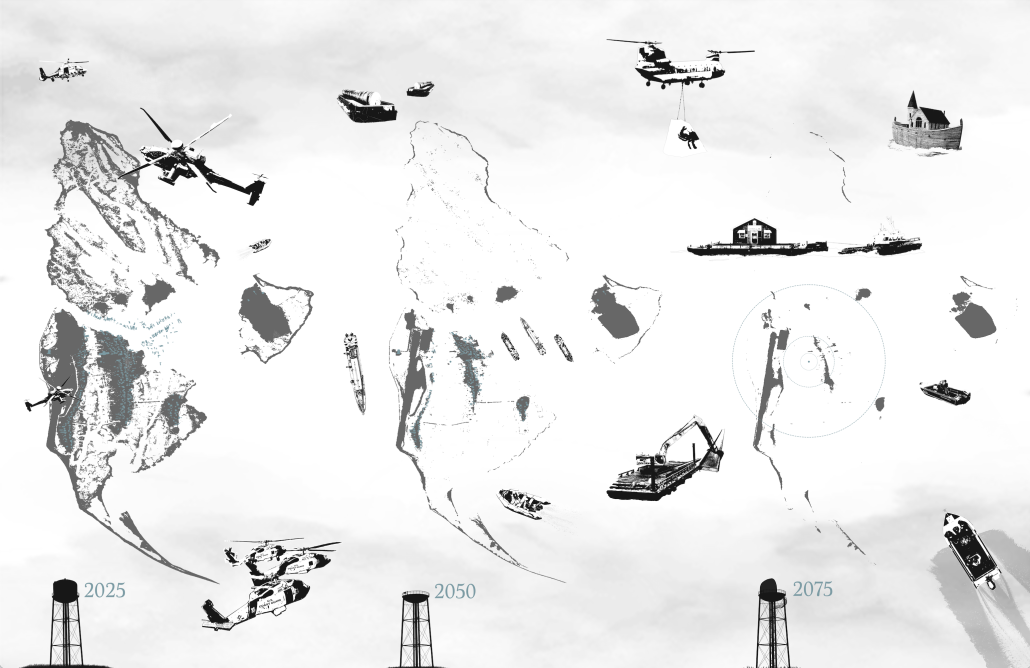
The project synthesizes two years of fascination for and research into the climate-threatened coastal community of Tangier, speculating as to what will ultimately happen to rural, low-income American communities in the wake of inevitable sea level rise. My interest lay not in the proposal of any sort of savior infrastructural solution, not in the proposal of a managed retreat plan, nor in the design of a mainland relocation for displaced refugee residents. I chose to develop a memorialized destination that could still exist on the island long after its ridges have turned to marsh, its homes have been barged away, and normally perceived connotations of inhabitability have all but vanished. I chose to create “A Place for Pilgrimage”, inspired by my own pilgrimage of El Camino de Santiago this past March.

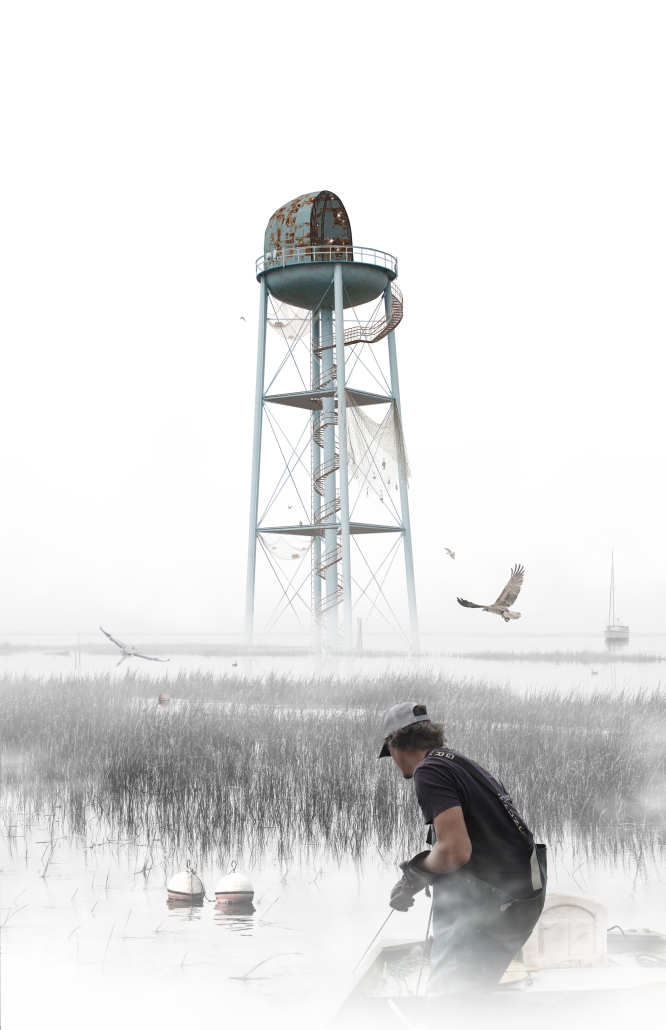
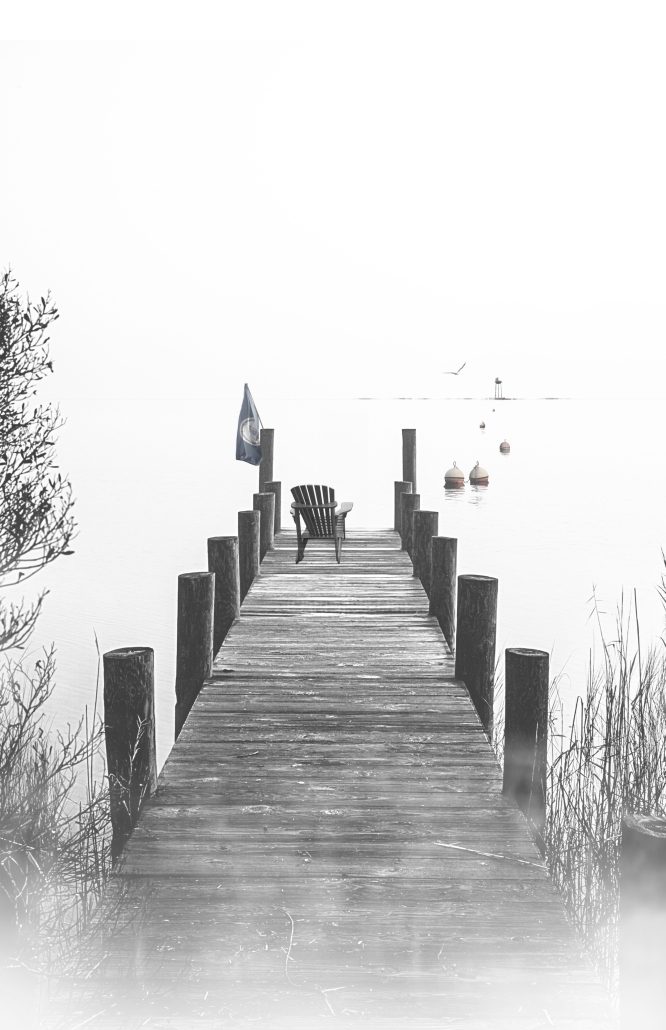
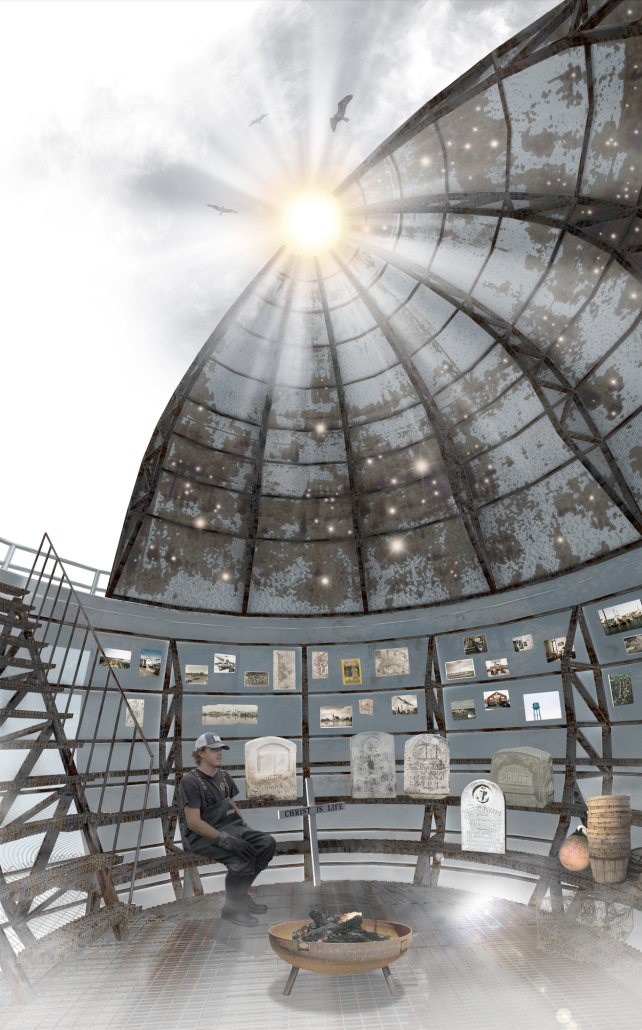
Simply put, the proposal is an adaptive reuse of the tallest structure on Tangier: its water tower. Adding a spiraling staircase and pushing the structure fifty years into the unknown, the design creates a single space in the sky through the removal of half of the tower’s upper dome. The approach is incredibly important; much of the final pin-up focused on rendering this pilgrimage step by step. Starting from the dock of the mainland resettlement, looking out into the Chesapeake Bay, a line of buoys trails towards the horizon. A bird soars toward the tower in the distance, the vestiges of marsh poking out of the water. Cameron Evans, current vice mayor and young watermen of the Island, embarks as this future pilgrim by skiff. He carries with him a gravestone; many cemeteries on the Island are often inundated by tidal flooding, and residents must move these tombs to higher ground, again and again.

What I have proposed is a final resting place, safe from the heights of sea level rise. A place for generations to visit, to bring tokens of remembrance, to occupy overnight, or to even continue their trade as watermen. Up within the dome of the water tower is a cenotaph for the people, memories, culture, history, and beauty of Tangier. We will need one.

This project was awarded High Honors for Thesis.
Ephemeral Spaces — Presence and Absence by Robin Xiao, B.S. in Architecture ’25
University of Virginia | Advisor: Peter Waldman

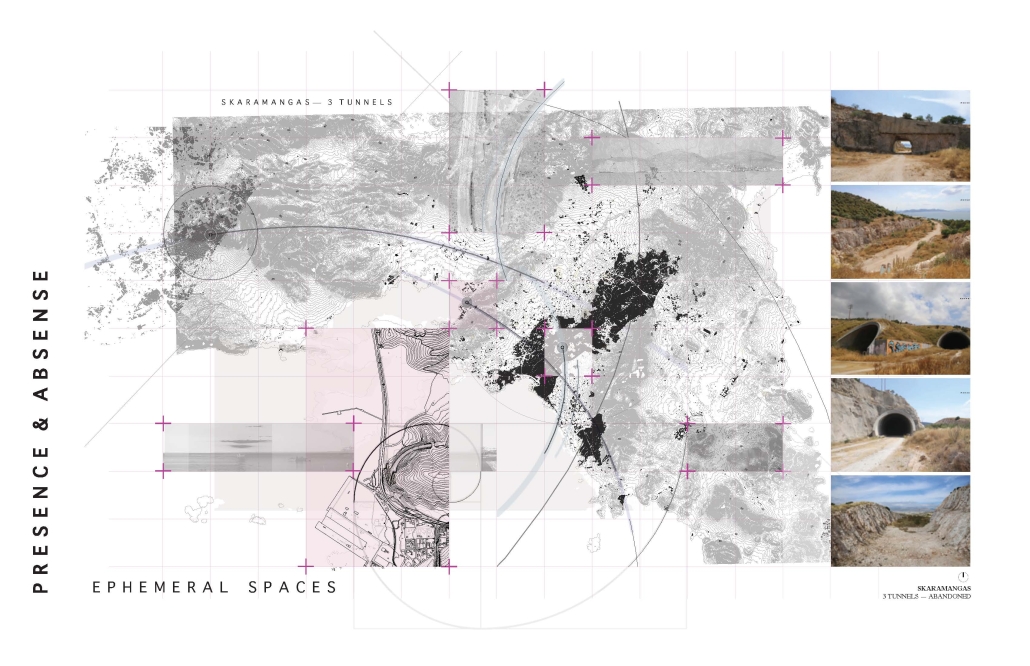
This thesis explores how architecture can emerge from the debris of the everyday to construct a space of ritual and transition—between life and death, presence and absence, memory and forgetting. 

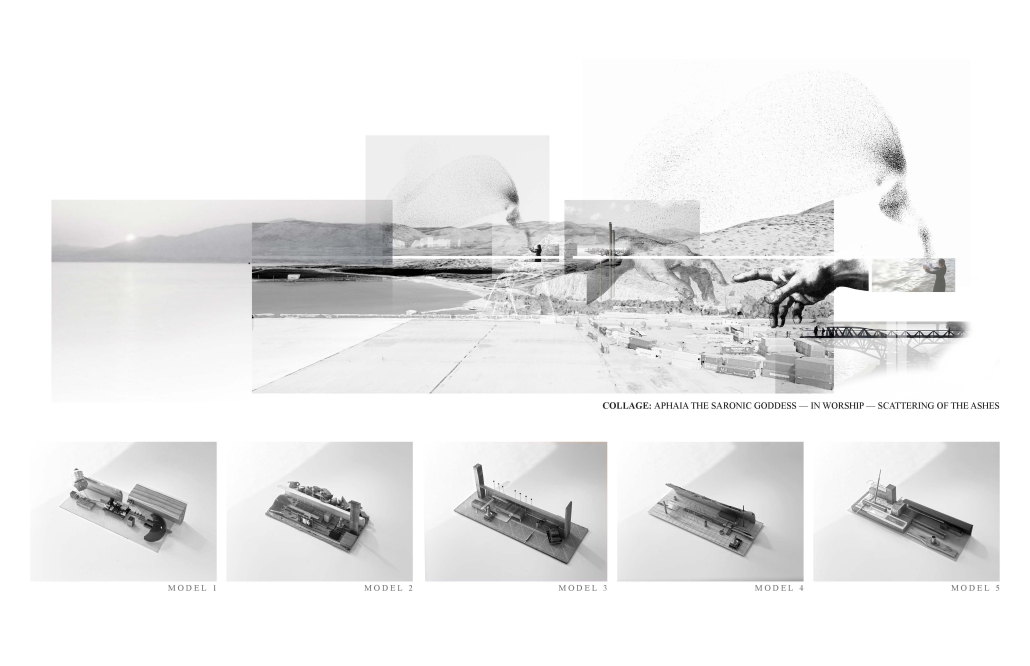
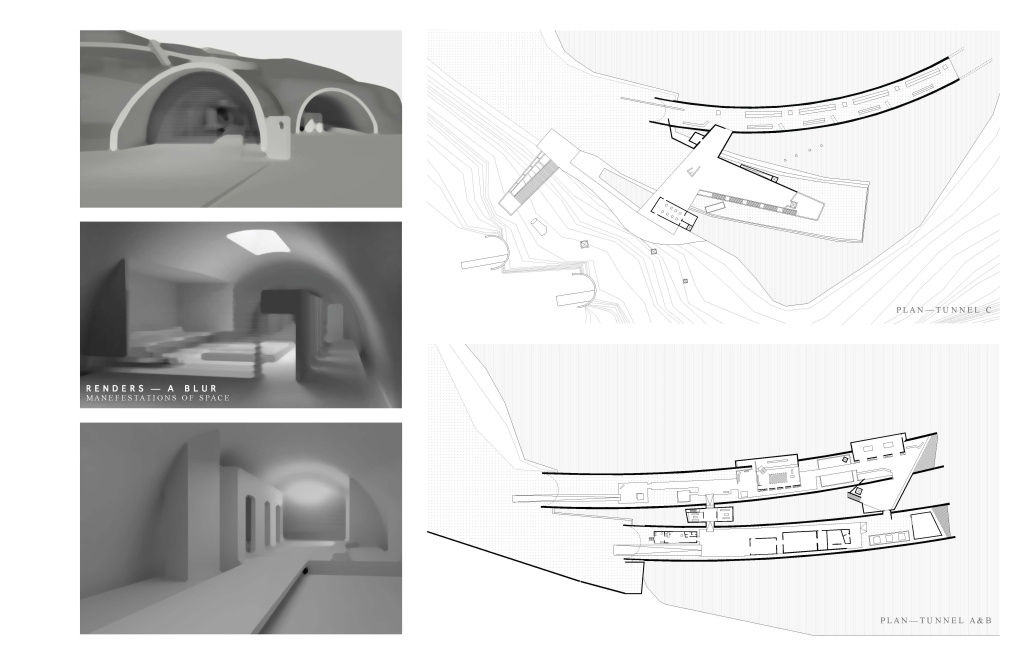
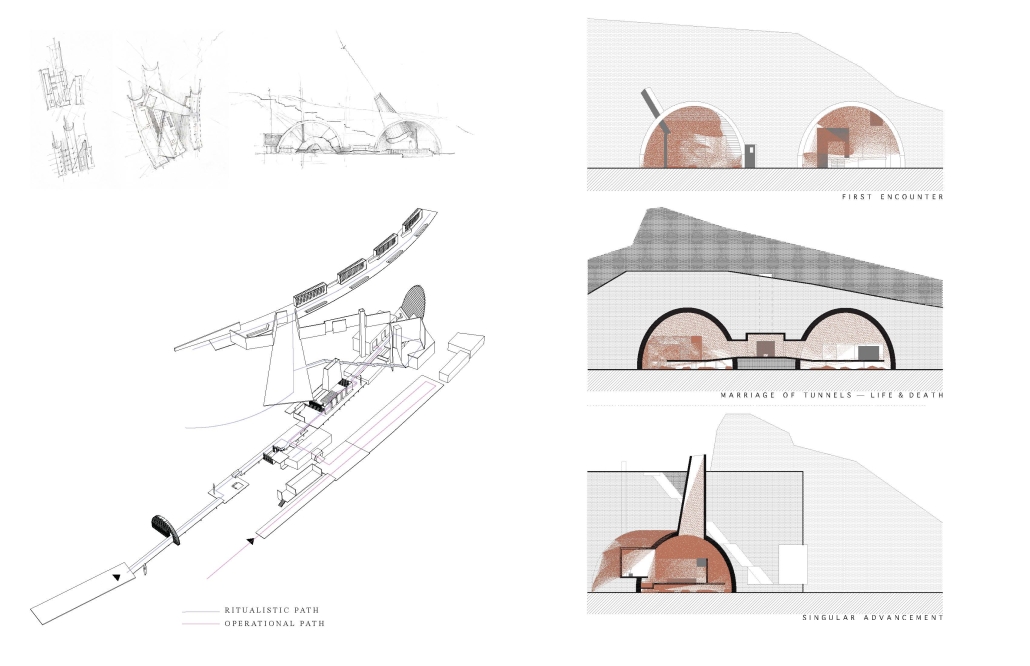
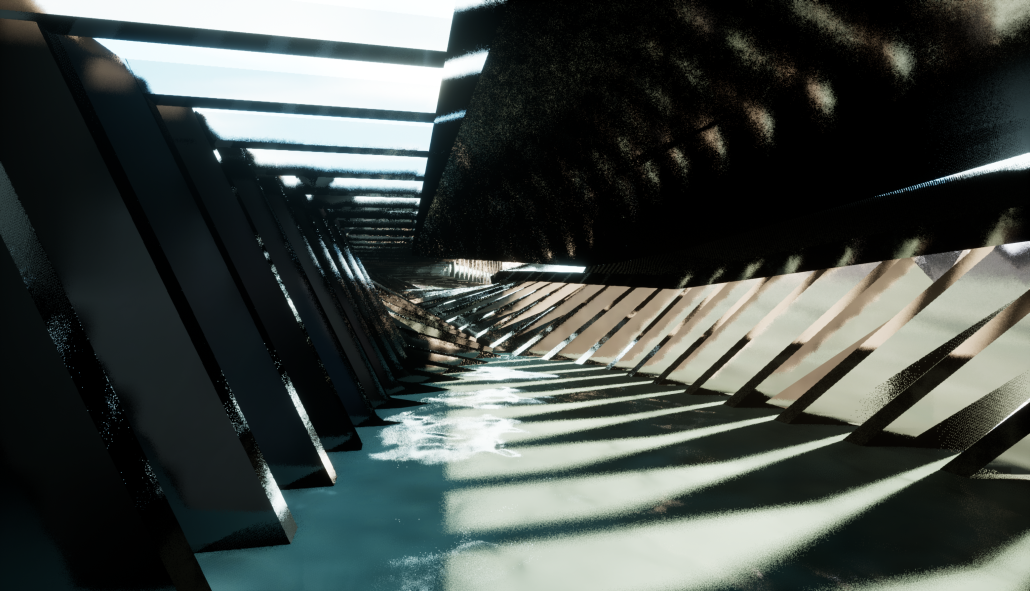
Situated in the post-industrial landscape of Skaramangas, Athens, the project transforms three abandoned military interchange tunnels into a procession of ephemeral architecture: a crematorium, a columbarium, and spaces for reflection, and spaces of pause/entry/exit. 

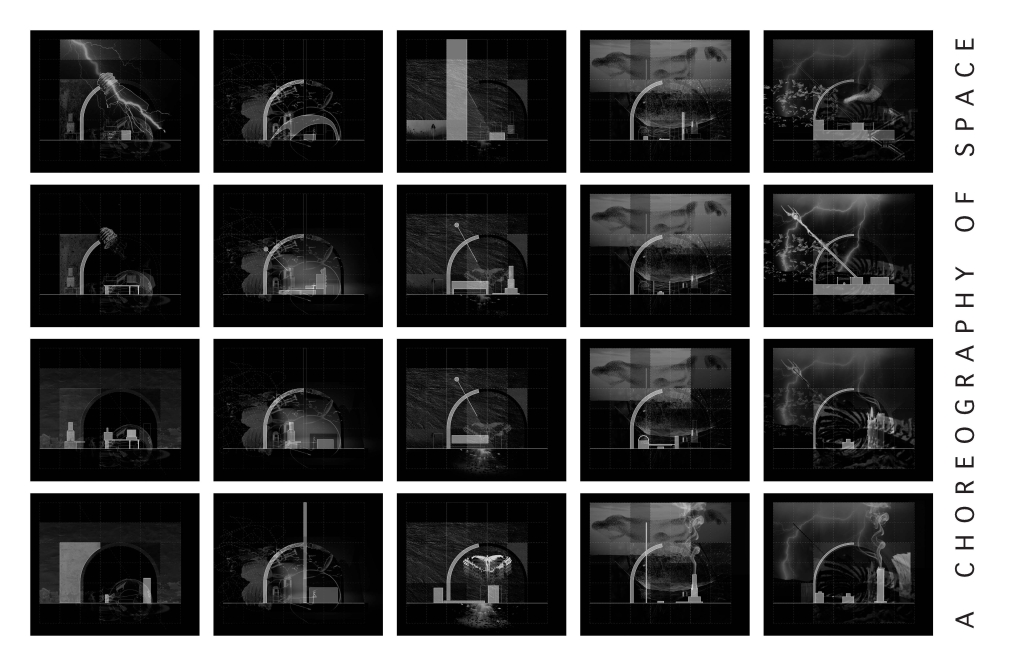
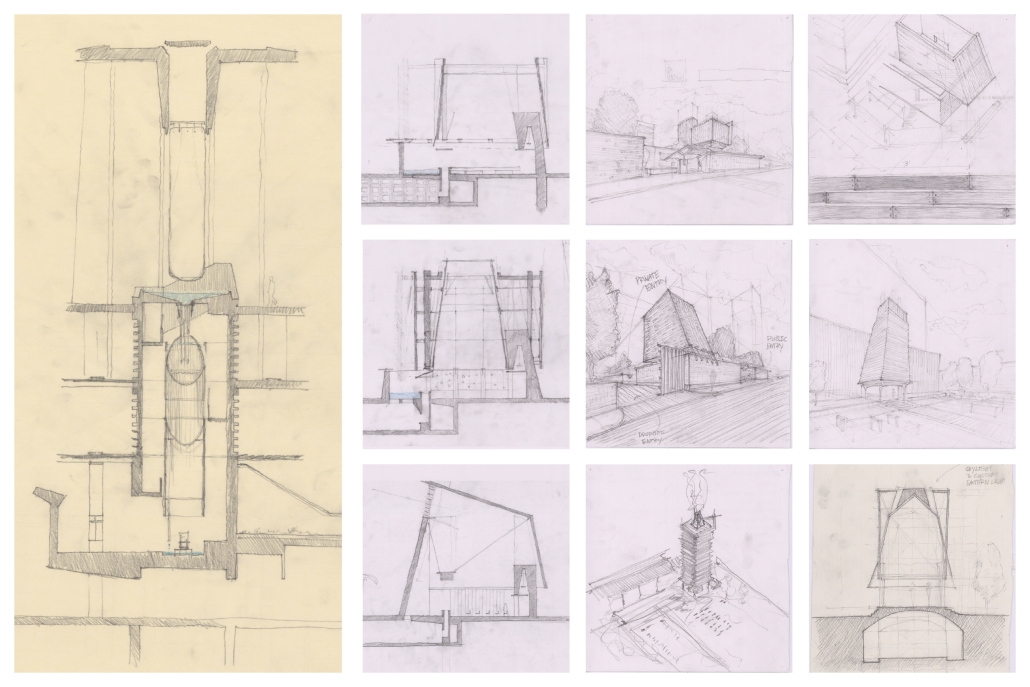
Through a series of five conceptual models, material fragments—broken light bulbs, candles, metal tubing, computer chips, wood scraps—become instruments of spatial inquiry, offering alternative ways to think about temporality, transformation, and the sacred. Each model gives rise to a set of sectional drawings, collaged with elemental forces—earth, fire, air, water—revealing a layered architecture of transition. 

The resulting proposal is not a fixed structure, but a choreography of spaces that invite the living to move with the dead, through tunnels repurposed as thresholds. This work situates ephemerality not as loss, but as an architectural condition of becoming—an act of spatial murmuration shaped by light, material residue, and memory in motion.

This project received High Honors for Undergraduate Thesis.

Instagram: @robinxiaostudio
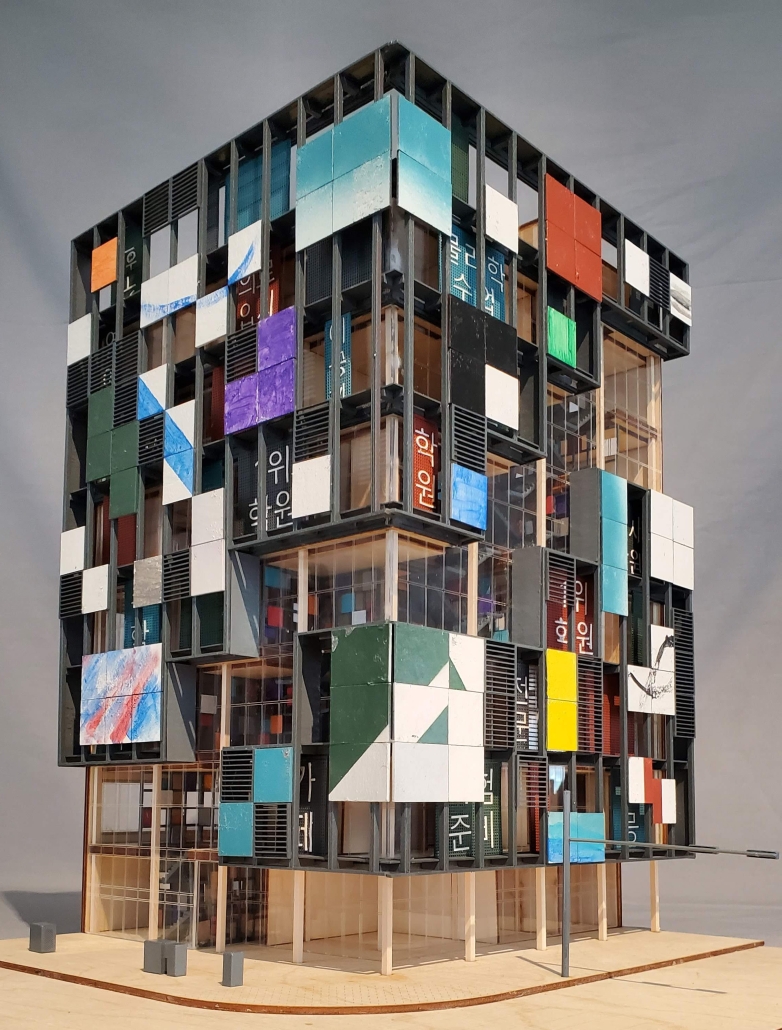
MOVING FUTURES VERTICAL SCHOOL by Alex Hoover & Zach Izzo, M.Arch ’25
University at Buffalo | Advisor: Jin Young Song

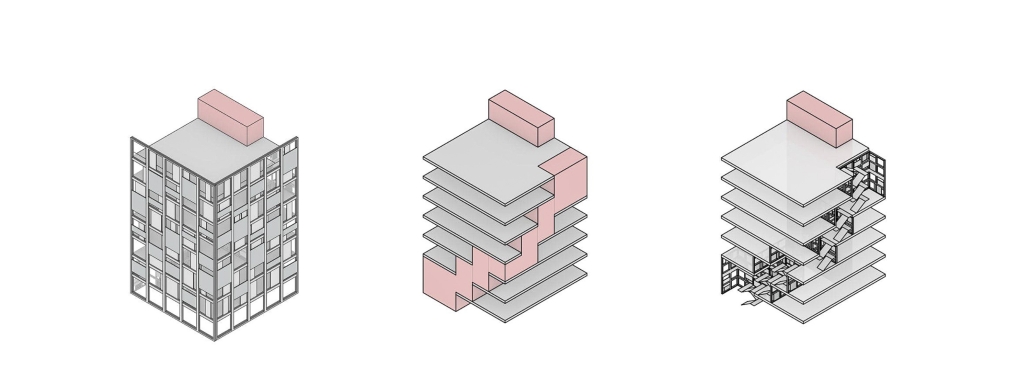
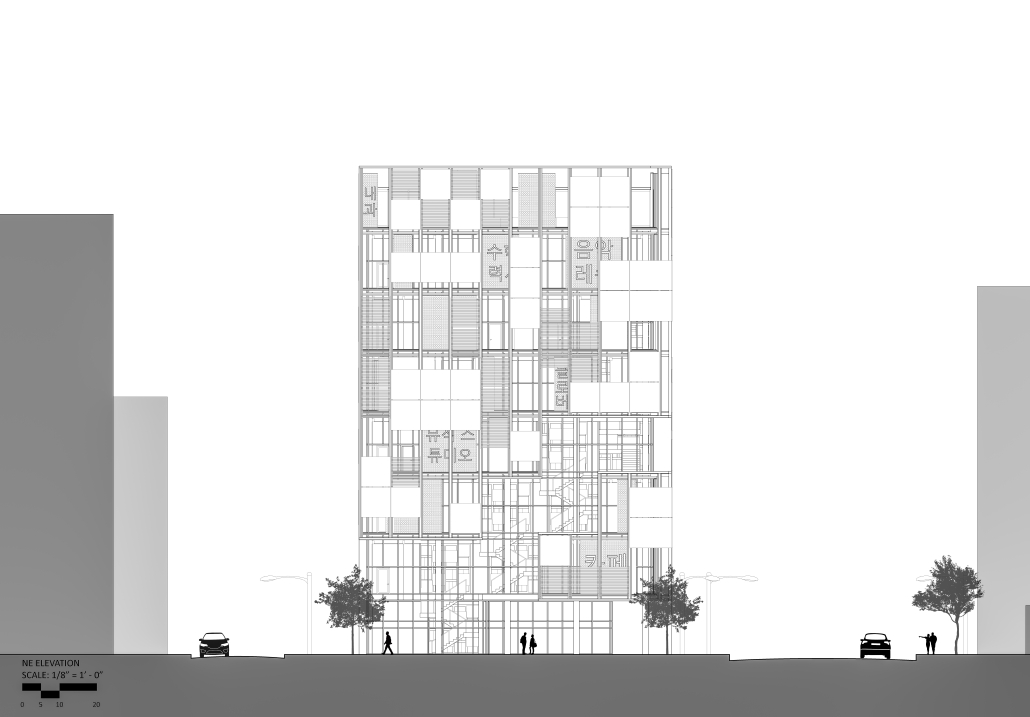
Located in Songdo, Seoul, our project reimagines the typical Korean private educational institutions, known as Hagwon, by prioritizing spatial flexibility and community engagement. Traditional Hagwons often feature cramped, efficiency-driven classrooms. However, research shows that children learn better in environments with diverse spatial qualities—high ceilings, minimal partitions, vibrant colors, and flexible layouts. To address this, we designed a highly adaptable building with movable interior and exterior components. Each main floor features partition walls on ceiling-mounted tracks, allowing spaces to transform easily—from small study rooms to large lecture halls or art galleries. This system ensures both spatial diversity for students and long-term adaptability for future tenants or programs. 

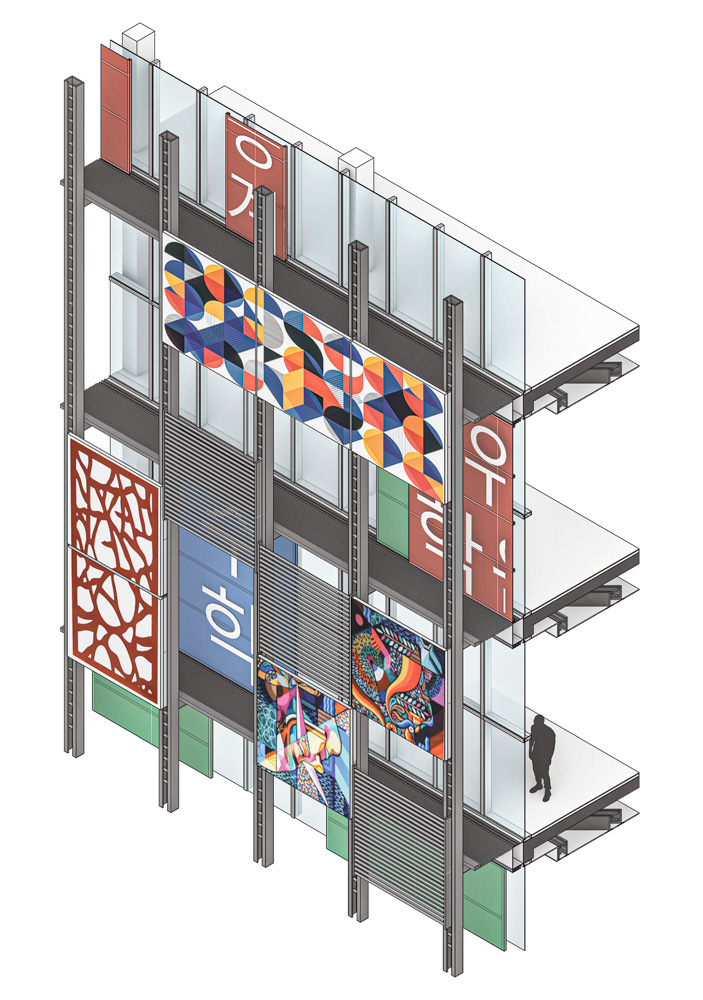
The facade similarly emphasizes flexibility, offering a reinterpretation of Korea’s dense, intrusive urban signage. The three-layer facade system integrates architecture, community identity, and student expression. The outer layer consists of LED media panels and sun-shading devices, configurable to display student artwork or community visuals, establishing the building as a neighborhood landmark. The second layer features sliding perforated metal signage panels, subtly blending information with the architecture rather than overwhelming it. The innermost layer wraps the social stair, visible from both adjacent streets, inviting public interaction and showcasing movement within the building. Smaller panels provide localized signage, such as floor numbers and bulletin boards. Together, the dynamic facade and transformable interior create a learning environment that fosters both community visibility and spatial flexibility, promoting a more engaging, human-centered educational experience.

The project was selected for the Cram Urbanism and Vertical Learning Space International symposium

Instagram: @_alex_hoover, @jinyoung___song  
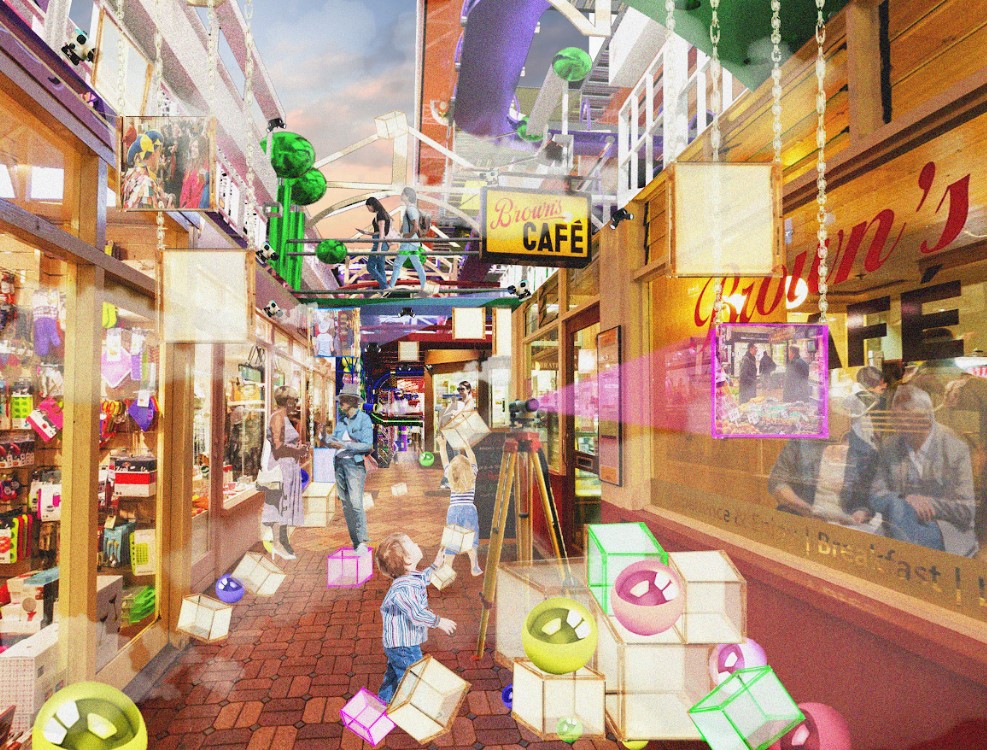
The Market of Joy by Shefa Quazi, M.ArchD ’25
Oxford Brookes University | Advisors: Toby Smith, Alexandra Lacatusu, Toby Shew, Charles Parrack

In a world dominated by seamless digital consumption, where screens dictate desires and algorithms predict movement, The Covered Market in Oxford becomes a site of rebellion—a place where reality is glitched, distorted, and reclaimed from commercial control. Instead of a polished, hyper-commercial spectacle designed to guide users into predictable behaviors, the proposed series of interventions hijack the mechanics of digital consumerism and turns them against themselves to exaggerate them into a physical, pseudo-reality. Attempting to readminister the loss currency of joy.

The market transforms into a disruptive, anti-brand arcade—a physical and augmented experience that interrupts, unsettles, and reawakens users to the absurdity of algorithm-driven life. Augmented Reality, typically a tool for corporate control (filters, tracking, gamified shopping), is instead repurposed to create moments of détournement, where the commercial is undermined, and participation leads not to consumption, but to adding weight to reality and human interaction. Overall revaluing the High Street as a whole. 

Instead of guiding users toward consumption, the market becomes a disobedient space, forcing engagement away from passive scrolling and toward critical awareness of spectacle itself. The interactions don’t feed an algorithm—they break it. The market is no longer a relic of pre-digital commerce but a living, evolving site of resistance against digital saturation and corporate control.

This project received the Oxford Brookes University Reginald W. Cave Award.
Instagram: @sheevz_q, @oxarch

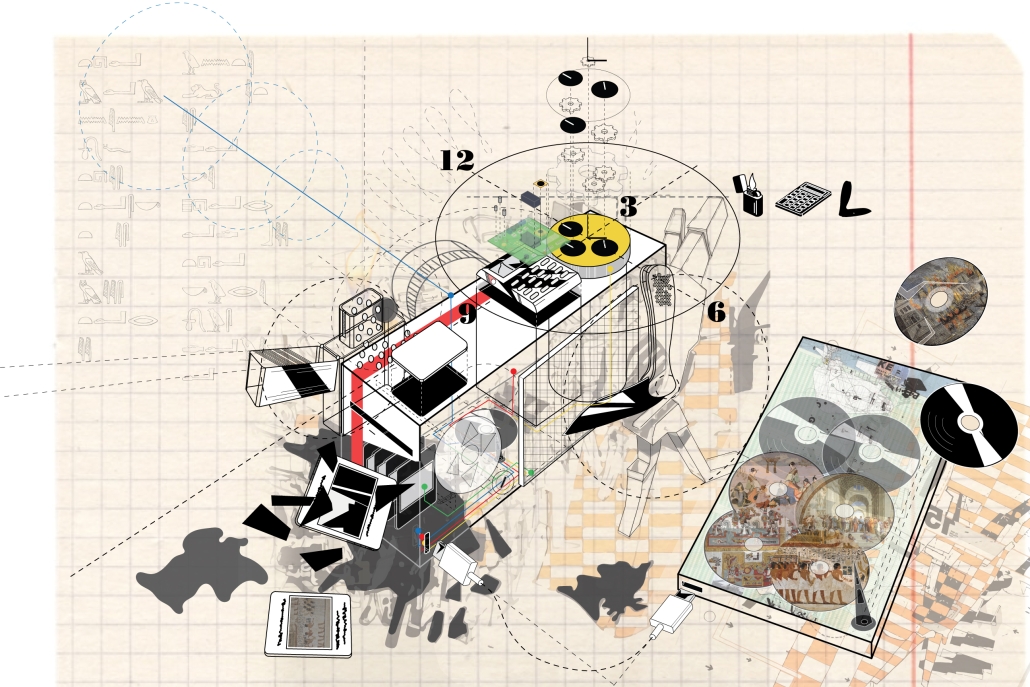
The Inner Mechanism by Jared Roberts, M.Arch ’25
Lawrence Technological University | Advisor: Masataka Yoshikawa

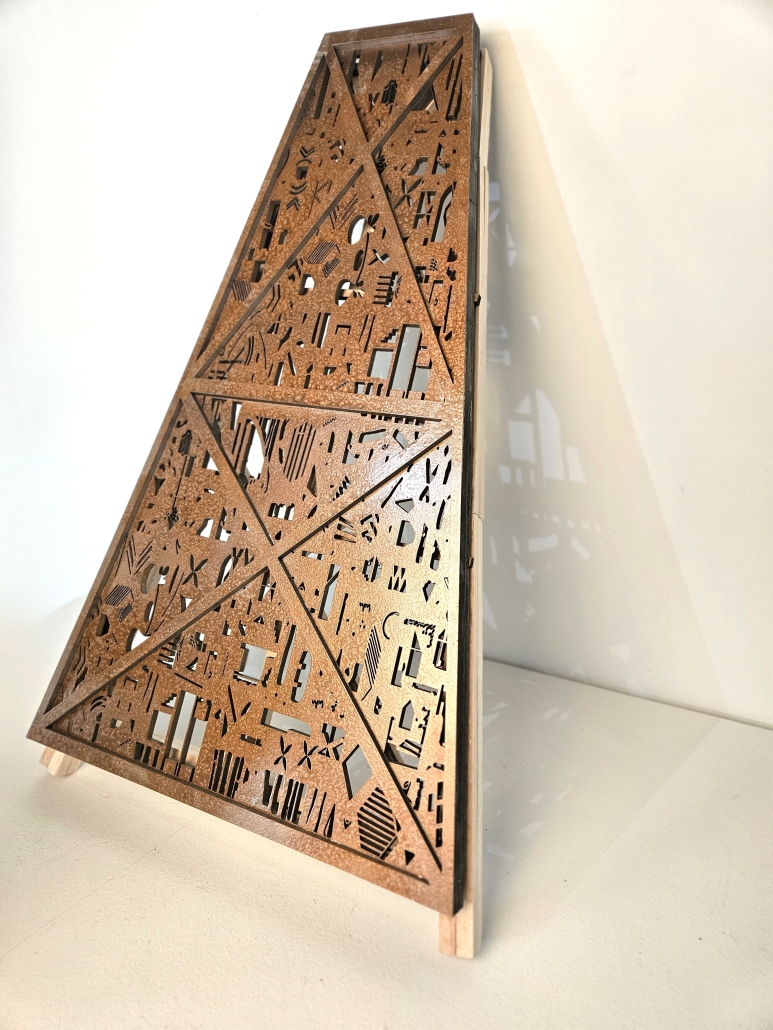
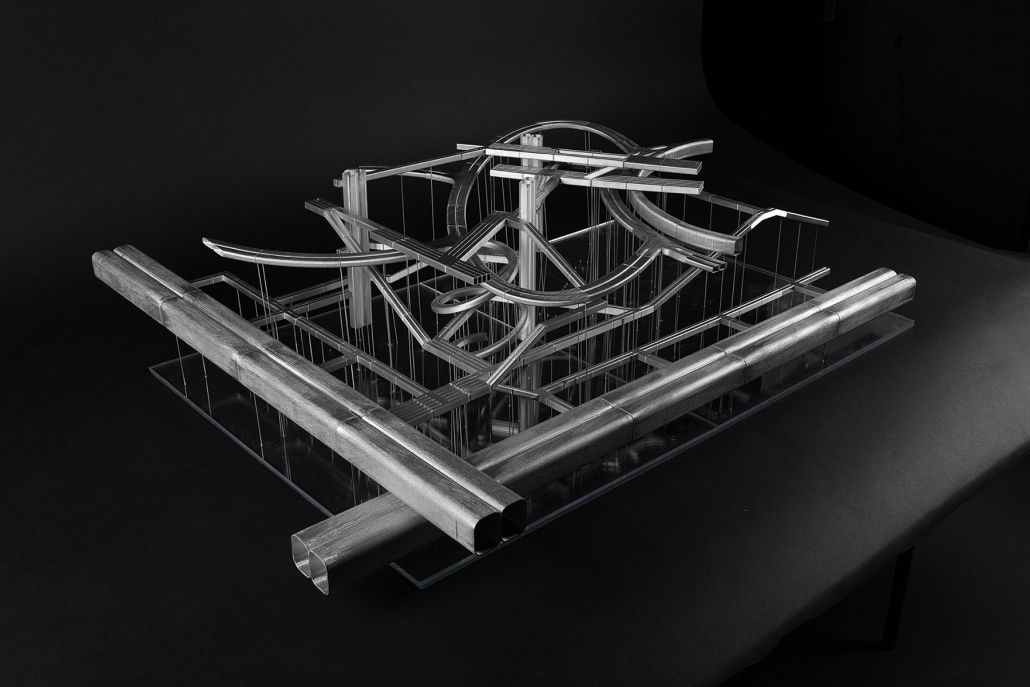
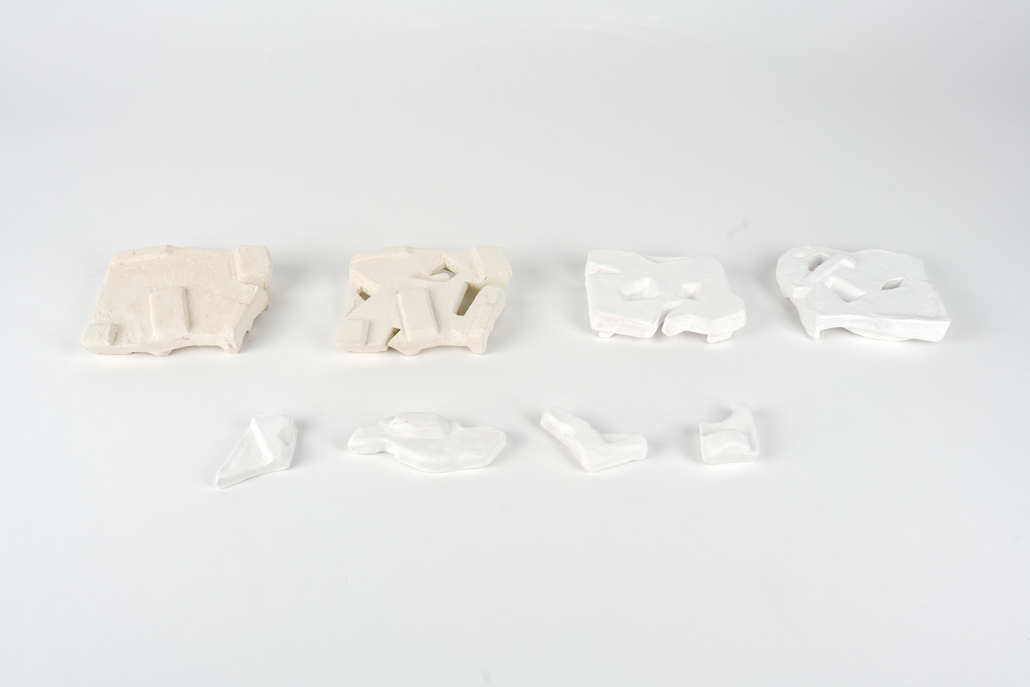
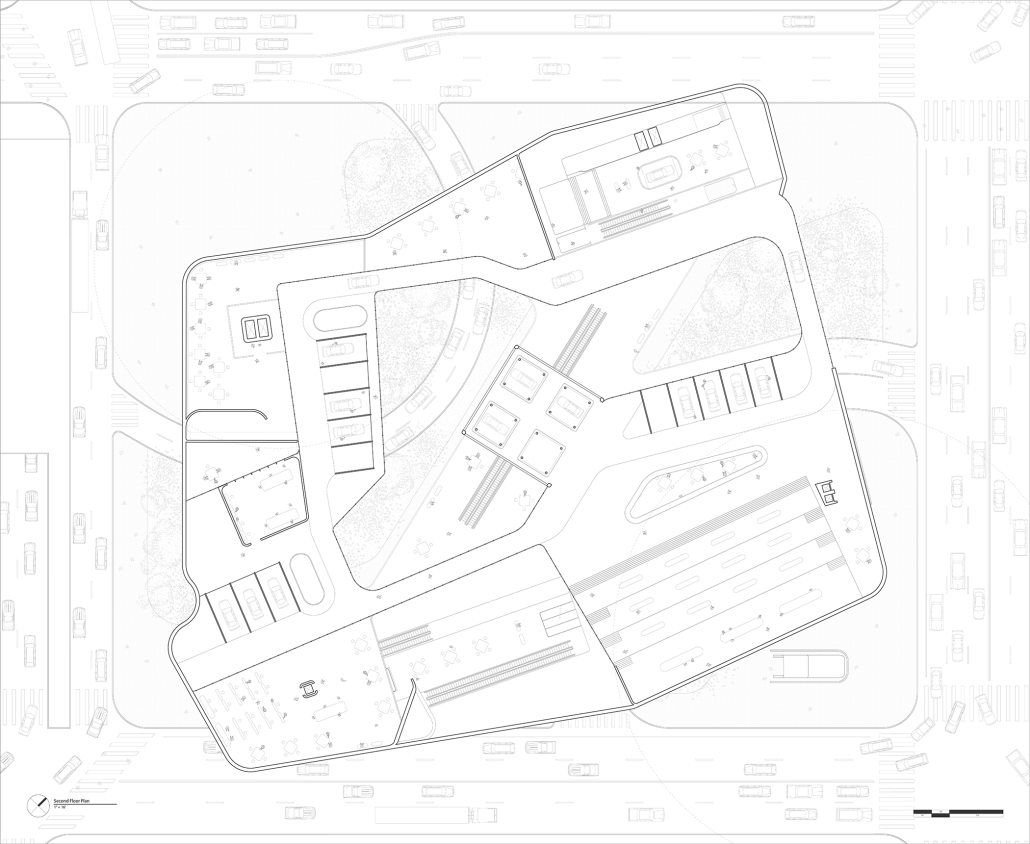
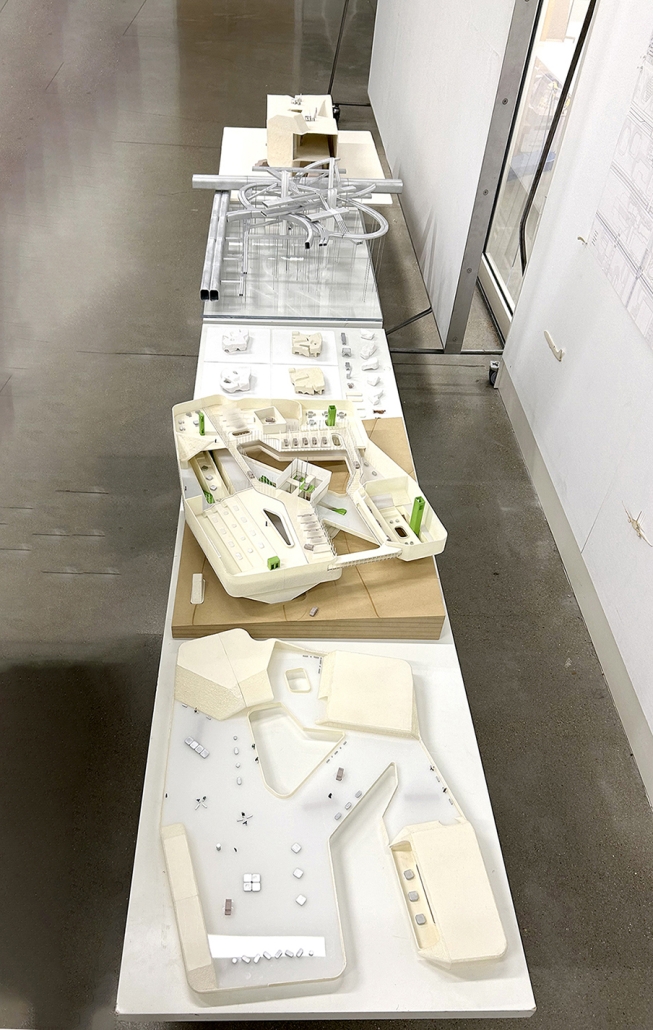
This project sees the physical model and 2D illustration of the hypothetical device abstracted to create architectural forms and spaces. The form derives itself from the concepts dealt with in the inner mechanisms and particularly information storage. The “nested” nature of digital information storage (i.e., nested file folders on a computer) translates to nested architectural forms that sometimes exist within or even overlap other parts of the model. Another concept was that of information’s changes and persistence over time. The form is constructed like a timeline that exists in all three dimensions, inspired by the flow map of Napoleon’s invasion of Russia, which charts various different variables including location, population, time, events and more about Napoleon’s Russian campaign. In the same way, the timeline is a two-dimensional visual representation of information gathered about events in history; this model is a three-dimensional representation of the information gathered and stored by the hypothetical device. 

Instagram: @masataka.yoshikawa
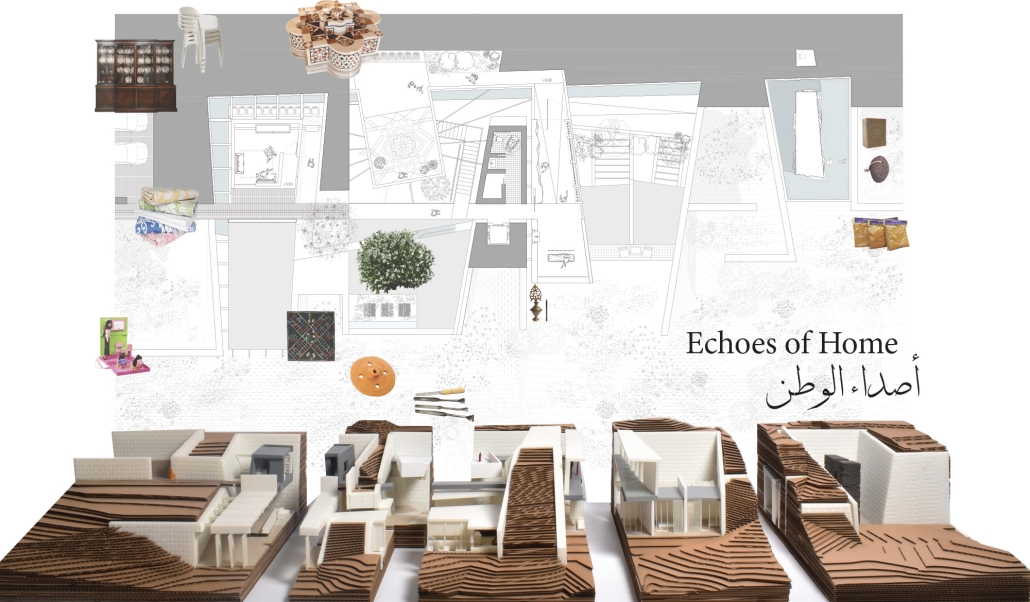
Echoes of Home by Zuha Arab Sabbagh & Rana Abdelhadi, B.Arch ’25
American University of Sharjah | Advisor: Gregory Thomas Spaw

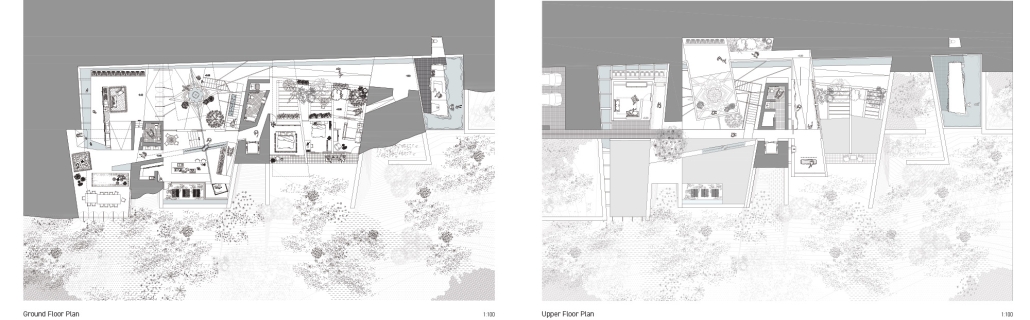
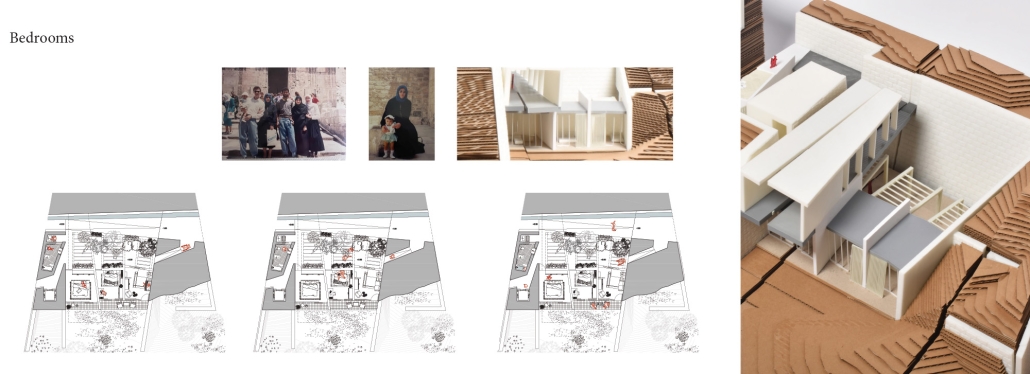
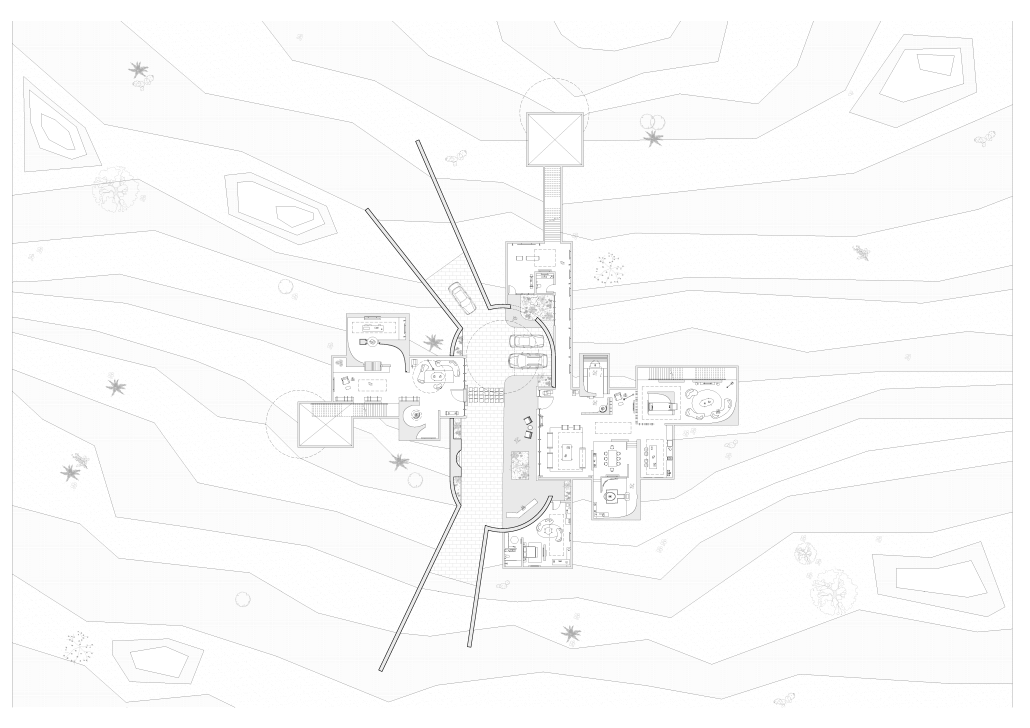
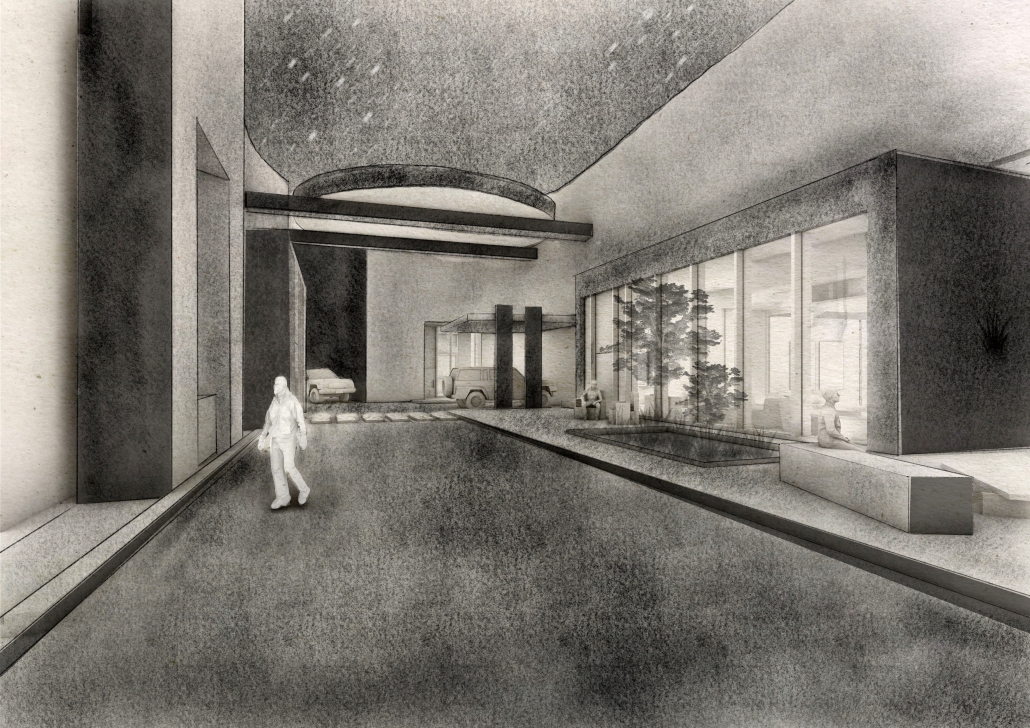
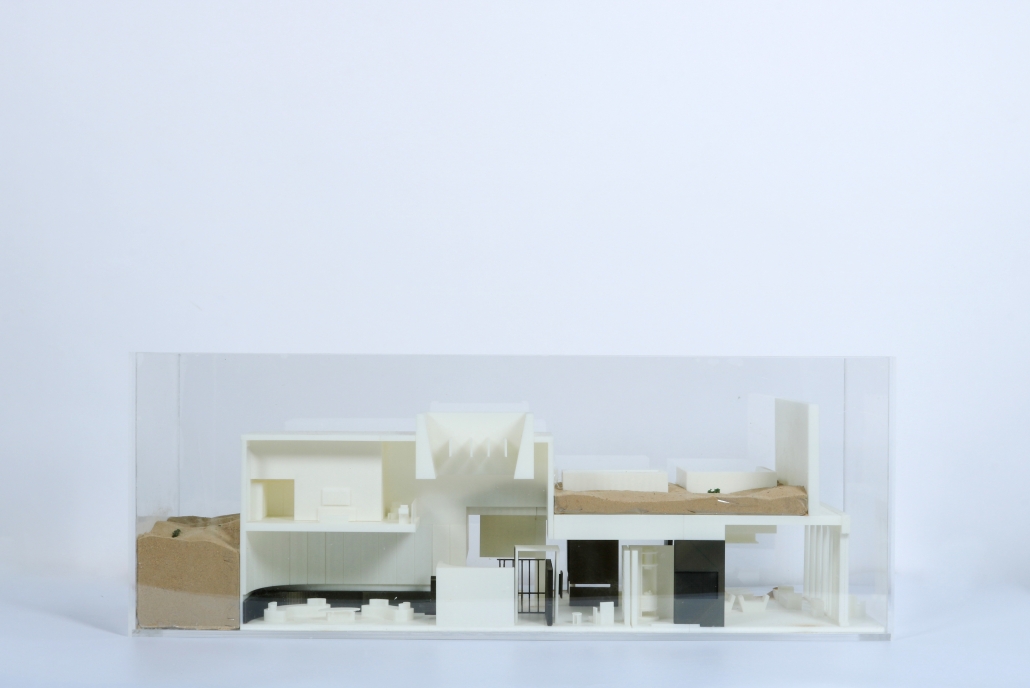
‘Echoes of Home’ responds broadly to displacement in our globalised world. Specifically, on the generational displacement of Syrians. Centralised on the intimate and underappreciated labour of homemaking, the project acts as a recognition and celebration of Womanhood as a discipline. It is designed to mark the story of displacement – building and rebuilding – into an inconstant world. The project tentatively approaches the need to capture the complicated ephemerality in our modern understanding of what ‘home’ is.

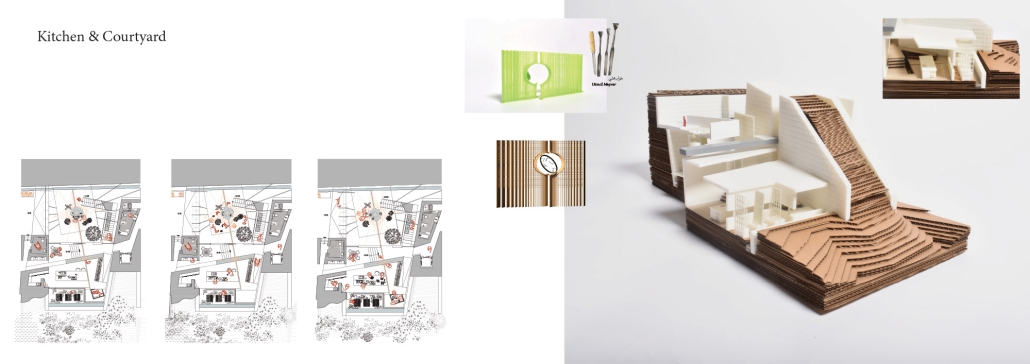
In designing a secondary residence-exhibition, the studio deployed the renaissance phenomenon of the cabinet of curiosities to challenge us to create spatially charged architecture focused on the exhibition of artifacts. We selected fictitious clients, curated a selection of curiosities to display, picked a suitable site, and decided the extent of distinction between the residence and the exhibition.

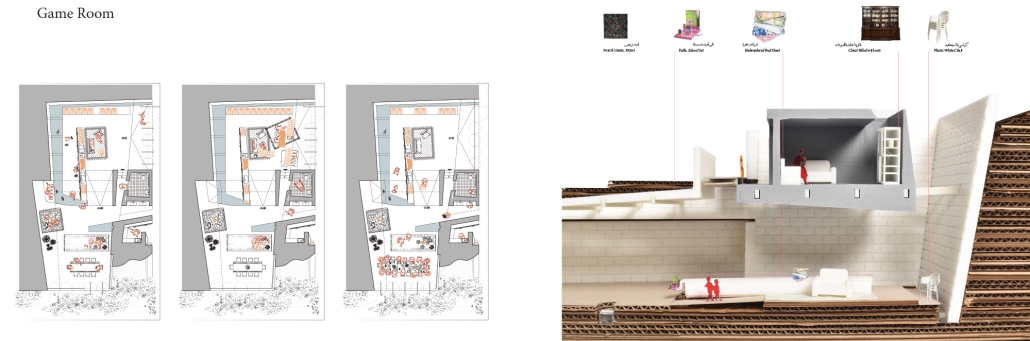
Designing a residence required an examination of the notion of ‘home’. Historically, ‘home’ has been explored as a vehicle for living and, with the rise of modernism, critiqued as performative. The programs selected recognise the labour of homemaking and extend to capture the performance of hosting and the pleasure of gathering. ‘Home’ has consistently been placed in women’s domain. The practice of homemaking falls under the discipline of Womanhood. The project adheres to the practice and rejects criticism, accommodating for it spatially. The kitchen, game room, bathing space, bedrooms, bathrooms, and guest room all double as exhibition spaces. The integrated spaces create opportunities for gathering and hakawayti (storytelling). Homes tell a story of past, present and future, and the project acts as a natural extension.

Encouraged to design spaces from the inside out, the client and narrative guided design decisions. The Characters: a mother, daughter and grandmother, based on Syrian women in our vicinity, emphasise the generational distinctions in modes of displacement: immigrant, diaspora and refugee. The clients’ stories resemble those of many diasporas. 

Instagram: @gregoryspaw
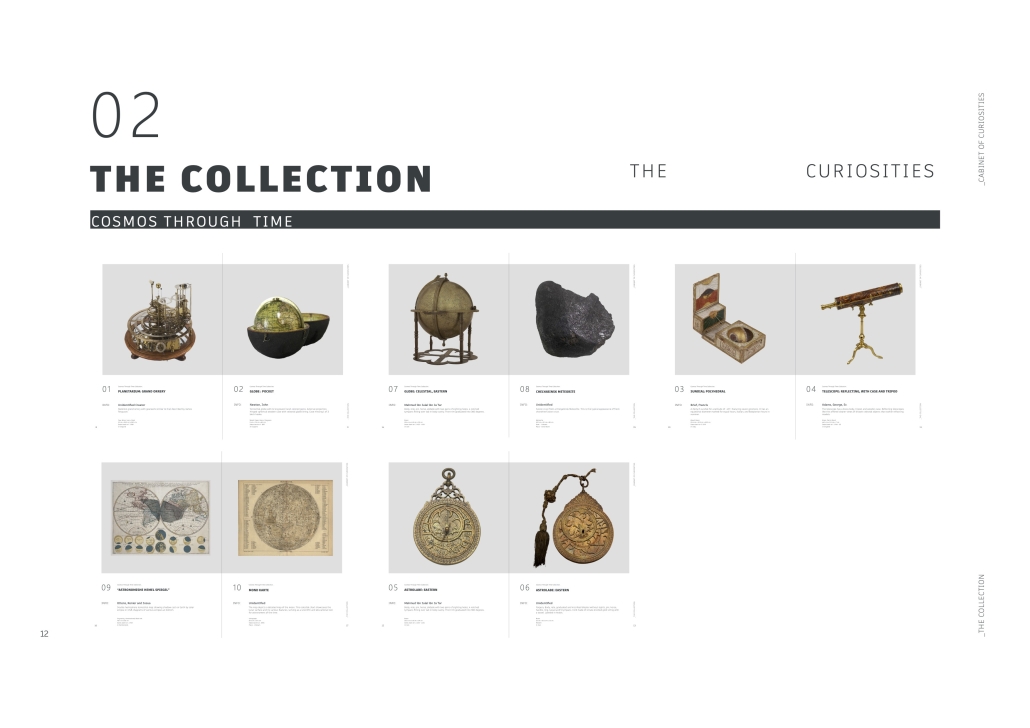
An Anchor in Time: A Dwelling Reflecting the Interplay of Time and Space by Salma Hani Mubarak Ali, B.Arch ’25
American University of Sharjah | Advisor: Gregory Thomas Spaw

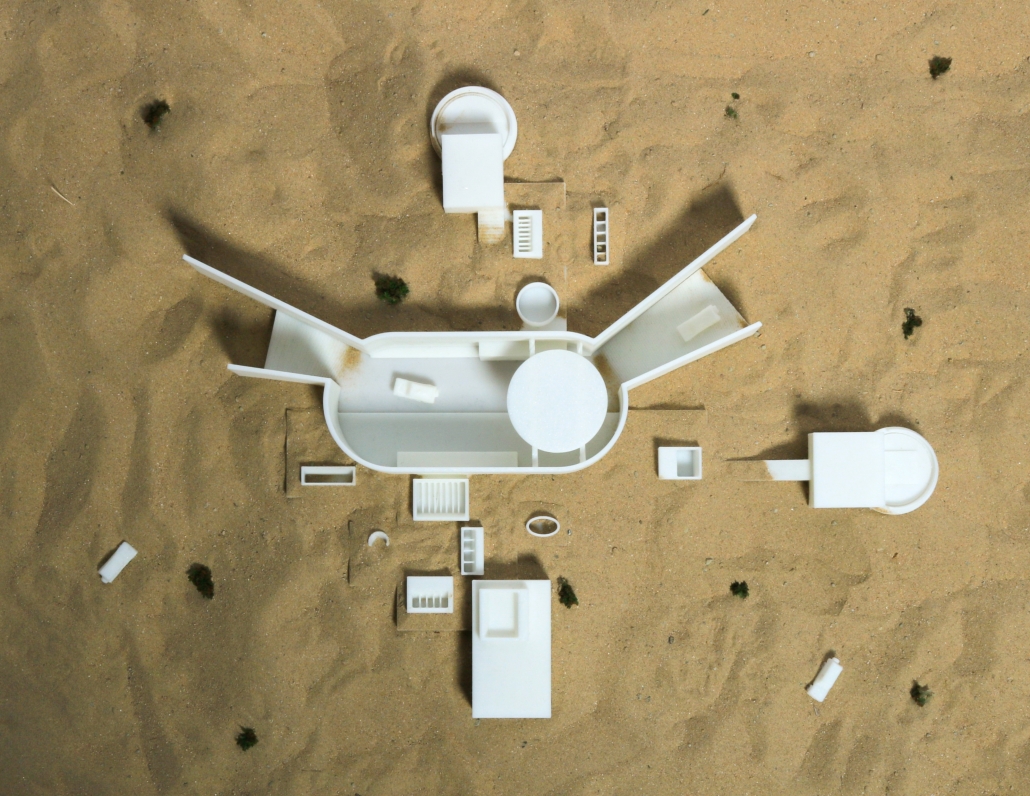
In the vast stillness of the desert, this residence becomes a compass of time—a place where shifting sands echo the dance of the stars, grounding life within the endless drift of the cosmos. The design emerges from the client’s collection of astrological instruments, shaping spatial arrangements that enhance functionality and interaction. Objects inform the layout, with dedicated areas that invite exploration and observation. Strategic openings frame views of the night sky and desert, enriching the experience of celestial observation. This residence serves as both a home and an observatory, fostering a profound connection to the cosmos while celebrating the beauty of time and change. (Text: Salma Hani Mubarak Ali)

Cabinet of Curiosities: Exploring the Ensemble (aka, house of the collector) is an option studio utilizing the 16th-century-18th-century phenomenon of the Cabinet of Curiosities or Wunderkammers (wonder-rooms) as a point of departure to explore the exhibition of ensembles of artifacts with the goal of creating spatially charged architecture.

Working as individuals or in pairs, students had the opportunity to curate their own collection of curiosities and develop a novel architectural language to facilitate the display of the exquisite objects. Associated with the collection was a real or imagined client that served to further drive a generated domestic program. With the scale of the overall proposals being purposely manageable, students had the opportunity to focus on developing architectural assemblies that directly engage with issues of materiality, connections, and details. As such, physical and digital models were heavily employed as tools to study the interplay of elements at a series of scales

This project won the RIBA Gulf: Future Architects 2024 Overall Best Model Award.

Click here to learn more.

 Instagram: @salma.hani.ali, @gregoryspaw
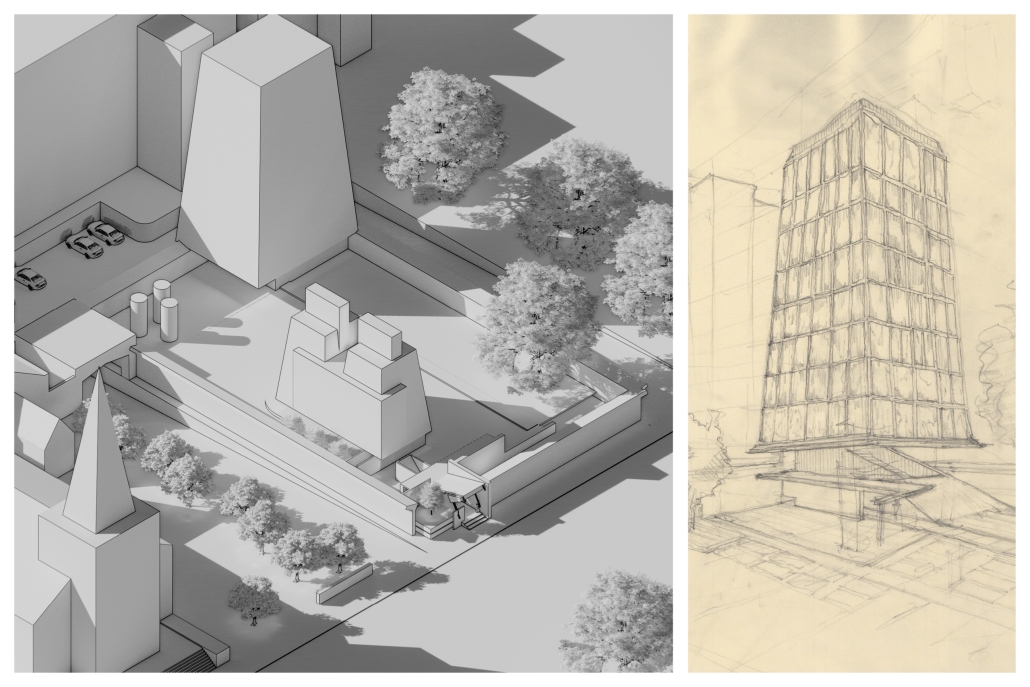
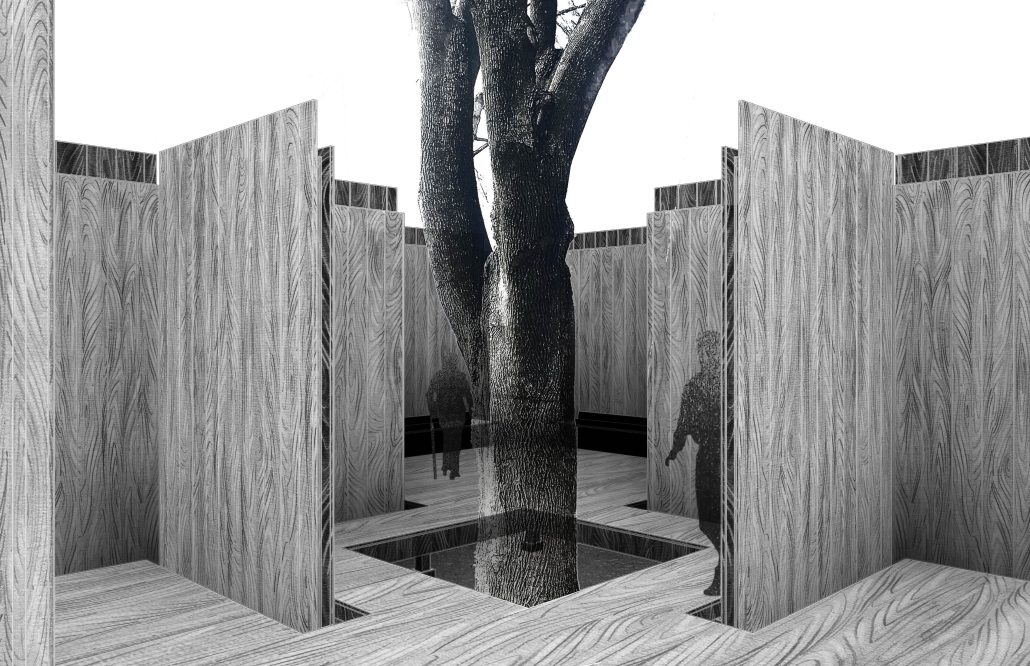
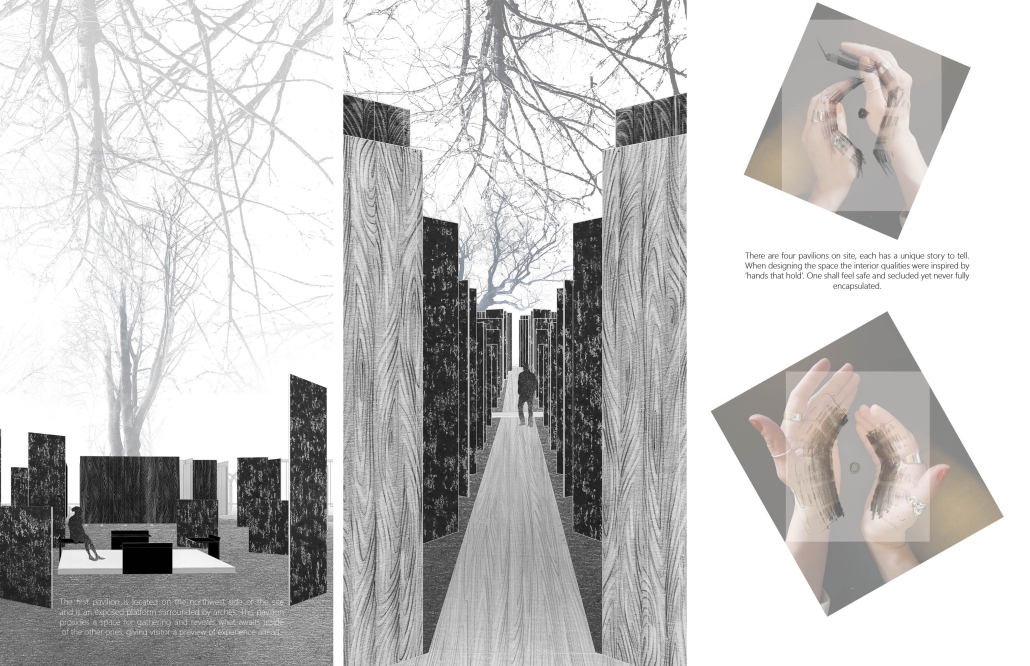
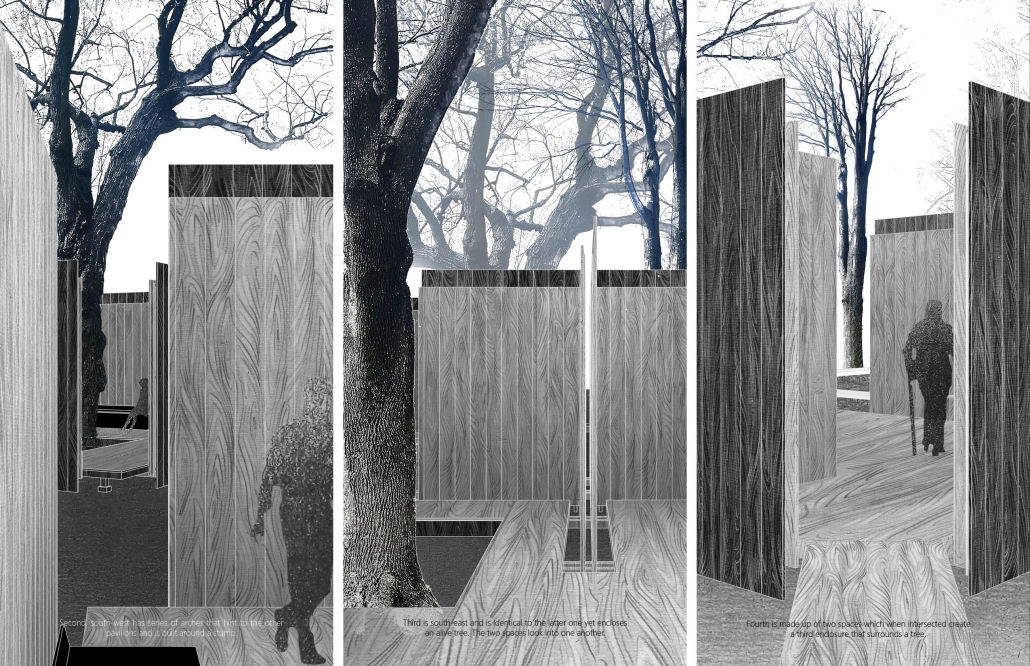
Evermore: A Cemetery For The City by Mo Karnes, B.Arch ’25
Mississippi State University | Advisors: Jassen Callender, David Buege, Aaron White, Mark Vaughan & David Perkes

My uncle died less than two years before I was born. I never met him, but his death is only an obstacle in my ability to know him. Chris was an artist and poet who left behind many things for me to know him by, including a poem entitled Evermore, written during his struggle with AIDS. The meditation is: 

I will walk unlonely,

Holding me up

As I begin to fall,

You Lead the way

And sometimes follow.

Our passage now is

Evermore.

(To be repeated, Unending).

To be ‘unlonely’ is a profound response to the impending, seeming loneliness that is death. Loneliness for those dying and those left behind. Chris’s poem is not just a meditation for himself, but for those struggling with loss. As a dying man, Chris places himself shoulder to shoulder with the reader; their journey is one and the same.

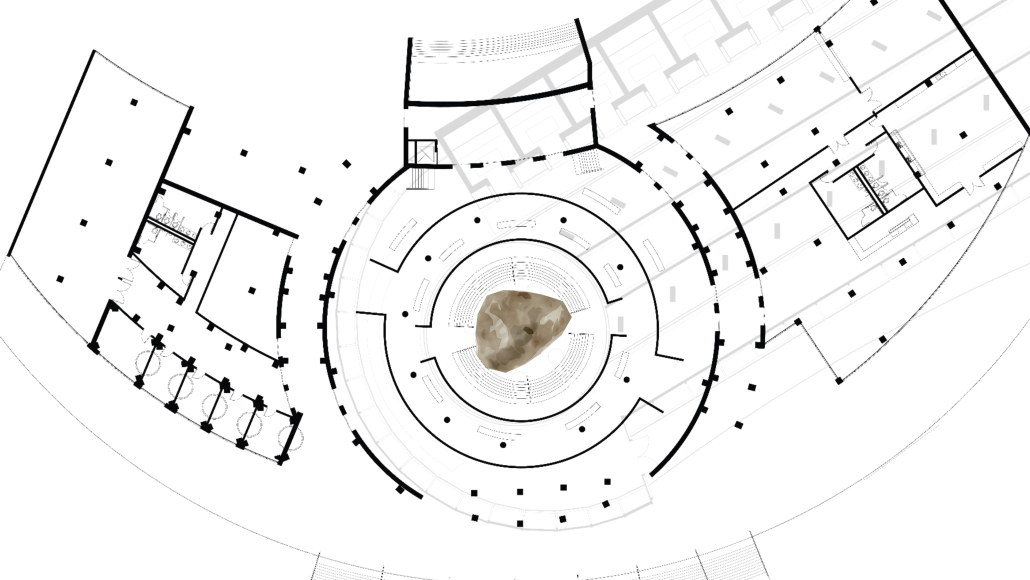
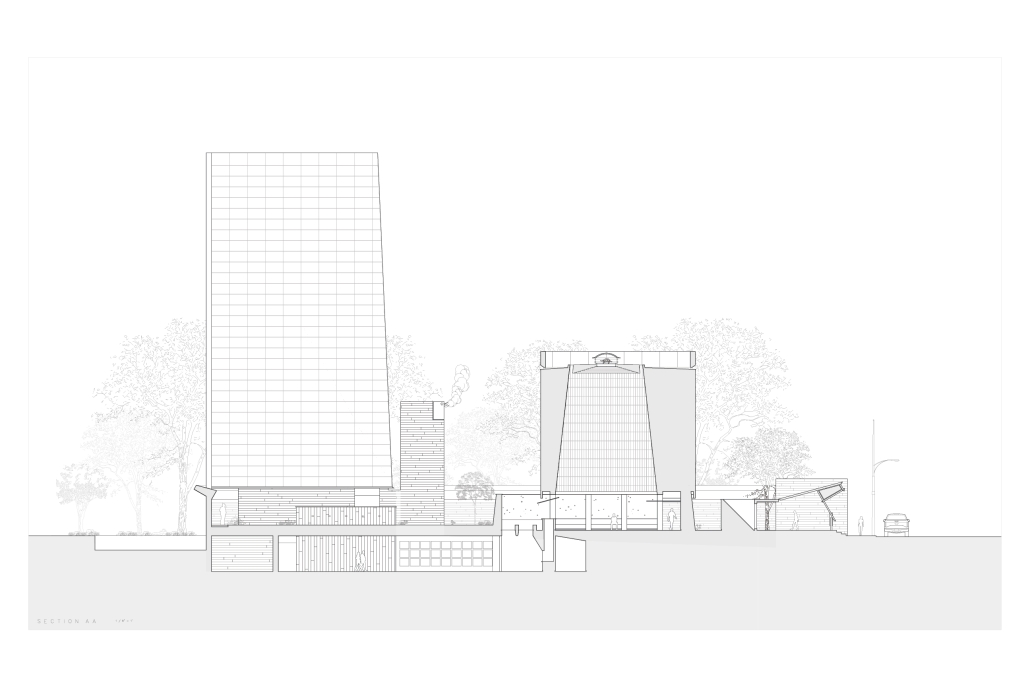
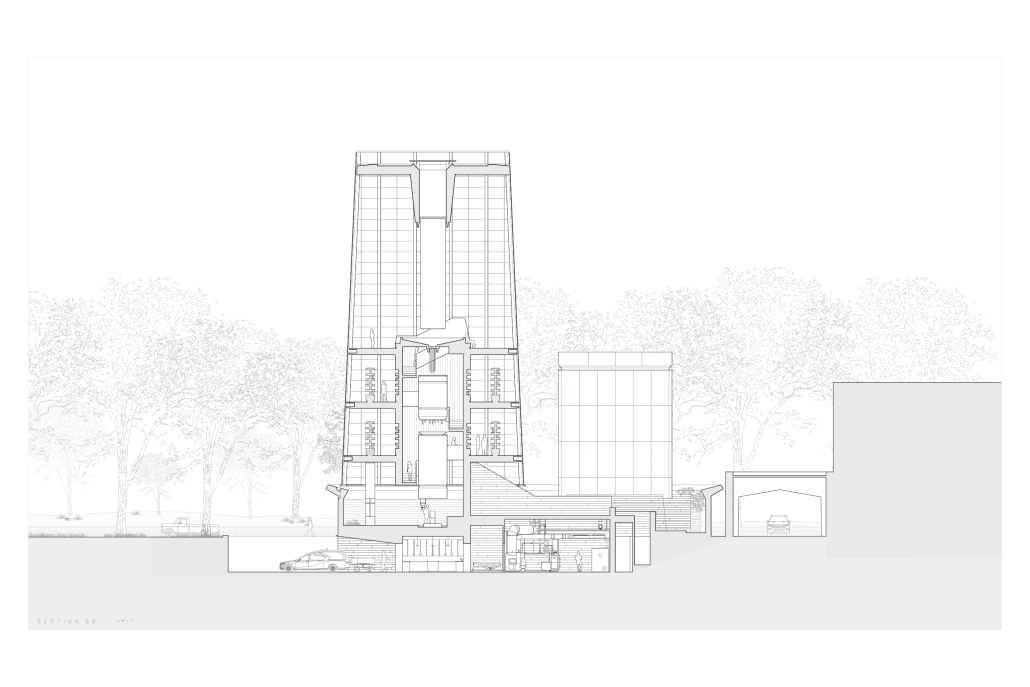
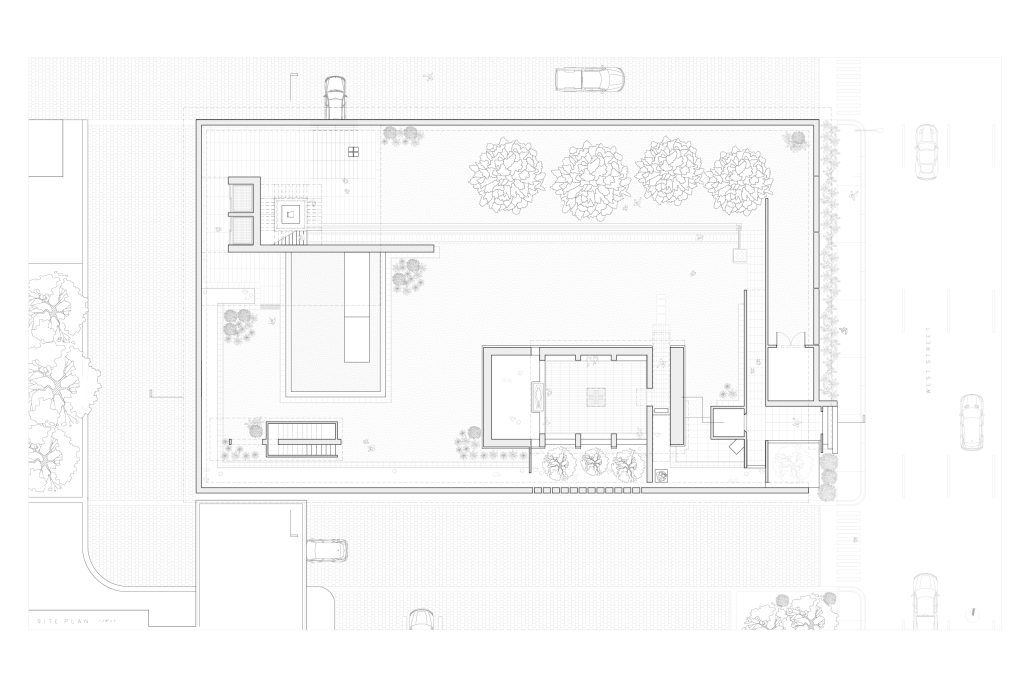
“Evermore: A Cemetery For The City” is a small cemetery complex adjacent to the Cathedral of St. Peter the Apostle in Downtown Jackson, Mississippi. The complex comprises a crematorium, vertical columbarium, and chapel. The site is rectangular, bound on all sides by concrete walls with only one threshold for entry. Two masses seemingly float behind the concrete boundary walls that veil them, the smaller chapel and the larger columbarium. Both stoic in form, they disguise the intricacies hidden in the interiors of their masses.  

The ambition of this project is to integrate the awareness of mortality into the city, while supplying architectural means to confront it. This awareness is not a means of oppression, but an attempt to convey the gift that is life. This cemetery is intended to be a public space where inhabitants can experience the city with citizens who came before them, inducing a relationship with the past, generating an appreciation of those who came before, and propelling the city forward with the intent to befriend and mentor the future.  

This project received the CDFL Capstone Studio Travel Award. 

Instagram: @mo.karnes, @jassencallender
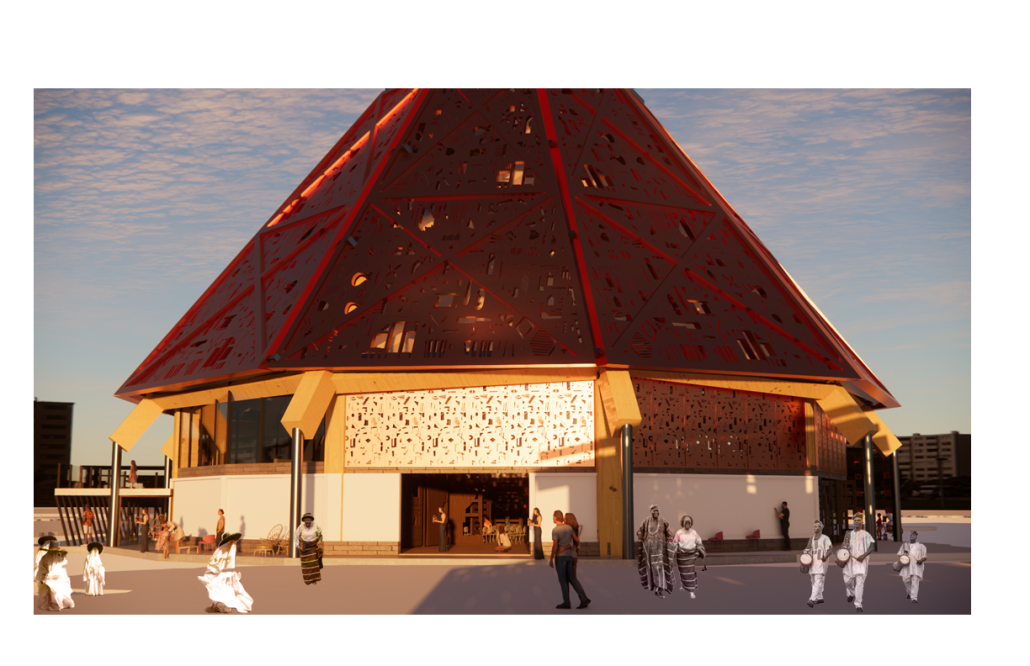
IMAGINATIVE REALITY: INVENTION OF SYNERGISTIC NARRATIVES by Chey Isiguzo, M.Arch ’25
Toronto Metropolitan University | Advisor: Lisa Landrum

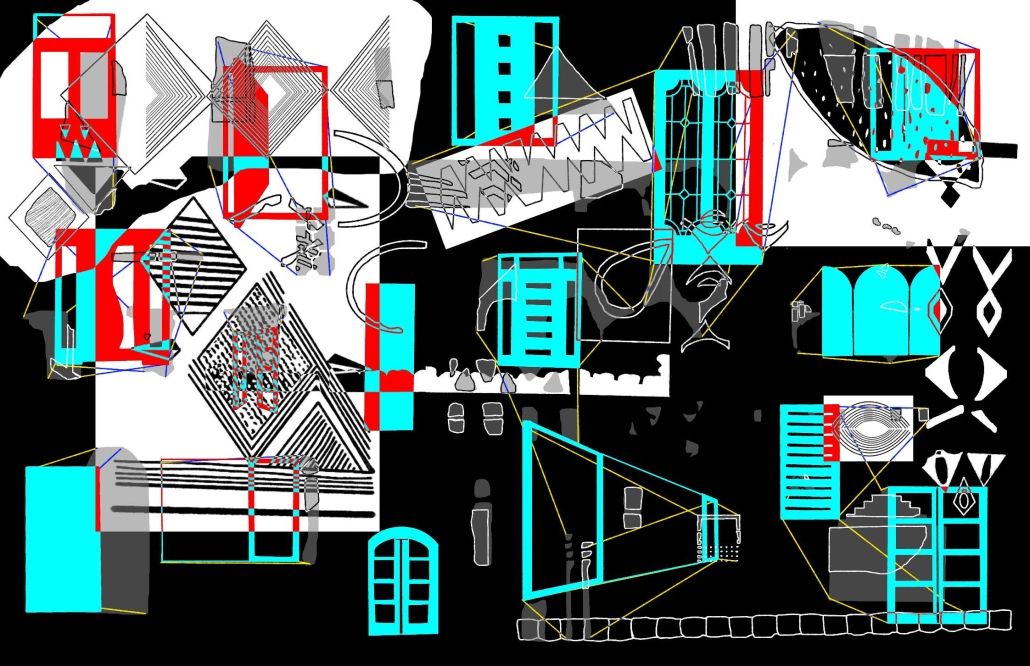
Imagination is both an act and a familiar, safe space, evoking nostalgic feelings rooted in our reality. 

This space can become unfamiliar when cultural expressions changes, leading to multifaceted identities and undeveloped narratives. This dynamic contributes to cultural conflict and highlights the juxtaposition of traditional and contemporary African architectural narratives. As a space, imagination can generate narrative 

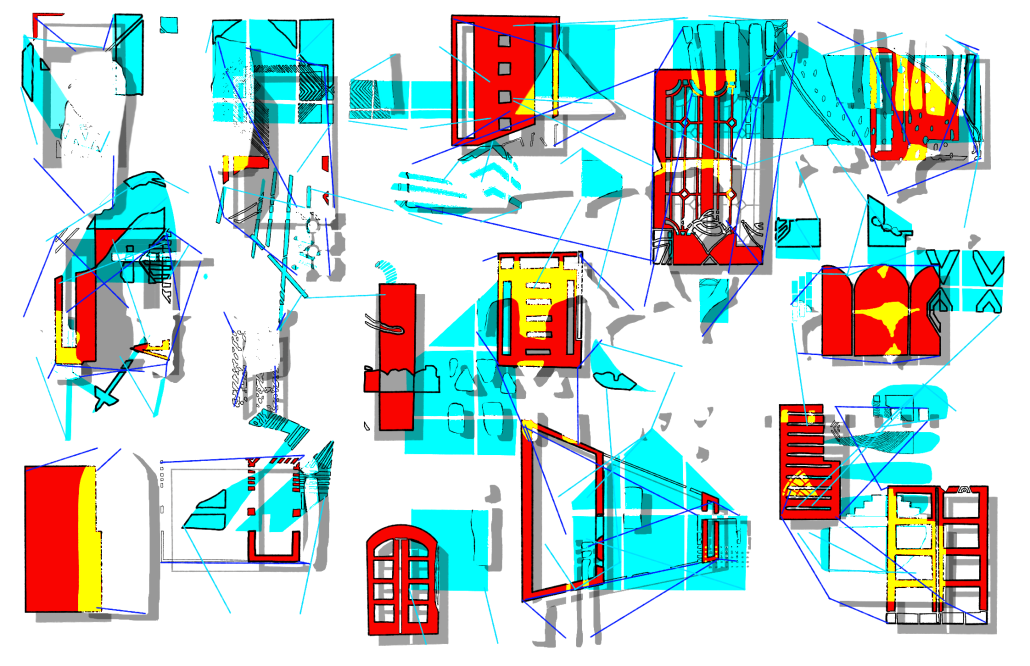
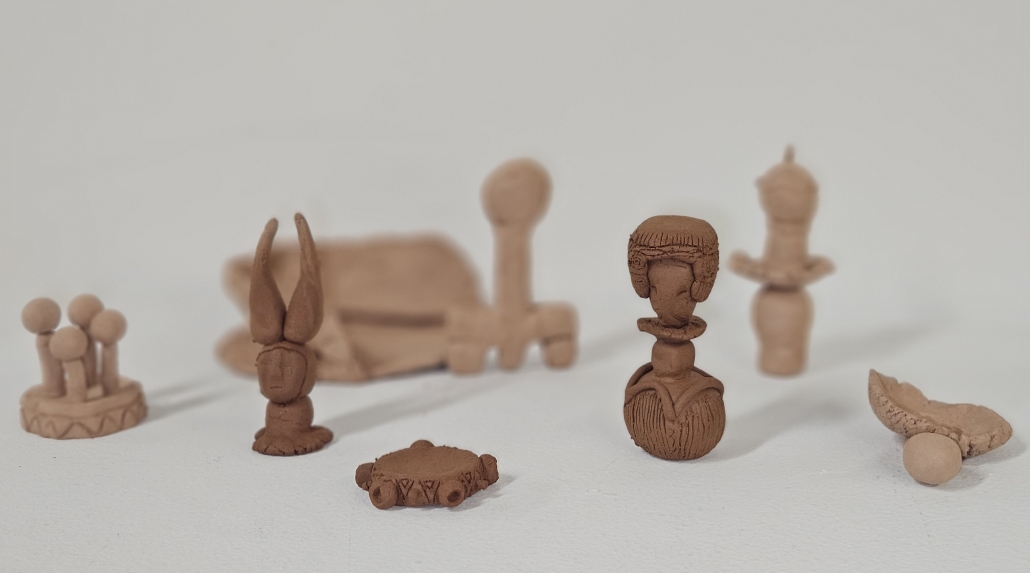
characters and elements by creating synergistic stories that incorporate traditional craftsmanship into contemporary African architecture. The imaginative process consists of three components. Imagining while thinking is an act that uses mental images from memories, dreams, fantasies, or visions to create one’s reality. Imagining while making is the act of craftsmanship used to speculate the distinction between traditional and contemporary architectural narratives through the lens of cultural expressions. Imagining while drawing is an act of translation by utilizing narrative characters—building elements like windows and doors—to dissect fragments of both traditional and contemporary architecture to find new narratives. 

These narrative characters work alongside structural elements, such as walls, roofs, layouts, courtyards, and compounds, to convey new stories that showcase materials and design techniques rooted in Igbo craftsmanship. To develop synergistic narratives, one can explore the evolution of traditional African craftsmanship, particularly within Igbo culture, across ancestral, post-colonial, and contemporary contexts. This exploration reveals how the architectural narratives of traditional and contemporary styles are increasingly distinct. Consequently, this imaginative space becomes a reality that examines the relationship between what is real and what is envisioned through architectural craftsmanship.

Instagram: @sumisi000, @ucisi_studios, @tmu_archgrad
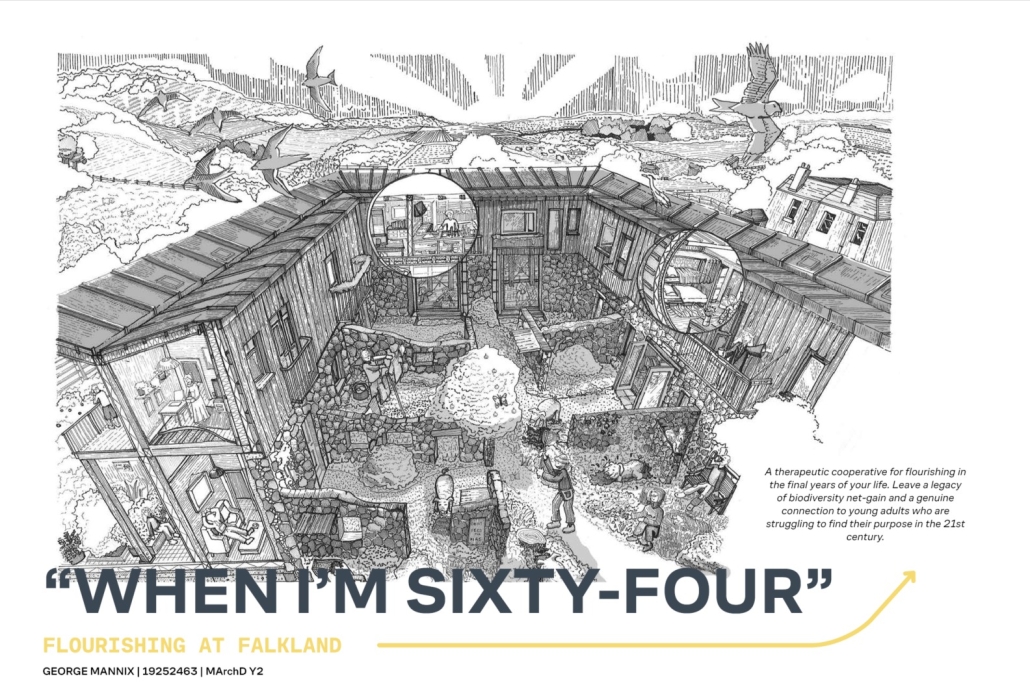
When I’m Sixty-Four: Flourishing at Falkland by George Mannix, M.ArchD ’25
Oxford Brookes School of Architecture | Advisors: Melissa Kinnear & Alex Towler

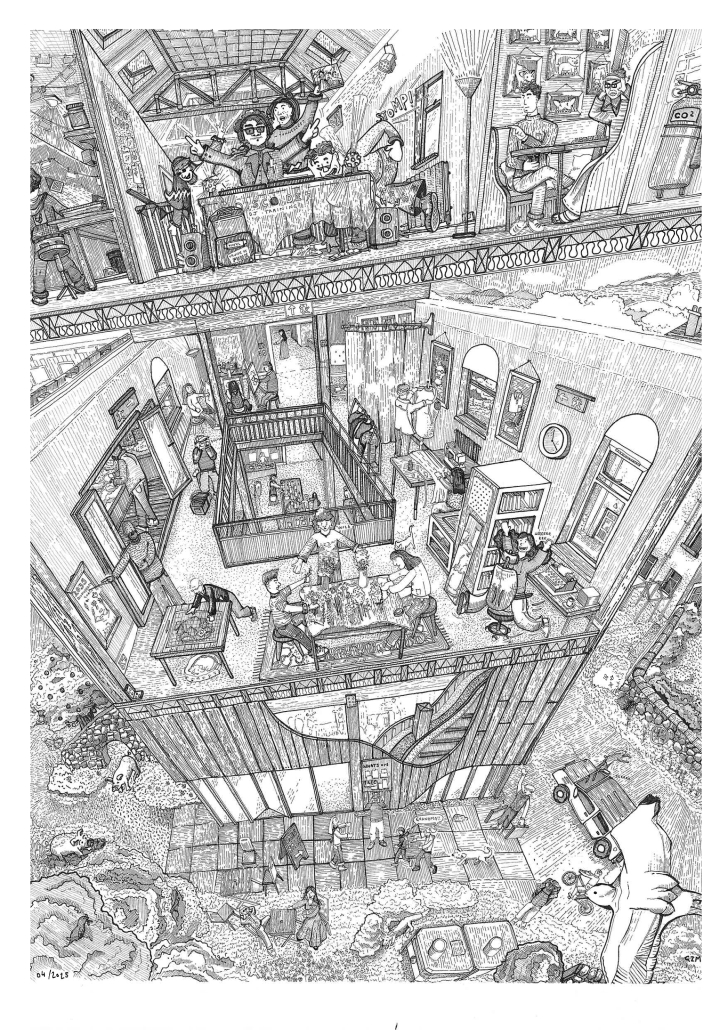
This project proposes a “therapeutic cooperative” that reimagines later life as a time for purpose, legacy, and connection. Designed for people aged 64 and over, the initiative creates a living environment where older adults can flourish by sharing life experiences with younger visitors while contributing to environmental and social regeneration. 

Central to the concept is the cohabitation of residents with Tamworth pigs, which serve both symbolic and ecological roles—facilitating intergenerational dialogue and promoting biodiversity through trophic rewilding.

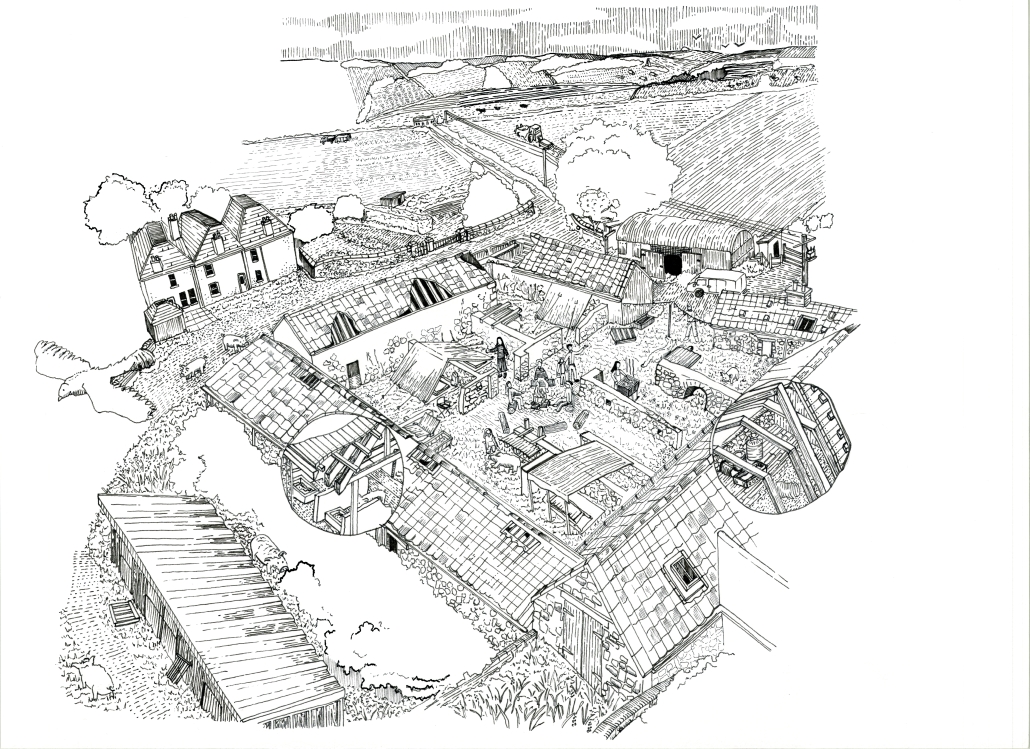
Located at Kilgour, a Victorian farm steading on Scotland’s Falkland estate, the site carries historical significance and a past tied to pig-rearing and the celebration of endings. 

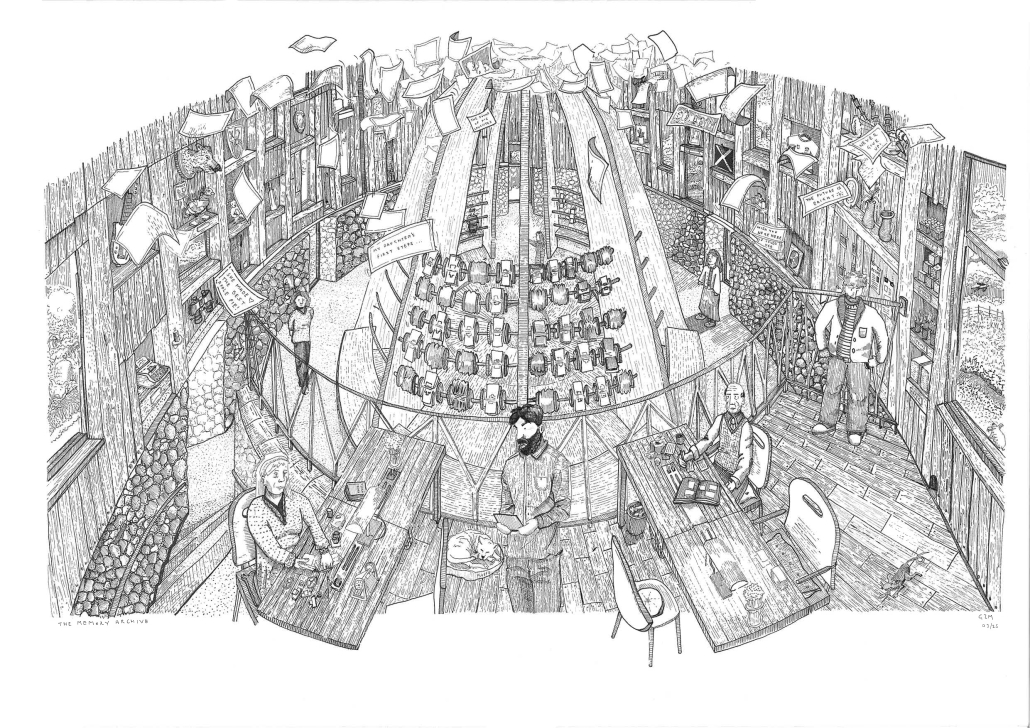
Accommodation includes accessible apartments, communal gardens, and a biodiversity-rich courtyard. Pigs will live in creatively built “Ad-Hog” styes using reclaimed materials. A chapel-like “Memory Archive” will hold personal stories of residents’ lives, offering a space for reflection and remembrance.

The project unfolds in three phases: first, clearing and revitalising the site with community involvement; second, welcoming the first residents and establishing the Memory Archive; and third, expanding the model across Scotland to transform abandoned steadings and boost natural regeneration.

Younger visitors, whom we have dubbed “biodiversity-backpackers,” can stay in on-site hostel lodgings, with the hope of fostering meaningful interaction between generations. Funding comes from elderly participants downsizing their homes, combined with national grants, giving them control over their later years.

Ultimately, this initiative responds to the growing issue of isolation among the elderly in Scotland. By embedding legacy, memory, and biocentric living into the design, it aims to help people see out their days with dignity whilst living with renewed purpose.

This project received the Ackroyd Lowrie Prize.

Instagram: @georgemannix, @ds3_obu
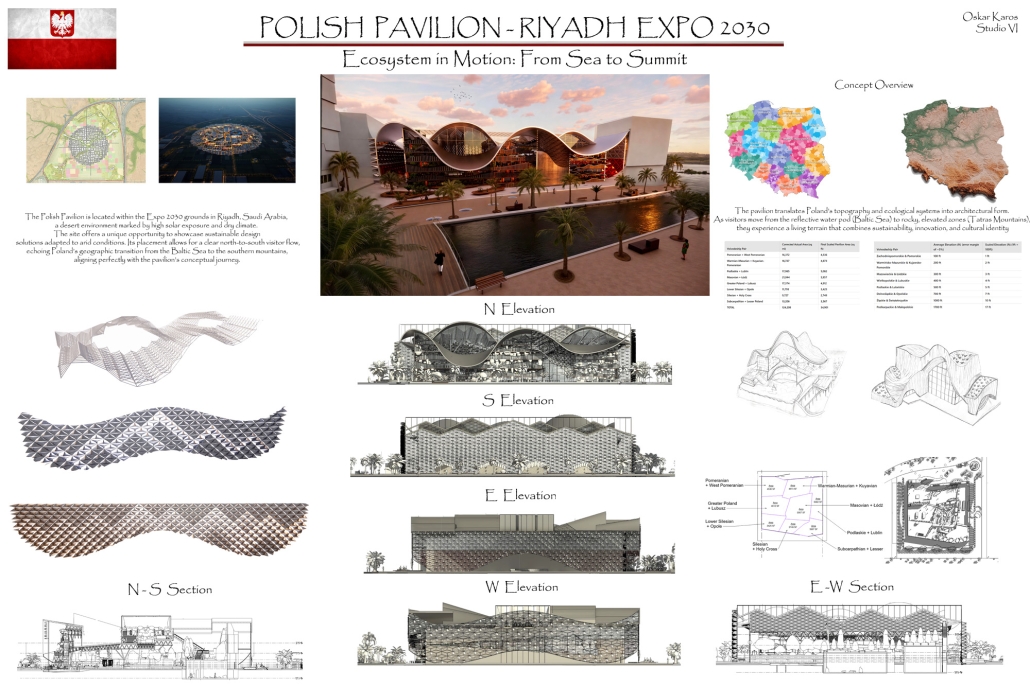
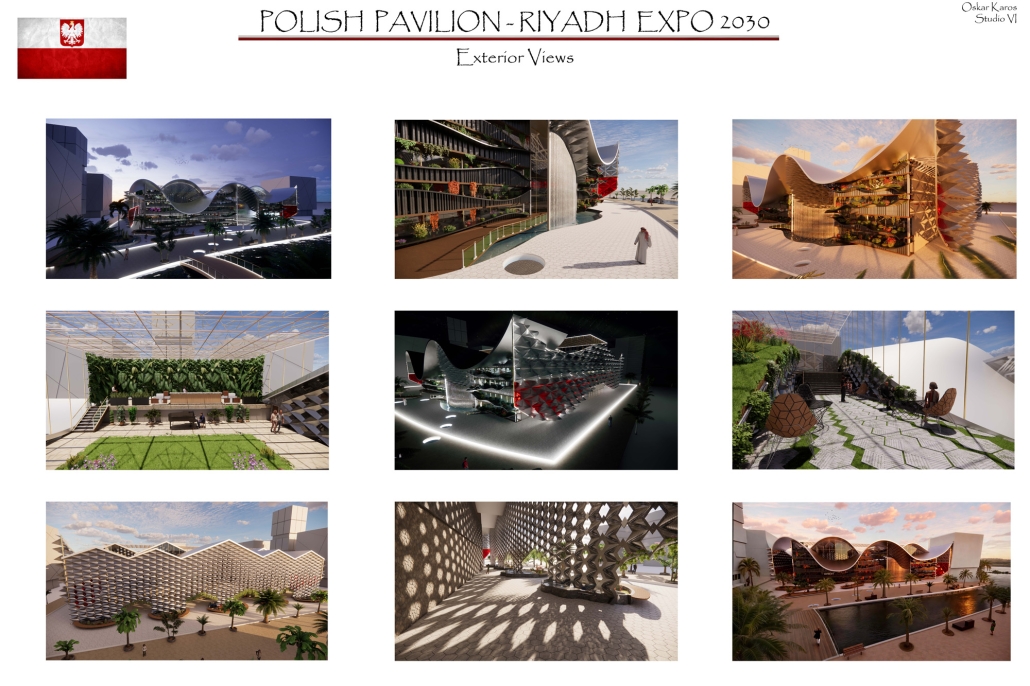
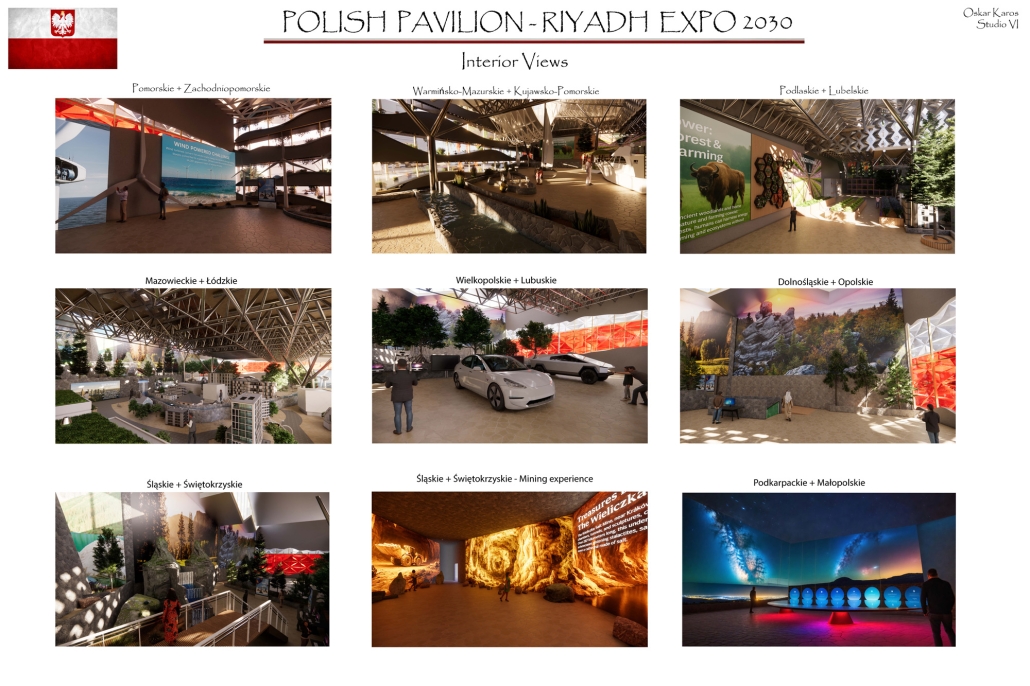
POLISH PAVILION – RIYADH EXPO 2030 by Oskar Karos, B.Sc. in Architecture ’25
University of the District of Columbia | Advisor: Golnar Ahmadi

Set in Riyadh for Expo 2030, the Polish Pavilion reinterprets the nation’s geography and ecological identity through architecture. Designed as a living map of Poland, the pavilion invites visitors to journey from the southern Tatra Mountains to the northern Baltic Sea, experiencing the country’s topography, climate, and innovation within one continuous landscape. The project explores how architecture can embody an entire nation’s ecosystem, transforming exhibition space into a self-sustaining organism.

Poland’s diverse terrain—from its rugged mountains to fertile plains and coastal winds—inspired a spatial narrative divided into eight regions. Each represents two neighboring voivodeships, blending their natural and technological identities: wind power in Pomorskie, hydropower in Warmińsko-Mazurskie, sustainable farming in Podlaskie, and smart urbanism in Mazowieckie, among others. 

Visitors move northward along a symbolic Vistula River, linking interactive installations that demonstrate Poland’s leadership in renewable energy, circular economy, and ecological stewardship. Constructed with steel, wood, stone, and glass, the pavilion merges material authenticity with sustainability. A closed water cycle system replicates natural evaporation and rainfall, powering greenery and regulating humidity. The accessible green roof offers shaded paths and aerial views of Poland’s “living topography,” blending innovation with environmental harmony.

Beyond a national exhibition, the pavilion is a statement of coexistence—between people and nature, culture and technology. It celebrates Poland not through static displays, but as a breathing ecosystem where every element, from water to wind, participates in a cycle of renewal.

Instagram: @Golnarahmadi

Stay tuned for Part XI!
2025 Study Architecture Student Showcase - Part III

Today’s installment of the 2025 Study Architecture Student Showcase highlights innovation in technology and artificial intelligence (AI). In Part III, we look at senior projects that reimagine how technology can transform architectural practices, human experiences, sustainability, and design workflows. You may find yourself asking: What happens when AI is used as a co-designer? 

From smart cities in Puerto Rico to augmented reality, each project will broaden your perspective on the capabilities of technology in design. 

Browse the projects below!

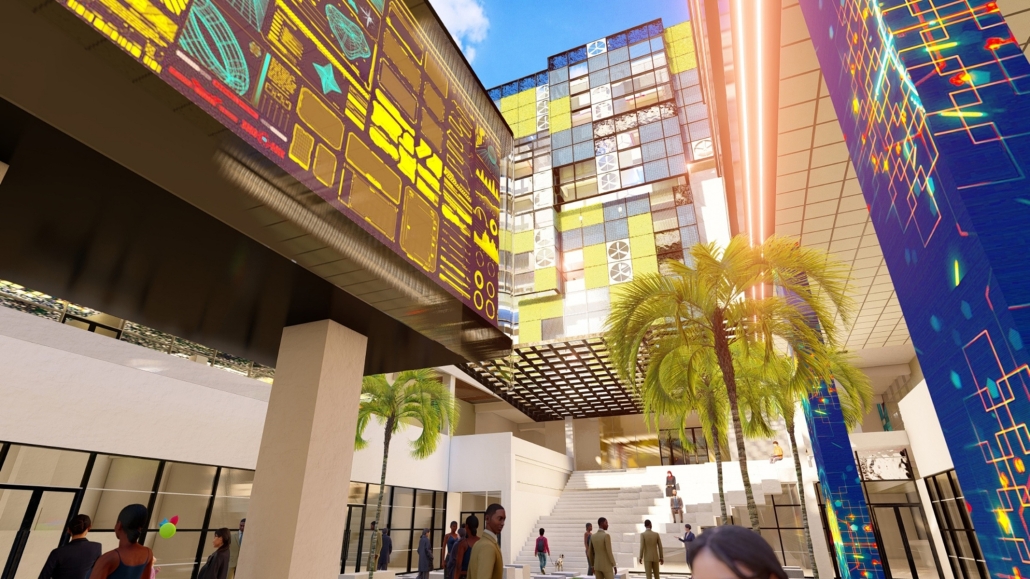
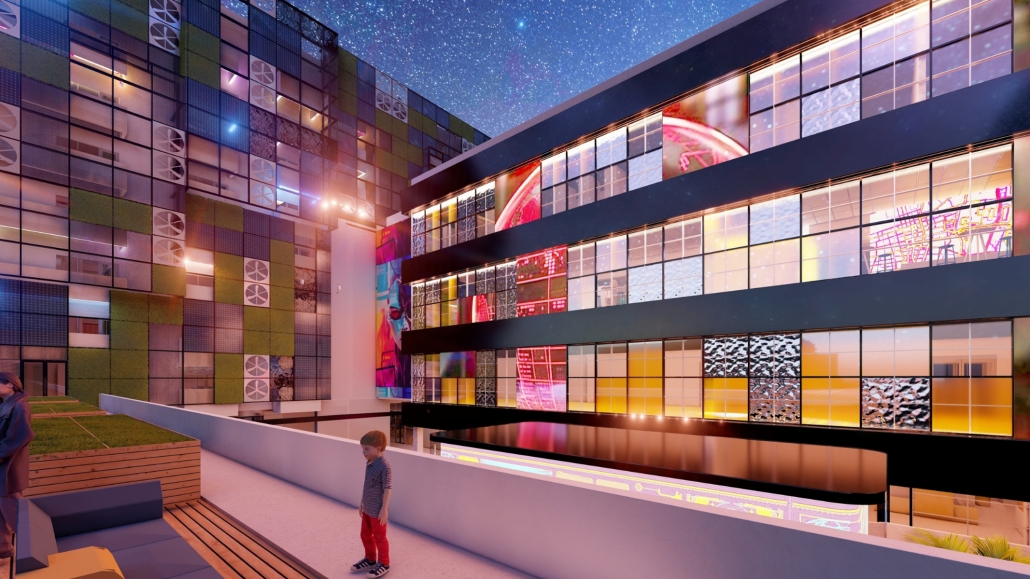
Urban Metamorphosis: Smart Cities Resignifying Spaces by Ramón L. Meléndez-García, B.Arch ‘25
Pontifical Catholic University of Puerto Rico | Advisors: Pedro A. Rosario-Torres & Juan C. Santiago-Colón

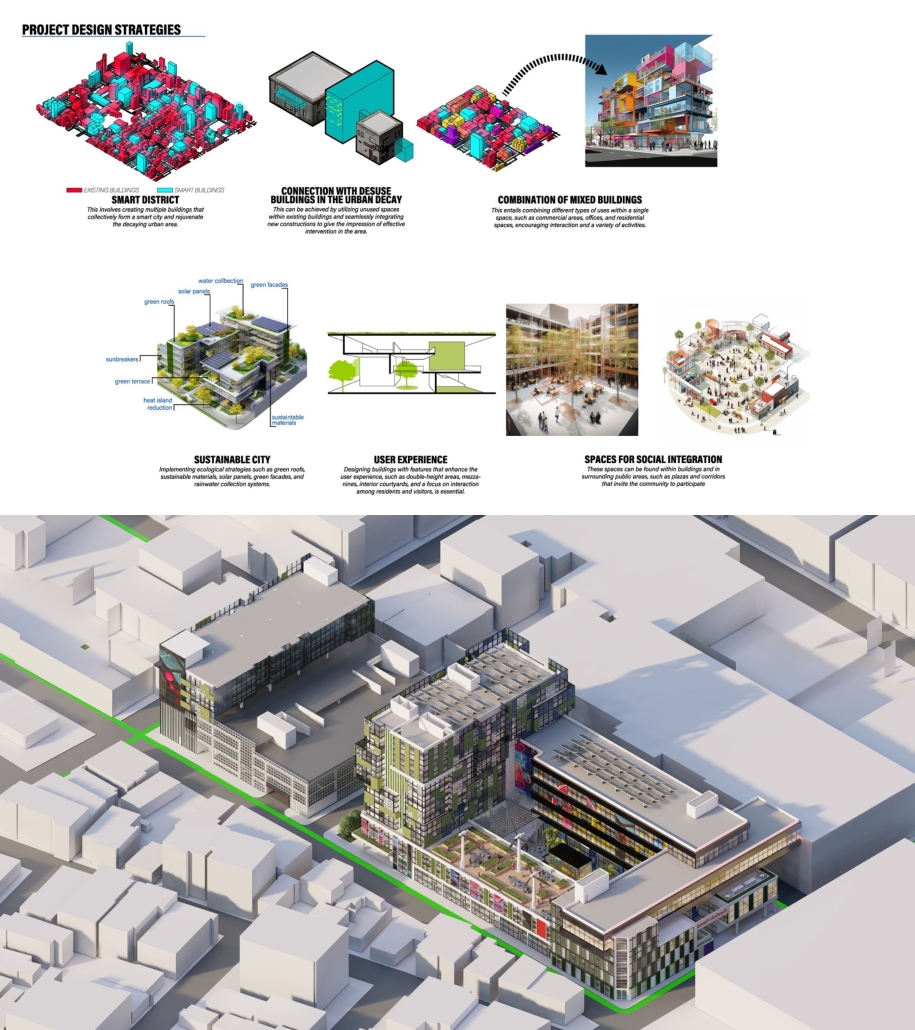
This research investigates the urban regeneration of Río Piedras, Puerto Rico, through the strategic implementation of smart city principles adapted to local needs. In response to widespread physical, social, and economic decay—evident in abandoned lots, deteriorated infrastructure, and declining public life—the study proposes a multidimensional framework that reimagines the urban fabric through technological innovation, sustainable development, and architectural intervention.

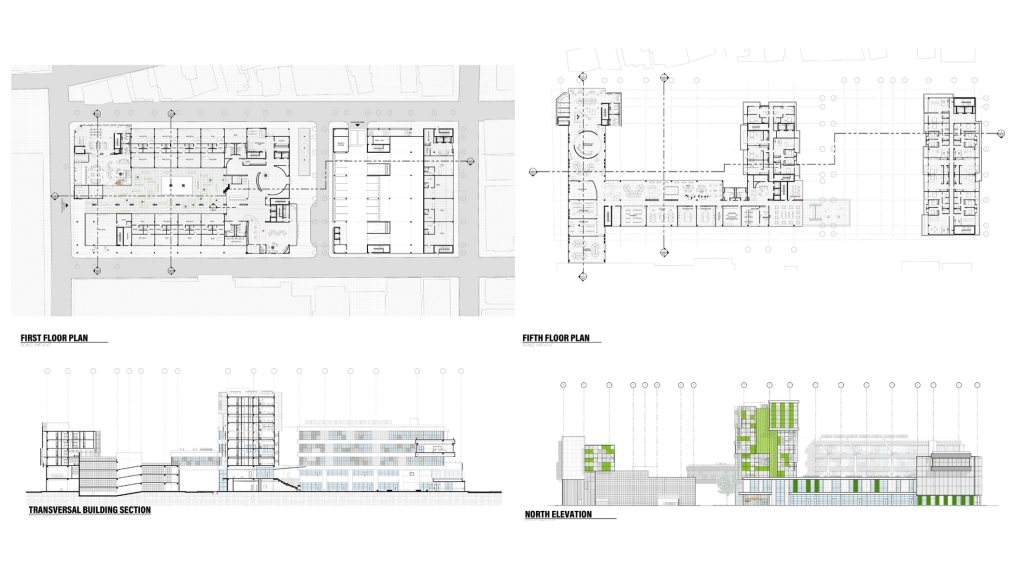
Departing from mainstream smart city models centered solely on digital efficiency, this study develops a localized smart city theory that combines cultural identity, community participation, and advanced technologies. The proposal includes the integration of smart housing, cultural and educational hubs with augmented reality capabilities, green infrastructure, efficient public transportation, and urban data nodes to improve services and connectivity. Core technologies such as the Internet of Things (IoT), Artificial Intelligence (AI), and Big Data are utilized to inform urban planning decisions, support sustainability, and foster civic engagement.

Río Piedras is positioned as a prototype for urban acupuncture, where vacant and underused parcels are reactivated as strategic anchors for community life, innovation, and economic growth. The intervention emphasizes not only technological transformation but also the importance of contextual design—bridging the gap between historic architecture and contemporary urban needs.

By transforming obsolete spaces into adaptive smart infrastructures, the project demonstrates how urban regeneration can be achieved through a balance of innovation and local identity. This research presents a replicable smart city model for Latin American contexts, focused on equitable access to services, environmental responsibility, and inclusive urban development.

Ultimately, the study reframes smart cities as people-centered ecosystems, where technology, space, and society coalesce to create resilient, livable, and forward-looking urban environments.

Fold Me a Path: An Experience of Fractured Flow by Farah Swilam, M.ArchD ’25
Oxford Brookes University | Advisors: Adam Holloway, Elliot Krause & Deniz Topcuoglu

Distortion:

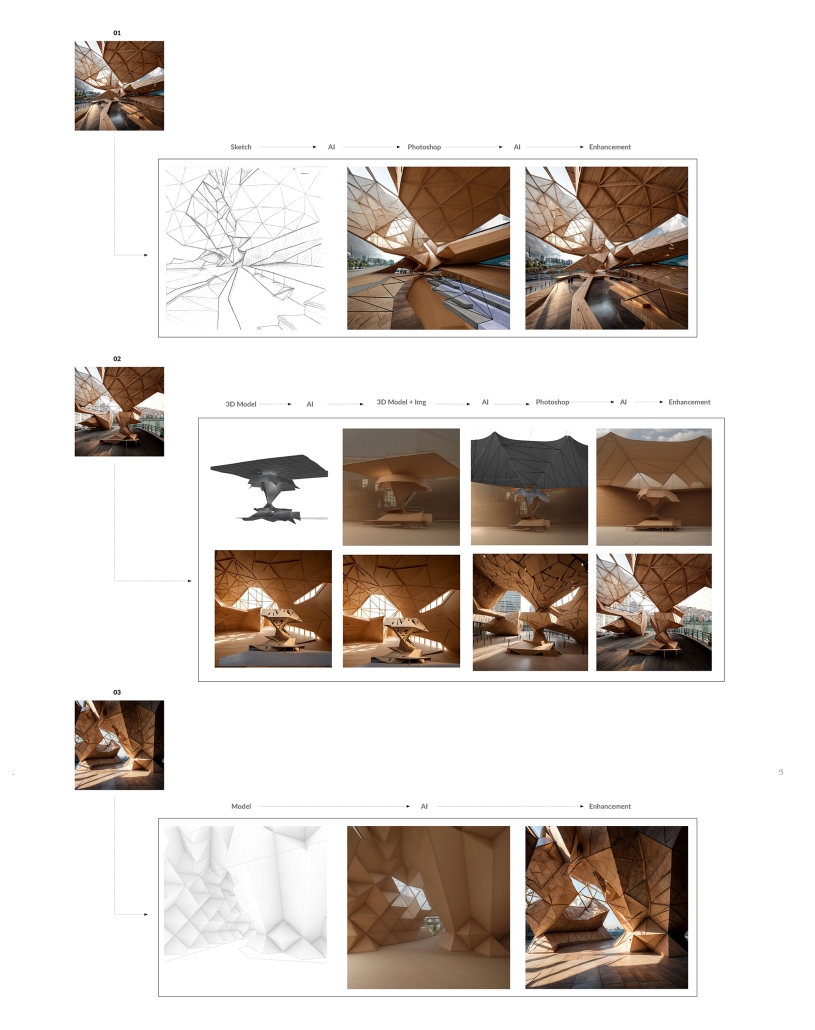
This project explores how fractured geometry and pattern-based aggregation can be reimagined through artificial intelligence to generate new kinds of human experiences in architecture. At its core is the idea of distortion—reshaping familiar systems like Islamic pattern growth and crystallographic expansion through AI to produce forms that feel intuitive yet unfamiliar.

Crystallization:

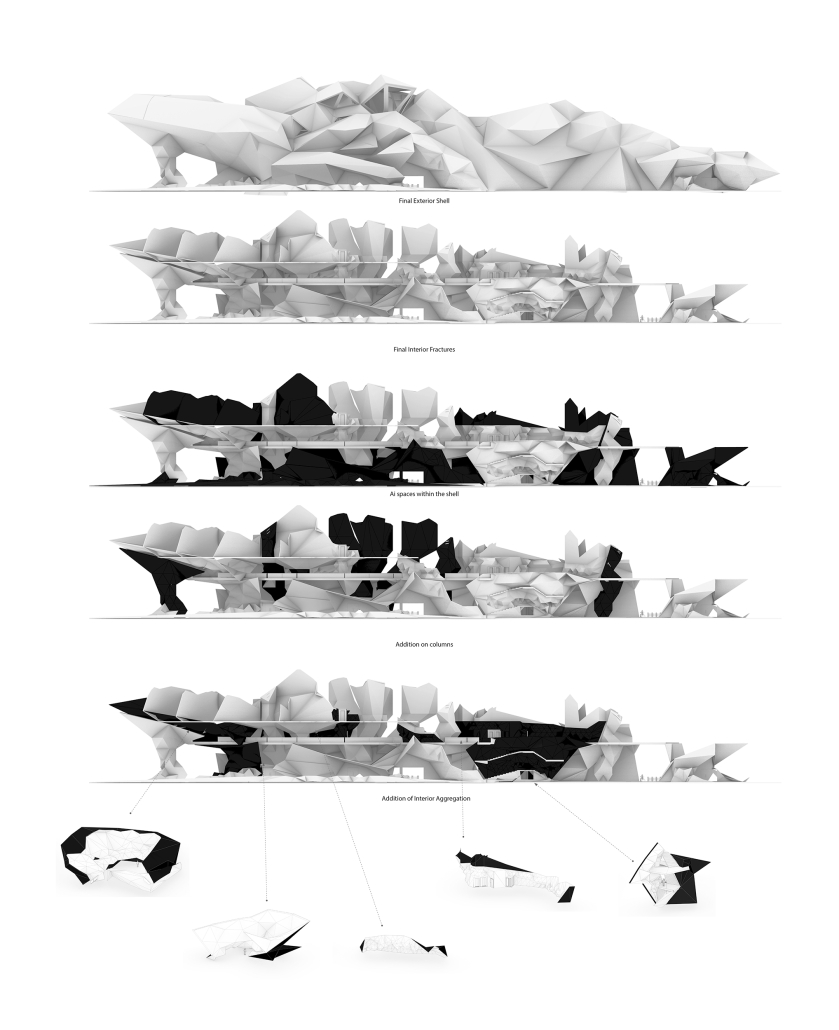
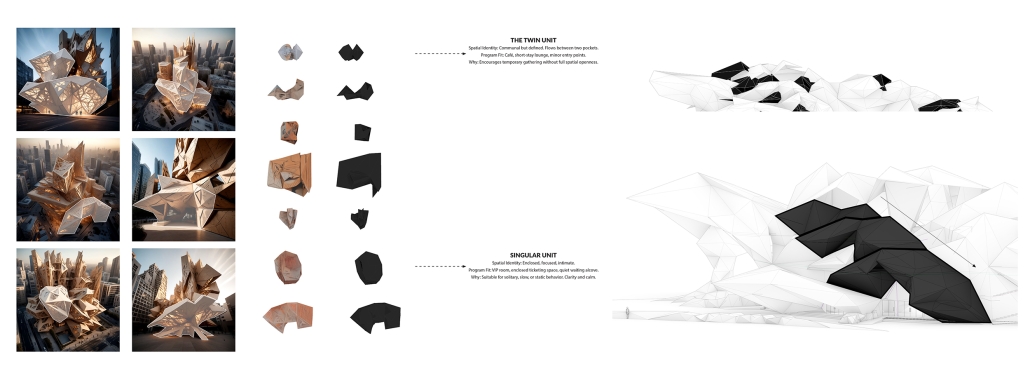
Inspired by how crystals grow—from a single point to complex geometries—the architecture builds on repetition, branching, and fracture. These logics were first tested physically and digitally, then handed over to AI as a co-designer. Trained on sketches, models, and prompts around fragmented patterns and public infrastructure, the AI generated outputs that became provocations, not solutions.

Narrative:

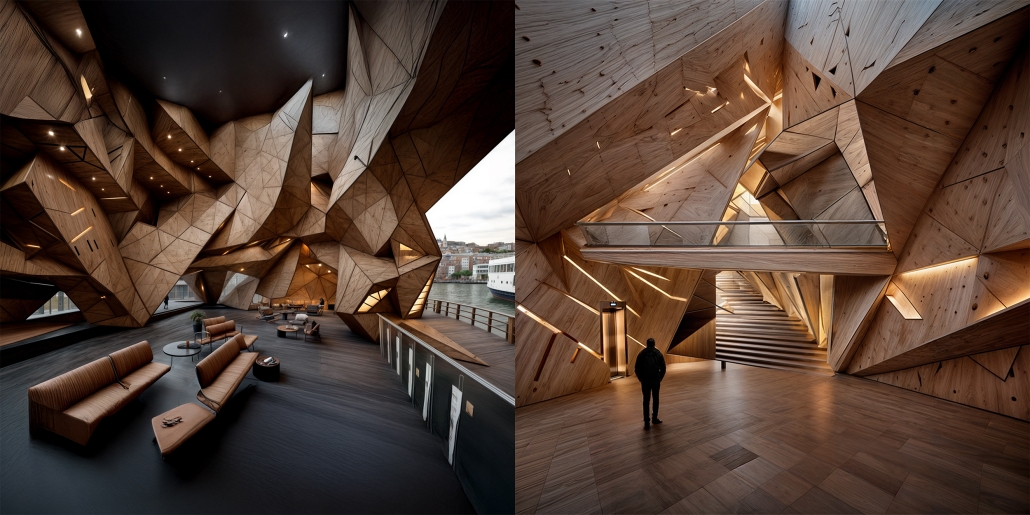
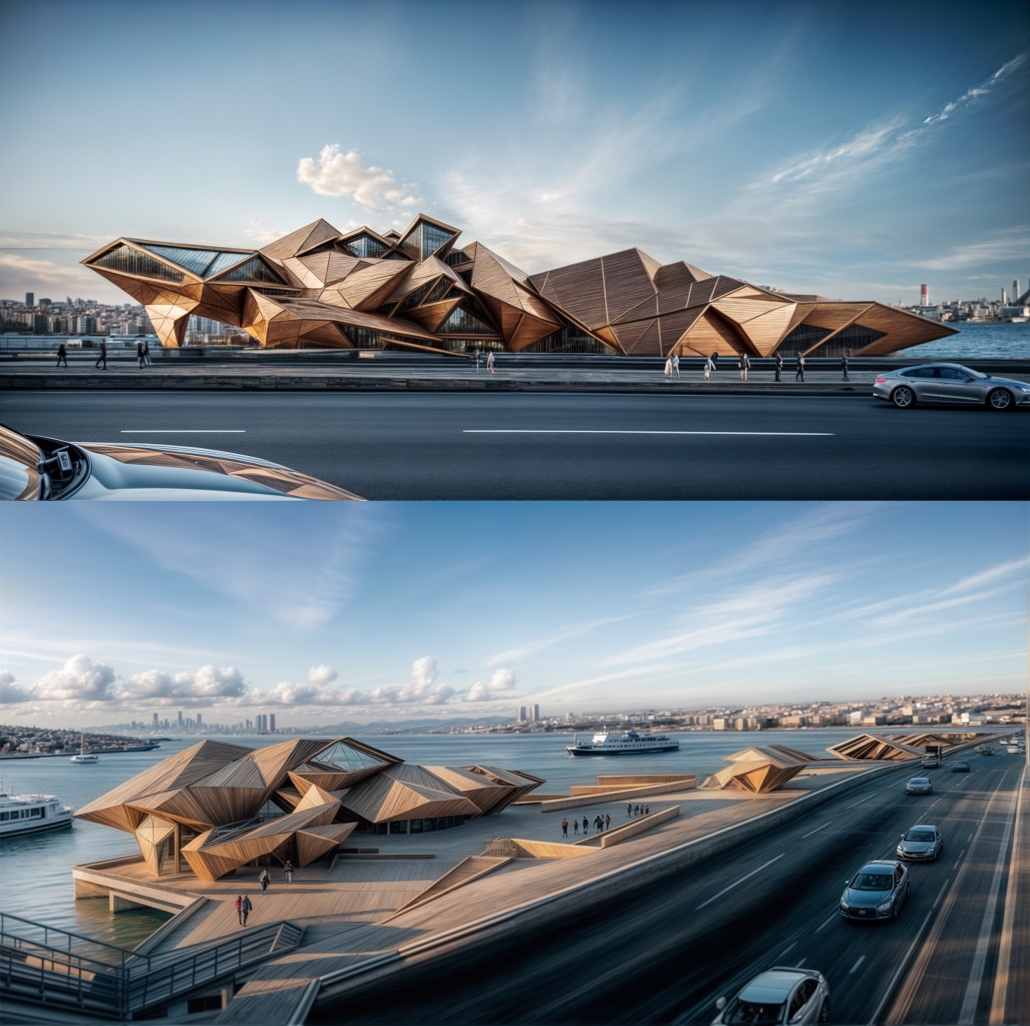
The result is a prefabricated ferry terminal on Istanbul’s Golden Horn waterfront—where infrastructure becomes a spatial narrative. Modular units cluster and grow across a path, shifting in orientation and size to guide a fractured journey from land to water, compression to openness.

Behavior:

AI simulations shaped the plan by mapping how curiosity, comfort, and pressure influence movement. These behavioral zones structured flows for tourists and commuters, varying path widths and densities to create both fast transitions and moments of pause.

Shell:

Externally, the terminal’s form draws from a library of AI-generated crystal geometries—clustered, mirrored, and oriented to respond to light, program, and views. The fragmented skin filters shadow and light, echoing Istanbul’s energy while remaining grounded in geometric order.

Assembly:

Constructed from prefabricated timber shells and CNC-milled panels, the structure sits lightly on steel piers over water. Brass cladding reflects the city’s historic palette. Passive strategies like cross-ventilation and rainwater harvesting are integrated into the system, and prefabrication minimizes urban disruption.

Resonance:

Ultimately, “Fold Me a Path” is a proposal for architecture that listens—guided by AI, rooted in culture, and attuned to human experience.

Instagram: @acciofxra7_, @holloway_arch

Gastro-Genesis by Dana Otoom, B.Arch ’25
American University in Dubai | Advisor: José Antonio Carrillo

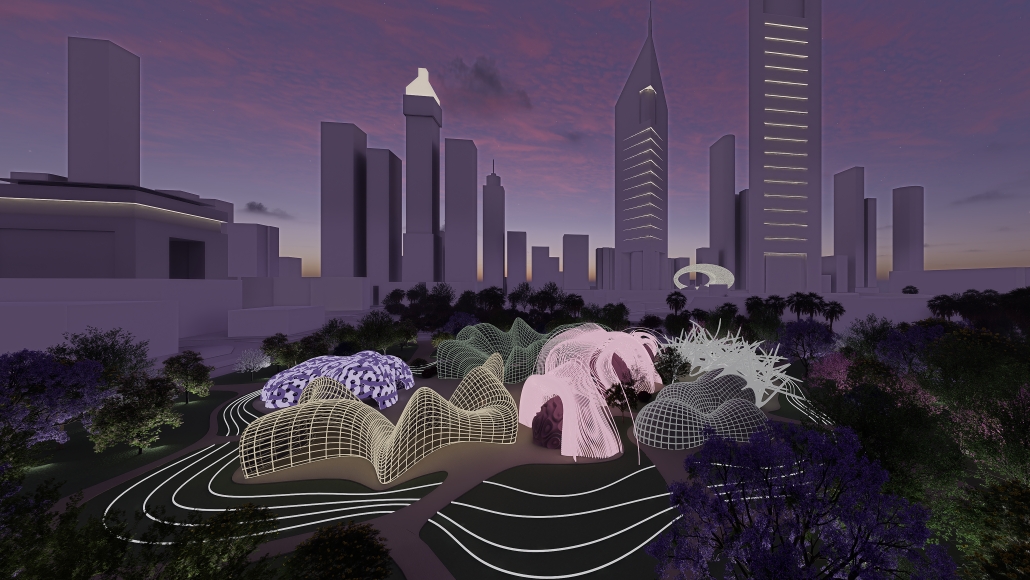
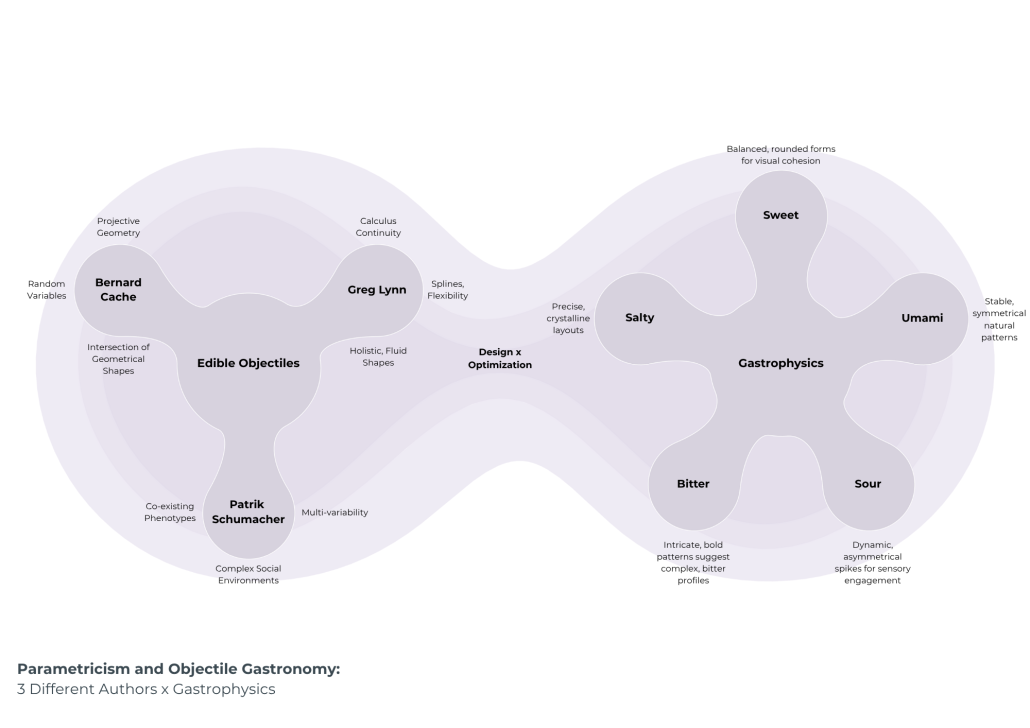
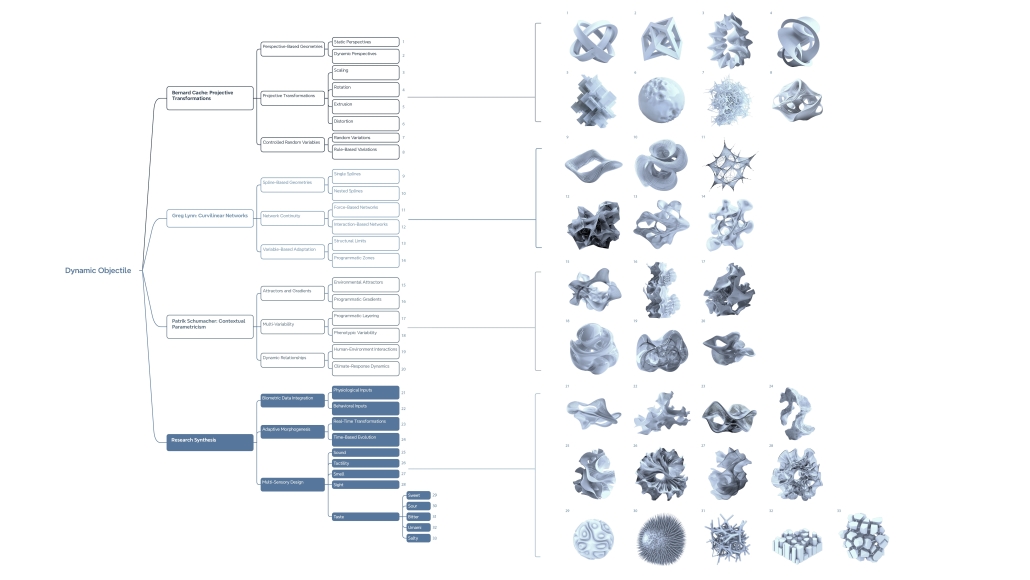
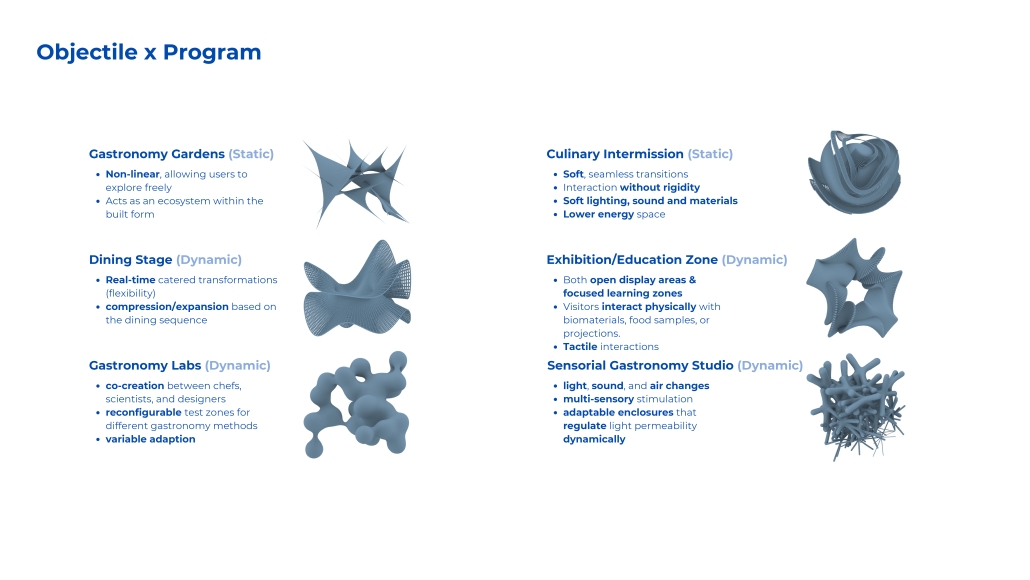
Exploring the intersection of architecture, gastronomy, and parametric design through the creation of edible objectiles-geometrically-driven food forms that act as catalysts for designing an entire multisensory dining experience. Drawing from the theories of Bernard Cache, Greg Lynn, and Patrik Schumacher, the project translates infinite variability into spatial and experiential diversity. Each objectile is generated through a parametric algorithm based on flavor perception, sensory attributes, and contextual cues such as temperature, aroma, and emotional response. The edible forms define not only the food but also influence the design of cutlery, furniture, spatial layout, and user journey within a dining environment. Set in the UAE, the project culminates in a metabolically inspired spatial sequence that mirrors digestion, transitioning from urban farming to sensory labs, with the buffer zone acting as a sensory terrain of sweet, rounded objectiles to ease entry and exit.

Click here for a closer look.

Instagram: @danaaotoom, @d.otoom, @j.carrilloandrada

Biosphere by Shrilaxmi Nair, Sharanya Mathrudev & Parth Solanki, M.Arch ’25
University of Illinois Urbana-Champaign | Advisor: Yun Kyu Yi

The landscape of architectural design is rapidly evolving with advances in 3D modeling, rendering software, and, more recently, artificial intelligence (AI). While tools like Stable Diffusion, DALL·E, and Midjourney have transformed illustration by allowing users to generate images from text prompts, architecture is now seeing its own set of AI tools tailored for design professionals. These tools can assist in generating building forms, interior styles, façade systems, and code-compliant floor plans, while also supporting layout optimization. As these tools become more powerful and accessible, they are beginning to reshape how architects approach the design process.

This shift is prompting reflection within architectural practice: Should traditional skills like manual representation and code literacy remain central, or should designers explore how to engage critically and creatively with AI? Rather than replacing the designer, AI has the potential to enhance creativity and support more thoughtful, design-driven decision-making.

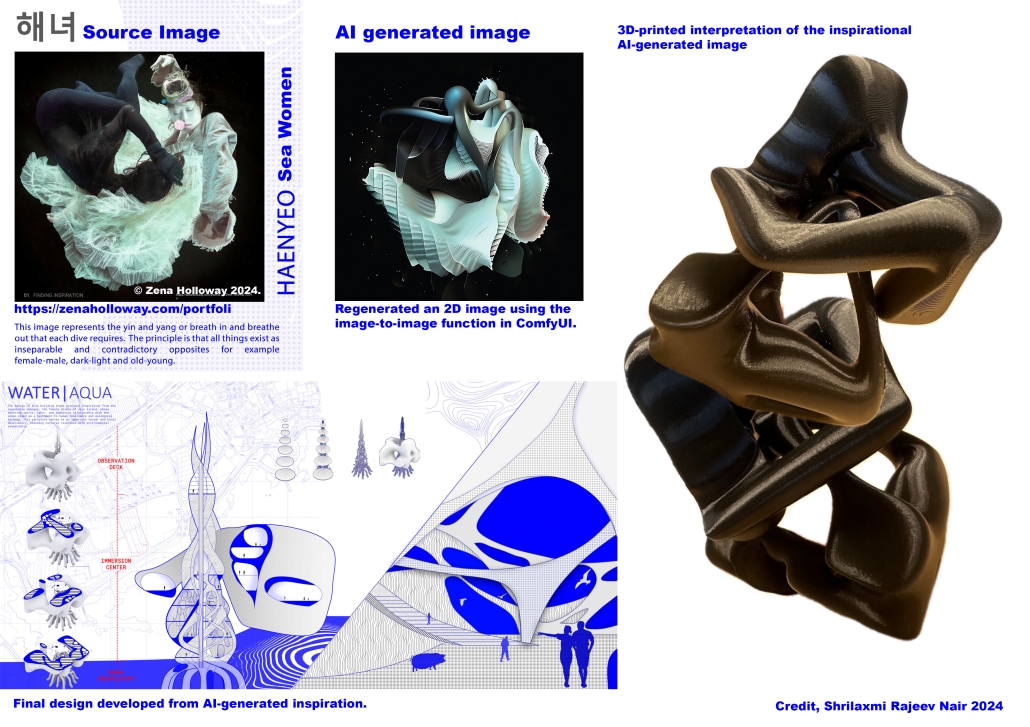
This project explored the role of AI not simply as a visualization tool, but as an active collaborator in the design process. The work focused on three key phases where AI tools were integrated into schematic design: Concept Development, Concept Actualization, and Objective-Based Form Finding. Through this exploration, the project aimed to understand how AI can shape design workflows, support ideation, and open new directions for architectural thinking and practice.

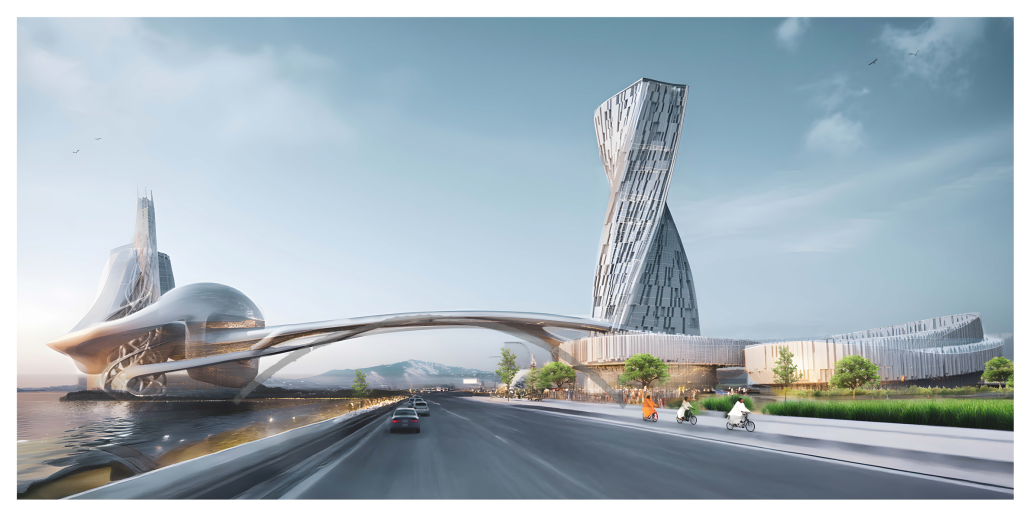
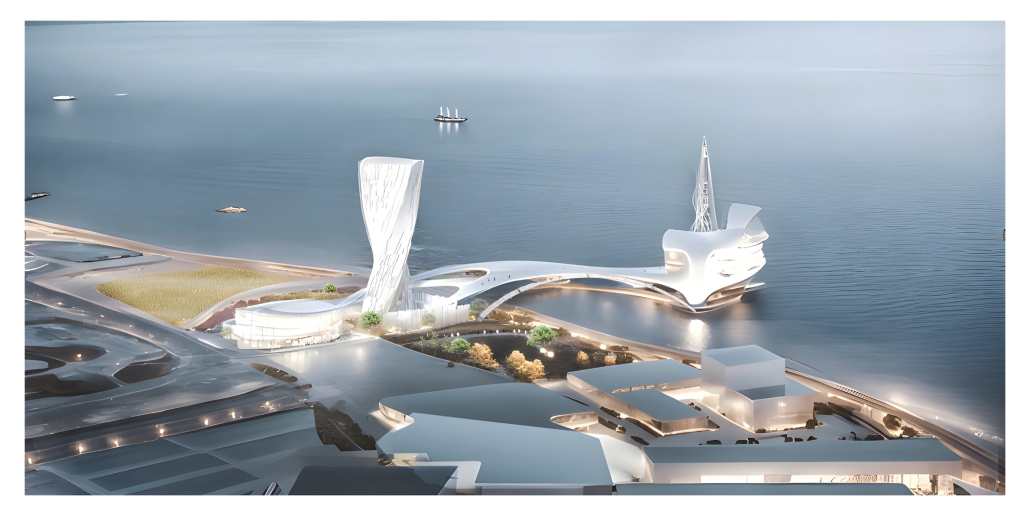
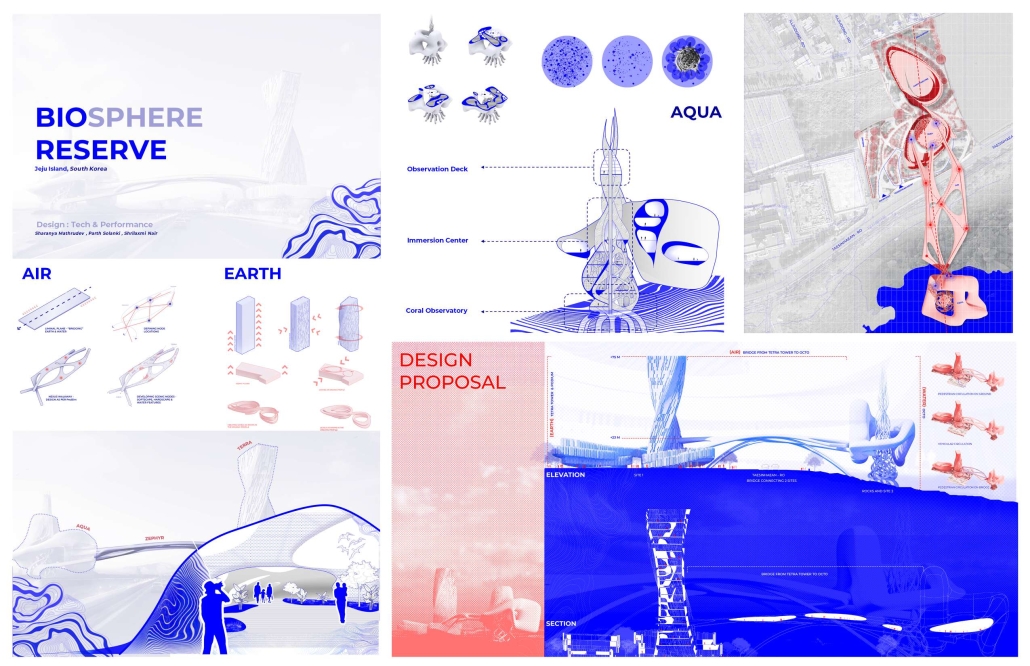
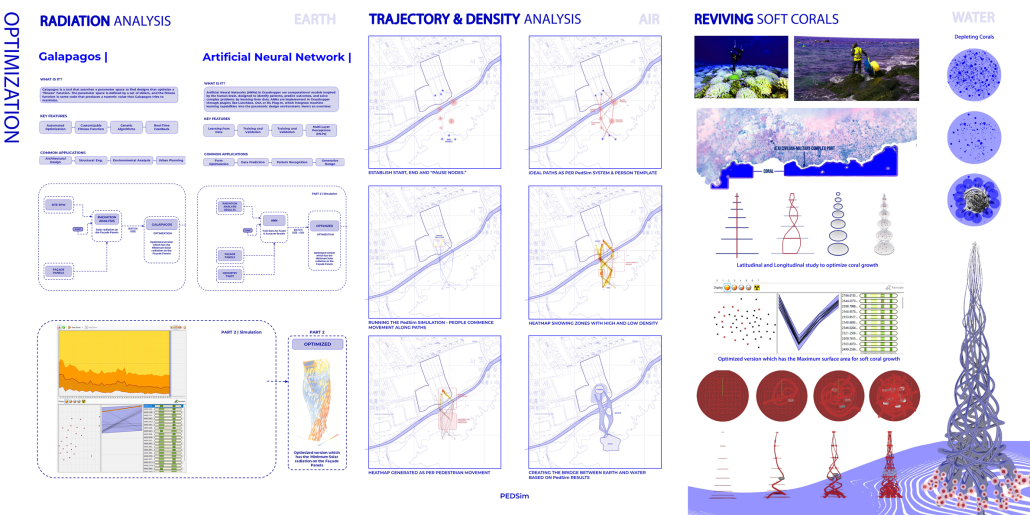
This project is inspired by Jeju Island, a UNESCO Biosphere Reserve. The design celebrates Earth, Air, and Water through architecture that blends with nature. Earth|Terra, the tower, reflects the volcanic rock found in Jeju and represents it through biomimicry and sustainability. Air|Zephyr, the bridge, flows seamlessly between land and water, evoking balance and calm. Water|Octo, inspired by Jeju’s Haenyo divers, serves as a cultural immersion center and coral observatory, honoring resilience and ecological harmony.

Instagram: @shrilaxmi_nair, @sharanya__2000, @iamparthsolanki, @ral_isoa

Embrace – Performative Connections by  Alejandro Arizpe, Stephanie Balbin, Javier Fano, Emily Guerrero, Erica Herrera, Kevin Linton, Raul Montalvo, Danny Murray, Ricardo Reyes, Sarah Staten, Gustavo Tirado, Jennifer Villarreal & John Zerda, B.Arch ’25
University of Texas at San Antonio | Advisor: Armando Araiza

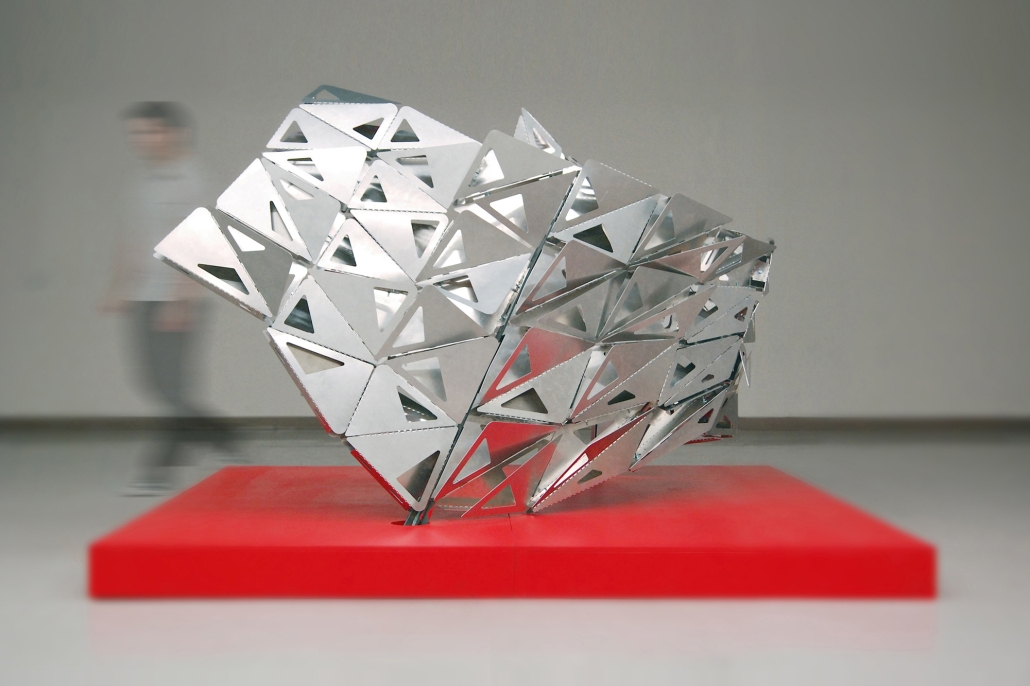
At its core, architecture is a choreography of connections. In this advanced research studio, students explored assembly not as an afterthought, but as the generative principle for design. Through a semester-long investigation, they studied how different elements, digital, material, and structural, come together to form performative wholes.

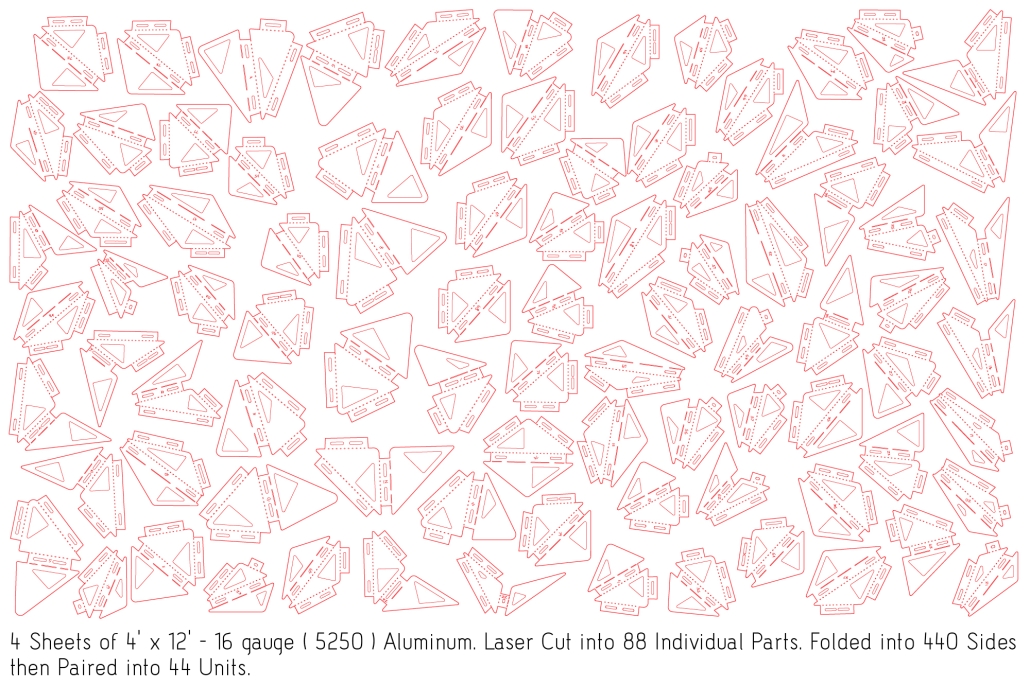
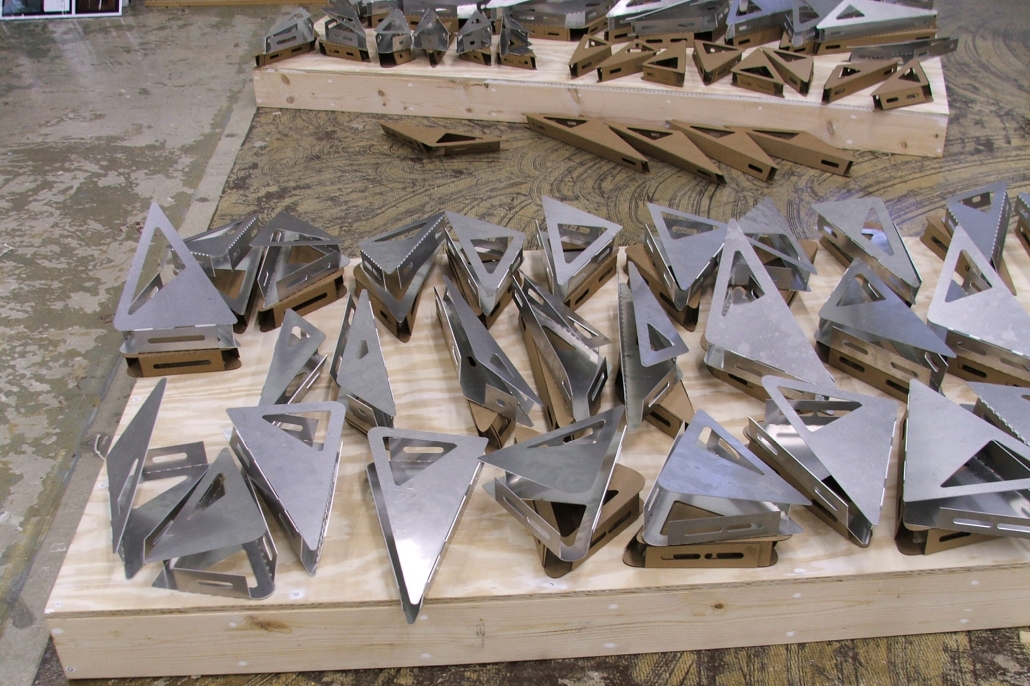
The studio began with an in-depth analysis of joints and bonding methods across disciplines and histories, treating the connection itself as both an aesthetic and structural act. From laser-cut prototypes to iterative digital models, each student developed a speculative connection system, refined through hands-on experimentation.

These efforts converged in the fabrication of a full-scale, inhabitable prototype. Built collaboratively and rapidly deployed, the final installation tested how a single connection logic could drive formal, spatial, and assembly decisions. With no hierarchy between part and whole, the project revealed how connection is not just a means of construction, it’s a way of thinking, making, and inhabiting space.

Instagram: @armando_araiza

The Waterscape: UNDERGRADUATE LIBRARY by  Kay Hau, Yogitha Reddi & Taylor Solomon, M.Arch ’25
University of Illinois Urbana-Champaign | Advisor: Yun Kyu Yi

Architectural design is undergoing a major transformation with advancements in 3D modeling, rendering software, and, more recently, artificial intelligence (AI). Tools like Stable Diffusion, DALL·E, and Midjourney have revolutionized illustration by enabling users to generate visuals from text prompts. Now, architecture is seeing the emergence of AI tools specifically developed for design professionals. These tools assist in generating building forms, interior designs, façade systems, and code-compliant floor plans, while also optimizing layouts. As they become increasingly powerful and accessible, AI technologies are redefining how architects approach the design process.

This evolution is sparking important questions within architectural practice: Should traditional skills like hand drawing and code literacy still hold central importance, or should designers embrace new ways to engage critically and creatively with AI? Rather than replacing the designer, AI has the potential to amplify creativity and encourage more thoughtful, design-driven decisions.

This project investigated the role of AI not just as a tool for visualization, but as a true collaborator in the design process. It focused on three key stages where AI was incorporated into schematic design: Concept Development, Concept Actualization, and Objective-Based Form Finding. The goal was to explore how AI can influence design workflows, spark new ideas, and open up innovative directions for architectural thought and practice.

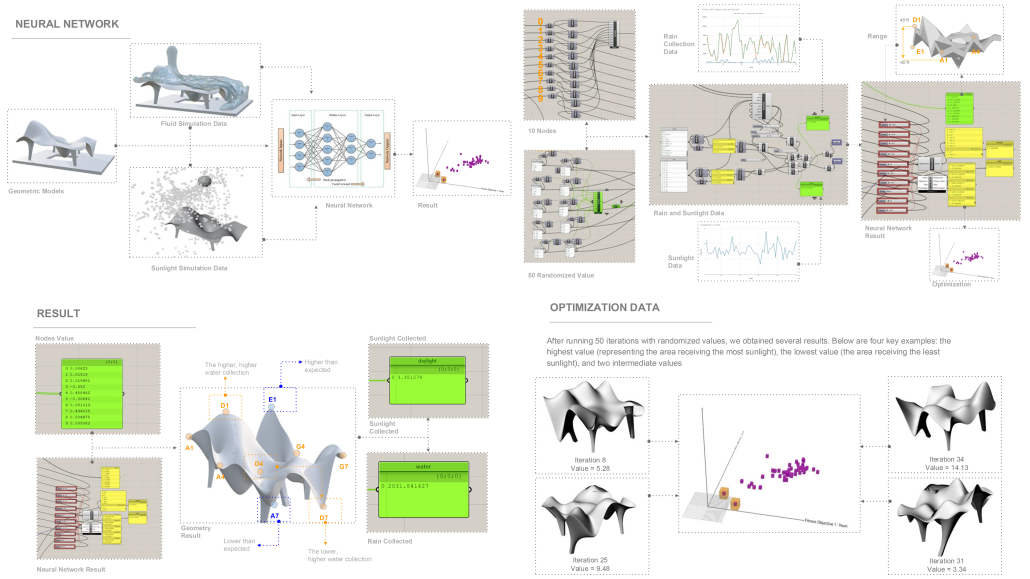
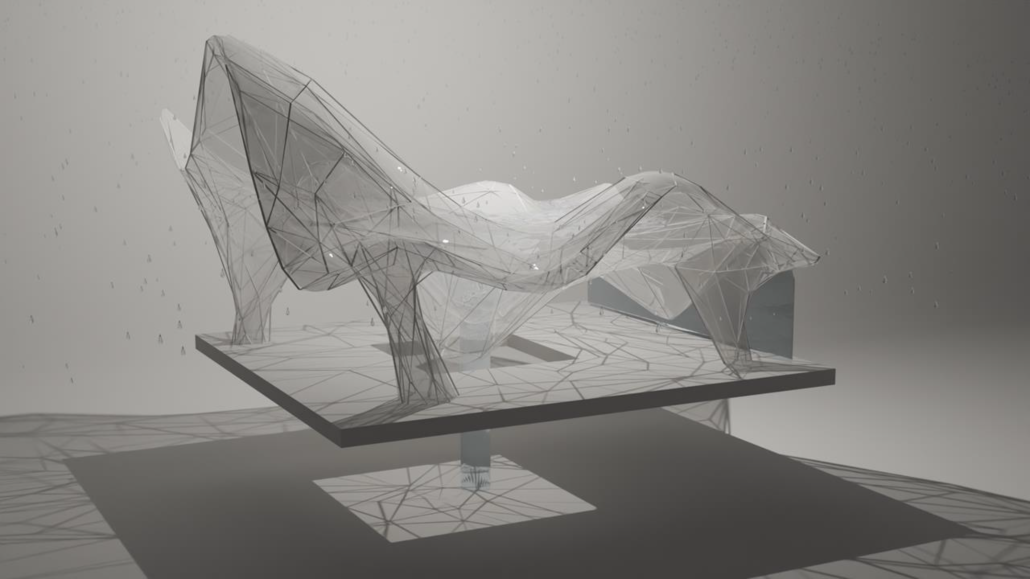
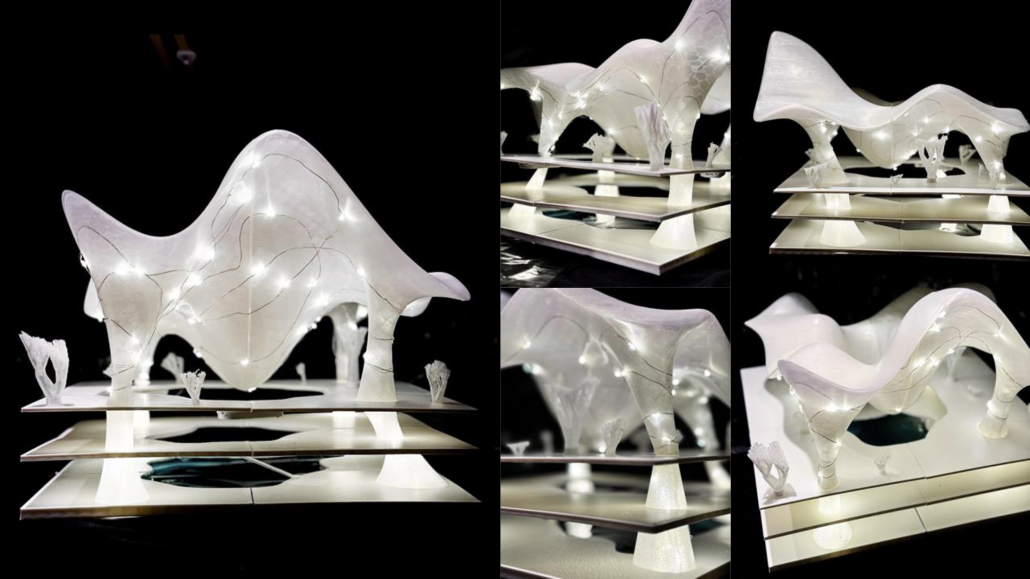
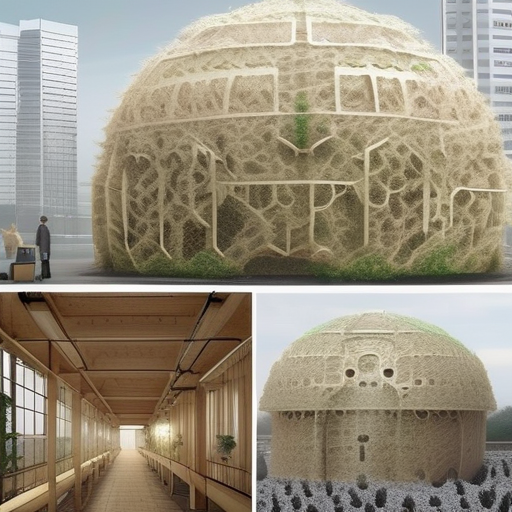
“The Waterscape” reimagines the UIUC Undergraduate Library site through three central ideas: Nexus, Senses, and Encapsulation. Drawing inspiration from the library’s legacy as a communal space, the design emphasizes sensory experiences—sight, sound, and touch—while maintaining the site’s natural environment and uncovering its hidden subterranean layers. Using AI tools such as ComfyUI, Neural Network, and DeepGaze, the design team explored form-making approaches that maximize daylight and collect water efficiently. The result is a passive cooling system that activates and unifies the three-tiered space.

This project received an Honorable Mention for the Ratio Prize, Spring 2025.

Instagram: @kaylhau, @ral_isoa

Sculpted Time by Layla Danelle Neira, B.Arch ’25
New Jersey Institute of Technology | Advisor: Andrzej Zarzycki

Project Description:

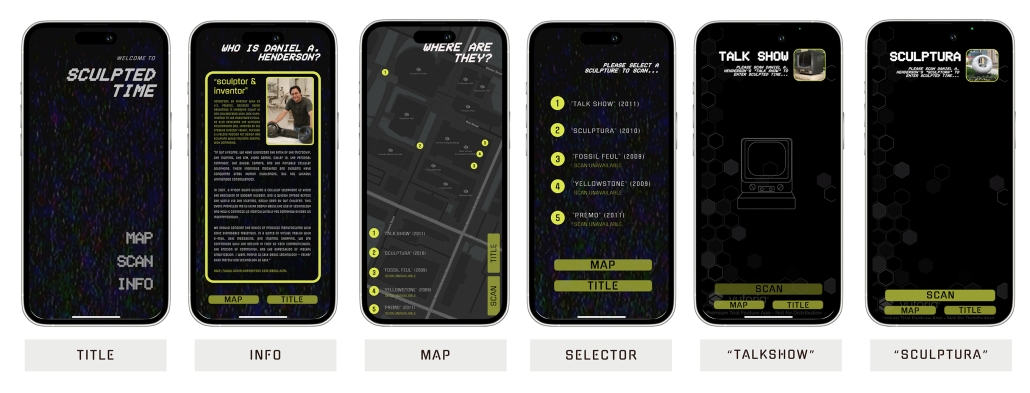
“Sculpted Time” is an augmented reality (AR) project designed to deepen community engagement with the large stone sculptures on NJIT’s campus. Despite their scale and presence, I noticed many students and visitors pass by them without knowing their significance. I wanted to create an experience that reintroduces these sculptures in a more dynamic and relatable way—inviting people to reflect on the tension between the permanence of stone and the fleeting nature of the technology these sculptures represent.

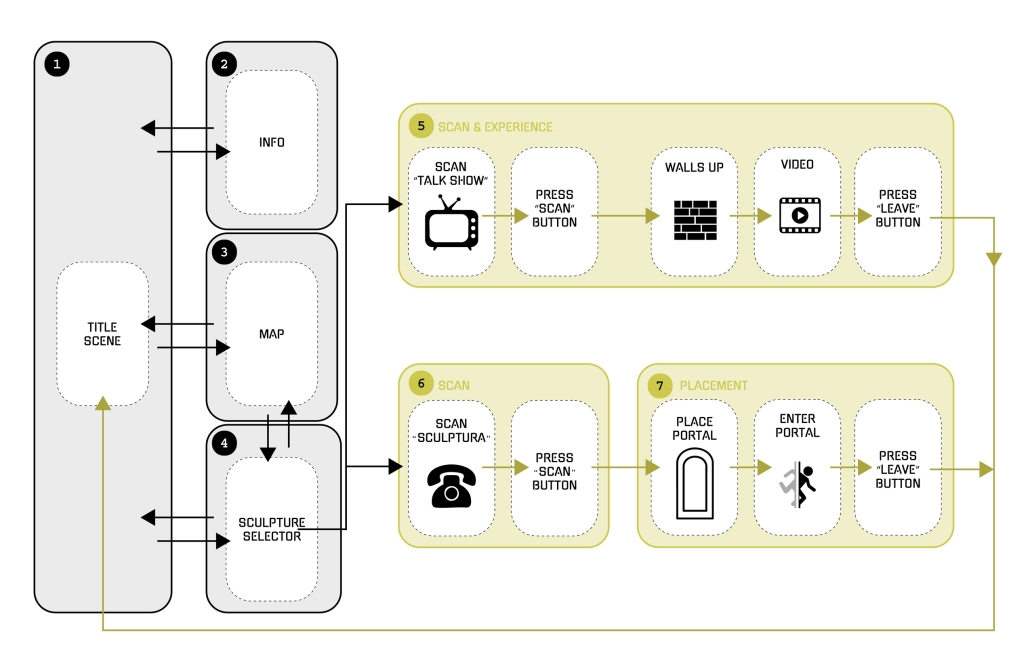
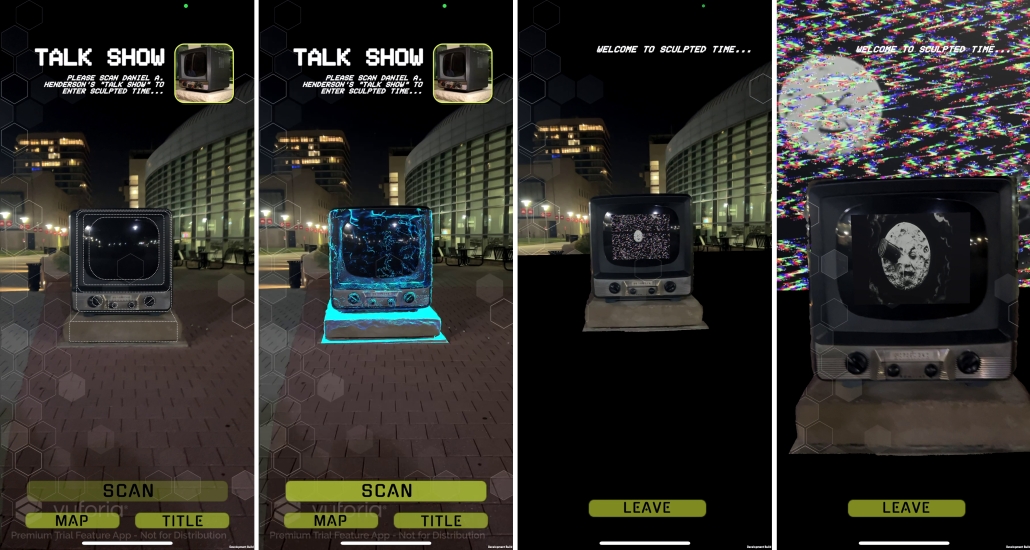
The project is ultimately an application where users can scan a sculpture and have immersive AR experiences that engage multiple senses. Through context-aware environments and storytelling, “Sculpted Time” aims to transform how we engage with public art on campus and rethink our role in an age of rapid technological change—especially within the context of NJIT, where many of us are preparing for careers in tech-driven fields.

Methodology:

This was my first time working with AR technology beyond social media filters, so much of the early stages were marked by experimentation and guidance from my studio professor, Andrzej Zarzycki. I developed the project using tools such as Unity for building the immersive AR environments, Kiri Engine for photogrammetry and 3D modeling, and Vuforia for marker-based AR tracking.

Since the final outcome was a functioning app prototype, I also had to learn and apply UI/UX design principles to ensure the experience was both user-friendly and intuitive. Designing the interface and user interactions became just as important as developing the AR content itself. This part of the process felt more familiar to me since my background in architecture helped me approach spatial planning, visual hierarchy, and user flow with confidence.

Click here for a closer look.

This project was recognized at NJIT’s Dana Knox Research Showcase, 2025.

Instagram: @laylan981, @andrzejzarzycki

Tame Your Mushroom by Tova Gold, M.Arch ’25
New York Institute of Technology | Advisor: Sandra Manninger

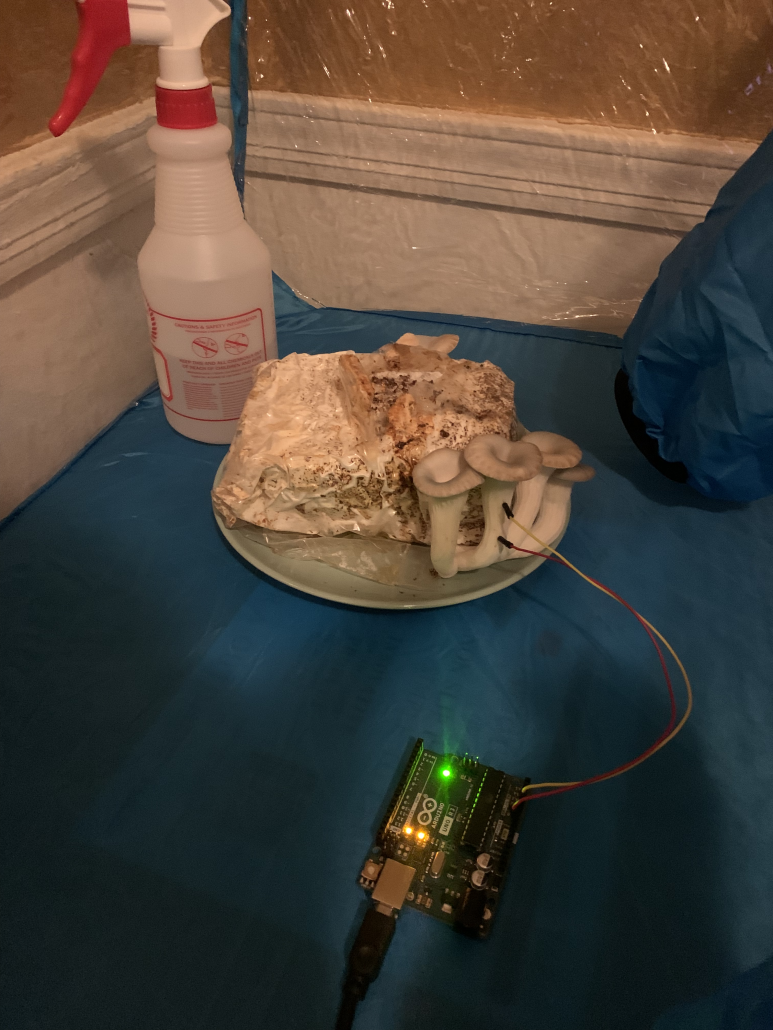
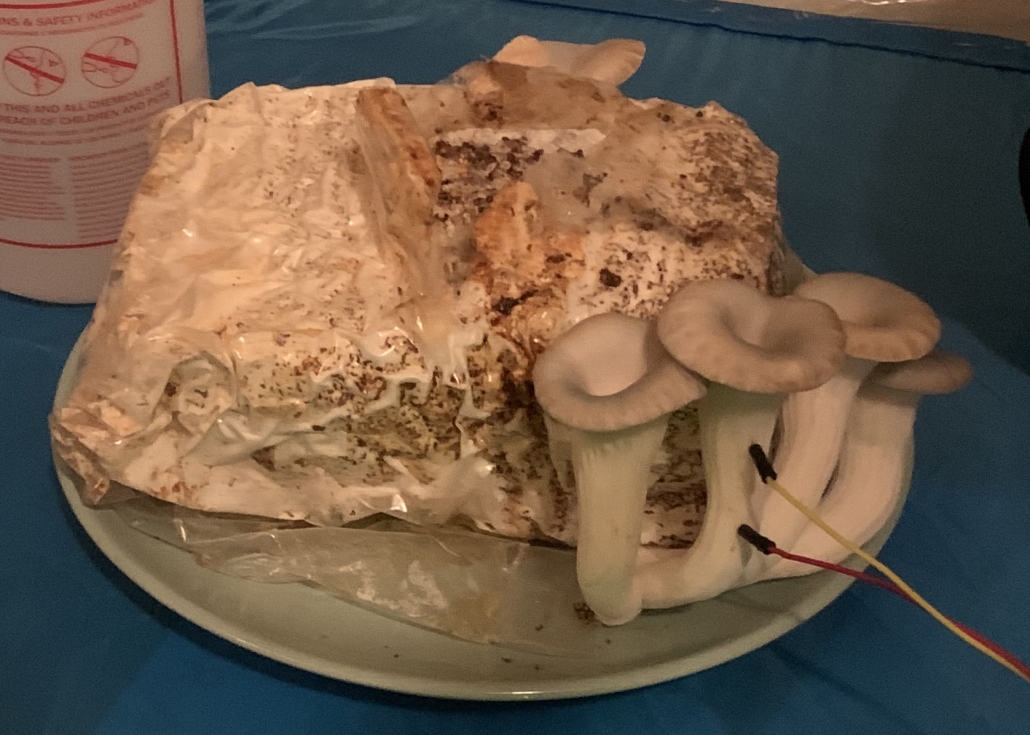
“How To Train Your Mushroom- Fungal Computation, Toward Sustainable Biocomputing in Architecture”

This research explores fungal bioelectricity as a foundation for sustainable, living computational systems with potential applications in architecture. Pleurotus ostreatus (oyster mushrooms) exhibit stimulus-responsive electrical activity analogous to neural computation. While traditionally studied for ecological roles, fungal mycelium demonstrates capacities for memory, adaptive behavior, and environmental sensing, positioning it as a viable substrate for biologically embedded computation within architectural systems.

Controlled experiments involved embedding electrodes into living fungal colonies to record voltage fluctuations under mechanical pressure, light exposure, and thermal stimuli. Time-series features from these electrical signals were processed and analyzed using convolutional neural networks to classify stimulus types. Preliminary results indicate distinct waveform patterns associated with different environmental inputs, suggesting that fungal networks encode information through structured bioelectrical signaling.

These findings highlight the potential of mycelium as a living sensor network capable of integration into architectural assemblies. Responsive to light, heat, mechanical stress, or air quality, fungal materials offer a pathway to architectural systems that adapt in real time to their environment. Unlike conventional computing systems, fungal substrates require minimal energy input, operate at ambient temperatures, and are biodegradable—aligning with goals of ecological design and regenerative material practices.

In architecture, fungal biocomputing implies a shift from inert, passive materials toward active, sensing infrastructures. Mycelium may serve not only as a sustainable building component but also as a medium for distributed computation, enabling novel forms of environmental interactivity and feedback. Moreover, fungal information processing—distributed, embodied, and chemically mediated—resonates with emerging paradigms in architecture that reject centralized control in favor of non-linear, rhizomatic systems.

By combining fungal electrophysiology, machine learning, and computational design, this research redefines the role of material intelligence in architecture and proposes a future in which built environments are both materially and computationally alive.

Instagram: @sandramanninger_studio

Stay tuned for Part III!
2024 Study Architecture Student Showcase - Part I

Welcome to the 2024 Study Architecture Student Showcase!
Over the summer, we called on architecture school faculty from across the globe to nominate graduating students whose work exemplifies excellence in architectural education. The submitted work reflects the various skills and concepts taught in architecture schools while inspiring future architecture students. With the Fall semester in full swing, we are excited to share these outstanding projects with you over the next few months.

These projects will focus on topics ranging from climate change and revitalization to public health and housing. Tune in every Tuesday and Thursday for a new installment focused on a specific topic.

Today’s showcase features projects that are centered around technology. As the world continues to make technological advances, architecture must adapt. Technology can benefit architecture in many ways, as demonstrated by the projects below. From AI and VR to robotics and other digital tools, these projects highlight opportunities to utilize technology as an avenue for innovation and construction.

Nexus by Angela Hanna, M. Arch ’24
Holy Spirit University of Kaslik (USEK) | Advisor: Louis Hachem

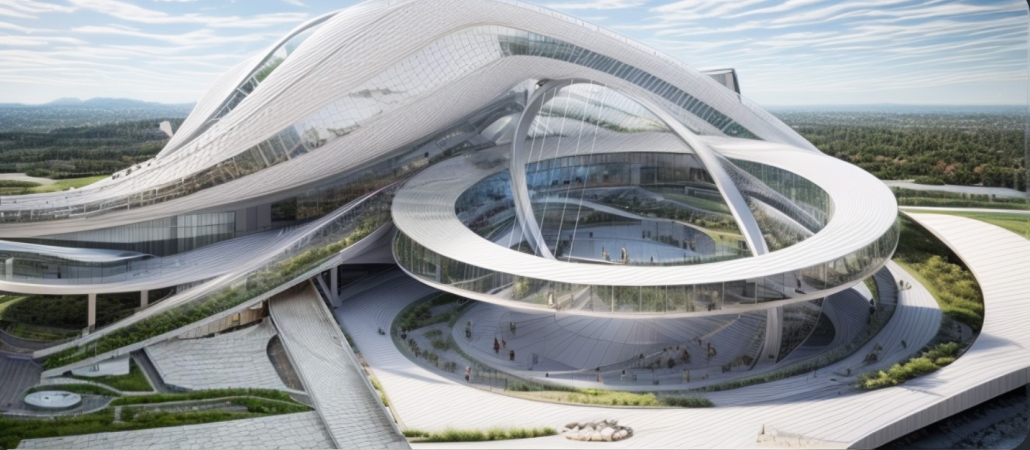
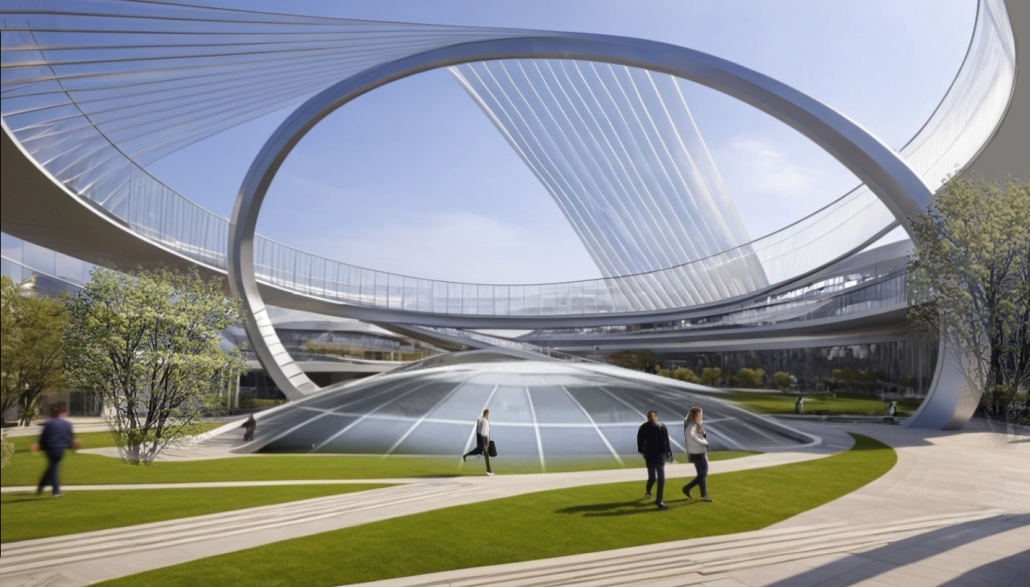
In the dynamic landscape of modern education, “NEXUS” underscores USEK’s unwavering commitment to excellence in education, envisioning a state-of-the-art, smart headquarters that serves as a global hub of interconnected learning.

The Faculty of Robotics and AI represents technological advancements. The iconic dome houses the main auditorium for global educational events, and the surrounding ring encapsulates research laboratories. Innovative features such as dynamic partitions and a revolving stage enhance flexibility, while holographic technology dissolves physical boundaries, fostering a network of knowledge exchange. Sustainability is a cornerstone of the Nexus, employing passive and active methods to reduce energy consumption. Welcome to Nexus, where Architecture, AI and Nature align.

Instagram: @angela.h_, @usekschoolofarchitecture

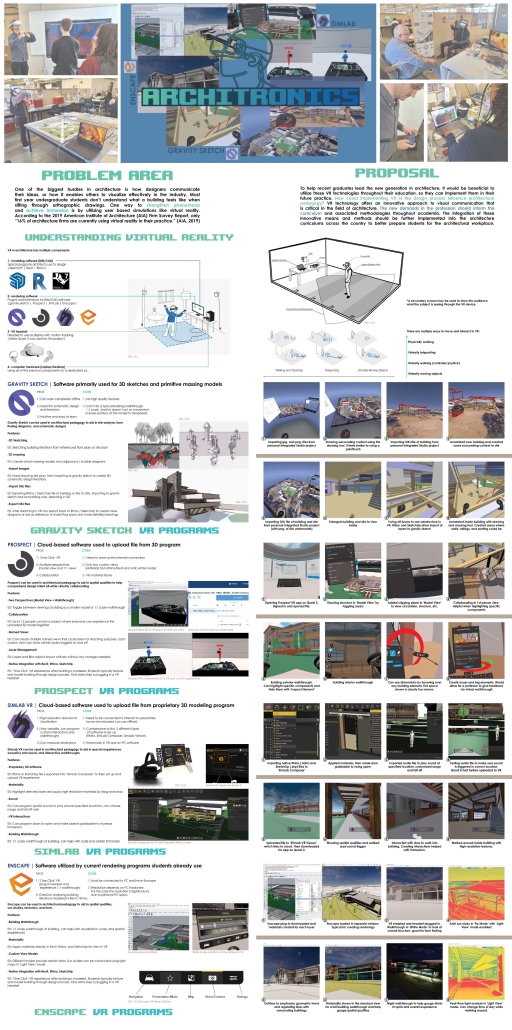
Architronics: Utilizing Virtual Reality in Architectural Pedagogy by Dean Lambros, B. Arch ’24
Kennesaw State University | Advisor: Robin Puttock

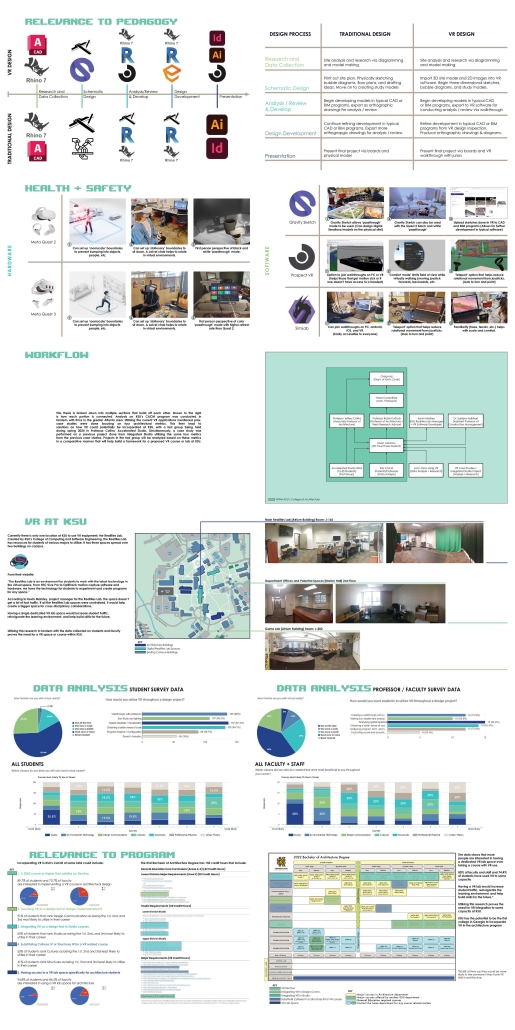
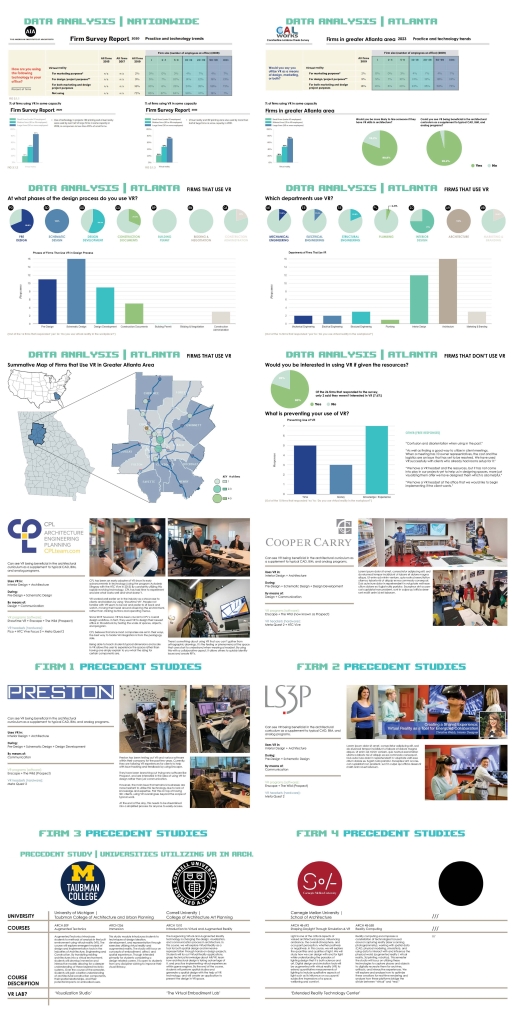
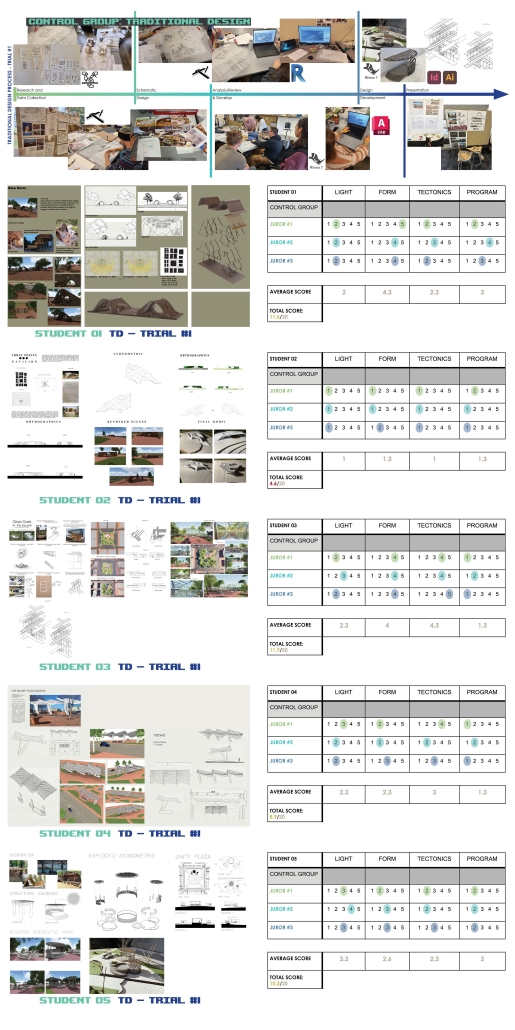
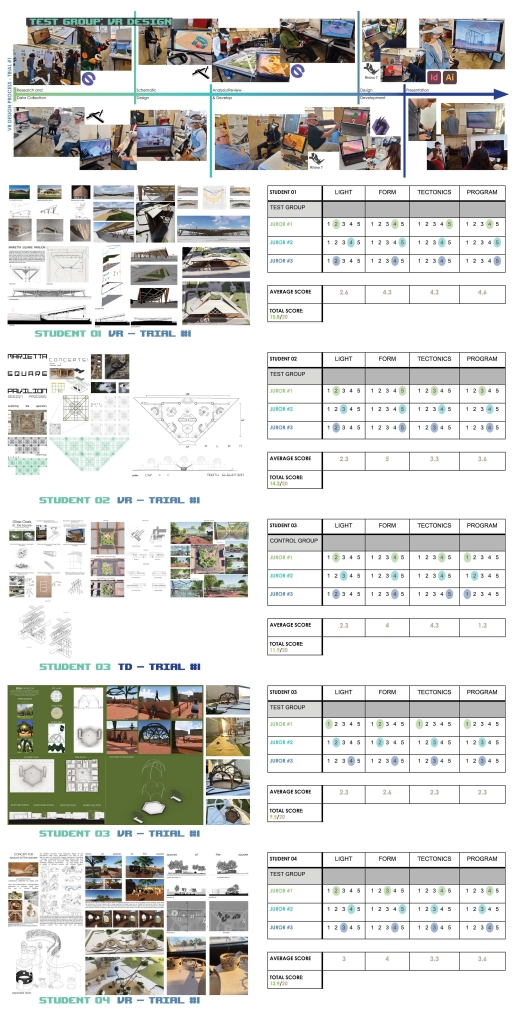
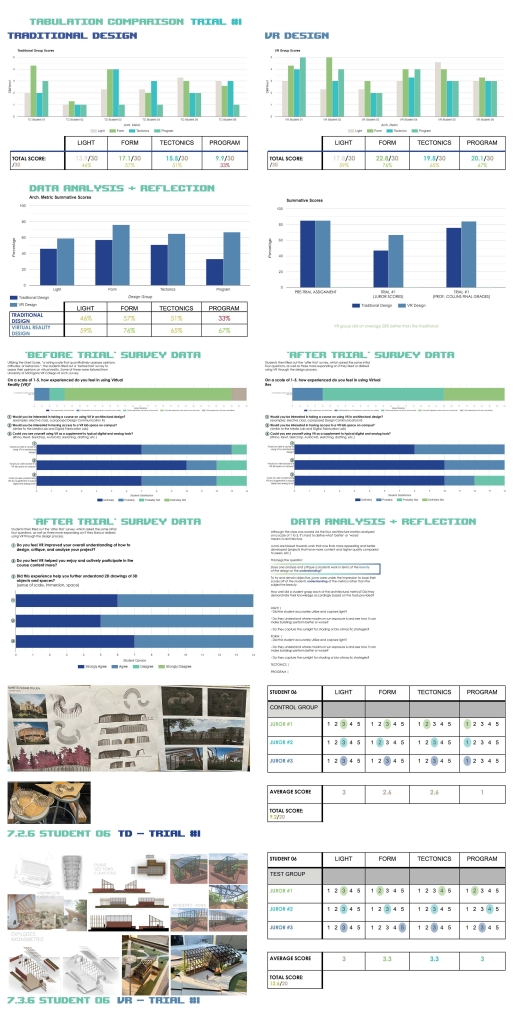
This research is about integrating the recent advancements in VR technology as a way to ‘playtest’ and design in architectural pedagogy. To better gauge the interest in VR and prove the need for VR integration, surveys were conducted among students and faculty within KSU’s College of Architecture and Construction Management (CACM).

A ‘site analysis’ was then conducted within surrounding firms in the greater Atlanta area, leading to precedent studies of local firms that use VR in their practice. By utilizing the firms’ advancements, this shed new light on how VR could be implemented into architectural pedagogy, and why it hasn’t been incorporated into the curriculum yet.

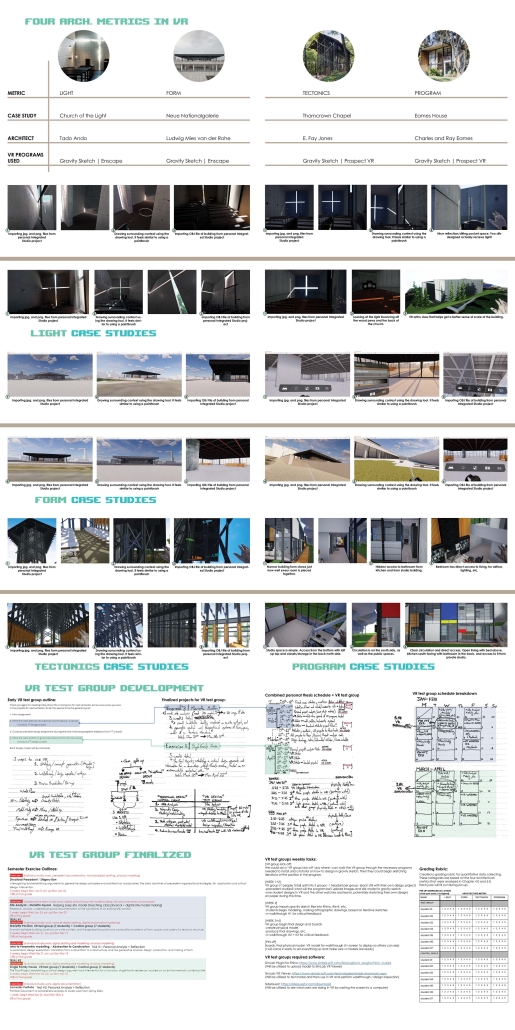
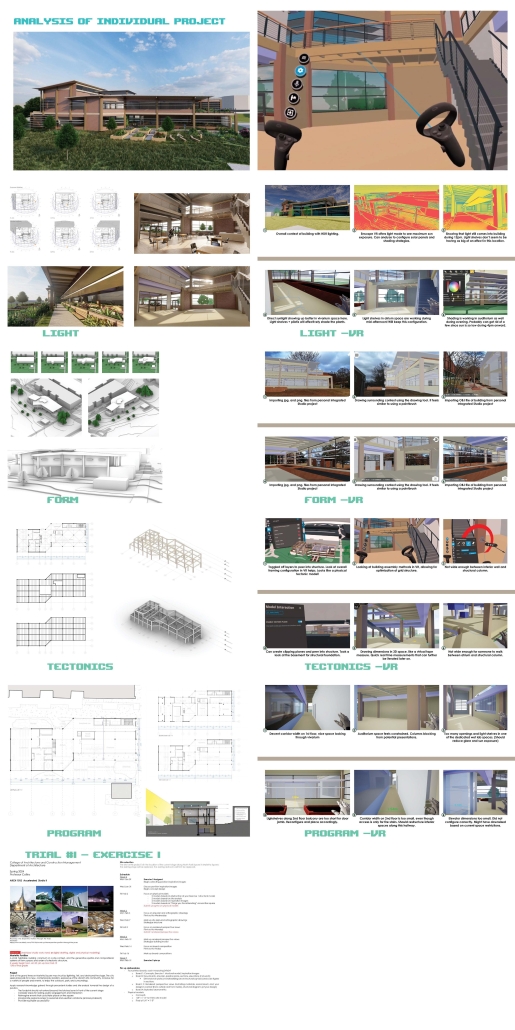
This then led to an analysis of four architectural metrics: light, form, tectonics, and program. Each of these metrics were analyzed in VR through case studies that best exemplify their features. Doing so allowed for a more immersive and concise design approach, which explored new ways to collaborate and critique, and help obtain a better sense of scale within each space.

To compare the architectural design process between traditional pedagogy and VR-tailored pedagogy, a research study was performed on a test group of 14 first-year students implemented in the spring semester 2024 accelerated program. They performed a small-scale design project where half utilized VR-centric design and the other half utilized traditional design. The students were critiqued based on the four metrics previously analyzed by qualified jurors, which revealed that the VR design group outperformed the traditional group by 20%, as well as getting twice as high of a score in the ‘program’ metric.

This research, performed within KSU’s College of Architecture and Construction Management, was utilized to propose a 2nd-year Studio course centered around these findings. This comparative analysis on VR pedagogy versus traditional design justifies the need to move towards a more immersive construction industry.

This project was recognized as a Thesis Competition Finalist.

Instagram: @robinzputtock,

Building Trust: Maintenance and Care for Autonomous Vehicles by Dear Liu, James Vadasz & Catherine Yu, BS (Bachelor of Science in Architecture) ‘24
Washington University in St. Louis | Advisor: Constance Vale

This multi-modal transit hub proposes a new AV transportation and maintenance center for people to learn about and experience the latest technology. To further publicize the use of AV, our building deliberately displays the acts of maintenance through material choices, apertures, and curated spatial sequences. As a result, we imagine the building welcoming anyone passing by as a place of efficiency, comfort, and wonder. 

Our design focuses on aperture and pushes it to the extreme. What if the ground floor was a multitude of portals that led one to their desired stops and lifted the building up? How can the mere use of a singular element not only segment spaces both above and below but also provide the necessary structural support for the building? 

This project was collected for the Washington University in St. Louis Student Work Publication, Approach.

Instagram: @dearliuweihang, @de_architects_, @jamesvadasz2, @catherineyu.qh, @constancevale, @washu.architecture

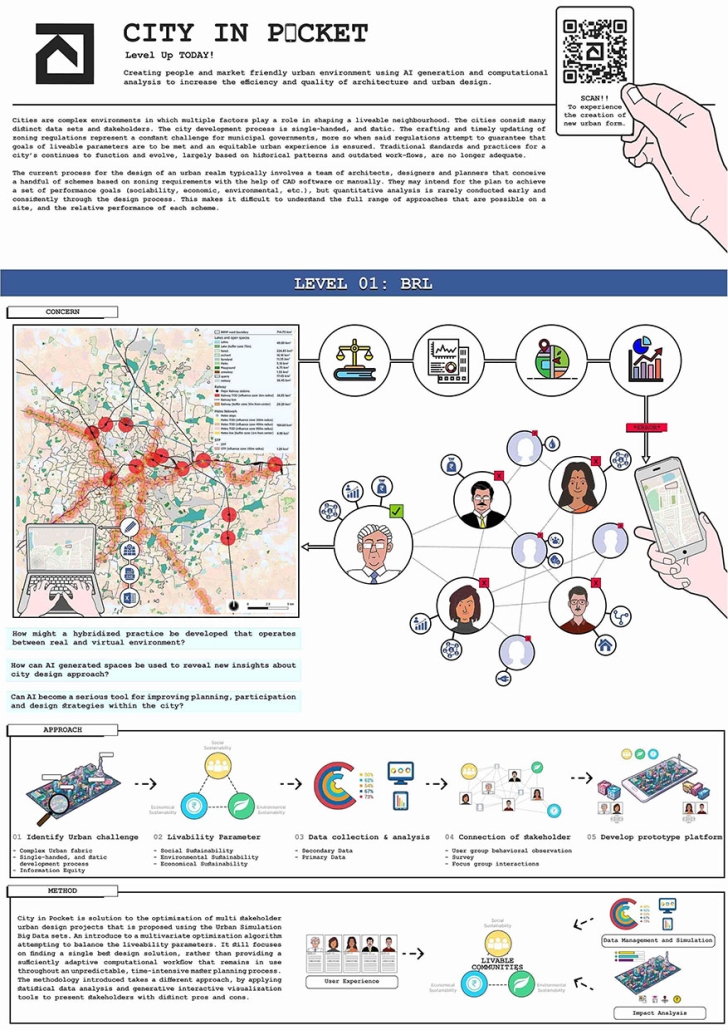
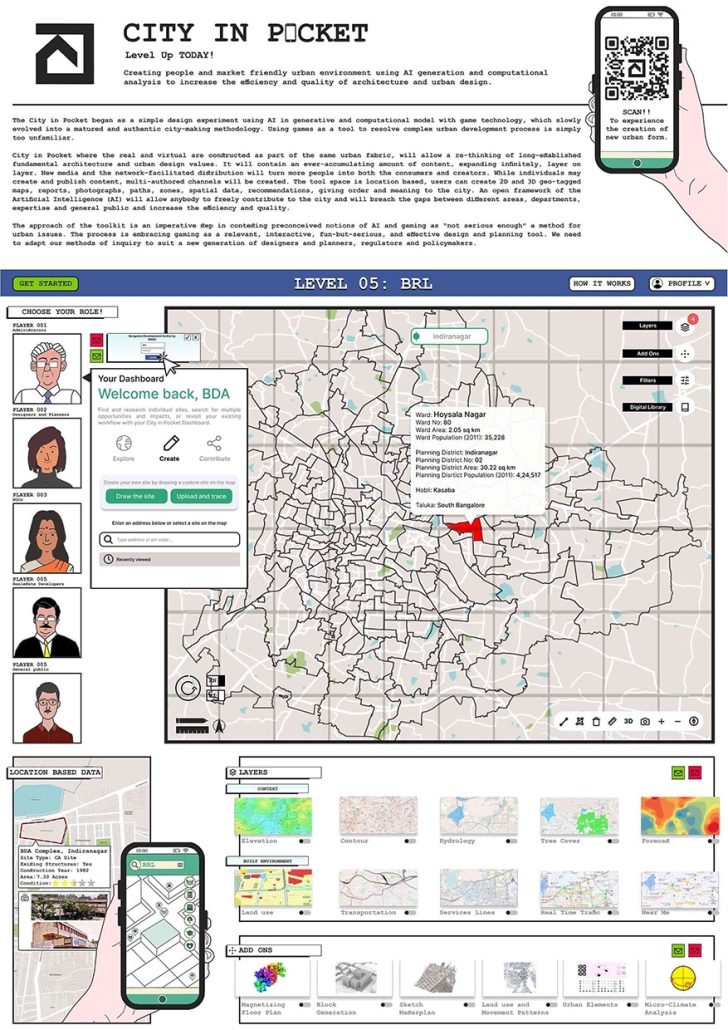
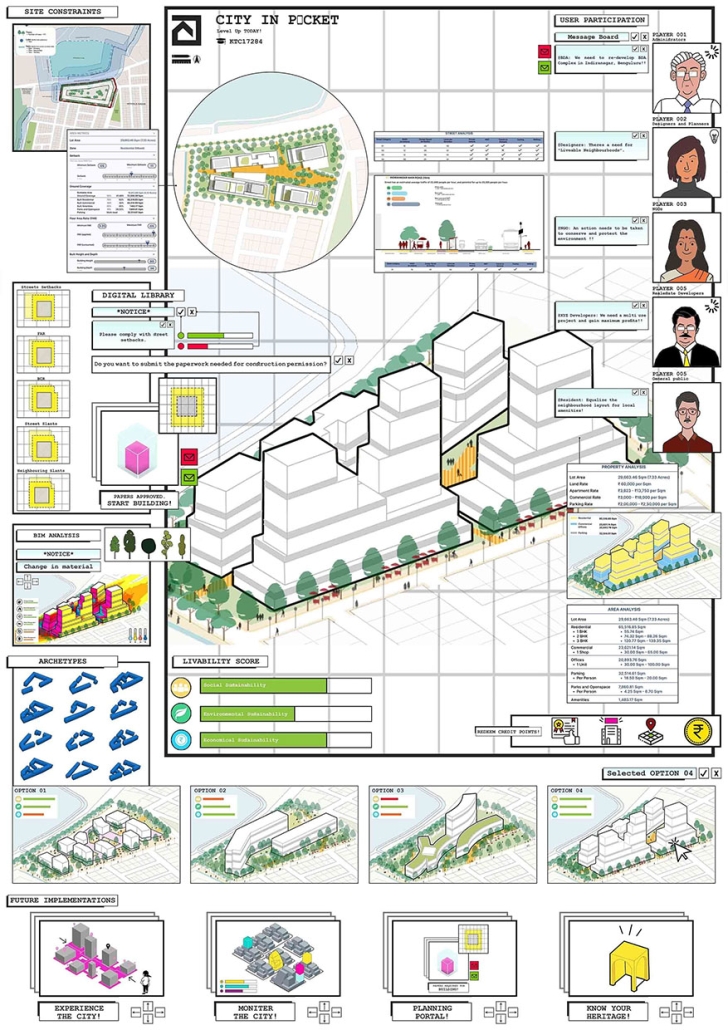
CITY IN POCKET, Level up TODAY! by Rachana Charate, M. Arch (Urban Design) ’24
R V College of Architecture | Advisors: Anup Naik & U. S. Maiya

This exploratory thesis looks at creating a people- and market-friendly urban environment by synthesizing AI computational analysis and generation to increase the efficiency and quality of architecture and urban design.

Cities are complex environments in which multiple factors play a role in shaping a liveable neighbourhood. The cities consist of many distinct data sets and stakeholders. The city development process is single-handed and static. The crafting and timely updating of zoning regulations represent a constant challenge for municipal governments, more so when said regulations attempt to guarantee that goals of liveable parameters are met and an equitable urban experience is ensured. Traditional standards and practices for a city continue to function and evolve, largely based on historical patterns and outdated workflows and are no longer adequate.

The current process for the design of an urban realm typically involves a team of architects, designers and planners that conceive a handful of schemes based on zoning requirements manually or with the help of CAD software. They may intend for the plan to achieve a set of performance goals (sociability, economic, environmental, etc.), but quantitative analysis is rarely conducted early and consistently through the design process. This makes it difficult to understand the full range of approaches that are possible on a site and the relative performance of each scheme. In order to best accommodate rapid urbanization while making cities more liveable, and equitable, designers must utilize quantitative tools to make informed decisions about their designs. Computational analysis and generative design techniques have been successfully used at the building scale to test numerous designs and quantify their performance, but are challenging to apply at the urban scale due to increased computational expense, difficulty in limiting inputs, and more stakeholders involved in the process. The purpose of this project is to introduce a methodology for AI generative models, capable of evaluating performance goals based on the information available at each step of the development and communicating the impacts on those goals of any decisions regarding land use, density and form, etc.

The City in Pocket proposes AI computational and generation, where the real and virtual are constructed as part of the same urban fabric, which will allow a re-thinking of long-established fundamental architecture and urban design values. It will contain an ever-accumulating amount of content, expanding infinitely, layer on layer. New media and the network-facilitated distribution will turn more people into both consumers and creators. While individuals may create and publish content, multi-authored channels will be created. The tool space is location-based, users can create 2D and 3D geo-tagged maps, reports, photographs, paths, zones, spatial data and recommendations, giving order and meaning to the city. An open framework of AI will allow anybody to freely contribute to the city and will breach the gaps between different areas, departments, expertise, and the general public and increase efficiency and quality.

Instagram: @_charate_, @usmaiya.design

Bespoke Moon by Austin White, B. Arch ’24
Kennesaw State University | Advisor: Jeffrey Collins

Welcome to Bespoke Moon, the next high-tech, component-based system that allows architects and designers to fully immerse themselves in design once again.

Designers grow up nurturing a passion for design, then eventually attend school to hone their skills. However, bringing these designs to life in the built environment involves a lot of tedious work and time to ensure safety, structural integrity, and compliance with codes. With that in mind, I aim to transform our traditional processes.

Bespoke Moon’s component-based system utilizes 3D-printed, prefabricated steel components that lock, seal, stack, and interlock in a unique way, allowing them to connect with one another and incorporate structure. These connections enable the components to withstand all weather and climate conditions in the future, potentially an extraterrestrial environment, reflecting an industrial outer-space aesthetic.

This high-tech component system is powered by Bespoke Moon’s new AI, which assists in generating these components, allowing architects and designers to focus solely on design. Moreover, the components generated from other designs provide an opportunity to create a library of Bespoke Moon components. This enables reuse in various ways in new designs across a variety of scales. The ultimate goal of this high-tech, component-based system is to allow architects and designers to dive back into design, as they were taught and born to do, by integrating artificial intelligence to revolutionize conventional construction and design processes in modern architecture.

This project was awarded third place in the KSU Architecture Thesis Competition 2024.

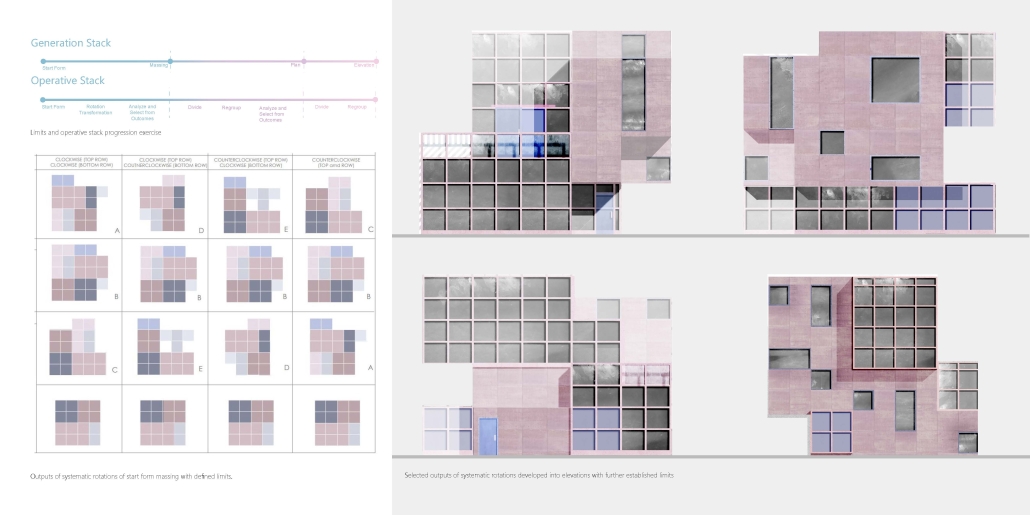
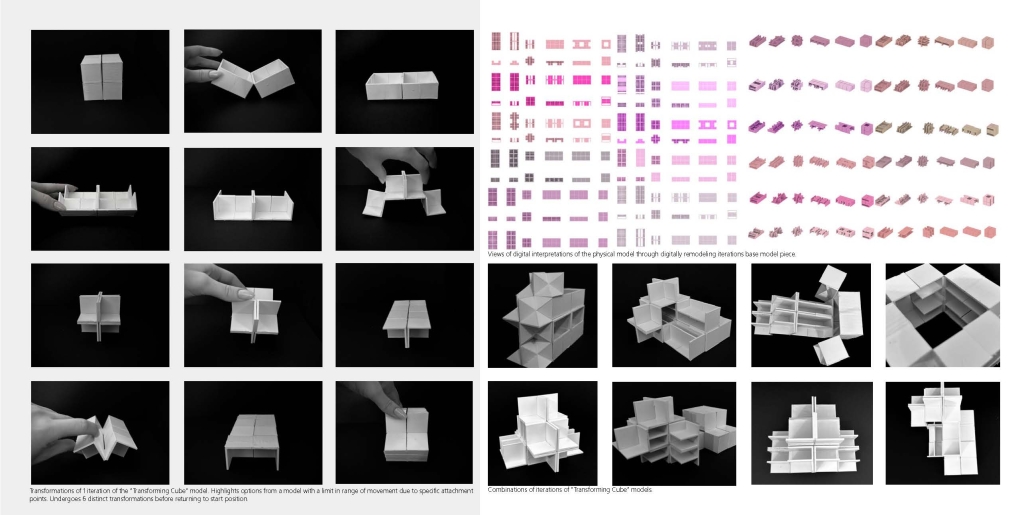
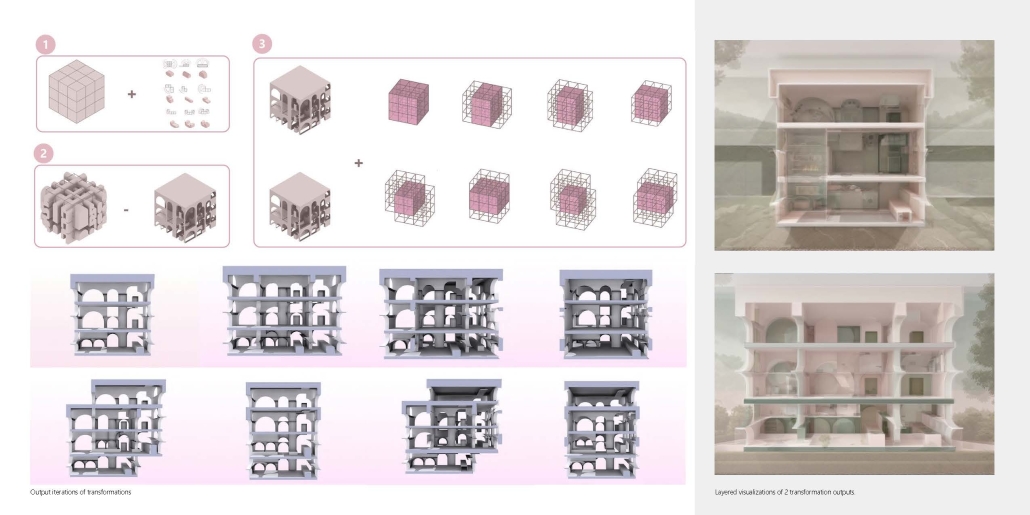
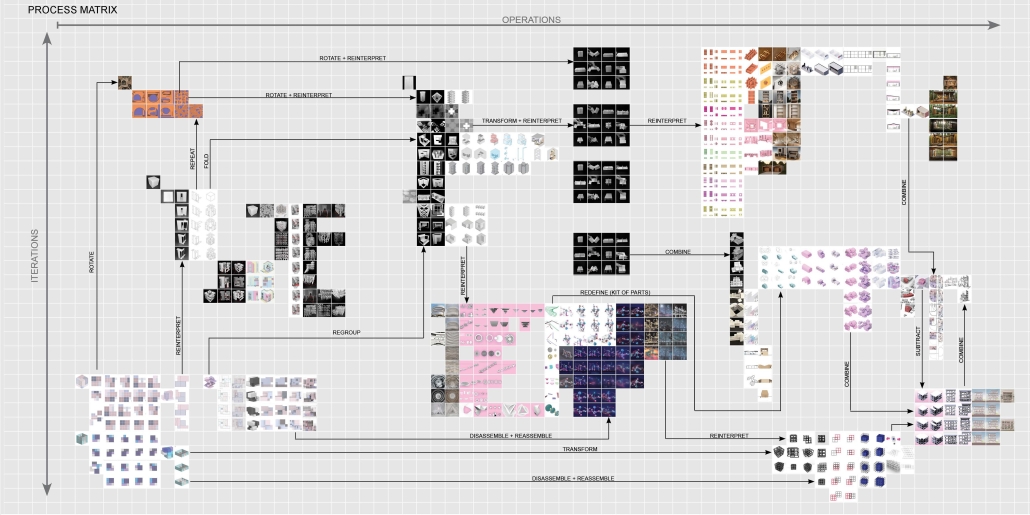
Operative Approaches: Potential in Limits in Design Process by Chantal Shahmooradian, M. Arch ’24
Toronto Metropolitan University | Advisors: Carlo Parente (Supervisor), Kate Myers (Second Reader) & John Cirka (Program Representative)

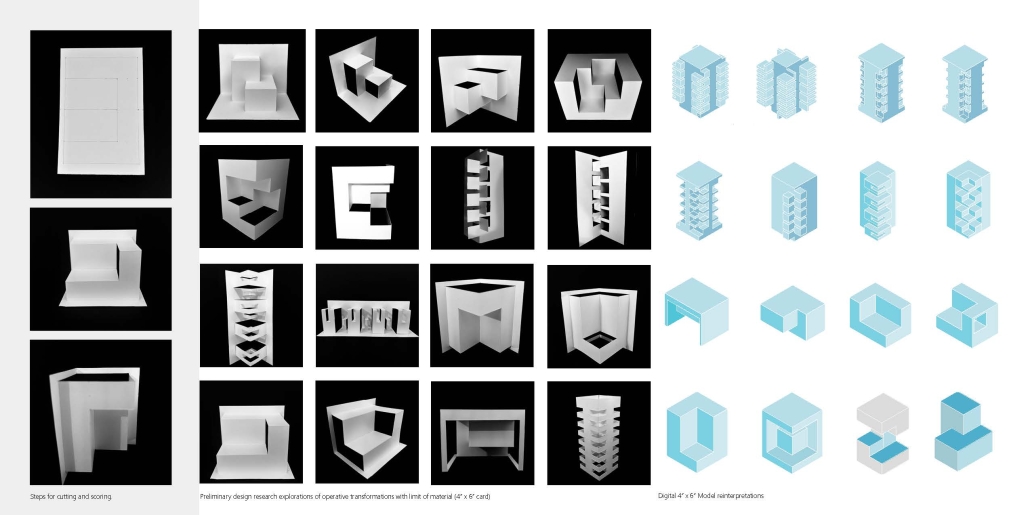
In the realm of architecture, limits are often perceived as obstacles, however, this research reimagines them as powerful catalysts for creativity. By embracing constraints and leveraging operative approaches– with structured systems revealing a comprehensive array of possibilities within project limitations– architects can unlock new depths of innovation within the design process. This research explores the transformative potential of working within limits, through the use of a variety of tools such as drawing, digital media, AI, and physical models to illustrate how constraints can inspire inventive solutions.

The thesis advocates for a holistic view of design tools, not merely as means of production but as active agents in the creative process. It demonstrates how models and drawing techniques can shape design outcomes from the earliest stages, fostering a dynamic and iterative approach. Through the use of exercises that implement transforming physical models, with chosen limits, the study underscores the critical role of limits in defining problem spaces and guiding the creative journey.

A key focus is the distinction between given constraints and those chosen by designers, showcasing the architect’s skill in navigating these boundaries. The research highlights heuristic reasoning’s impact on design decisions, balancing the benefits of guided problem-solving with an awareness of cognitive biases. Visual explorations with the use of dynamic physical models with limits demonstrate the potential of these approaches as key pedagogical tools which can enhance the way designers and architects approach design problems, fostering innovative design thinking strategies.

Operative approaches are explored through physical models inspired by 3D puzzles, which serve as inspiration for problem-solving methodologies within defined limits in the design research. These models reveal the rich spatial possibilities that emerge within set constraints, offering new avenues for creative exploration that exist within the limits.

By showcasing a series of innovative design solutions derived from these explorations, the thesis illustrates how constraints can be harnessed as opportunities rather than hindrances. This approach not only enhances architectural creativity but also provides meaningful insights and outcomes, demonstrating the profound potential of limits in the design process.

Instagram: @chantal_shah, @dastorontomet, @tmu_archgrad

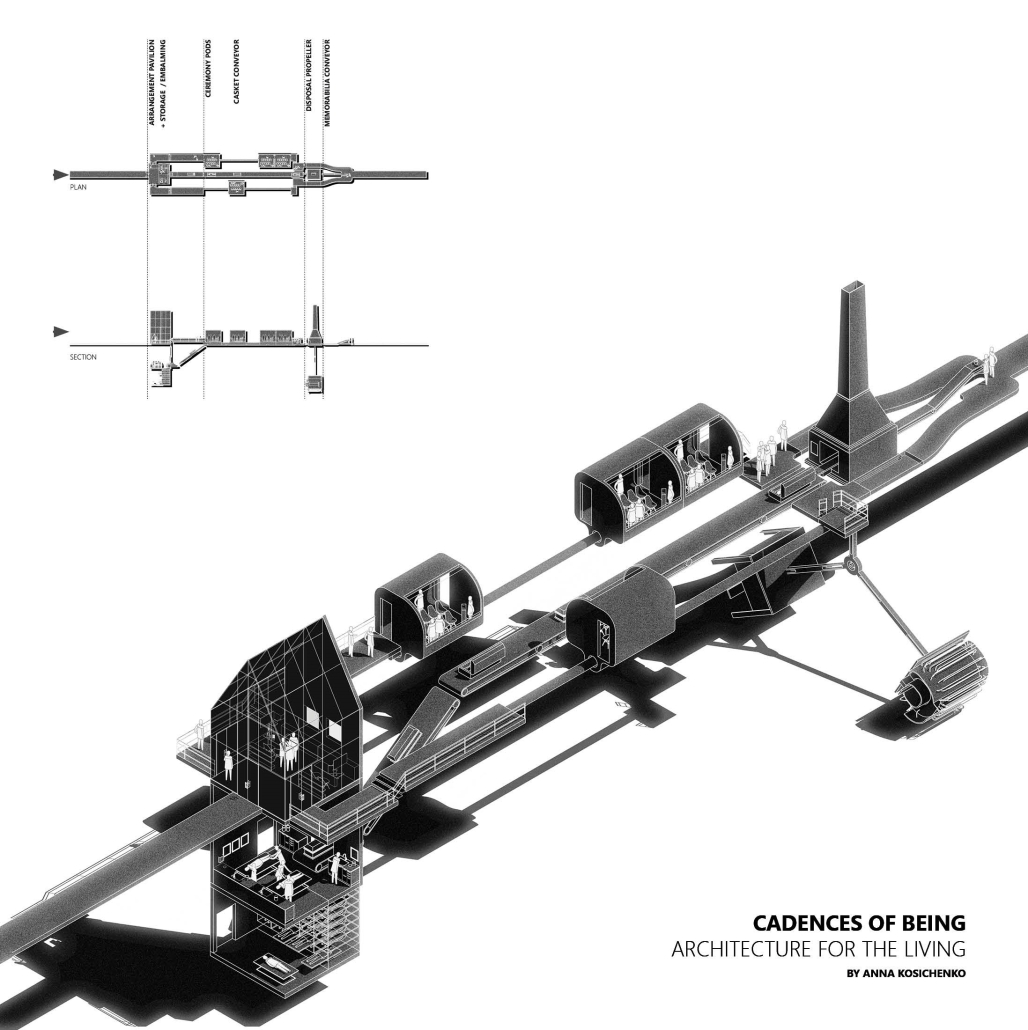
Cadences of Being: Architecture for the Living by Anna Kosichenko, M. Arch ’24
Toronto Metropolitan University (formerly Ryerson University)| Advisors: Paul Floerke (Supervisor) | Stanislav Jurcovic (Second Reader) | Carlo Parente (Program Rep)

Architecture is an artifact frozen in time, a physical ‘time stamp’ – an object that reflects its environment and values. While such physical ‘time stamps’ define our relationship with mortality, it begs the question: “What is the future role of burial architecture in the realm of living?”

‘Funeral Machine’ is a conceptual representation of current outdated, mechanized and costly burial practices are centred on the efficiency of the process rather than the experience of users, facilitating further physical and metaphysical disconnect between life and death.

New technologies for sustainable dying provide an opportunity to reform the ritual of mourning and use the built form to redefine culture’s relationship with mortality and grief. The proposal provides a space for grieving in a city, crafting architecture that values human-centred experience and shines a light on death as part of life.

Instagram: @enot_sosna5, @tmu_archgrad

The Architecture Factory by Steven Fallon, M. Arch ’24
Boston Architectural College | Advisor: Sam Landay, AIA

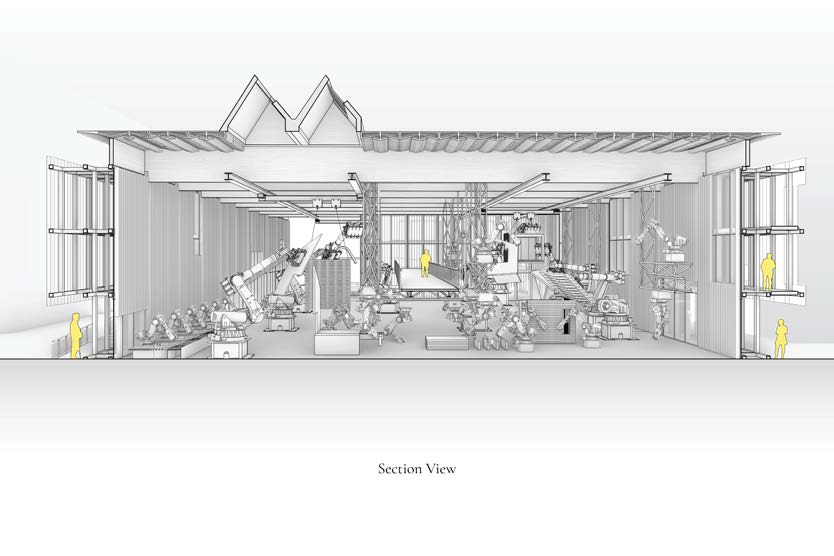
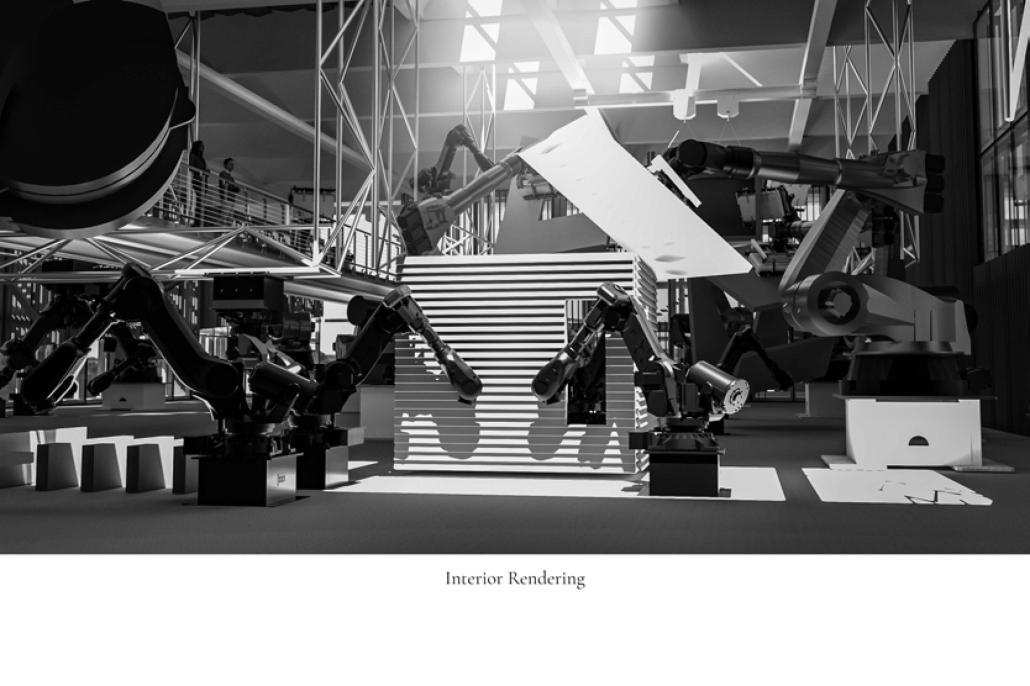
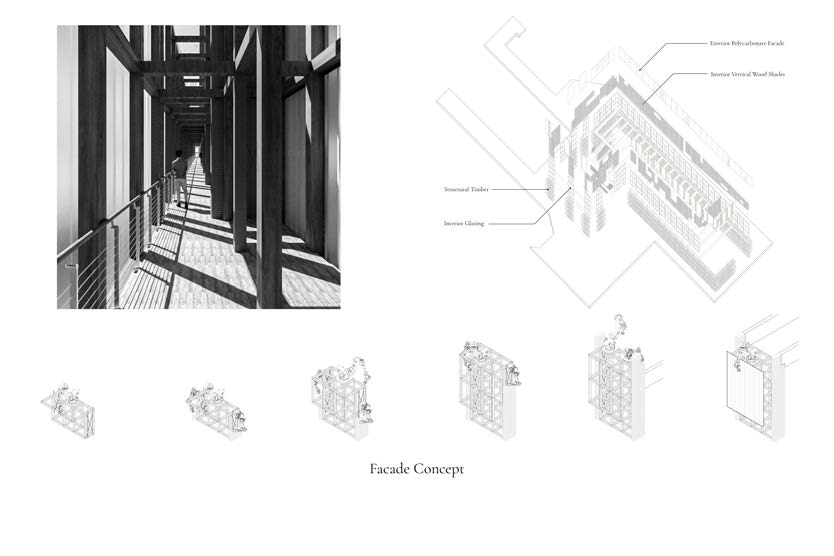
The Architecture Factory contemplates craftsmanship in the context of contemporary architecture and re-imagines the role of the Architect in a new age of digital design and construction. Standing amidst the global housing and climate crises, the project asks how we can utilize robotics to not only advance construction and design efficiency but also enter a new age of design that is built upon excellence in the craft of building.  

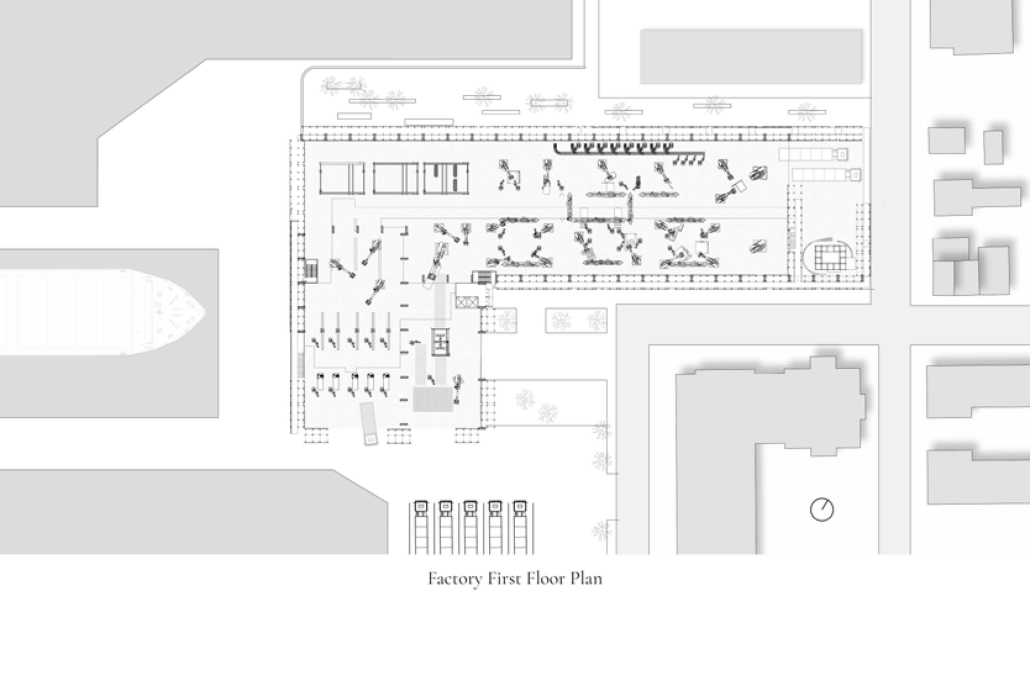
The ideas of this thesis are represented through the design of a factory on the site of a previous machine shop on the waterfront of East Boston, Massachusetts. Inside, a new studio space takes hold, where architecture comes to life in the form of physical construction, a craft that is taught and learned, experimented with, and refined. No longer would architecture be represented just by drawings, but by physical and material representations of the designer’s imagination, built directly in the studio. Wielding the powers of the robot and computer to their advantage, here, the robot becomes a prosthetic arm and extension of the architect, while the architecture transcends from concepts and representations into physical, tangible creations.

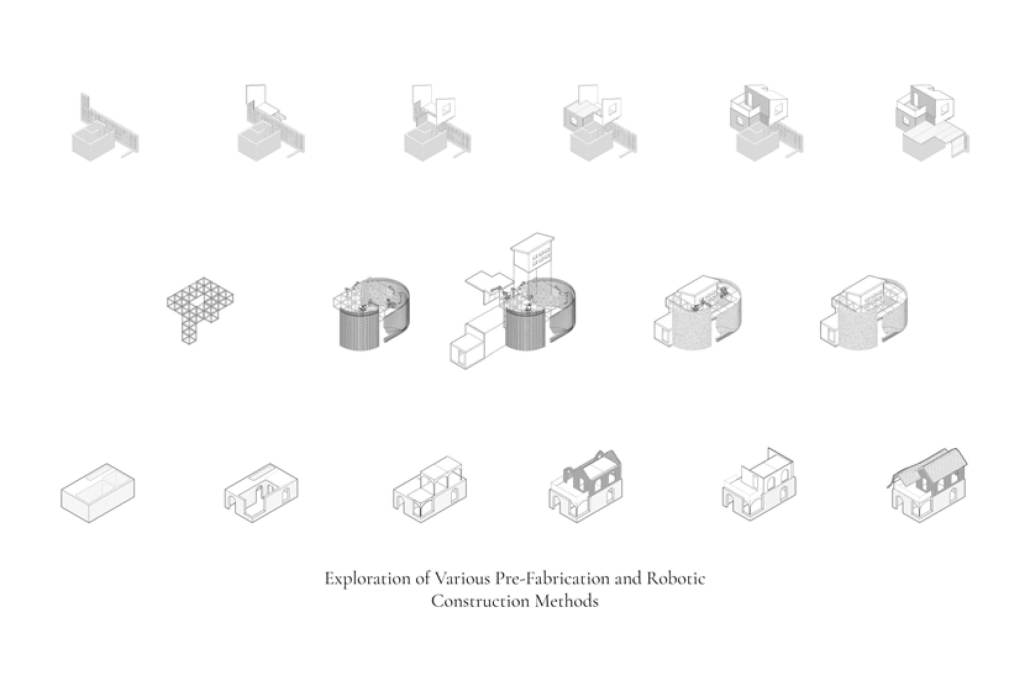
The project first delves into the fabrication and construction methods of our future homes. It then examines the design and construction of the factory itself, considering the human interaction with the building process and asking how we can bring light to the processes that build the world around us. Robots construct their own factory and provide humans the space to observe the performance of construction from a distance. Architects serve as maestros of a robotic symphony, guiding these machines and orchestrating a performance of precision and efficiency-driven construction, resulting in an architecture that is founded in the fundamental elements of architecture – material, craft, and construction.

This project was awarded Commendations: Master of Theis Excellence – Architecture. 

Instagram: @stevenfallon7

Stay tuned for Part II!
2023 Study Architecture Student Showcase - Part XXX

In Part XXX of the Study Architecture Student Showcase, we take a look at student work that addresses ecological challenges. The featured projects include housing structures that mitigate flooding, coastal urban parks, prairie education centers, visualizations of toxic destruction, and more. Each design invites viewers to reflect on the connection between human and non-human environments, whether by providing ecological interventions or embracing toxic sites of ecocide.

Revitalizing the Meander by Alec Paulson, B.Arch ‘23
Tulane University | Advisor: Ruben Garcia-Rubio

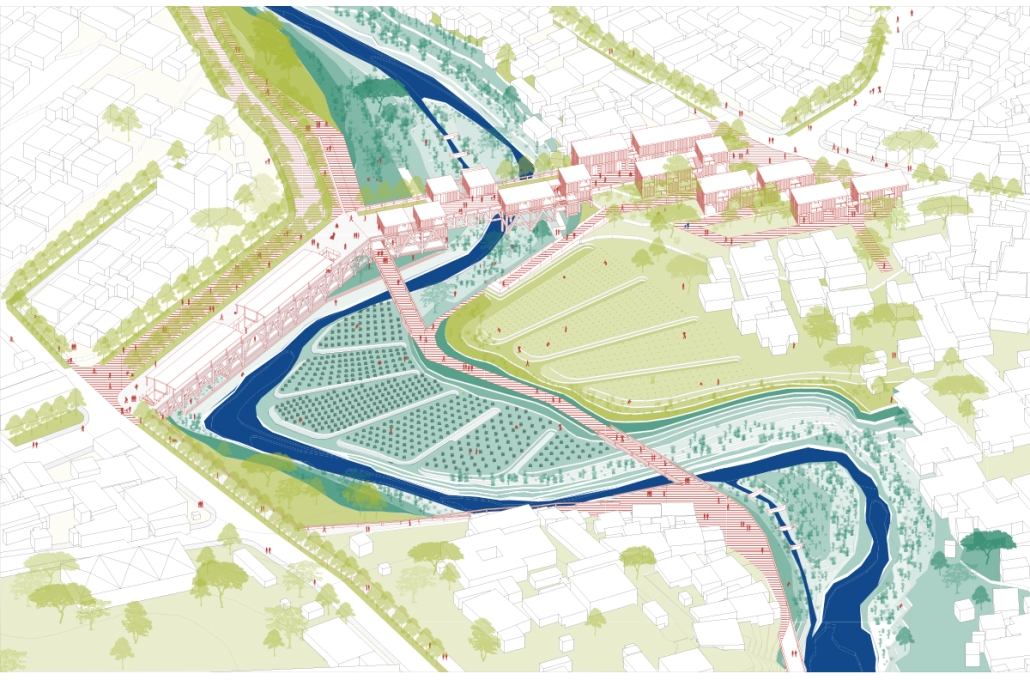
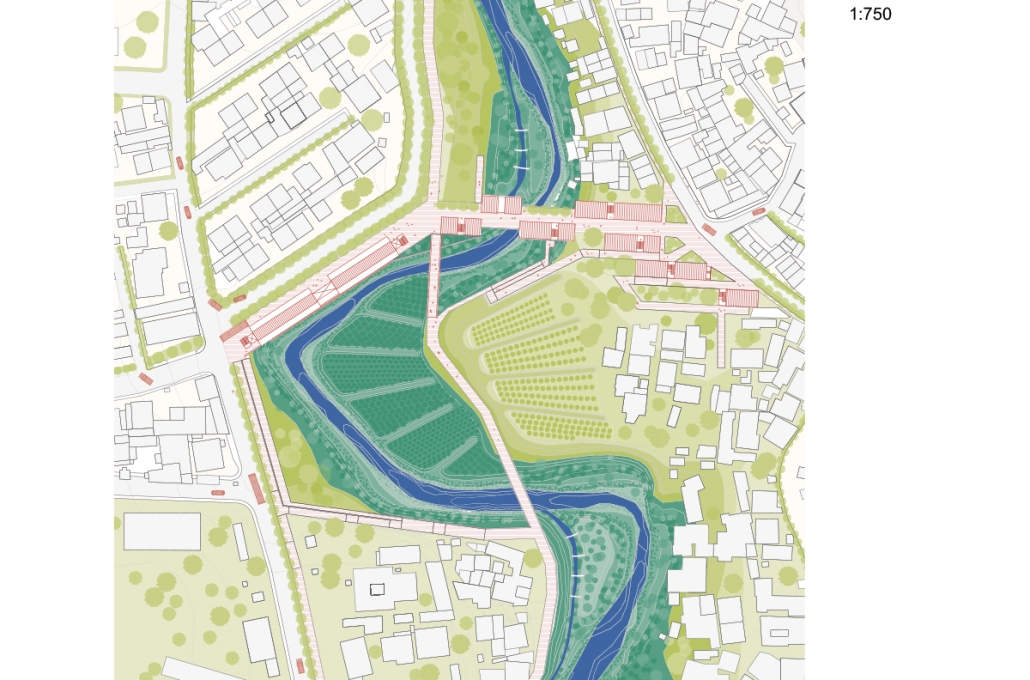
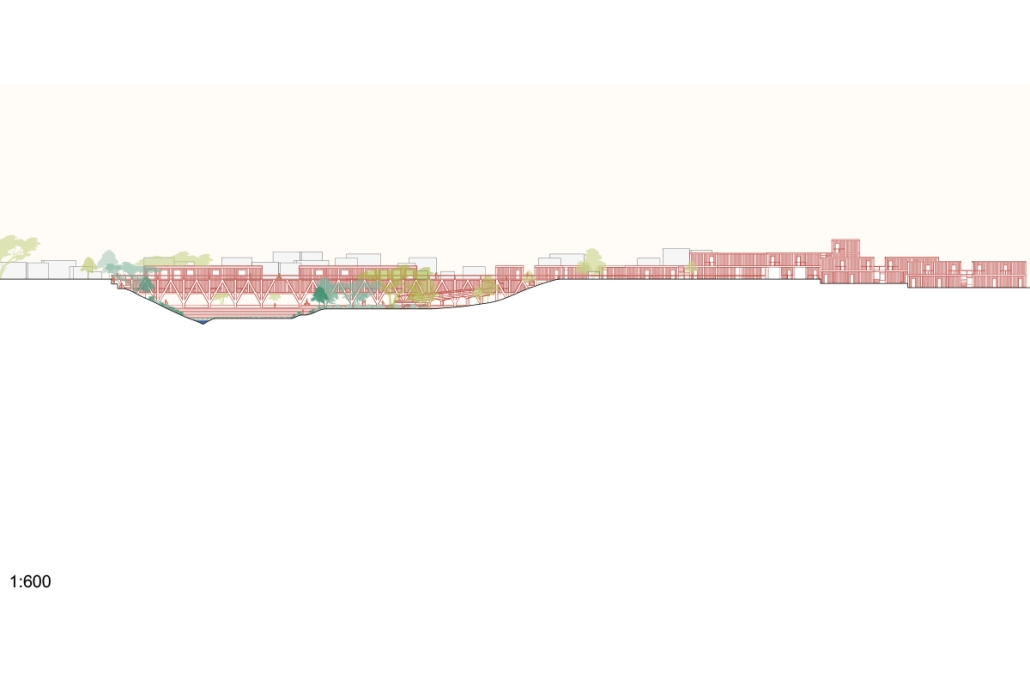
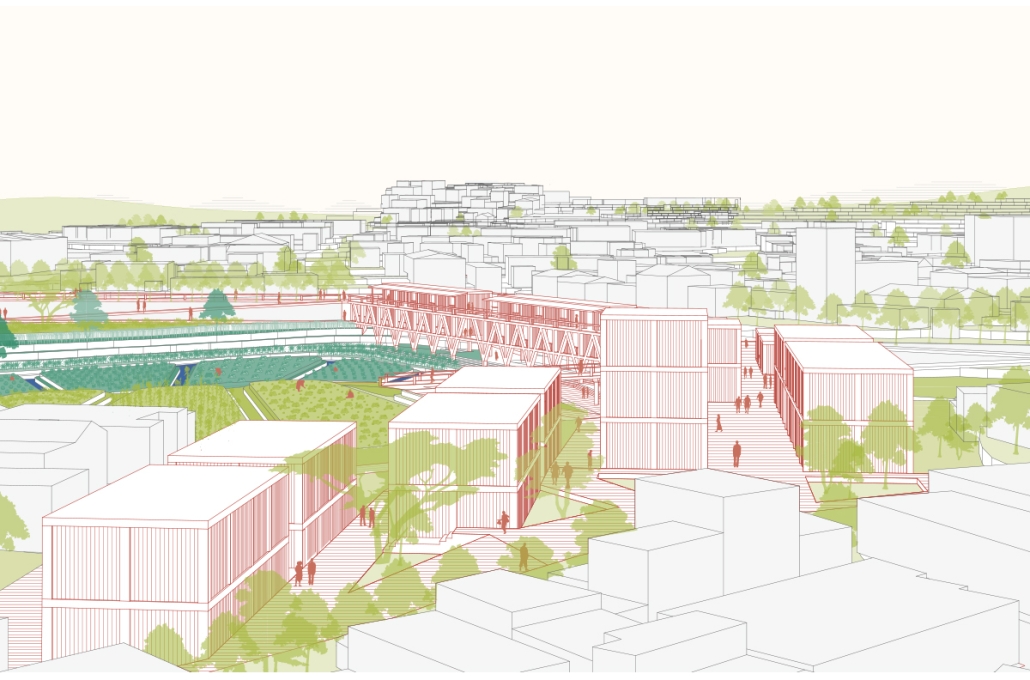
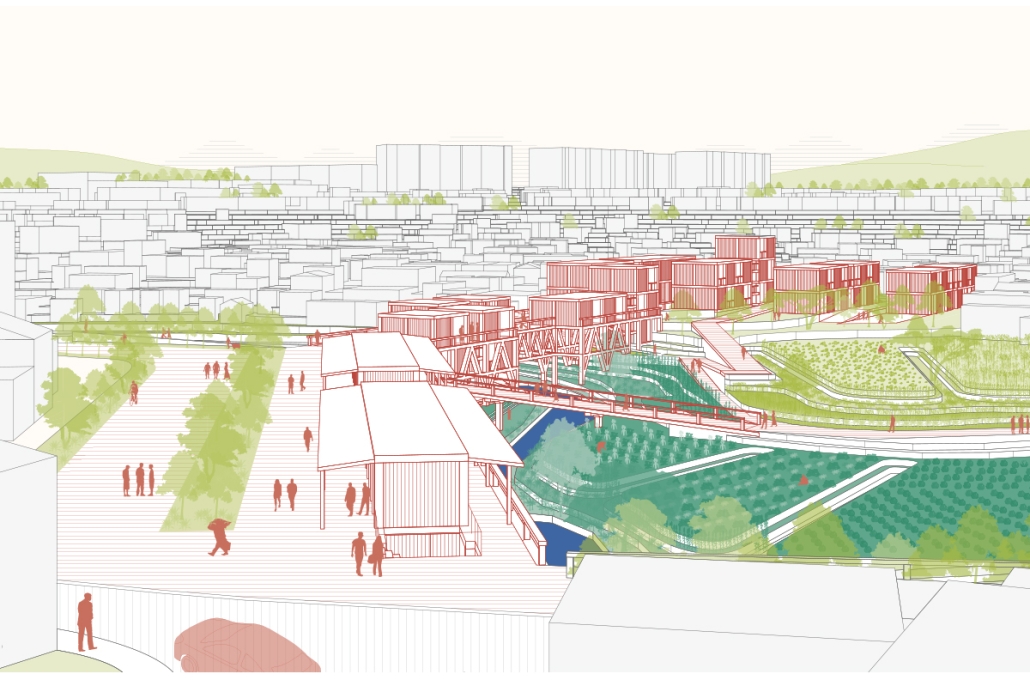
Revitalizing the Meander is a project that seeks to mitigate flooding issues along a portion of the Upper Kebana River (Addis Ababa, Ethiopia) through soft ecological interventions while also creating new connections across the river where they are currently missing. Most of the housing on site along the river is poorly constructed informal housing built close to the bank due to a lack of space with the rapidly growing city population. This informal housing easily floods due to the winding meanders of the river and contributes to erosion along the banks. 

The proposed masterplan for the site relocates residents who live in flooding-prone areas to new housing structures which also function as bridges, creating new connections across the river and providing amenities to residents. These connections are determined by where green streets can continue across the river, allowing pedestrians new modes of travel. Zooming into the bridge structure that was further designed at a higher resolution, one can see the connection that is created between the two proposed green streets on either side of the river. Bioswales from the green streets are continuous over the bridge structure, filtering runoff water. On one side of the structure, a market acts as an entry point to the bridge while on the other side, new housing relocates those prone to flooding. The bridge has arms that extend off it, fostering additional connections to lower levels of the structure, as well as to the river and the slow mobility path that runs along the river. In the center, urban agriculture provides a local food source for the surrounding neighborhoods and helps to mitigate fluvial flooding. 

This project was presented at the International Union of Architects (UIA) World Congress of Architects in Copenhagen 2023

Instagram: @rubgarrub

NATURE: RECLAIMED by Jason Hayden, M.Arch ‘23
University of North Carolina at Charlotte | Advisor: Chris Jarrett

In “Walking the Walk: A Path towards Praxis Inspired by an Ecological Reading of The Tale of Genji and a Japanese folktale,” Marjorie Rhine discusses the growing disconnect of the relationship between human and non-human environments. Critical of the perception of Japan as a society in harmony with nature, Rhine adopts the term ‘ecoscape’ from the field of urban ecology, offering a way of conceptualizing the complex interplay of the built and natural environments that is less human-centered. 

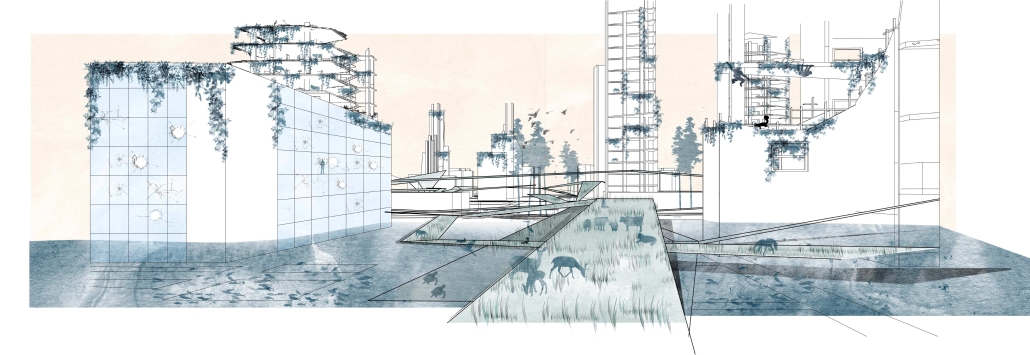
“Nature: Reclaimed” proposes a perspective into how a coastal greenway park shifts the balance over time between human and non-human environments in an adapted coastal urban park, which illustrates the conflict between rising sea levels, loss of native habitat and human’s perpetual desire for control over nature.

This project won the AIA Henry Medal.

Instagram: @jhayden.ii

Environmental Education Center by Ivan Flores, AAS (Pre-Architecture) ‘23
College of DuPage | Advisor: Mark Pearson

PROGRAM STATEMENT:

This project explores the relationship between architecture, ecology and environmental stewardship. Students are challenged to design a prairie environmental education center that will provide educational outreach to the COD community. The project site is located directly adjacent to the Russell R. Kirt Prairie, an 18-acre natural area on the College of DuPage main campus.  

The design intent of this studio project is to create an innovative and thoughtfully conceived prairie education center that will provide educational programming on sustainability, environmental stewardship and ecology. This center includes spaces for education, research, and outreach. Projects should educate visitors (and COD students) about the importance of the region’s natural heritage, as well as physically connect visitors to the prairie landscape itself. 

Successful design projects must include a clearly articulated design concept and engage the natural context of the site.  Projects are intended to embody the idea of environmental stewardship and sustainability. 

DESIGN CONCEPT:

This design expresses the beauty of unique patterns formed by nature. As one walks through the prairie, the sights of tall grass and trees become overwhelming. This inspired the building’s sun shading strategy through materiality and visual appearance. The earth’s topographical map creates distinctive complex patterns that are implemented into the building’s exterior stairs. The circulation’s design intent was to reflect the particular paths in the prairie with various level changes and curves. Apart from implementing the following unique patterns into the design, there are key elements that accentuate views of the prairie to further express the beauty of unique patterns formed by nature. A long plan accommodates the space with ample views of the prairie. The roof’s pitch slopes upward to accentuate views of nature.

Instagram: @ma_pearson75, @cod_architecture

Rock and Roll by Zihua Mo & Chunyu Ma, M.Arch ‘23
University of Pennsylvania | Advisor: Simon Kim

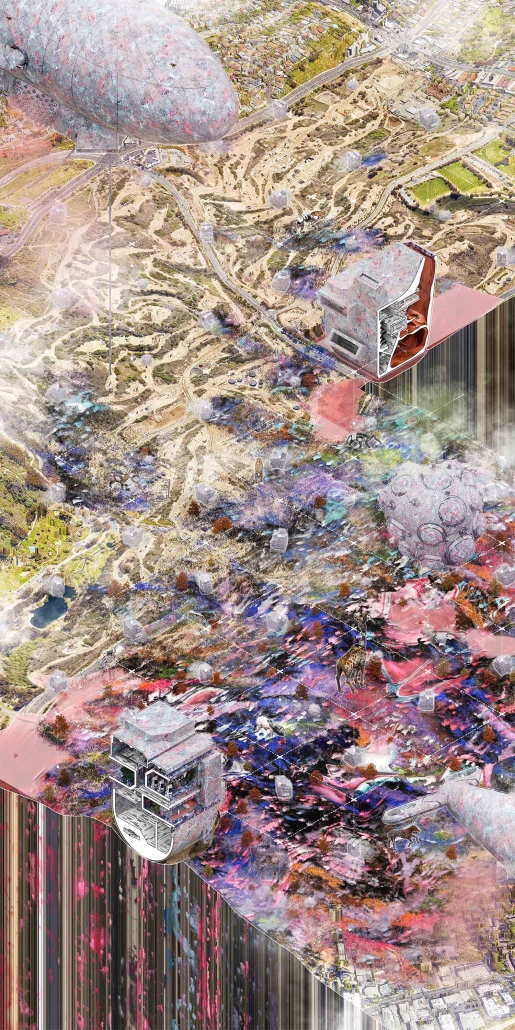
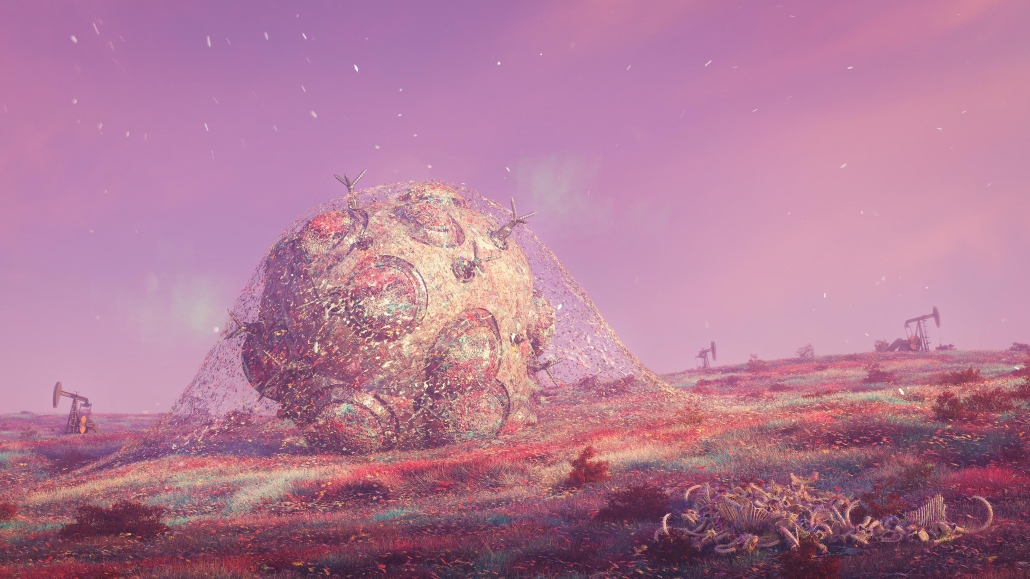
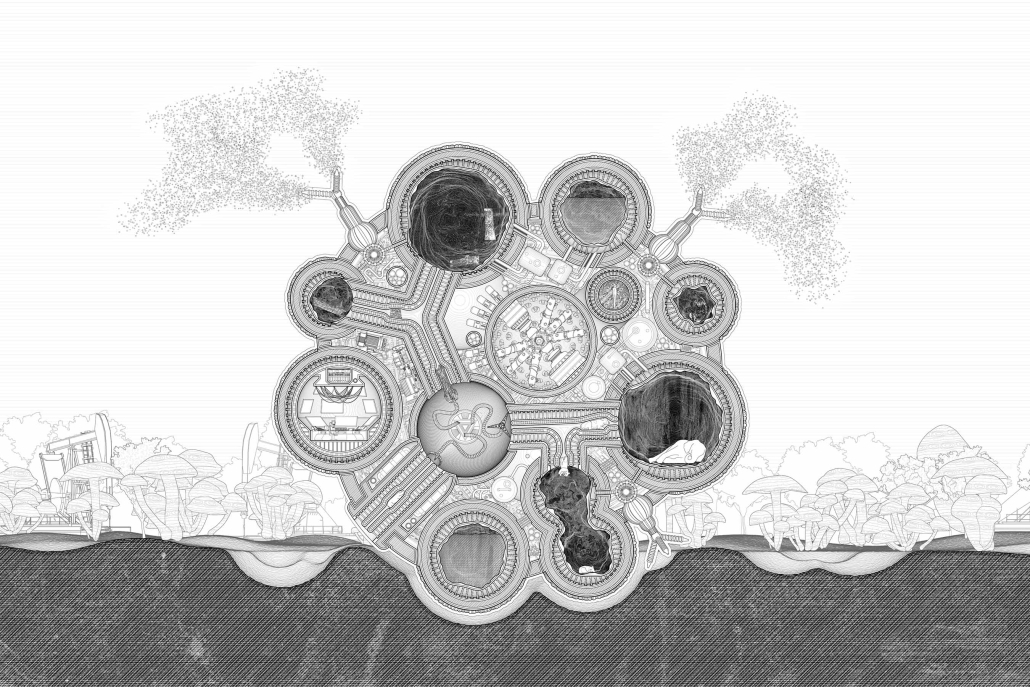
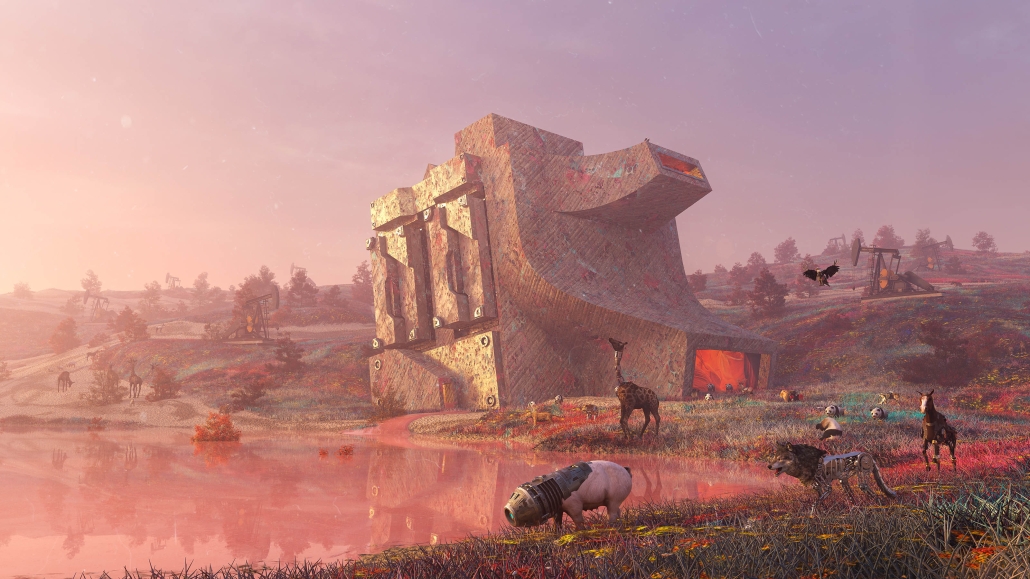
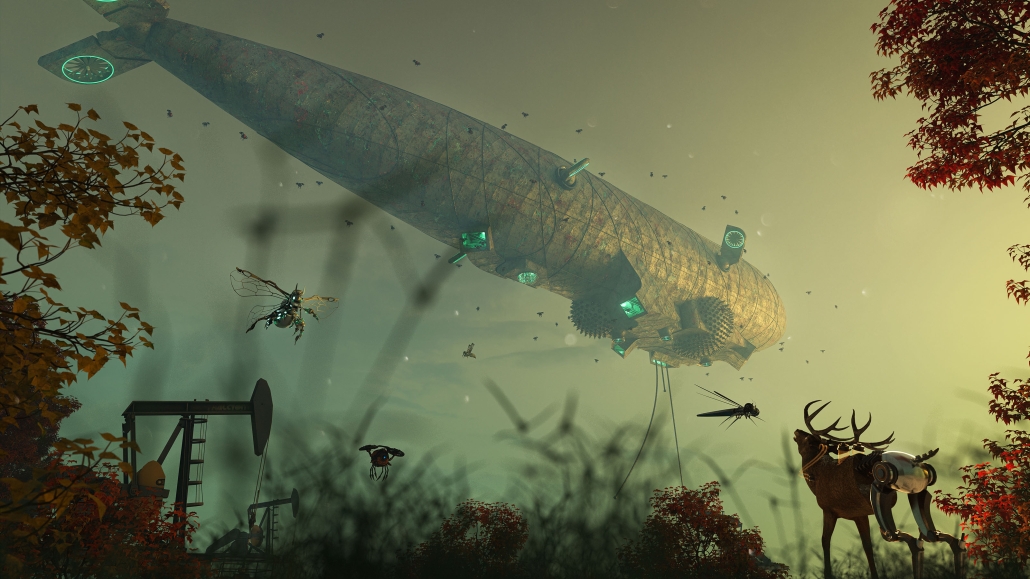
This project is an ecological architectural initiative poised in Los Angeles’s Inglewood Oil Field. It devises an evolutionary future for the historically industrial site, bridging gaps between technology, ecology, and synthetic nature to reimagine a thriving, non-human-centric, biodiverse habitat.

Within this biodome, four architectural characters breathe life into the project. These are the Manimal, Putant, Fungle, and Outsect, each serving as a sanctuary for animals, plants, fungi, and insects respectively. Originally positioned in a grid pattern, they autonomously operate within their domains, engaging in a unique ‘rock and roll’ motion, synergistically transforming the old industrial heart of Inglewood into a revitalized natural space.

The Manimal is a marvel of bio-engineering, nurturing synthetically developed, intellectually advanced animals. These life forms, combining the grace of nature with the precision of technology, gradually assimilate into the ecosystem, their waste contributing to a vibrant ‘Waste Lagoon.’ This vivid waterbody, contrary to its name, is a source of nourishment and a symbol of rebirth, the raw material for the neighboring Putant.

The Putant, swayingly mimicking nature’s breeze, harbors and nurtures the next-generation, pollutant-absorbing plants. These green soldiers mature inside the cultivation chamber, their seeds eventually dispersed by the Putant’s gust-like motions, sowing life across the transformed oil field.

Symbiotically supporting this green wave is the Fungle, a mobile architectural body enriching the soil with vital nutrients. The Fungle rolls across the landscape, absorbing deceased organic matter, and utilizing it to cultivate various fungi, whose spores are then disseminated, forming a natural cycle of life and decay.

Overseeing this intricate world-building is the Outsect, a hovering haven for mechanical insects. It regulates material exchange within the field, deploying these mechanical insects for tasks ranging from delivery to capturing animals. Moreover, it functions as an atmospheric purifier, inhaling air for power, purifying it, and also drawing from the Waste Lagoon to disperse nourishment across the field.

Instagram: @zihua_mo, @cyyyy_ma, @ibanez.kim

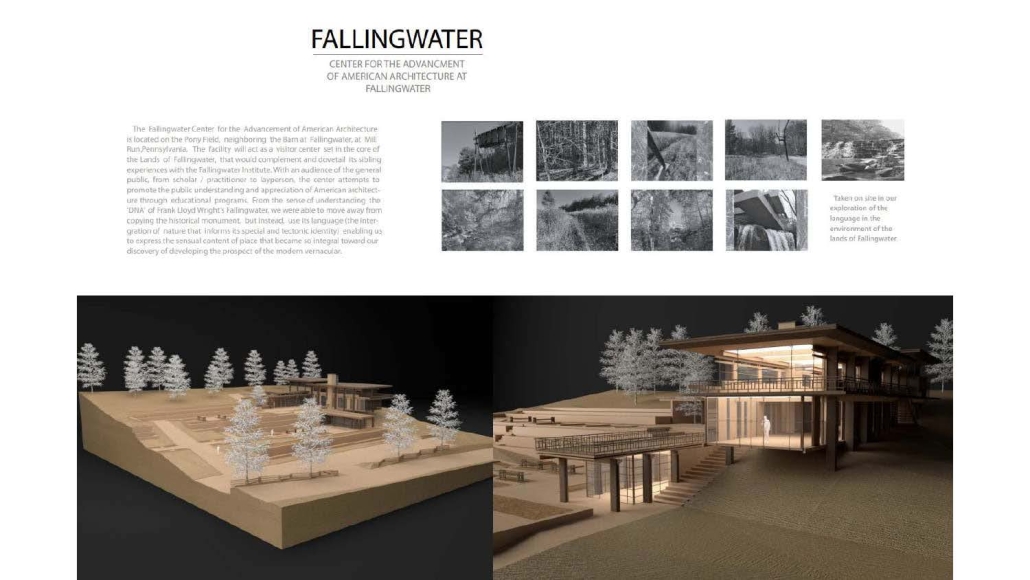
Center For the Advancement of American Architecture at Fallingwater by Frank Michel, Jason Loeb & Roman Marra, BA. Arch ‘23
Miami University | Advisor: John M. Reynolds

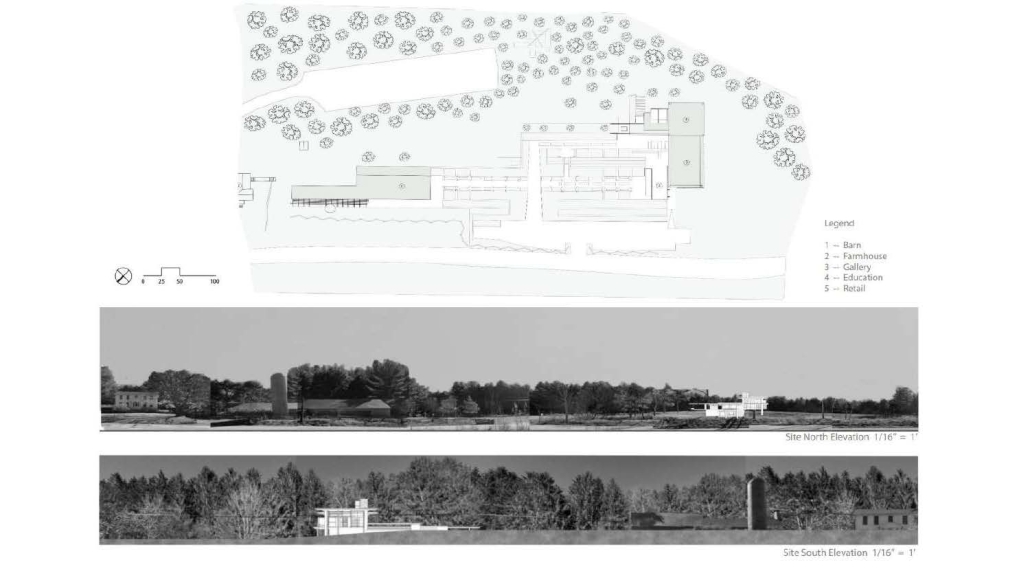
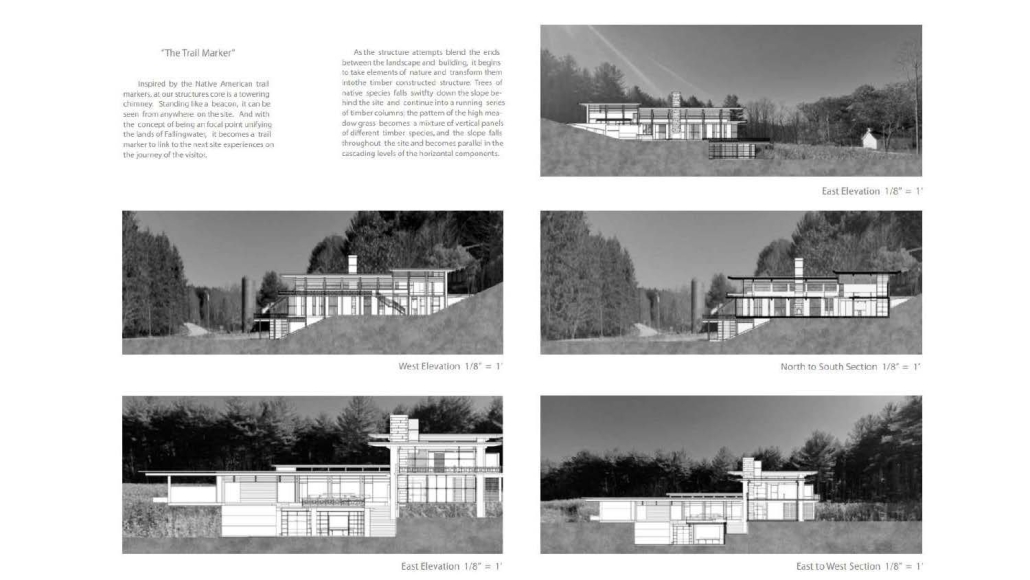
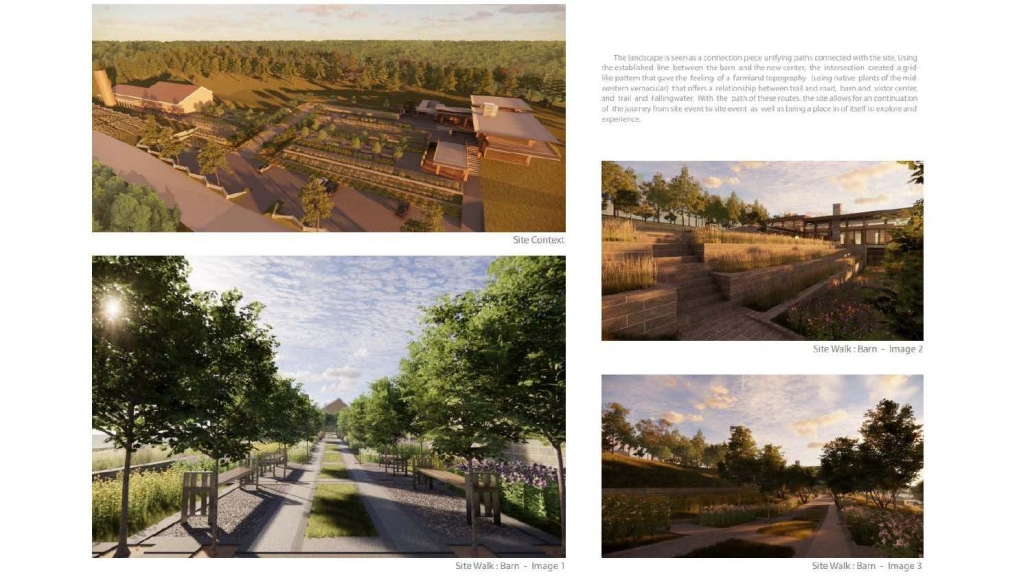
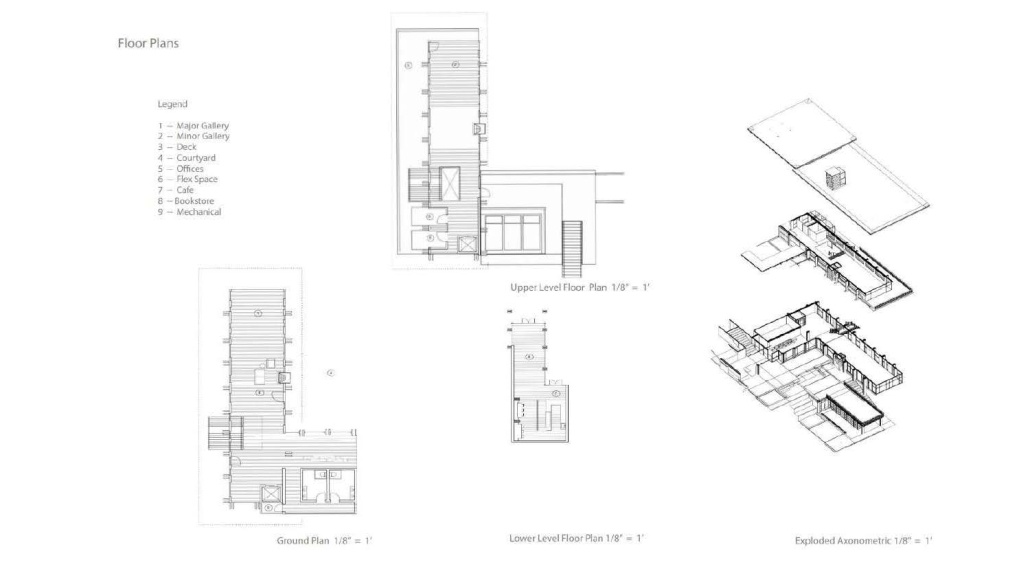
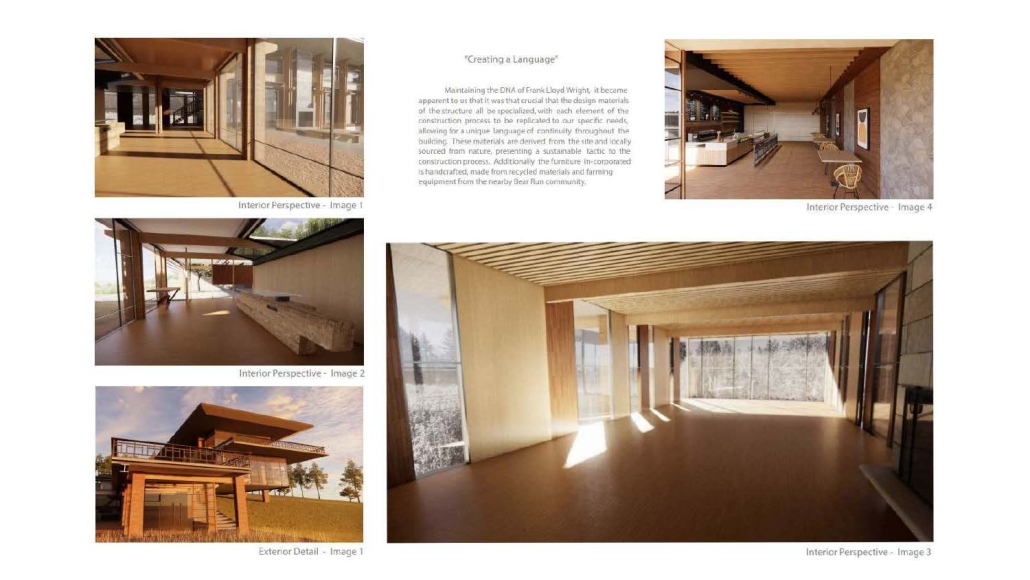
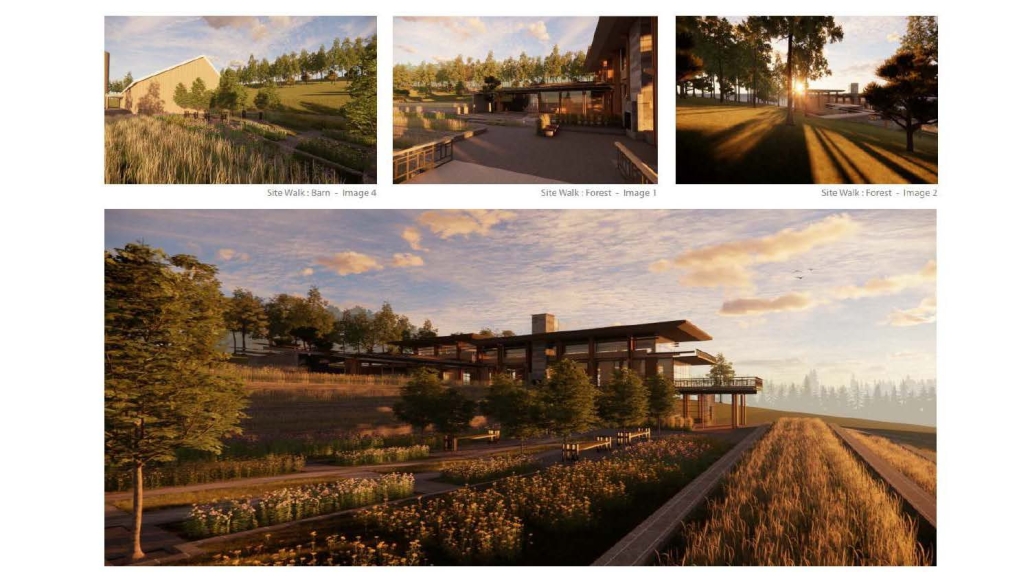
The Fallingwater Center for the  Advancement of American Architecture is located at the  Pony Field, neighboring the Barn at Fallingwater, Mill Run, Pennsylvania. The facility will act as a visitor center set in the core of the Lands of Fallingwater, that would complement and dovetail its sibling experiences with the Fallingwater Institute. With an audience of the general public, from scholars/practitioners to laypersons, the Center attempts to promote the public understanding and appreciation of American architecture through educational programs.  From the sense of understanding the ‘DNA’ of Frank Lloyd Wright’s Fallingwater, we were able to move away from copying the historical monument, but instead, use its language (the integration of nature that informs its special and tectonic identity) enabling us to express the sensual content of place that became so integral towards our discovery of developing the prospect of the Modern Vernacular. The landscape is seen as a connection piece unifying paths connecting from the site. Using the established lines between the barn and the center, the intersection created a grid-like pattern that gave the feeling of a farmland topography (using native plants of the midwestern vernacular) that develops the relationship between trail and road, barn and visitor center, trail and Fallingwater. With the path of these routes, the site allows for a continuation of the journey from site event to site event, as well as being a place in of itself to explore and experience.

Instagram: @Fpmichel_design, @jasonloebdesign, @marrarchitecture

Paradigms of the Post-Natural by Charlotte Rose Bascombe & Andrea De Haro, B.Arch ‘23
Syracuse University School of Architecture | Advisors: Jean-François Bèdard, Britt Eversole & Julie Larsen

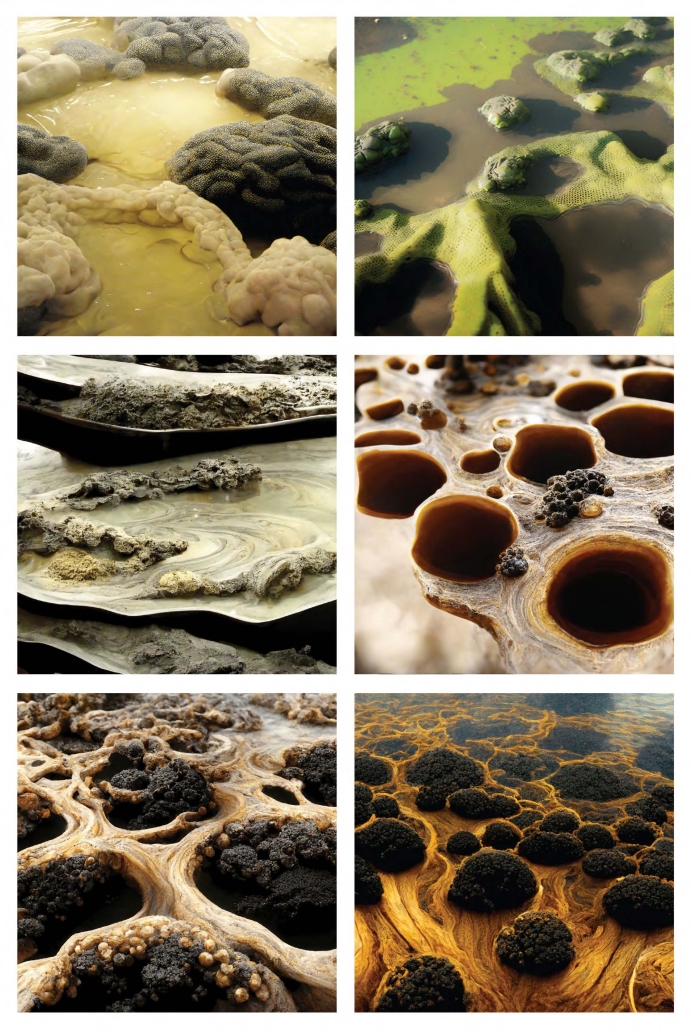
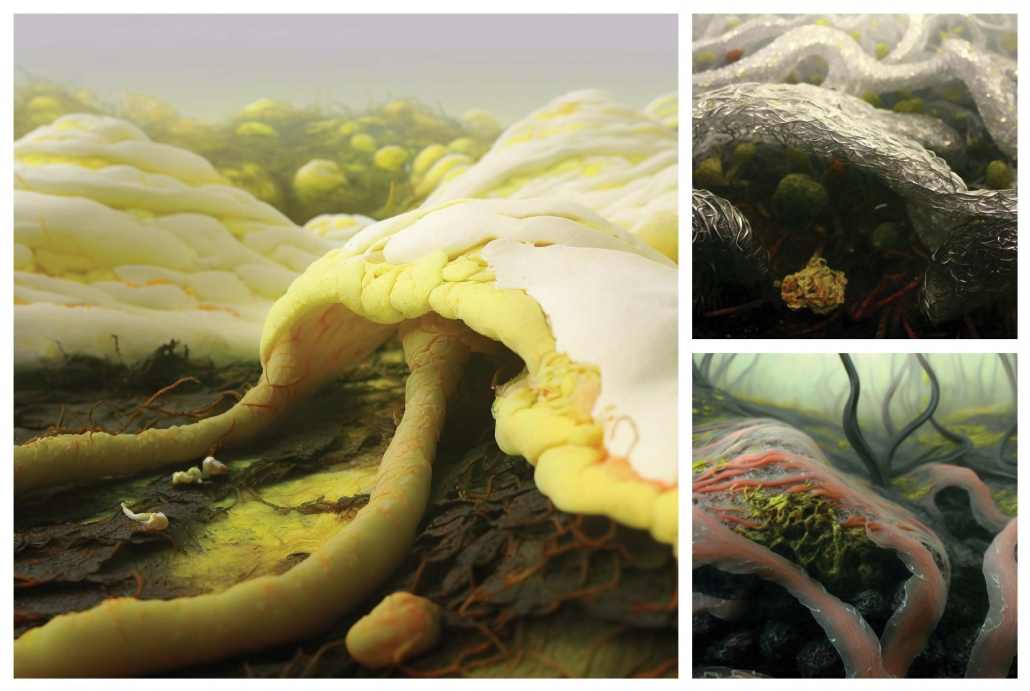
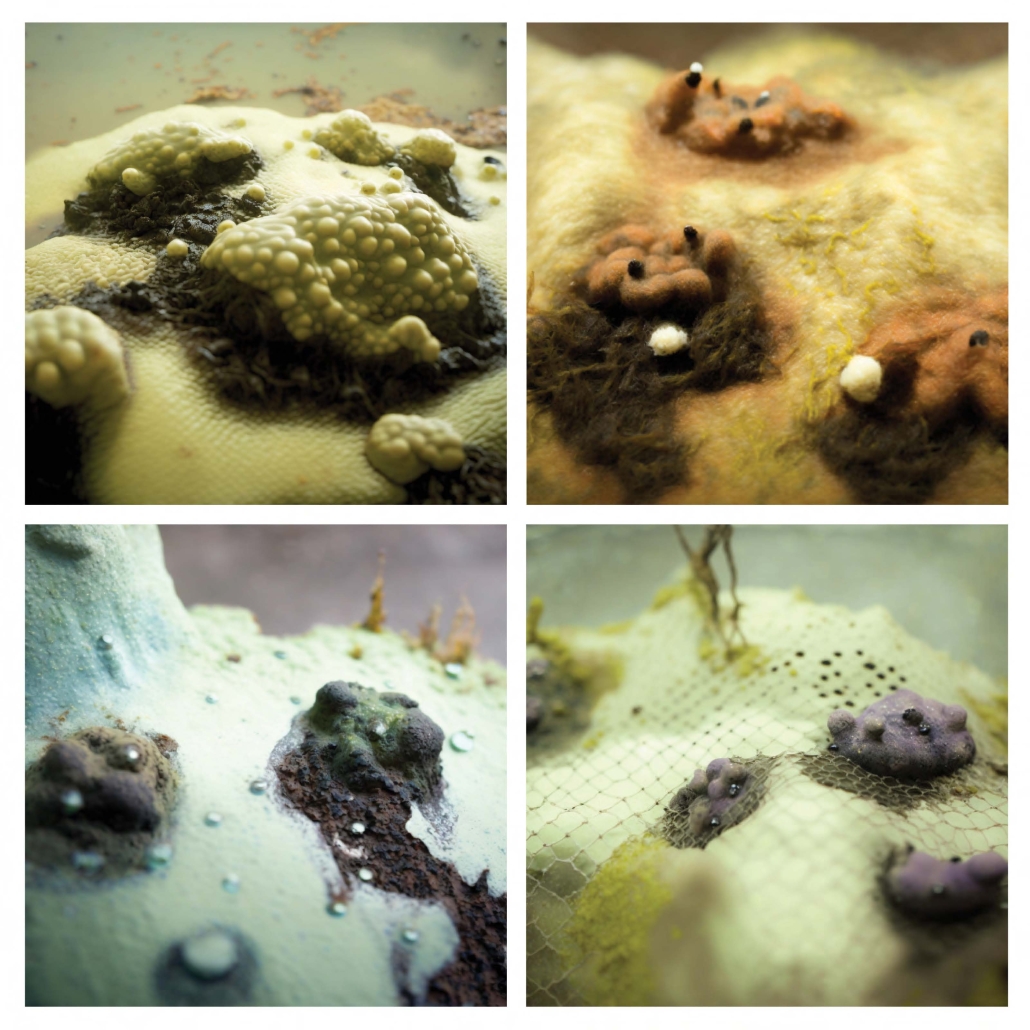
Paradigms of the Post-Natural is a thesis that rejects architects’ predilections for greenwashing. In doing so, we depict the inevitable evolution of our environment and embrace the beautifully toxic and grotesque environments that are evidently created. Specifically, we are interested in ecocides, exploited areas in which animals are forced to genetically adapt as they experience the destruction of their habitat by humans. 

We focused on the Athabasca Oil Sands in Alberta, Canada, and Chornobyl in Ukraine, two preeminent sites where industrial activity has caused a direct threat to ecological well-being. Chernobyl is an example of a disaster where the release of toxic compounds has had long-term effects on the genetic evolution of species creating a radioactive wildlife refuge. The Alberta Oil Sands is an oil reserve that highlights the detrimental effects of mining, resulting in contaminated wastewaters that release heavy metals into nearby bodies of water. These polluted environments forced humans to evacuate, while other living species were left behind to absorb the contaminants. 

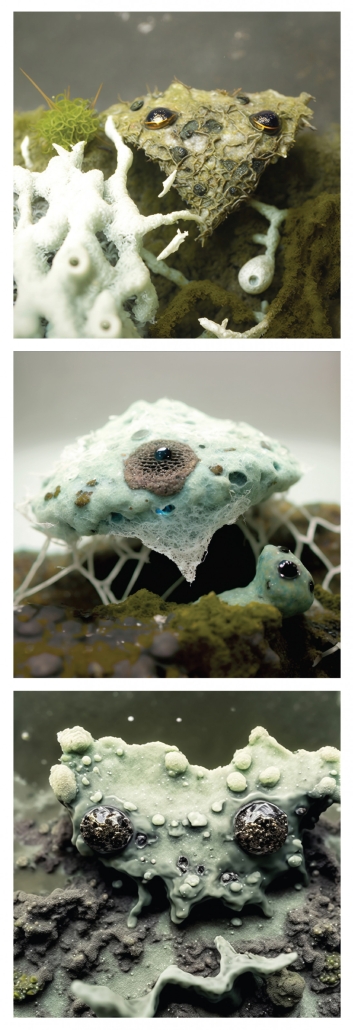
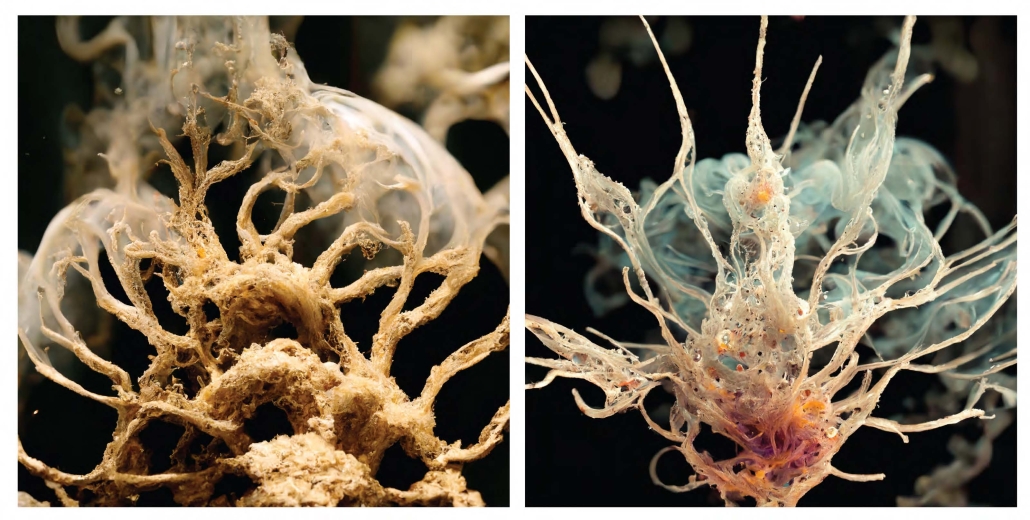
Depicting these unimaginable environments, we collaborate with MidJourney, an artificial intelligence text-to-image generator. Site-specific research determined our text parameters. Using keywords such as “Iodine-131” and “polycyclic hydrocarbons”, compounds found on both sites, helped us visualize the toxic destruction. Other terms, such as “grotesque” and “photo-realistic” helped maintain a consistency in the aesthetics of these scenes. After generating our productions, we emphasized their ecologies through the microscopic scale, which led us to create material studies influenced by the characteristics of the generated scenery. Fusing our images with physical models resulted in a feedback loop that allowed for more agency in imagining alternative futures. We used various materials to reflect the detailed environments, providing us with the ability to precisely recreate the animals’ habitats. Alternating between MidJourney and model-making was crucial for the development of the final images.

Our thesis depicts the unavoidable evolution of these environments and their accompanying organisms. “Ecologies in Disguise” is an atlas that we produced, set in the year 2550, that documents a paradigm shift in the relationship between humans, flora, and fauna, where the lack of human contact becomes a defining characteristic of the new era. The impact of current “ecocides” are threatening all types of organisms, causing them to fuse and entangle with chemical substances that swarm through the environment. What ultimately emerges is the aesthetic sublime; ecosystems that simultaneously have the power to compel and destroy us. 

See you in the next installment of the Student Showcase!
“Still Human: In the Age of Selfies + Surveillance” by Carlos Serrano, California College of the Arts

The digital age has changed the face of social interactions, and transformed our behavior in the built environment. This has given rise to questions regarding architecture’s role in accommodating this new age of social relationships, and how it can actively uncover new ways to merge the digital and physical worlds. 

Recent graduate from California College of the Arts, Carlos Serrano, who received his M.Arch in May 2019, tells us about his thesis: “Still Human: In the Age of Selfies + Surveillance”, and how it addresses this topic. 


“Still Human: In the Age of Selfies + Surveillance” by Carlos Serrano, California College of the Arts

WHY DID YOU CHOOSE TO STUDY ARCHITECTURE?

Even when applying to architecture grad school, I was pretty sure I did not want to be an architect. Designing buildings was never quite my thing. However, I strongly believe in the education. It gives you a creative and critical skill set that is highly adaptable, which can take many different forms and can open many doors. Architectural education has always been about problem-solving, systems thinking and making the world a better place.

WHY DID YOU SELECT THE SCHOOL YOU ATTEND?

After much deliberation, I decided to attend the California College of the Arts (CCA) in San Francisco for a few different reasons. First off, CCA is first and foremost an art and design school. I had the opportunity to take classes in fashion, garment structures, and performance art in addition to architecture electives like Urban Interactive Surfaces (projection mapping). Secondly, San Francisco is the home of tech and innovation! Living here is like living in the future and you can see that in the students and faculty. Lastly, CCA fully covered my tuition.

TELL US ABOUT THE PROJECT

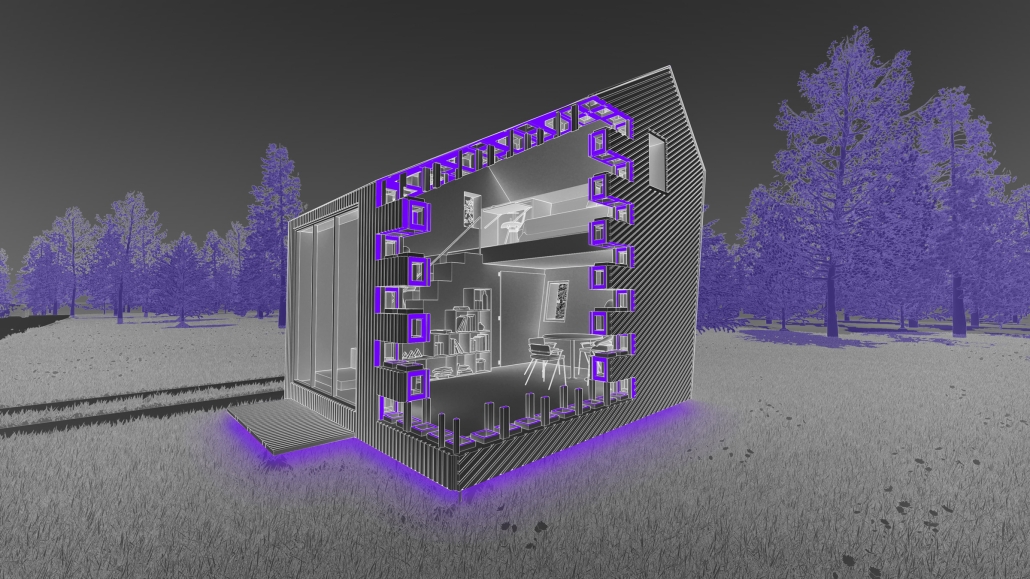
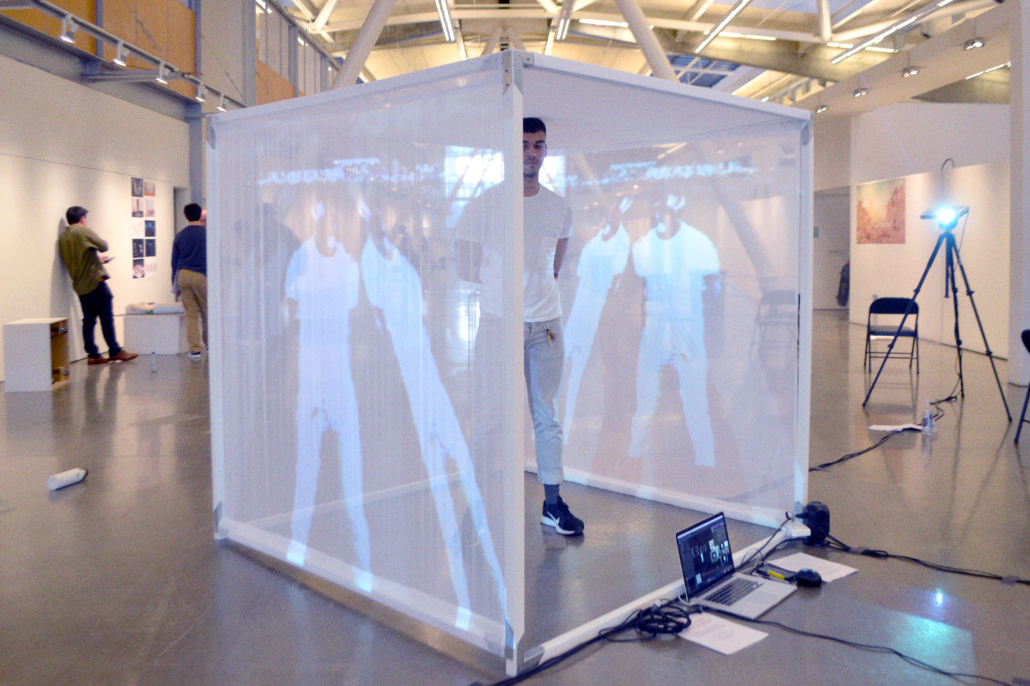
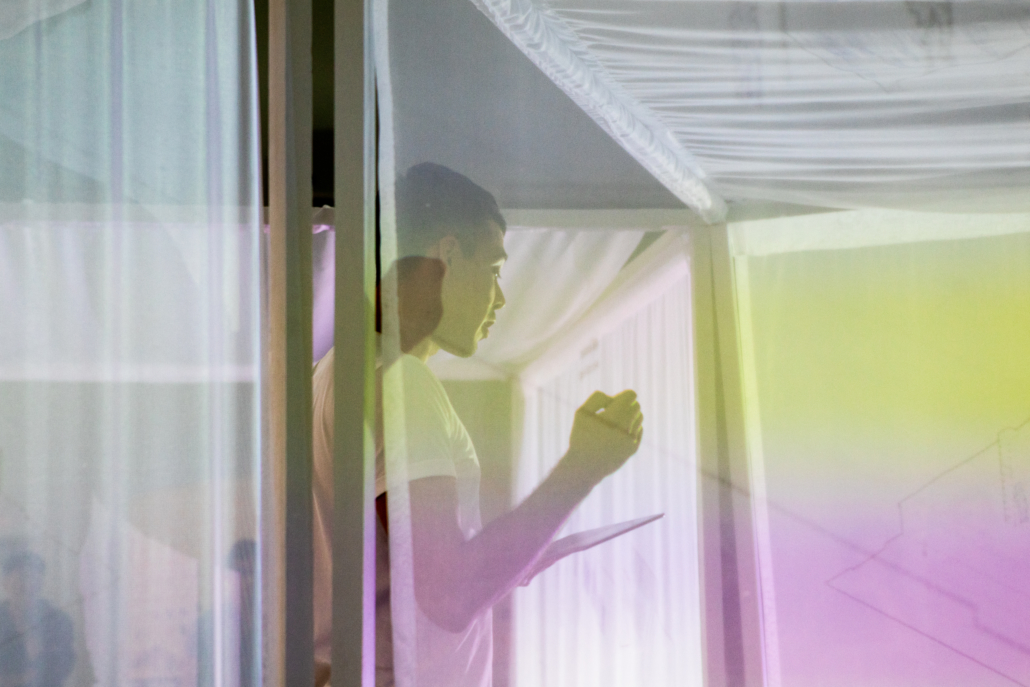
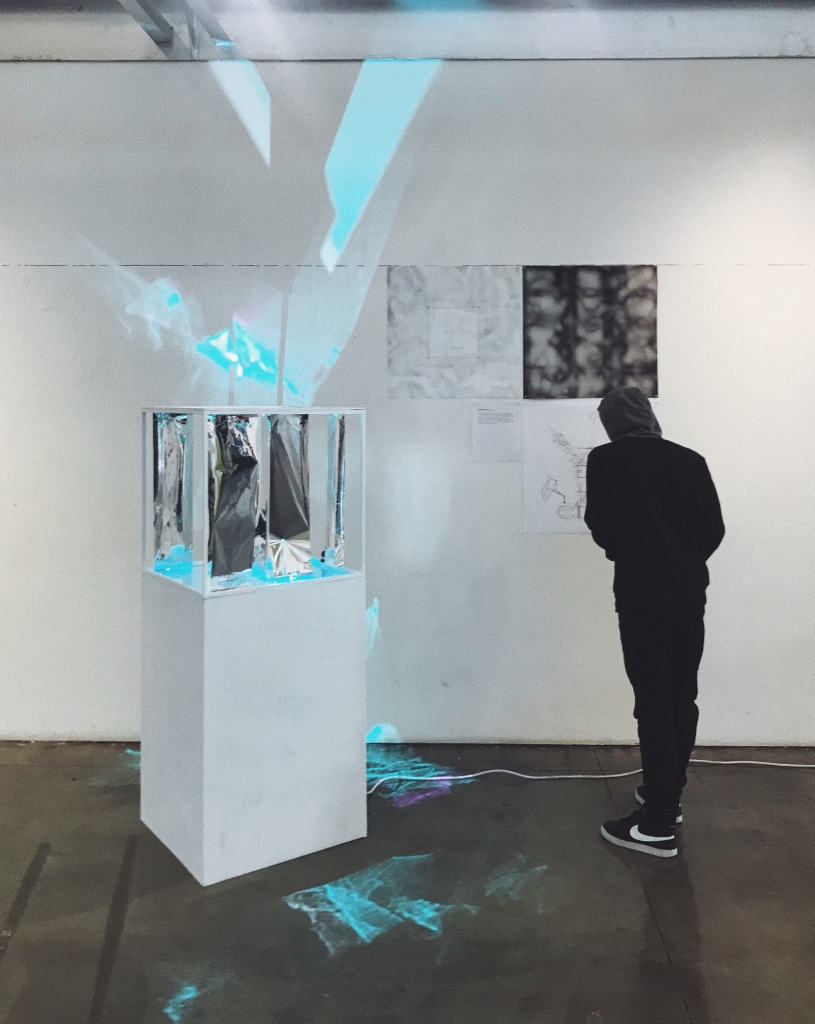
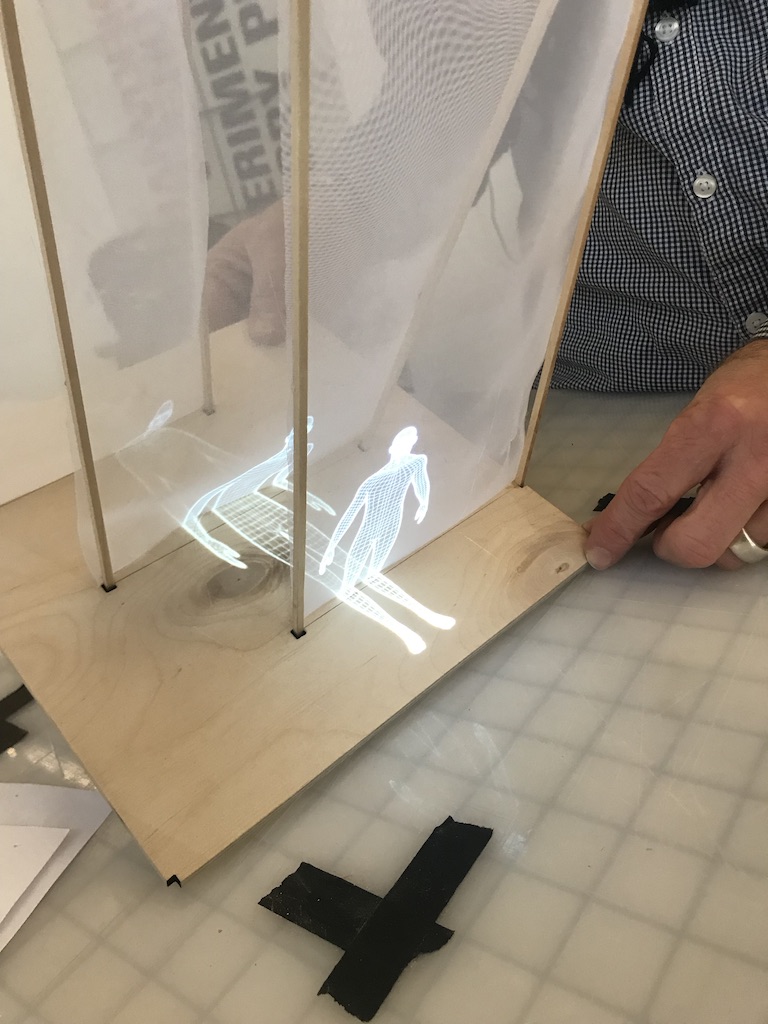
My thesis, “Still Human: In the Age of Selfies + Surveillance” investigated the way architecture has been built without digital information and communication technologies in mind and how that has had a negative impact on our social relationships and physical abilities. Using a Kinect Sensor, TouchDesigner and projection mapping, the final result was a full-scale installation, where space and architecture became the interface for heightened social exchange and the human body became the input for interacting with technology.


“Still Human: In the Age of Selfies + Surveillance” by Carlos Serrano, California College of the Arts

WHO ALL WAS INVOLVED?

My thesis was primarily self-led, but I definitely had some major help along the way. Thom Faulders of Faulders Studio and Chris Falliers of ULA Design were my advisors. My boyfriend, Tim Carlson, and dear friends, José Meza and Shuba Shekar, helped with installation multiple times. I also couldn’t have done it without my 23 fellow thesis peers!

WHAT DID YOU LEARN FROM THIS PROJECT?

Since the release of the iPhone 10 years ago, our world has seen immense change in the way we relate to each other and our physical environment. Although architecture has been great about embracing technology in the design process, it has not been very good about embracing our new digital identities and relationships (e.g. texting in a long-distance relationship, Instagram stalking, using LinkedIn to find a new employer, etc). Our online selves are now as valid as our physical selves. If architecture wants to continue contributing to society, it must accept this and build between the digital and the physical.


“Still Human: In the Age of Selfies + Surveillance” by Carlos Serrano, California College of the Art

WHAT DO YOU HOPE TO DO AFTER YOU GRADUATE?

I actually planned for my last/thesis year to coincide with the direction I wanted to take my career: into the tech world. I’m now working as a Product Designer at Tradecraft between digital and physical products. I’m hoping to end up in AR/VR, wearables, or smart home products in the next year or two.

NAME A PROFESSIONAL THAT IS DOING AMAZING WORK.

I really admire the trajectory and work of Blake Hudelson. He’s been a great mentor. Along with a few others, he started Architechie, an organization based in San Francisco for architectural designers now working or looking to work in tech. He also worked on the Jacquard Jacket, a collaboration between Levi’s and Google Advanced Technology and Projects (ATAP).

ANY ADVICE FOR PROSPECTIVE ARCHITECTURE STUDENTS?

Never forget that architecture can be anything you want it to be! Architecture is about the act of building, sometimes that just happens to be an actual building. Other times, it ends up being a jacket, a piece of furniture or even an app. 


“Still Human: In the Age of Selfies + Surveillance” by Carlos Serrano, California College of the Art


For more information on the Master of Architecture program at the California College of the Arts, click here.

Follow Carlos Serrano on Instagram.